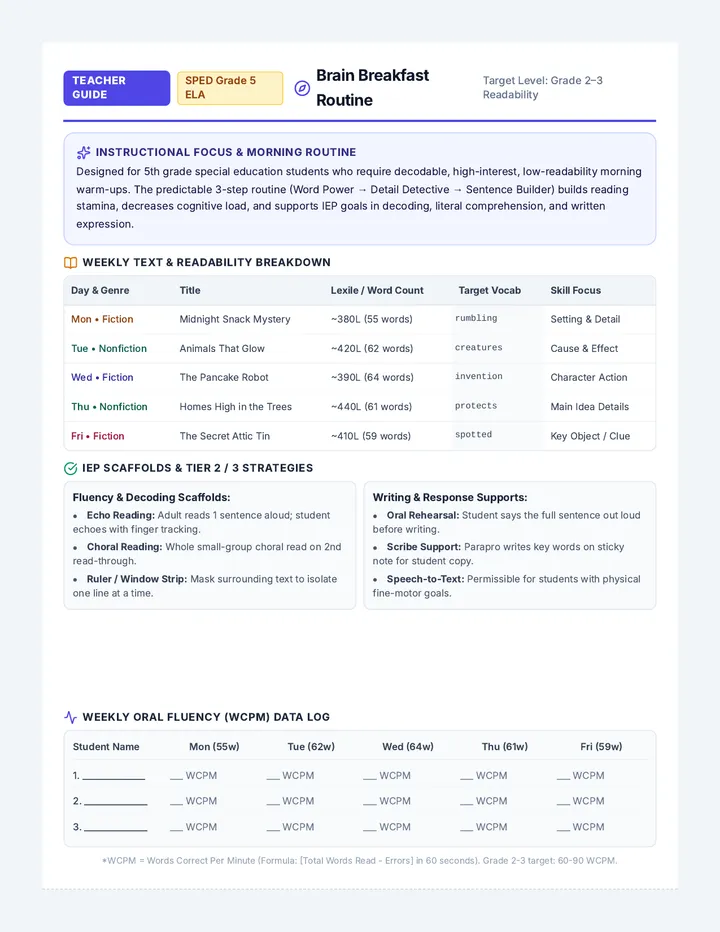
Brain Breakfast Student Packet
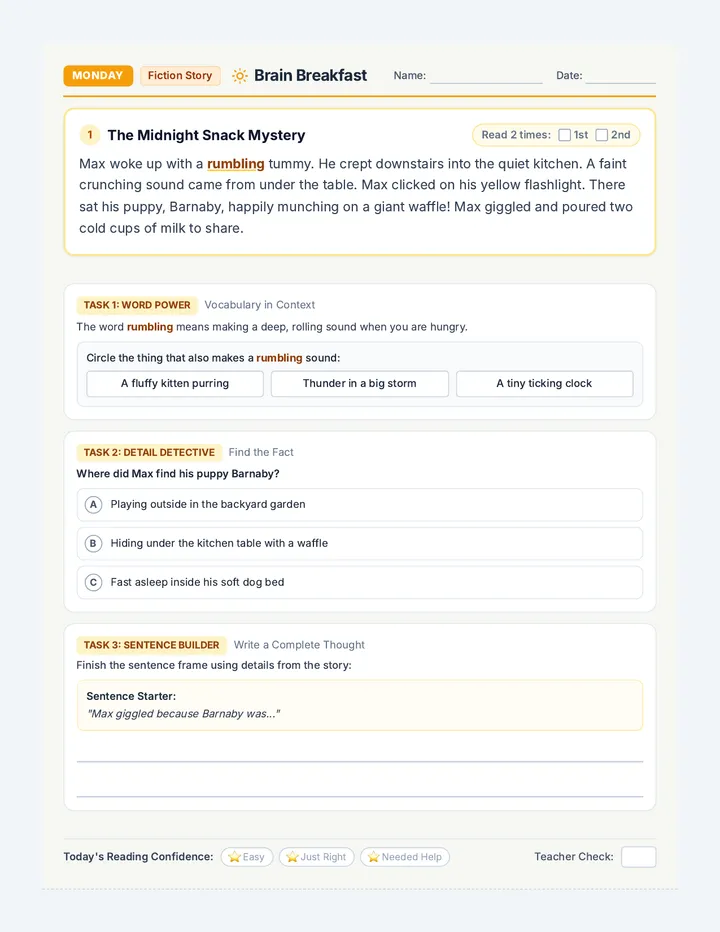
Monday Fiction Story
Brain Breakfast
Name:
Date:
1
The Midnight Snack Mystery
Read 2 times: 1st 2nd
Max woke up with a rumbling tummy. He crept downstairs into the quiet kitchen. A faint crunching sound came from under the table. Max clicked on his yellow flashlight. There sat his puppy, Barnaby, happily munching on a giant waffle! Max giggled and poured two cold cups of milk to share.
Task 1: Word Power Vocabulary in Context
The word rumbling means making a deep, rolling sound when you are hungry.
Circle the thing that also makes a rumbling sound:
A fluffy kitten purring
Thunder in a big storm
A tiny ticking clock
Task 2: Detail Detective Find the Fact
Where did Max find his puppy Barnaby?
A Playing outside in the backyard garden
B Hiding under the kitchen table with a waffle
C Fast asleep inside his soft dog bed
Task 3: Sentence Builder Write a Complete Thought
Finish the sentence frame using details from the story:
Sentence Starter:
"Max giggled because Barnaby was..."
Today's Reading Confidence: ⭐️ Easy ⭐️ Just Right ⭐️ Needed Help
Teacher Check:
Tuesday Nonfiction Fact
Brain Breakfast
Name:
Date:
2
Animals That Glow
Read 2 times: 1st 2nd
Some wild creatures make their own glowing light. Fireflies flash on warm summer nights to talk to other bugs. Deep down in the pitch-black ocean, the anglerfish has a bright tip over its head. The glowing light attracts curious little fish so the anglerfish can catch dinner in the dark.
Task 1: Word Power Vocabulary in Context
The word creatures means living animals, insects, or sea beasts.
Circle the item below that is an example of a creature:
A deep-sea octopus
A tall wooden flagpole
A smooth grey stone
Task 2: Detail Detective Find the Fact
Why do fireflies flash their glowing lights on warm nights?
A To cool off their bodies in the summer
B To talk to other bugs in the dark
C To hide away from birds in tall grass
Task 3: Sentence Builder Write a Complete Thought
Finish the sentence frame using details from the text:
Sentence Starter:
"The anglerfish uses its light in the deep ocean to..."
Today's Reading Confidence: ⭐️ Easy ⭐️ Just Right ⭐️ Needed Help
Teacher Check:
Wednesday Fiction Story
Brain Breakfast
Name:
Date:
3
The Pancake Robot
Read 2 times: 1st 2nd
Maya loved building machines with old gears and wires. For the school science fair, she made a helper robot called Flip-Bot. She poured pancake batter onto the warm pan. Flip-Bot whirred, clicked, and flipped a golden pancake straight into the air! It landed neatly on Maya’s blue plate. Maya yelled, "My new invention really works!"
Task 1: Word Power Vocabulary in Context
The word invention means a brand-new tool or machine created by a person.
Circle the choice that is an example of an invention:
A robot that washes dishes
A fresh green leaf on an oak
A fluffy white cloud in sky
Task 2: Detail Detective Find the Fact
Where did the flipped pancake land?
A Inside the metal kitchen sink
B Neatly right on Maya's blue plate
C Up high stuck on the kitchen wall
Task 3: Sentence Builder Write a Complete Thought
Finish the sentence frame using details from the story:
Sentence Starter:
"Maya felt proud of Flip-Bot because..."
Today's Reading Confidence: ⭐️ Easy ⭐️ Just Right ⭐️ Needed Help
Teacher Check:
Thursday Nonfiction Fact
Brain Breakfast
Name:
Date:
4
Homes High in the Trees
Read 2 times: 1st 2nd
In rainforests across the world, people build amazing houses high in giant trees. Tall wooden poles support floors forty feet off the ground! Living up in the green branches protects families from heavy river floods and wild forest animals. Fresh breezes also keep the homes cool in hot tropical weather.
Task 1: Word Power Vocabulary in Context
The word protects means guards something to keep it safe from harm.
Circle the item below that protects your head:
A bike safety helmet
A shiny silver spoon
A thick wool sock
Task 2: Detail Detective Find the Fact
What is one benefit of building homes high in the trees?
A It stops the sun from rising in the morning
B It keeps families safe from heavy river floods
C It makes the house completely invisible
Task 3: Sentence Builder Write a Complete Thought
Finish the sentence frame using details from the text:
Sentence Starter:
"Tree houses stay cool in hot weather because..."
Today's Reading Confidence: ⭐️ Easy ⭐️ Just Right ⭐️ Needed Help
Teacher Check:
Friday Fiction Story
Brain Breakfast
Name:
Date:
5
The Secret Attic Tin
Read 2 times: 1st 2nd
On a rainy Friday morning, Leo explored his grandfather’s quiet attic. Tucked behind a tall grandfather clock, he spotted an old red tin box. Leo gently opened the lid. Inside lay three shiny silver coins and a folded map of a secret tree fort! Leo grinned and said, "Now our weekend adventure begins!"
Task 1: Word Power Vocabulary in Context
The word spotted means saw or caught sight of something special.
Circle the sentence that uses spotted correctly:
Sam spotted a deer in the woods.
The warm tea spotted into the mug.
Task 2: Detail Detective Find the Fact
What two things were stored inside the old red tin?
A A pair of dirty boots and an old paintbrush
B Three shiny silver coins and a secret tree fort map
C A bag of candy and a wooden toy car
Task 3: Sentence Builder Write a Complete Thought
Finish the sentence frame using details from the story:
Sentence Starter:
"Leo was excited about the weekend because..."
Today's Reading Confidence: ⭐️ Easy ⭐️ Just Right ⭐️ Needed Help
Teacher Check: