Safety First Lesson Plan Safety First!
A Complete Guide | Lesson Plan
Caution
Duration
120 Minutes
Audience
High School (incl. ASD Accommodations)
Approach
Interactive & Visual
Learning Objective
Students will be able to identify and apply safety measures in and outside the home, including the workplace, to enhance their personal safety and well-being.
Why This Matters
This lesson is crucial for empowering students with practical knowledge and skills to protect themselves and others in various environments, fostering independence and confidence.
Teacher Preparation
Review Materials: Slides, Script, Spot the Hazard (Warm Up), Scenarios Reading, Home Safety Checklist, Matching Game, Discussion Prompts, Action Plan, Quiz, and Test.
Printing: Home Safety Checklist (all students), Matching Game (print & cut), Quizzes/Tests.
Equipment: Projector/Screen for Slide Deck.
Inclusion: Prepare visual schedules or sensory tools for students with autism. Ensure peer support is arranged for the matching game.
i
Instructional Sequence
10 min
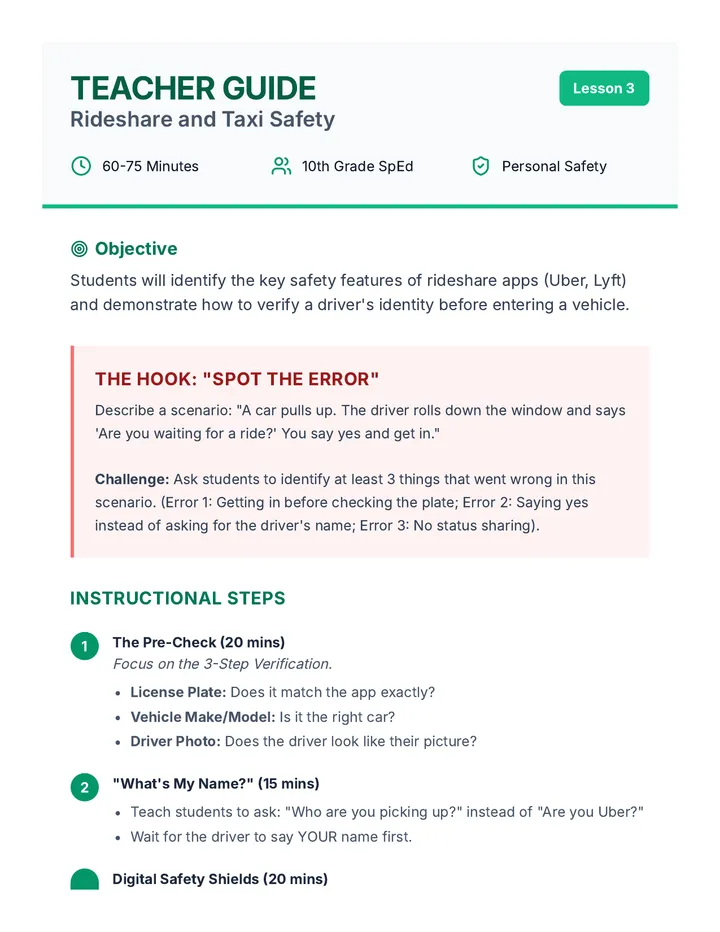
Warm-Up: Spot the Hazard!
Activity: Visual Analysis
Display the "Spot the Hazard" image. Have students identify dangers. Provide specific praise and clear, step-by-step instructions (especially for the student with autism).
15 min
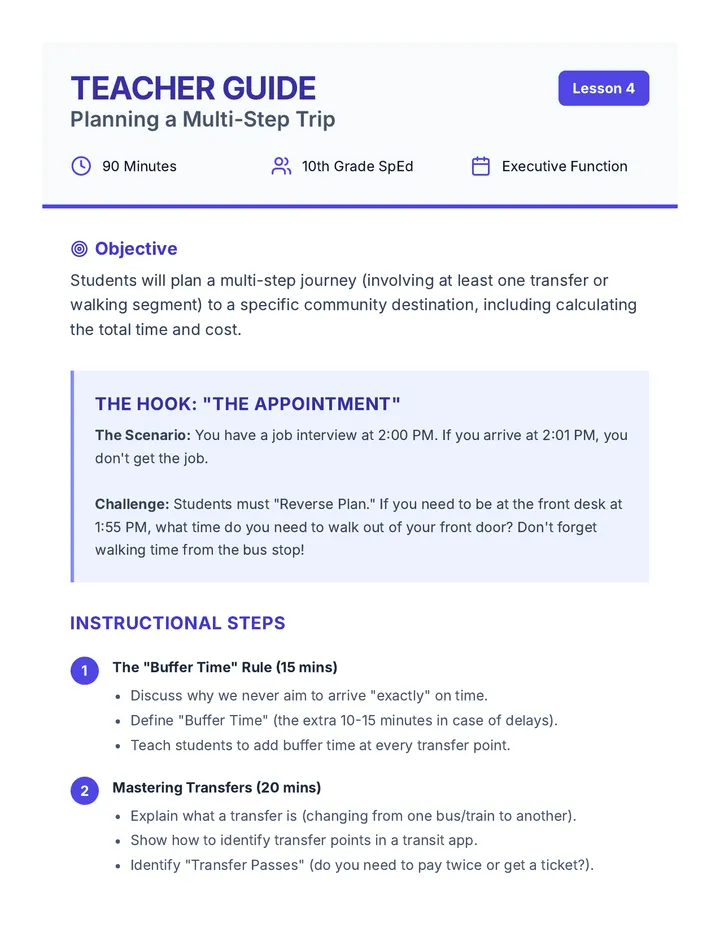
Intro to Safety (Slides & Script)
Activity: Direct Instruction
Cover Home, Community, and Workplace safety using the Slide Deck. Allow extra processing time and use visual cues for questions to support neurodiverse learners.
25 min
Home Safety Deep Dive
Activity: Reading & Checklist
Read scenarios together. Students complete the checklist. Offer concrete examples and clarifying support for the checklist items.
20 min
Workplace Safety Fun
Activity: Matching Game
Pair students for the matching game. Pair the student with autism with a supportive peer. Use visual examples of the matching process if needed.
20 min
Community Safety Exploration
Activity: Discussion
Discuss pedestrian safety, emergency contacts, and personal boundaries. Allow written/drawn responses for students who find verbalizing difficult.
15 min
Putting it into Practice
Activity: Action Plan
Students develop a personal safety action plan. Provide sentence starters and templates for scaffolding.
15 min
Assessment & Wrap-Up
Activity: Quiz & Review
Administer the Knowledge Quiz. Review answers as a group to clarify misconceptions.
Safety First Slide Deck CAUTION
CAUTION
CAUTION
CAUTION
CAUTION
CAUTION
SAFETY FIRST!
A Complete Guide to Staying Safe
Home
Community
Workplace
SAFETY
SAFETY
SAFETY
SAFETY
SAFETY
SAFETY
Where Do We Need Safety?
At Home
Keeping your living space safe for you and others.
Outside
Staying safe in your neighborhood and community.
At Work
Being safe on the job and following rules.
Safety is Everywhere!
Because YOU are important!
Home Sweet Safe Home
Kitchen
• Fire safety / Stoves
• Sharp objects (knives)
• Cleaning supplies
Bathroom
• Wet floors (slipping)
• Electricity & Water
• Medicines & First aid
General
• Smoke detectors
• Emergency exits
• CO detectors
"Your home should be your safest place!"
Out & About
Road Safety
Cross at crosswalks, look both ways, and stay on sidewalks.
Stranger Safety
What to do if approached by someone you don't know.
Weather Safety
Knowing when to seek shelter from storms or heat.
Situational Awareness
Always be aware of your surroundings!
Working Wonders
1
Know your tasks and how to do them safely.
2
Use tools and machines the right way.
3
Learn emergency procedures immediately.
Safety is everyone's responsibility at work!
Stay Safe, Stay Smart!
Be Aware
Notice what's around you.
Ask Questions
If you're unsure, ask!
Report Dangers
Tell a trusted adult.
Have a Plan
Know what to do in emergencies.
Your Safety Matters!
Warm Up Spot the Hazard Warm Up: Spot the Hazard!
How many safety dangers can you find?
10 MIN
Student Name
Date
!
Look at the "Home Safety Scene" descriptions below. Some things are very dangerous! Circle the 5 hazards you find and explain why they are unsafe.
Kitchen Stove
A cloth towel is sitting right next to a burning stove flame.
Why is this a hazard?
Bathroom Sink
A hair dryer is plugged in and sitting on the edge of a sink full of water.
Why is this a hazard?
Under the Sink
Bottles of toxic bleach are open and left on the floor where a toddler or pet could find them.
Why is this a hazard?
Living Room Floor
There are long extension cords stretched across the middle of the walking path.
Why is this a hazard?
Exit Route
Stacks of heavy boxes are blocking the back door so it cannot be opened quickly.
Why is this a hazard?
What is the first thing you should do if you see a fire? Safety Scenarios Reading Safety Scenarios
Read and Discuss
Instructions: Read each scenario below. Think about what the person is doing right and what could be dangerous. Be ready to share your ideas with the class.
Scenario 1: The Busy Kitchen
Alex is making pasta for dinner. He turns on the stove and puts a pot of water on the burner. While waiting for the water to boil, Alex hears his phone ring in the other room. He leaves the kitchen to answer the phone and starts a long conversation with his friend. Meanwhile, a dish towel he left near the burner starts to get very hot.
Discussion Questions:
What was Alex's biggest mistake?
What could happen if the towel catches fire?
What should Alex have done before leaving the room?
Scenario 2: The Evening Walk
Maya is walking home from the library. It is starting to get dark. She is wearing dark clothes and has her noise-canceling headphones on, listening to loud music. She needs to cross a busy street but doesn't want to walk all the way to the corner where the traffic light is, so she decides to run across the middle of the road between parked cars.
Discussion Questions:
What three things make this walk unsafe for Maya?
How does wearing headphones change her "situational awareness"?
How can Maya make her walk home safer next time?
Scenario 3: The New Job
Sam started a new job at a grocery store. His manager asks him to use a large machine to crush cardboard boxes. Sam hasn't used this machine before and isn't sure which buttons to press. He sees a co-worker using it quickly and thinks, "I can probably figure it out on my own." He doesn't want to look like he doesn't know what he's doing by asking for help.
Discussion Questions:
Why is "figuring it out" dangerous in a workplace?
What should Sam say to his manager?
What is the most important rule when using new equipment?
The Golden Rule of Safety
"If you feel unsure, stop. If you see a danger, speak up. Your life and the lives of others are more important than being fast or looking 'cool'."
Home Safety Checklist Worksheet Home Safety Checklist
How safe is your living space?
Student Name
Date
Instructions: Read each item below. Check the box if that safety measure is already in place. If it's not, leave it blank and think about how you can fix it!
Kitchen Safety
Are towels, paper, and curtains away from the stove?
Are pot handles turned toward the back of the stove while cooking?
Are sharp knives stored in a block or drawer insert?
My Improvement Plan:
Bathroom Safety
Is there a non-slip mat in the shower or bathtub?
Are all electrical items kept far away from the sink and water?
Are medicines stored in a high or locked cabinet?
My Improvement Plan:
Living Areas & Exits
Are hallways and stairs clear of toys, boxes, and clutter?
Are extension cords tucked against walls (not under rugs)?
Can all doors and windows be opened easily in an emergency?
My Improvement Plan:
Emergency Alarms
Do you have a working smoke detector on every level of the home?
Do you have a working carbon monoxide (CO) detector?
Have the batteries in all detectors been changed in the last 6 months?
My Improvement Plan:
Reflection
What is the most important thing you need to fix at home to be safer today?
Workplace Safety Matching Game Workplace Safety Matching Game
Hands-On Activity
Instructions: Cut out the 12 cards below. Match the Safety Hazard (the danger) to its Safety Solution (how to stay safe). Use the icons to help you find the pairs!
Hazard
Wet floor / Spill
Solution
Place a "Caution" sign and clean it up
Hazard
Lifting heavy boxes alone
Solution
Ask a co-worker for help or use a cart
Hazard
Grease fire in a kitchen
Solution
Use a fire extinguisher (PASS method)
Hazard
Using a broken tool or machine
Solution
Report it to your manager immediately
Hazard
Very loud machinery noise
Solution
Wear earplugs or ear protection
Hazard
Handling strong cleaning chemicals
Solution
Wear safety gloves and goggles
Teacher Tip: Laminate these cards for durability! For students with ASD, consider gluing one set (Hazards) to a folder and having them velcro the Solutions to the matching side.
Community Safety Discussion Prompts Community Safety
Class Discussion Prompts
Teacher Note: Use these prompts to facilitate a group conversation. For the student with autism, consider showing the corresponding icons or photos to provide a visual anchor for the question.
1
Pedestrian Safety
"When you are walking in the neighborhood and need to cross a busy street, what are the three most important things you should do to stay safe?"
Look Left/Right Use Crosswalk Eye Contact with Drivers
2
Emergency Contacts
"If you get lost or have an emergency while you are out alone, who are the first three people you should call? Do you have their numbers saved in your phone or memorized?"
3
Personal Boundaries
"What should you do if a stranger approaches you and asks for help finding their 'lost dog' or offers you a ride in their car?"
4
Environmental Awareness
"Why can wearing headphones or looking at your phone while walking be a safety risk? How can you stay connected to your music safely?"
Phone Charged
Be Visible
Know the Route
Hear Surroundings
Safety Action Plan Activity Safety Action Plan
Prepare for safety in any situation.
Student Name
Date
1 Choose Your Scenario
Circle one area you want to focus on for your safety plan:
Home Safety
Community Safety
Workplace Safety
2 Identify Your Goal
What specific safety situation are you planning for? (e.g., "Walking to the store alone" or "Using the stove safely")
Write your goal here...
3 Safety Action Steps
What 3 steps will you take to stay safe?
Step 1:
Step 2:
Step 3:
4 Emergency Contacts
Who can you call if there is an emergency? List two people.
Contact #1 (Name)
Phone Number
Contact #2 (Name)
Phone Number
5 Review and Sign
Review your plan with a teacher or a trusted adult at home. Once you both agree on the plan, sign below.
Student Signature
Teacher/Adult Signature
Ready for Action!
By having a plan, you are taking control of your safety. Keep this plan in a safe place where you can find it!
Safety Knowledge Quiz Safety Knowledge Quiz
How much did you learn today?
Quiz
Student Name
Date
Instructions: Circle the best answer for each question.
1. What is the most important thing to do before leaving the kitchen while cooking?
Check your phone for messages.
Turn off the stove or stay in the room.
Put a towel near the burner.
2. Where should you store sharp knives at home?
In a knife block or a safe drawer insert.
Loose on the kitchen counter.
In the sink under some dishes.
3. True or False: It is safe to run across the middle of a busy street if you are in a hurry.
True
False
4. What should you do if you see a spill on the floor at your workplace?
Walk around it and don't tell anyone.
Wait for someone else to find it.
Put up a caution sign and clean it up (or tell a manager).
5. Why is "situational awareness" important when you are outside?
So you can find the best stores to shop at.
To notice potential dangers like cars, strangers, or hazards.
To help you count how many steps you are walking.
6. What should you do if your manager asks you to use a machine you haven't been trained on?
Try to figure it out by yourself.
Ask for training or help before using it.
Just push buttons until it works.
7. Who should you tell if you notice a safety hazard (like a broken smoke detector) at home?
A trusted adult or family member.
Nobody, it will probably fix itself.
Wait until the next time you go to the store.
8. Write one way you will be safer in your community starting today:
"Knowing the rules is the first step. Following them keeps you safe!"
Comprehensive Safety Test Comprehensive Safety Test
Show what you know about staying safe!
Student Name
Date
1 Multiple Choice
1. Which device is essential for detecting a fire in your home?
Carbon Monoxide Detector
Smoke Detector
Thermostat
2. When walking at night, what is the best way to be seen by drivers?
Wear dark-colored clothes like black or navy blue.
Wear reflective gear or light-colored clothes.
Walk very fast across the street.
3. What should you do if you find a broken ladder at your job?
Use it carefully and quickly.
Label it "BROKEN" and tell your supervisor.
Put it back in the closet for someone else to find.
2 True or False
4. It is safe to use water to put out a grease fire on a stove.
True
False
5. You should always look both ways before crossing any street.
True
False
6. If a stranger asks you for a ride, you should say "Yes" if they look nice.
True
False
3 Safe or Unsafe?
Read each behavior and write "SAFE" or "UNSAFE" on the line.
7. Leaving a wet floor without a caution sign.
8. Keeping pot handles turned toward the back of the stove.
9. Using a cart to move heavy boxes at work.
4 Short Answer
10. What are two items you should have in a home emergency kit?
11. If you are walking home and feel like someone is following you, what should you do?
12. Why is it important to ask for help before using a new tool at work?
Great Job!
You've finished the safety test. Please turn it in to your teacher.
Safety Answer Key Safety Answer Key
Teacher Resource | Answer Guide
Warm Up: Spot the Hazard
1. Kitchen Stove: Cloth near flame is a fire hazard.
2. Bathroom Sink: Hair dryer near water is an electrocution risk.
3. Under Sink: Open toxic chemicals are poisoning hazards.
4. Living Room: Extension cords in path are tripping hazards.
5. Exit Route: Blocked door prevents escape during fire/emergency.
Safety Knowledge Quiz
1. Turn off the stove or stay in the room.
2. In a knife block or a safe drawer insert.
3. False.
4. Put up a caution sign and clean it up (or tell a manager).
5. To notice potential dangers like cars, strangers, or hazards.
6. Ask for training or help before using it.
7. A trusted adult or family member.
Comprehensive Safety Test
Multiple Choice
1. Smoke Detector
2. Wear reflective gear or light-colored clothes.
3. Label it "BROKEN" and tell your supervisor.
True or False
4. False (Never use water on grease fires; use a lid or extinguisher).
5. True
6. False
Identification
7. UNSAFE
8. SAFE
9. SAFE
Short Answer (Sample Responses)
10. Emergency Kit Items:
Acceptable: Water, canned food, flashlight, batteries, first aid kit, whistle, local maps.
11. Being Followed:
Acceptable: Go to a well-lit public place (store, station), call 911/emergency, call a parent, stay where people can see you.
12. Why Ask for Help:
Acceptable: To prevent injury to self or others, to avoid damaging expensive equipment, to ensure the job is done correctly.