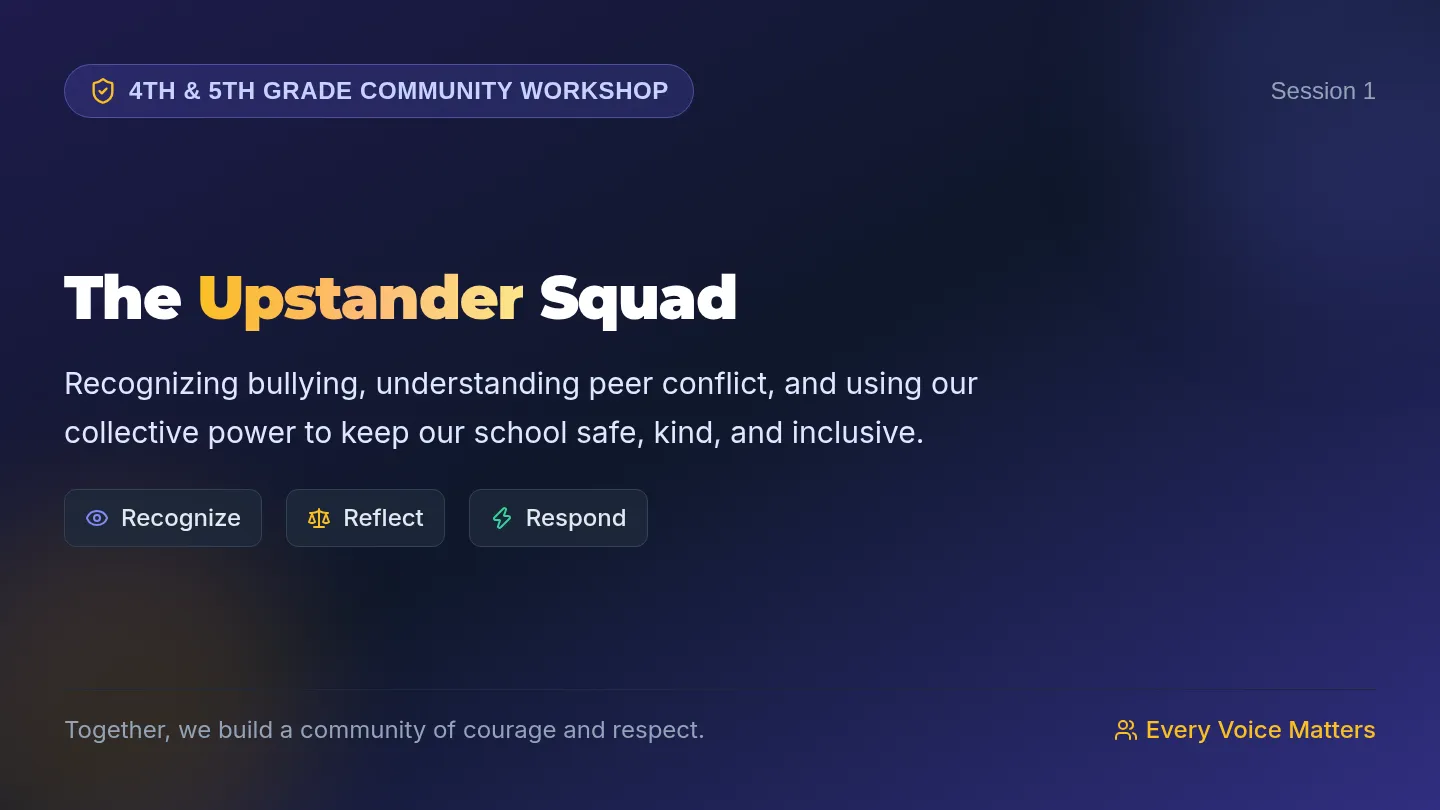
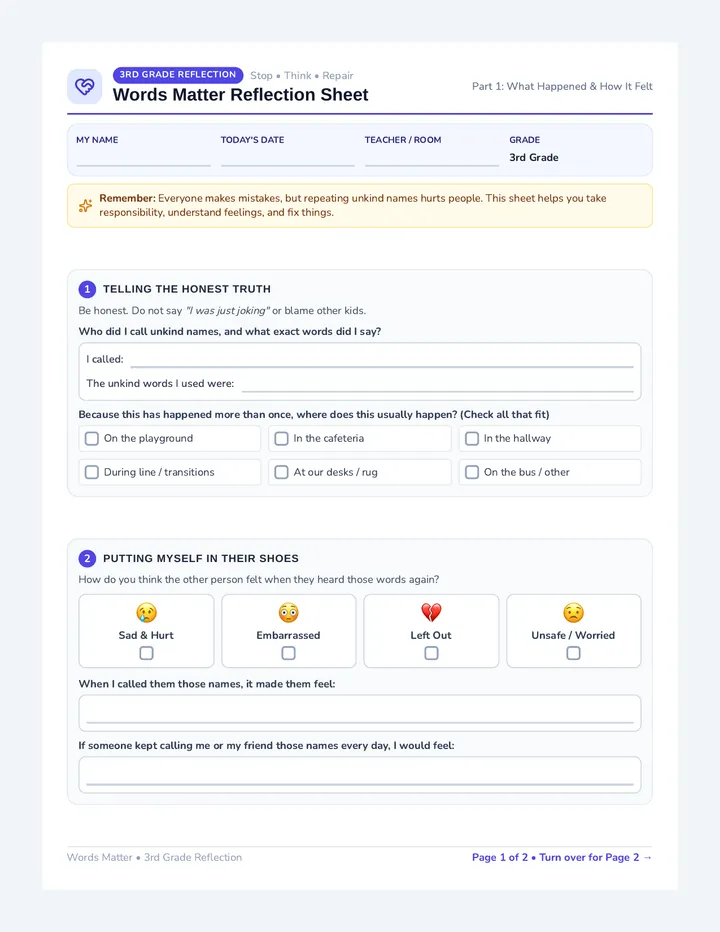
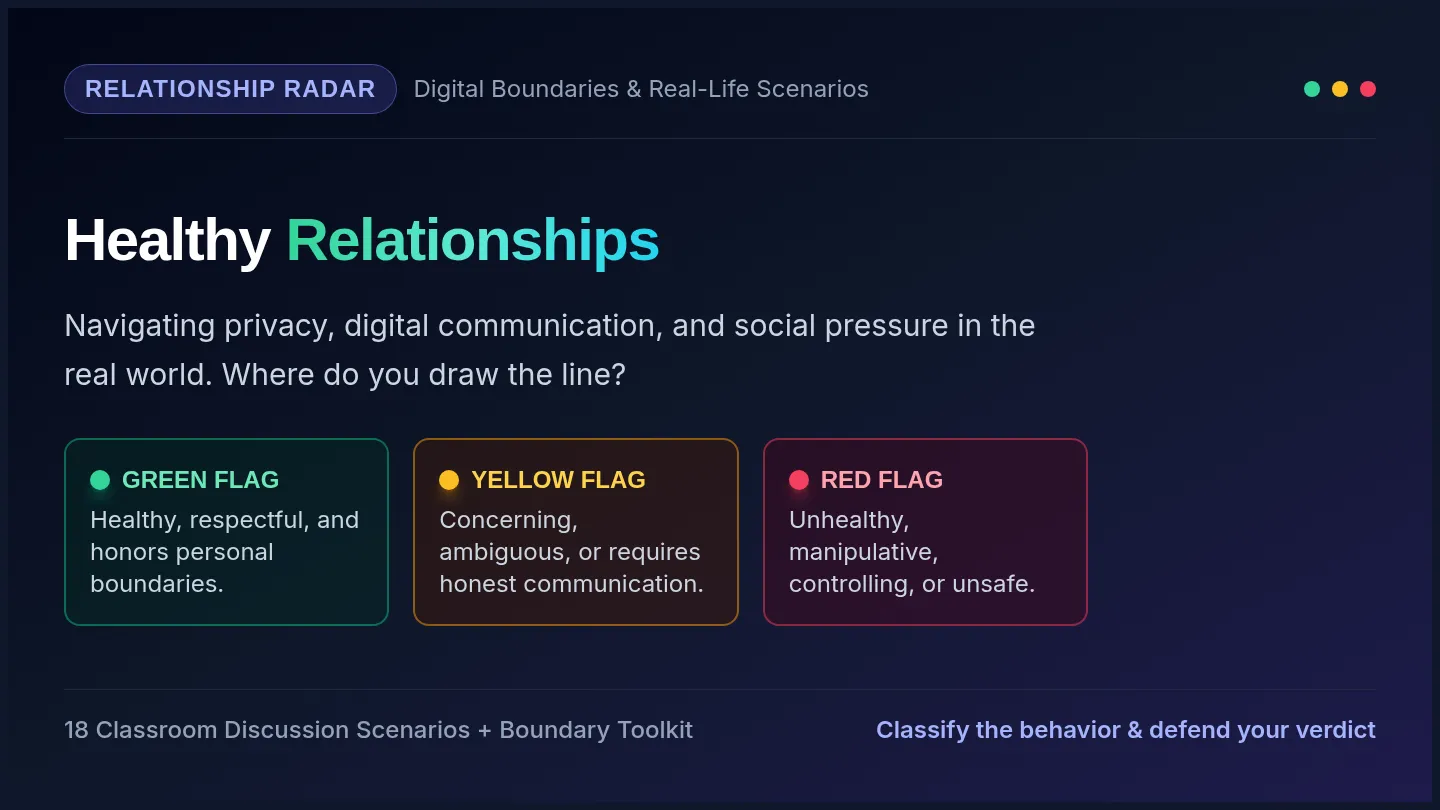
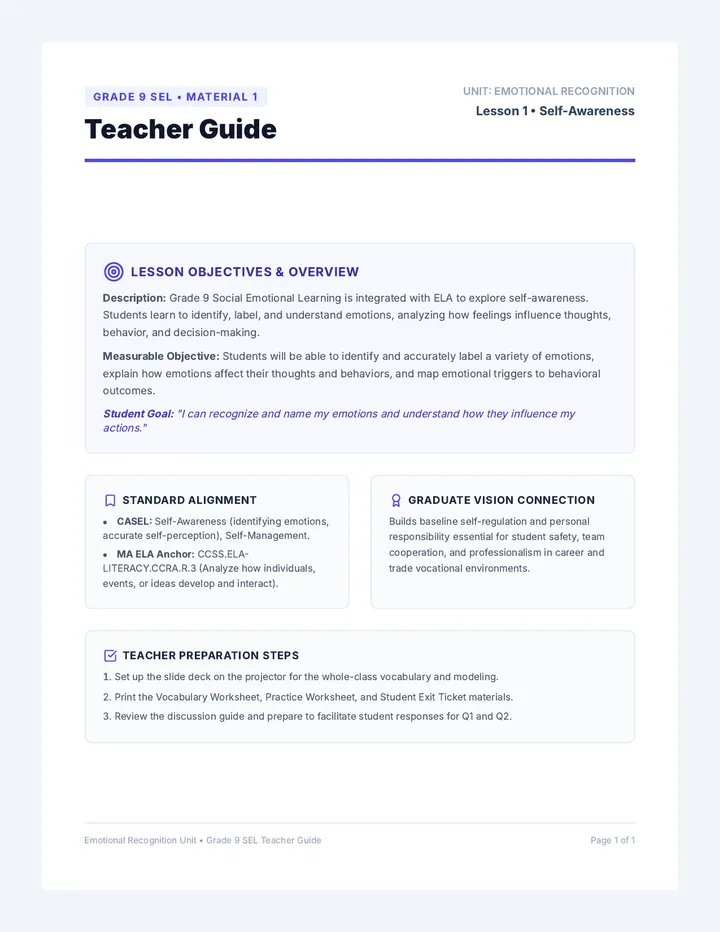
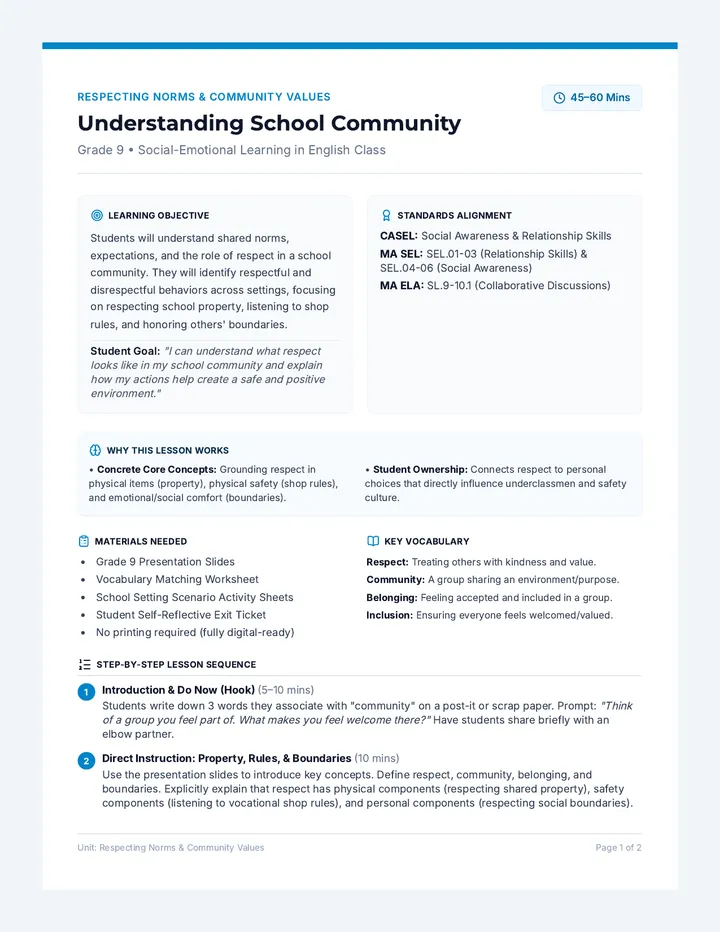
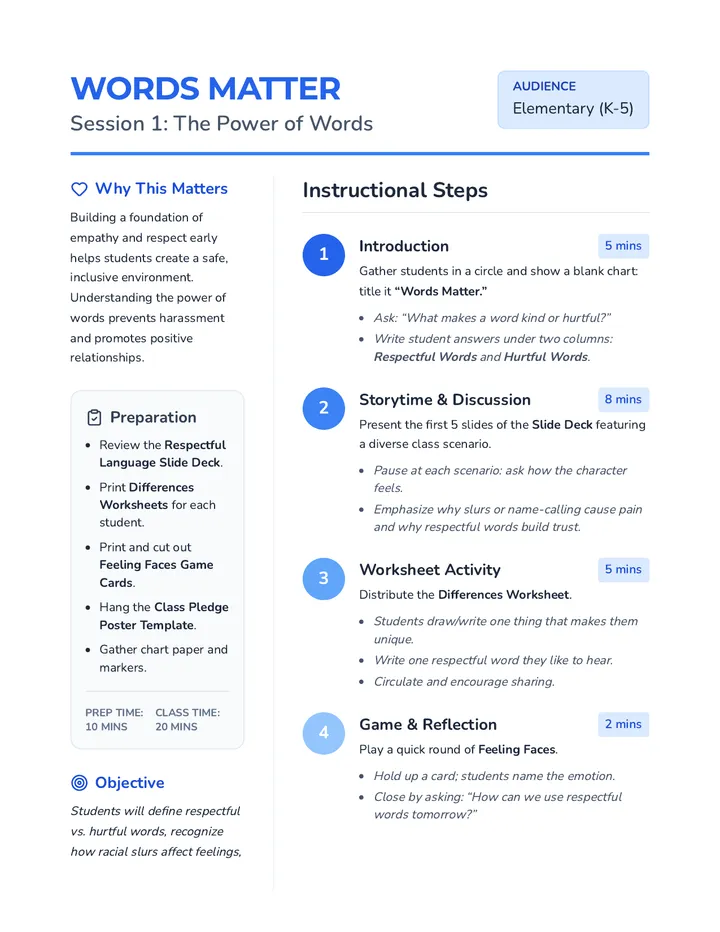
Empathetic skill development through emotion recognition, cultural diversity appreciation, and bias confrontation. Targets multi-perspective analysis to support respectful interactions and complex social responses.
A high-intensity simulation-based unit for 12th graders focusing on situational awareness and the early detection of behavioral escalation in dynamic environments. Students take on the role of behavioral analysts to identify subtle cues before they lead to crisis.
A comprehensive 5-lesson unit for 12th-grade students on identifying behavioral baselines and recognizing early warning signs of emotional escalation through analytical observation of verbal, para-verbal, and non-verbal cues.
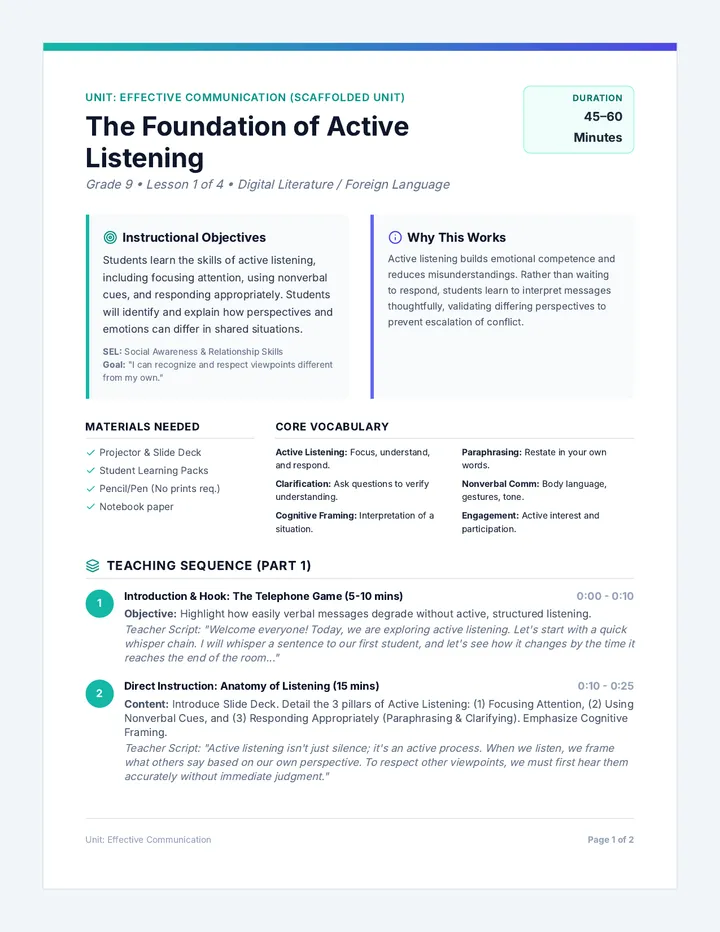
A comprehensive 11th-grade sequence focusing on auditory and paraverbal warning signs of behavioral escalation. Students learn to analyze tone, volume, cadence, and speech patterns to identify emotional states and prevent conflict.
A comprehensive sequence for 9th-grade students exploring the legal definitions, impacts, and identification of sexual harassment and hostile work environments in the professional world. Students move from basic legal definitions to nuanced evaluations of intent versus impact and digital professional conduct.
A 5-lesson sequence for 7th grade students focusing on restorative practices, the difference between intent and impact, crafting genuine apologies, and the long-term process of rebuilding trust after conflict.
This sequence teaches 7th-grade students how to move beyond simple compromise to collaborative negotiation. Students learn to separate people from problems, brainstorm creative 'win-win' options, use objective criteria for fairness, and develop a BATNA (Best Alternative to a Negotiated Agreement) to handle complex conflicts effectively while preserving relationships.
This sequence teaches 7th-grade students to navigate complex conflicts using the Iceberg Model. Students learn to look beneath surface-level arguments ('positions') to identify underlying human needs ('interests') through techniques like the Five Whys, core needs analysis, and multi-party mapping.
A 5-lesson unit for 7th graders on the formal structure of peer mediation. Students transition from observers to facilitators, learning to maintain neutrality, set ground rules, reframe toxic language, and guide parties toward mutually agreed-upon solutions.
A comprehensive 6th-grade sequence on conflict navigation, teaching students to identify root causes, recognize personal conflict styles, practice perspective-taking, understand escalation, and diagnose complex disputes.
This simulation-heavy sequence trains 8th-grade students to act as neutral peer mediators. Students move from establishing ground rules and neutrality to mastering advanced communication skills like reframing and open-ended questioning, culminating in a full mock mediation of complex social conflicts.
An advanced clinical sequence for graduate-level counseling students focused on the nuances, cultural adaptations, and schema-level applications of thought record tracking in cognitive-behavioral therapy.
This sequence explores complex conflict navigation for 12th graders, moving from the psychological roots of identity-based conflict to the practical application of restorative circles and sustainable resolution design.
Students present their Joy Menus to small groups, allowing peers to borrow ideas to add to their own lists. The lesson concludes with a commitment to try one menu item over the weekend.
Using their investigations, students create a visual 'menu' or choice board of their top 5 reliable mood-boosting activities. They illustrate these options to serve as a reference tool.
Students rotate through stations testing different types of positive engagement: creative (drawing), active (jumping jacks), and relaxing (deep breathing). They record how each station changes their energy level.
Students engage in an activity sorting game where they categorize various pastimes into 'Love it,' 'It's okay,' and 'Not for me.' This helps them realize that positive experiences are unique to each individual.
Students define joy and identify what happiness feels like in their bodies. They brainstorm activities that elicit positive emotions and distinguish between short-term fun and long-term happiness.
In this culminating lesson, students take the role of a compliance officer auditing a fictional company. They apply all learned concepts to identify potential liabilities and recommend legal corrections.
The lesson moves beyond overt slurs to examine microaggressions and intersectional discrimination where multiple protected identities overlap. Students discuss the complexity of proving intent versus impact.
Students explore the 'reasonable person standard' used by courts to determine if conduct is objectively offensive. They analyze court opinions to see how this metric is applied in objective legal rulings.
This lesson breaks down the two primary categories of sexual harassment: Quid Pro Quo and Hostile Work Environment. Students analyze specific criteria required to meet the legal burden of proof, including severity and pervasiveness.
Students examine the core statutes governing workplace rights, specifically Title VII, the ADA, and the ADEA. The session focuses on identifying protected classes and understanding the historical context of these protections.
Students step out of role to analyze the simulation outcomes, discussing where systemic bias entered the process. The lesson culminates in a proposal for improving the equity of the admissions review workflow.
The simulation introduces real-world constraints such as legacy preferences, athletic recruitment needs, and yield protection strategies. Students must adjust their cohort selections to meet these external institutional demands.
A Pre-K sequence focused on building self-esteem and positive experiences through mastery, growth mindset, and persistence. Students learn to navigate challenges and celebrate their own progress.
A Pre-K sequence focused on moving from individual joy to shared happiness through social connection, invitations, collaboration, and celebration. Students learn how community and play amplify positive emotions and build resilience.
A sequence for Pre-K students focused on building emotional resilience through predictable, positive daily routines. Students explore greetings, reframing chores, managing transitions, finding peace in quiet time, and practicing daily gratitude.
A Kindergarten sequence focused on shared positive experiences to boost mood and build social connections through invitations, cooperation, laughter, altruism, and gratitude.
A Kindergarten sequence focused on teaching emotional regulation through positive actions. Students learn to use activities like physical movement, deep breathing, and creative expression to 'switch the channel' from negative to positive emotions, building a toolkit of coping strategies.
A Kindergarten sequence focused on helping students identify personal interests and the link between activities and emotions through sensory exploration and creative mapping.
A therapeutic and self-discovery sequence for 2nd graders to identify personal sources of joy. Students explore the physical sensations of happiness, categorize their interests, and create a personalized 'Joy Menu' to use as a coping strategy for emotional regulation.
A Kindergarten sequence focused on making digital footprints concrete through physical analogies, promoting online kindness, and establishing safety protocols for young internet users.
This sequence examines the PLEASE skills (Physical illness, Lunch/Eating, Avoid mood-altering substances, Sleep, Exercise) through a Social Determinants of Health lens. Undergraduate counseling students will learn to adapt these therapeutic interventions for clients facing systemic barriers such as food insecurity, housing instability, and physical disability.
A 5-lesson unit for 3rd-grade students focused on identifying and categorizing obstacles that prevent task completion. Students learn to recognize internal emotional signals and external barriers (physical, informational, and environmental) to build self-advocacy and problem-solving skills.
A social-emotional learning sequence for 1st graders focused on empathy, perspective-taking, and challenging exclusion. Students experience simulations, role-play, and creative projects to build an inclusive classroom community.
This 5-lesson sequence for 1st-grade students explores social awareness through the lens of challenging stereotypes and bias. Students move from understanding basic assumptions via object lessons to identifying and debunking gender-based and role-based stereotypes in play and careers, ultimately celebrating individual uniqueness.
Students synthesize their learning by creating a personalized visual map of 'Plan B' options for common classroom obstacles.
Focuses on the skill of 'waiting' and choosing alternatives when preferred items are unavailable.
Students practice managing anxiety during schedule shifts by using visual aids and moving to a 'Plan B' activity.
Students role-play tool breakage and practice a three-step reset routine: Stop, Breathe, Swap to maintain emotional regulation.
Students explore the difference between 'rock brain' (stuck) and 'noodle brain' (flexible) using physical objects and metaphors. They establish the core vocabulary for the unit.
The sequence culminates with students mapping local community resources that support the PLEASE skills for low-income or marginalized clients.
Students learn to adapt movement recommendations for mood regulation for clients with physical disabilities or chronic pain, focusing on 'building mastery'.
This lesson addresses sleep hygiene for clients in crowded or noisy environments, focusing on environmental adaptation and behavioral modifications.
Students modify nutritional advice for clients with limited budgets or access, developing realistic harm-reduction strategies for 'Eating Balanced'.
Students critique standard PLEASE skills through a socioeconomic lens, identifying how food deserts, shift work, and environment impact emotional regulation.
A culminating lesson where students rapidly sort various scenarios into barrier categories to reduce the time between hitting a wall and identifying the solution.
Investigates sensory and environmental barriers like noise or clutter, conducting a 'detective walk' to identify classroom distractions.
This sequence trains 9th-grade students in bystander intervention techniques and active allyship within a workplace context. Students explore the psychological barriers to action (the bystander effect) and master the '4 Ds'—Direct, Distract, Delegate, and Delay—to safely interrupt harassment and support colleagues.
A comprehensive unit for 10th graders on identifying, distinguishing, and responding to workplace harassment. Students explore the legal definitions of 'quid pro quo' and 'hostile work environment' while investigating the nuances of intent versus impact.
This sequence shifts from identification to action, equipping students with the tools to report misconduct and intervene safely. Students learn the formal mechanisms for reporting discrimination, protections against retaliation, and the '4 Ds' of bystander intervention.
This sequence immerses undergraduate students in the federal legal frameworks of workplace discrimination and harassment, focusing on Title VII, the ADA, and the ADEA. Students learn to distinguish between general conflict and legally actionable harassment through case law analysis and real-world simulation.
This sequence empowers students to act as third-party neutrals, introducing the specific structure and skills of Peer Mediation. Students learn the distinct phases of a mediation session, the importance of neutrality, and how to facilitate dialogue without taking sides.
This graduate-level sequence critically examines the DBT FAST skills (Fair, Apology-free, Stick to values, Truthful) through the lenses of cultural humility, intersectionality, and systemic power dynamics. Students will move beyond a Eurocentric assertiveness model to develop nuanced, safe, and culturally responsive clinical interventions.
A graduate-level inquiry into the role of quantitative metrics in admissions, exploring the technical mechanics of GPA recalculation and the ethical implications of standardized testing through an equity lens.
Weekend commitment exit tickets for Lesson 5, where students pledge to try one activity from their Joy Menu.
Small affirmation cards for students to give to peers during the Joy Map sharing circle, reinforcing positive social interactions and peer support.
Student worksheet for Lesson 5, used during the Joy Exchange to collect activity ideas from classmates.
A facilitation guide for the final sharing circle, emphasizing active listening, positive feedback, and peer affirmation.
A Kindergarten presentation focused on social skills, teaching students how to present their Joy Maps and offer positive affirmations to peers.
Visual presentation for Lesson 5, guiding the 'Joy Scavenger Hunt' and the sharing of personalized menus.
A large-format template for students to create a collage of their favorite things, serving as a visual reference for emotional regulation.
Reference sheet for students to use when illustrating their Joy Menus, providing simple icons and labels for various activities.
A teacher's guide for facilitating the Joy Map collage project, including prompts for guided visualization and creative support.
A Kindergarten presentation introducing the concept of a 'Joy Map'—a visual reference tool of personal interests used for mood regulation.
Personalized Joy Menu template for Lesson 4, designed like a restaurant menu for students to fill with their favorite activities.
A cut-and-paste sorting activity where Kindergarteners categorize activities like running, reading, and dancing into 'Zoom' or 'Zen' energy levels.
A culminating event where students plan and execute a simple shared activity (like a dance party or snack share). They reflect on how doing things together feels different than doing them alone.
Students learn to identify when a friend does something good and how to celebrate them (clapping, cheering). This shifts focus from self-gratification to finding joy in others' success.
Small groups work together to build something (block tower, art piece). The focus is on the positive feeling of achieving a goal together rather than the final product.
The class engages in silly activities designed solely to produce shared laughter. They discuss how hearing others laugh makes them want to laugh too, introducing the concept of emotional contagion.
Reflecting on achievements and celebrating the internal feeling of pride through a classroom showcase.
Empowering students to share their mastered skills with peers, building leadership and reinforcing their own learning.
Learning emotional regulation tools and positive self-talk to manage frustration when learning something new.
Focusing on persistence and tracking small improvements through repeated practice of simple skills.
Introduction to the growth mindset using the word 'yet' to transform frustrations into future goals.
Students learn simple scripts and gestures to invite peers to join a positive activity, practicing inclusion and social courage.
Students establish a gratitude habit by sharing the best parts of their day, reinforcing positive memories before going home.
Students explore visualization and relaxation techniques to find joy and stillness during quiet or nap times.
A facilitation guide for the 'Zoom or Zen' lesson, including game instructions, discussion prompts about timing, and regulation strategies.
A Kindergarten slide deck teaching the difference between high-energy (Zoom) and low-energy (Zen) activities and identifying appropriate times for each.
A sorting worksheet for students to draw or glue images of sensory experiences they like versus those they find unpleasant.
A teacher's guide for managing sensory stations, including setup tips for touch, sound, and sight activities and reflection prompts.
A Kindergarten presentation for exploring sensory preferences, introducing 'Things I Like' vs 'No Thank You' and highlighting individual differences in sensory joy.