Flexibility Lab Intro Slides The Flexibility Lab
Lesson 1: Rock vs. Rubber Band
Which is Stronger?
A Rock
Hard, steady, but if you try to bend it...
SNAP!
A Rubber Band
Stretchy, bouncy, and when things change...
ADAPTS!
Meet: Rock Brain
Gets stuck on one idea.
Wants things to be the same forever.
Feels angry when plans change.
The Rock Brain Catchphrase:
"But that's NOT how we do it! It has to be MY way!"
Meet: Flexible Thinking
Looks for a different way to solve a problem.
Can try something new, even if it's scary.
Listens to other people's ideas.
The Flexible Catchphrase:
"That's different, but let's give it a try!"
Scenario Lab: You Decide!
"It's raining outside, so the class can't go to the playground. Instead, you have to stay inside and do puzzles."
Rock Brain: "I hate puzzles! I'm not doing anything!"
Flexible Thinking: "I wanted the swings, but puzzles could be fun with my friends."
Which one feels better in the end?
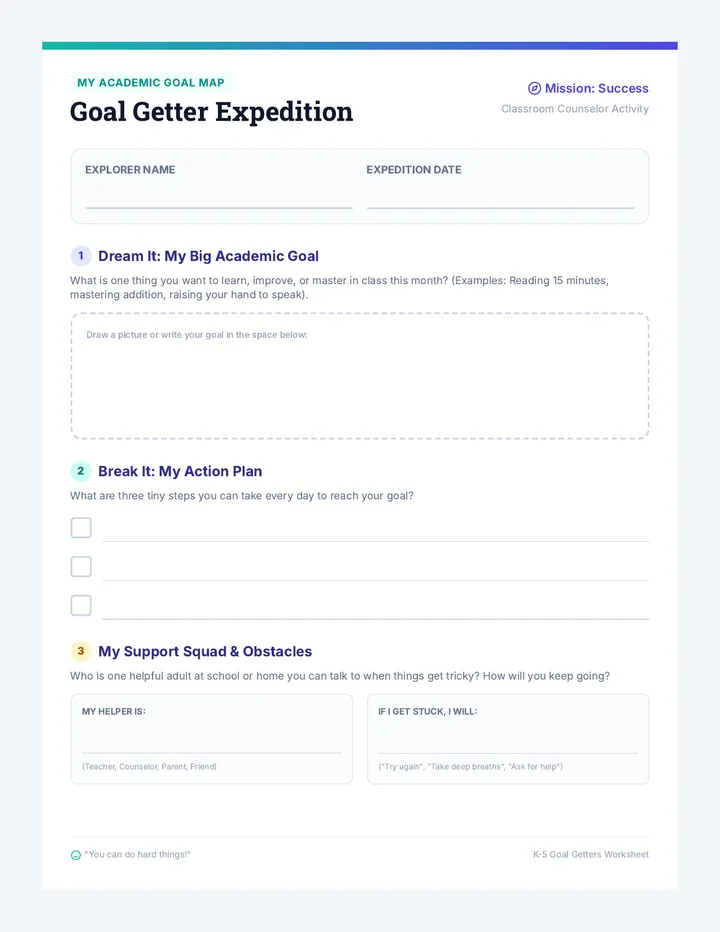
Thought Sort Lab Worksheet Thought Sort Lab
Flexibility Lab: Module 1.1
Scientist:
Date:
Lab Directions
Read each scenario below. Decide if the response shows Rock Brain (rigid/stuck) or Flexible Thinking (stretchy/adaptive). Circle the correct brain icon and write one "Flexible Strategy" to help the Rock Brain get unstuck!
Observation #01
The Cafeteria Swap
"The lunch menu says pizza, but they ran out. Now you have to choose a turkey sandwich instead."
Rock Brain
Flexible Thinking
Lab Notes: How can you stay flexible here?
Observation #02
The Game Glitch
"You are playing a board game. Your friend wants to add a new 'house rule' that you didn't agree on at the start."
Rock Brain
Flexible Thinking
Lab Notes: How can you stay flexible here?
Observation #03
The Rain Delay
"Gym class was supposed to be soccer outside, but it's raining. Now you're doing indoor yoga in the classroom."
Rock Brain
Flexible Thinking
Lab Notes: How can you stay flexible here?
Goal: Be like a rubber band - stretch, don't snap!
Flexibility Lab Teacher Guide Teacher Resource
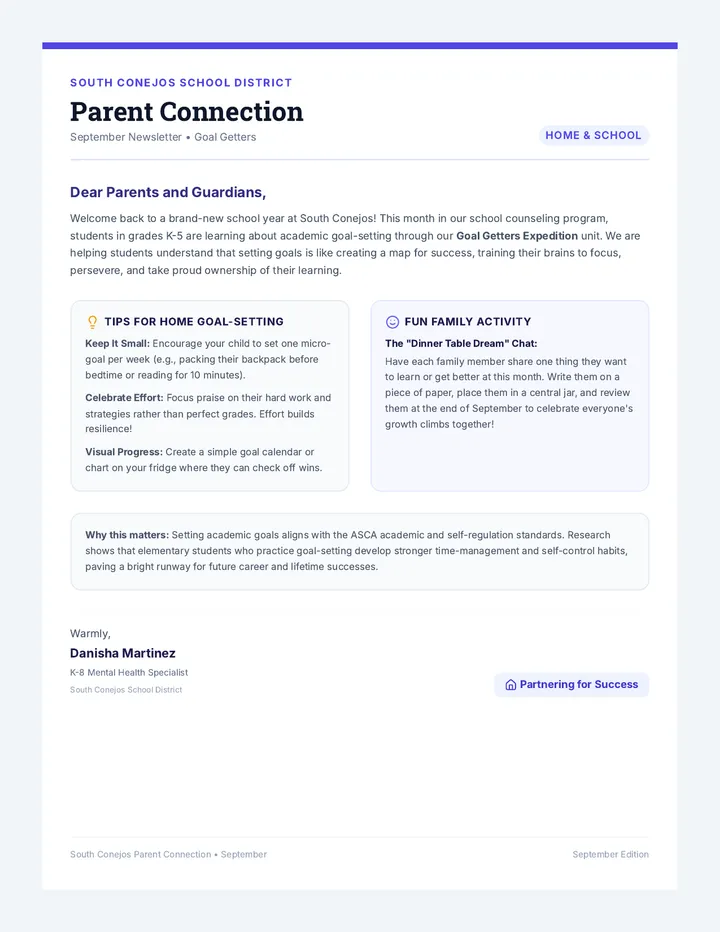
Flexibility Lab Guide
Lesson 1: Rigid vs. Flexible Thinking
Unit: Task Management
Grade: 4th Grade
Objective
Students will distinguish between 'Rock Brain' and 'Flexible Thinking' and identify positive outcomes of adaptability.
Materials
Introduction Slides
A small rock & a pipe cleaner
Thought Sort Worksheet
Key Vocabulary
Rigid, Flexible, Adapt, Compromise, Stuck
1
The Hook: Snap vs. Stretch (10 min)
"I have two scientists' tools here: a rock and a pipe cleaner. Let's see what happens when I try to change their shape."
Demonstrate: Try to bend the rock. It doesn't move. If you used a hammer, it would shatter. Explain that a "Rock Brain" is like this—strong but breaks when things change.
Demonstrate: Bend the pipe cleaner into a circle, a square, a zig-zag. It adapts! This is "Flexible Thinking."
2
Direct Instruction: Meeting the Brains (15 min)
Use the Flexibility Lab Intro Slides to introduce the two characters. Focus on the internal feelings vs. external behaviors.
Rock Brain Clues:
"No!" is the first response.
Physical tension (fists, frowning).
Insisting on specific rules or order.
Flexible Clues:
"Okay, let's try..."
Calm body posture.
Looking for "Plan B".
3
Guided Lab: Thought Sorting (20 min)
Distribute the Thought Sort Lab Worksheet . Work through Scenario #1 together as a class.
Teaching Tip: "Ask students: 'If we use Rock Brain during the Cafeteria Swap, how do we feel at the end of lunch? If we use Flexible Thinking, how do we feel?' Help them see that flexibility is actually for THEIR benefit, not just the teacher's."
Lab Modifications
Support
Provide pre-written "Flexible Strategy" cards for students to glue onto their worksheets instead of writing.
Extension
Ask students to act out a 'Rock Brain' reaction and then have a peer 'tap them out' to show the 'Flexible Thinking' version.
Bodys Alarm System Slides The Body's Alarm System
Lesson 2: Decoding Your Signals
Why Do We Get Frustrated?
When plans change, your brain sends a warning signal to your body.
Your body is trying to protect you from the "unknown," but sometimes the alarm is TOO LOUD!
What Does Your Alarm Sound Like?
Fast Heartbeat
Thump-thump-thump! It feels like you're running a race.
Hot Cheeks
Your face feels warm or even itchy and red.
Clenched Fists
Your muscles get tight and ready to fight the change.
The Catch it! Strategy
If you can NAME the signal, you can TAME the reaction.
Step 1: Notice
"My hands are tight."
Step 2: Breathe
"I'm taking 3 deep breaths before I speak."
Body Scan Investigation
Time for the Jumping Jack Challenge!
Let's feel our "Alarm Signals" in real-time.
Prepare your lab sheets...
Alarm Map Activity Sheet My Alarm Map
Flexibility Lab: Module 2.1
Investigator:
Mark where you feel the alarm!
Color Key:
Hot / Burning
Fast / Thumping
Tight / Squeezing
Part 1: The Heart Race
How did your body feel after 30 jumping jacks?
My heart was beating fast.
My face felt hot.
I was breathing hard.
Part 2: Detection
When a plan changes suddenly, which two signals do you notice first?
Part 3: The Tamer
My "Catch it!" Breathing Plan:
When I feel my alarm signal, I will take _____ deep breaths and say this to myself:
(Example: "I can handle this change" or "It's just a plan B")
Detect the signal. Protect the plan.
Alarm Simulator Teacher Guide Teacher Resource
Interoception Lab
Lesson 2: The Body's Alarm System
Status: Facilitator Guide
Goal
To help students identify their unique physiological stress markers when faced with sudden transitions or rule changes, enabling early self-regulation.
Teacher Prep
Ensure enough space for jumping jacks.
Set up "My Alarm Map" sheets.
Prepare a loud buzzer or bell.
The "Aha!" Moment
"If a student can notice their fists clenching *before* they shout at a peer, they have a 3-second window to choose a Flexible Strategy. Interoception is the bridge to self-control."
Activity: The Alarm Simulator
Step 1: The Baseline (2 min)
"Scientists, sit perfectly still. Place your hand on your heart. Can you feel it? Is your face cool or warm? Are your hands tight or loose?"
Wait for students to observe their calm baseline state.
Step 2: The Alarm State (5 min)
"Now, we are going to simulate the feeling of a 'Big Plan Change' alarm. Everyone stand up! 30 jumping jacks. Ready? GO!"
Encourage high energy. Immediately after, ring a bell or buzzer.
"FREEZE! Don't move. Notice your body NOW. Is your heart thumping? Is your breath fast? This is what your brain does when a plan changes—it revs up your engine!"
Step 3: The Map (15 min)
Direct students to their Alarm Map Activity Sheets . Have them use colors to represent different intensities of sensations.
Prompt Questions:
"Where does the 'Heat' start for you? Your neck? Your ears?"
"Do your shoulders go up to your ears when you're surprised?"
"How many deep breaths do you need to feel your heart slow down?"
Common Roadblock
"Some students may struggle to feel their heart rate. Suggest they check their pulse on their neck or wrist, or notice if their breathing feels 'noisy' instead."
Success Criteria
Students can name at least two specific physical signals and one self-calming statement they can use during a transition.
Gear Shifter Game Slides The Gear Shifter Game
Lesson 3: Training Your Brain to Pivot
Shifting Gears
When a car changes speed, the driver shifts gears.
Your brain does the same thing when you stop one task and start another.
Set Shifting: The ability to quickly change your rules or focus without getting stuck.
1
2
3
R
How to Play
01
Round 1: The Rule
We start with one rule (e.g., "Sort by Color").
02
The Buzzer
When you hear the buzzer, the rule INSTANTLY changes!
03
The Shift
Don't pause. Don't complain. Just SHIFT your focus!
Flexible Shifting Strategies
Reset Your Eyes
Look away for one second to "clear your screen" before starting the new rule.
Self-Talk
Whisper the new rule to yourself: "Color, color, color..."
Embrace Mistakes
It's okay to mess up! Just keep moving to the new gear.
Let's Warm Up!
Opposite Action Challenge
Teacher Says:
"LOOK UP"
You Do:
LOOK DOWN
Ready for the Gear Shifter Game?
Gear Shifter Scorecard Gear Shifter Log
Flexibility Lab: Module 3.1
Driver:
Mission Objective:
Stay flexible! When the buzzer sounds, immediately stop what you're doing and start the new rule. No complaining—just shifting!
ROUND 1
The Shift:
Color ➔ Shape
How did your brain feel during the shift?
Smooth
A Little Stuck
Very Rigid
ROUND 2
The Shift:
Letters ➔ Numbers
How did your brain feel during the shift?
Smooth
A Little Stuck
Very Rigid
BONUS ROUND
The Shift:
The Reverse Shift!
Did you use a specific strategy to shift?
Self-Talk
Eye Reset
Deep Breath
Hand Shake-Out
After-Action Report:
What was the hardest part of shifting gears today?
100% Flexible Thinking Logged
Gear Shifter Teacher Guide Lesson Plan 3.0
Game Master Guide
Topic: Set Shifting & Task Management
Equipment
Sorting Cards:
Prepare a deck of 50 cards with shapes (Circle/Square) in different colors (Red/Blue). Some cards should also have numbers (1/2) written on them.
The Buzzer:
A bell, whistle, or loud sound effect to signal the "Gear Shift."
Scorecards:
One Gear Shifter Scorecard per student.
The Skill: Set Shifting
"Set shifting" is the executive function that allows us to move back and forth between different tasks or mental states. It is the core of cognitive flexibility.
Instructional Focus:
Observe students' emotional reactions when the buzzer sounds. Are they freezing? Are they groaning? Use these as teachable moments for 'Eye Resets'.
The Mission Briefing
1
The Basic Shift (Color ➔ Shape)
Students sort cards by Color . Every 30 seconds, hit the buzzer. Students must immediately switch to sorting by Shape . Continue for 3 minutes.
Success Look-Fors:
Fast transition (under 3 seconds), no audible complaints, accurate sorting after the shift.
2
The Content Shift (Letters ➔ Numbers)
Using a different set of cards (or the flip side), students sort by Letter (A/B). On the buzzer, they shift to sorting by Number (1/2).
Instructional Prompt:
"Notice how your brain feels heavy? That's your engine shifting gears! Take a breath and focus on the new rule."
!
The Rapid Fire (Chaotic Shift)
Call out different rules at random intervals (Color! Shape! Number! Color!). This builds stamina for high-speed flexibility.
The Lab Debrief
"Which rule was hardest to 'let go' of when the buzzer sounded?"
"What did you say in your head to help you switch gears?"
"How can 'shifting gears' help you when a teacher says it's time to stop a fun activity and start math?"
Role Playing Disappointment Slides The Pivot Plan
Lesson 4: Handling Disappointment Like a Pro
The Plan Just Changed...
When you hear "No" or "The plan has changed," it feels like a stomach drop or a tight chest.
"I was REALLY looking forward to that..."
Disappointment is Real
It's okay to feel sad or frustrated. What matters is what we DO with it.
Using Neutral Statements
Instead of a Rock Brain Shout, try a Flexible Pivot.
"Okay, maybe next time."
"I can handle this change."
"It's not what I wanted, but it's okay."
"THE PIVOT"
Changing your words to change your mood.
The Flexibility Rehearsal
1
Notice
The "Alarm Signal" starts in your body.
2
Breathe
Take 3 deep breaths before you speak.
3
Pivot
Say your neutral statement aloud.
4
Move On
Do the next activity with a calm body.
Scenario Lab
"Your favorite teacher is out sick today, and there is a substitute you've never met."
How do you PIVOT?
Wait Breathe Speak
Pivot Scenario Cards Pivot Scenario Cards
Flexibility Lab: Module 4.1
Practice Directions
Cut out the cards below. Work with a partner to act out each "Disappointment" scenario. Use one of the Pivot Phrases from the bottom of the page to finish your role-play calmly!
Scenario A
"Your teacher says the class is too loud, so you have to cancel the extra 5 minutes of recess."
Body Signal: Tight Chest
Scenario B
"It's your turn to use the iPad, but it's not charged and you have to wait 20 minutes."
Body Signal: Clenched Fists
Scenario C
"You worked hard on a drawing, but someone accidentally spilled water on it and it's ruined."
Body Signal: Hot Face
Scenario D
"The school lunch is fish sticks, but you really wanted chicken nuggets today."
Body Signal: Fast Heart
Pivot Phrase Cheat Sheet
"That's a bummer, but I can handle it."
"Plans change. No big deal!"
"I'll try my best with the new plan."
"It's okay. I'll do it a different way."
"Maybe next time will be better!"
"Deep breath... Okay, I'm ready."
Cut along the dotted lines
Role Play Feedback Rubric Teacher Resource
Role Play Facilitation
Lesson 4: Pivot Strategy Rehearsal
The "Wait & Replace" Method
"The goal of this lesson is NOT to make disappointment go away. It is to create a buffer zone between the feeling and the reaction. We teach students to 'Wait' (breathe) and then 'Replace' (the Pivot Phrase) their typical Rock Brain response."
Flexibility Observational Rubric
Skill Rock Brain (1) Flexible Thinking (3) The Pause Reacts instantly with shouting, crying, or freezing. Takes at least one visible breath before speaking. The Pivot Uses blame ("You ruined it!") or demands ("Fix it!"). Uses a neutral phrase like "That's okay" or "Next time." Body Language Clenched fists, red face, stomping away. Keeps hands loose and stays in the group. Recovery Stays upset for more than 5 minutes. Can start the next activity within 1 minute.
Coaching Cues:
"Try that again, but use a quieter voice."
"Show me what your hands look like when they are 'flexible'."
Success Story:
"I saw [Name] start to frown when the iPad card was drawn, but then they actually whispered 'It's okay' to themselves. That is a massive win for cognitive flexibility!"
Flexibility Obstacle Course Slides The Master Challenge
Lesson 5: The Flexibility Obstacle Course
Today's Mission
You will navigate a path of challenges. But there's a catch...
THE RULES WILL CHANGE!
You must use your Rock vs. Flexible thinking, your Body Signals, and your Pivot Statements to finish.
ROADBLOCK!
Success Requirements
No Snapping
When a rule changes, keep your body calm and your brain stretchy like a rubber band.
Take the Pause
Notice your "Alarm Signals" and take a breath before you move to the new plan.
The Pivot
Say a neutral statement aloud if you feel frustrated. "It's okay, I've got this!"
Watch Out For...
The Time Warp
You might only have 10 seconds to finish a task that normally takes 1 minute!
The Rule Swap
"Drawing a cat" might suddenly become "Drawing a dog" mid-way through!
Good Luck, Scientists!
Flexibility Reflection Log Master Reflection
Flexibility Lab: Module 5.1
Flexible Leader:
Lab Completion Report
1. The Rule Change Challenge:
When the teacher yelled "THE RULES CHANGED!", what was the first thing your brain thought?
"Oh no! This isn't fair!"
"Okay, what's the new plan?"
2. My Lab Tools:
Which flexibility tool did you use the most during the obstacle course? (Check all that apply)
Deep Breathing
Pivot Phrase
Eye Reset
A "Flexible" Moment:
Describe a time during the course when you felt like a **Rubber Band** instead of a Rock.
Real World Pivot:
How can you use these skills at home when your parents change a plan?
CERTIFIED
Master of Flexibility
Flexibility Lab Final Assessment • Grade 4 Special Education
Obstacle Course Teacher Guide Teacher Resource
Course Director's Manual
Lesson 5: The Flexibility Obstacle Course
I. Station Setup Guide
A
The Drawing Duel
Students draw a specific object. Mid-way through, shout "SWAP!" and they must turn their drawing into something completely different (e.g., Cat becomes a Plane).
B
The Sorting Sabotage
Students sort items by one rule. Suddenly, announce a "Roadblock"—the rule is now reversed or a new category is added without warning.
C
The Movement Maze
A simple walking path. As a student enters, place a "Detour" sign. They must find an alternate path while keeping a calm body.
II. Master Observation Log
Use this grid to track which strategies students employ in the heat of the moment.
Student Name Pause / Breath Pivot Statement Smooth Recovery ▢ ▢ ▢ ▢ ▢ ▢ ▢ ▢ ▢ ▢ ▢ ▢
Emergency Stop:
"If a student hits their 'Meltdown Threshold', pause the course for everyone. Model a collective 4-count breath. Use this as a 'Master Strategy Reset' before continuing."
Final Badge Criteria:
100% participation + at least one visible 'Pivot' during a rule change.