Methods for tracking progress against milestones and evaluating the effectiveness of current action plans. Equips individuals to identify obstacles and implement tactical adjustments to maintain momentum toward long-term objectives.
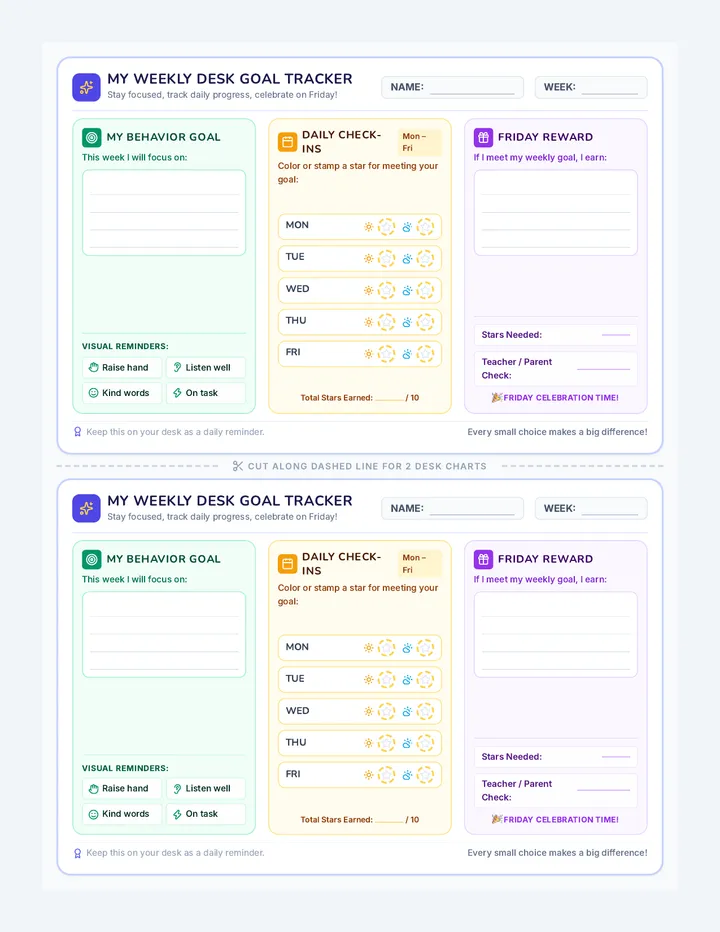
A streamlined, colorful weekly tracker for a 10-year-old boy featuring Name and Week fields, 3 spacious session task rows for Monday through Friday with blank tracking boxes, and an uncluttered end-of-week prize box.
An engaging, student-centered one-page goal setting worksheet featuring goal categorization, SMART goal framing, three-step action planning, obstacle problem-solving, and a commitment meter.
A comprehensive, no-tech social-emotional lesson plan guiding students to identify meaningful goals, break them into manageable stair-steps, build obstacle shields, and track progress with physical classroom routines.
A balanced two-per-page printable redemption reflection worksheet for Principles of Digital Design. Students analyze daily journaling habits, identify obstacles, take accountability, and outline actionable commitments for Ms. Stahl's next check to earn back up to 10 points.
A condensed half-sheet version of the 1st-grade Star Power Check-In/Check-Out tool, formatted 2-up on a printable page with a cut guide for classroom efficiency.
A 2-page printable dry-erase desk tracker kit designed for student-led blurt self-monitoring. Page 1 features two laminated-ready desk mats for Goal & Count tracking and Interval Self-Checks with a dedicated Thought Parking Lot; Page 2 provides slim desk-edge ruler strips and a weekly goal progress log.
A two-page guided practice worksheet specifically tailored to social pragmatic skills—including perspective taking, reading social cues, choosing appropriate tone and timing, expressing goals to varied audiences, collaborative action planning, and receiving feedback constructively.
A comprehensive two-part unit for Secondary 1 and 2 students focusing on developing impulse control. Students learn to navigate immediate urges using the 'Pause, Think, Act' and 'Pause, Process, Proceed' frameworks through interactive activities, real-world scenarios, and personal planning.
A 6-week social-emotional learning program for 6th-grade girls focused on building healthy friendships, resolving conflicts, practicing empathy, and setting boundaries.
A comprehensive sequence for 6th graders to understand and apply behavioral activation. Students learn how their actions impact their emotions, track their energy levels, brainstorm nourishing activities, and create a sustainable weekly schedule to improve their mental well-being.
In this inquiry-driven sequence, students explore behavioral activation, investigating how their actions influence their emotions. They learn to distinguish between pleasure and mastery activities, conduct personal experiments to track mood changes, and create a personalized evidence-based plan for mood regulation.
A 1st-grade counseling sequence that uses game-based mechanics and metaphors to teach behavioral activation, emotional resilience, and the importance of daily positive routines.
This sequence shifts focus from the design of the study guide to its utility, emphasizing active recall and self-testing strategies to help students distinguish between familiarity and actual mastery of material.
A 5-lesson unit for 3rd graders focused on building emotional resilience through habit formation. Students learn to audit their time, identify small 'micro-moments' of joy, and design balanced daily schedules that prioritize positive experiences.
A comprehensive sequence designed for 6th-grade students to master executive function skills. Students will learn to audit their time, effectively use planners, prioritize tasks using the 'Big Rocks' method, break down large projects through backward planning, and optimize their study environments for focus.
This 7th-grade sequence teaches the principles of behavioral activation, helping students understand how their actions influence their moods. Through self-monitoring, activity categorization, and strategic planning, students develop a toolkit for proactively managing their mental well-being.
A 10-session course for high school students focused on developing healthy communication, boundaries, and empathy across romantic, platonic, and digital relationships. Students engage in interactive role-plays, games, and reflections to build practical social-emotional skills.
A comprehensive sequence where 8th-grade students act as 'organizational consultants' to diagnose and solve scheduling conflicts and executive functioning challenges through case studies. Students learn root cause analysis, professional self-advocacy, emotional regulation strategies for procrastination, and tool evaluation before creating a final consultancy report.
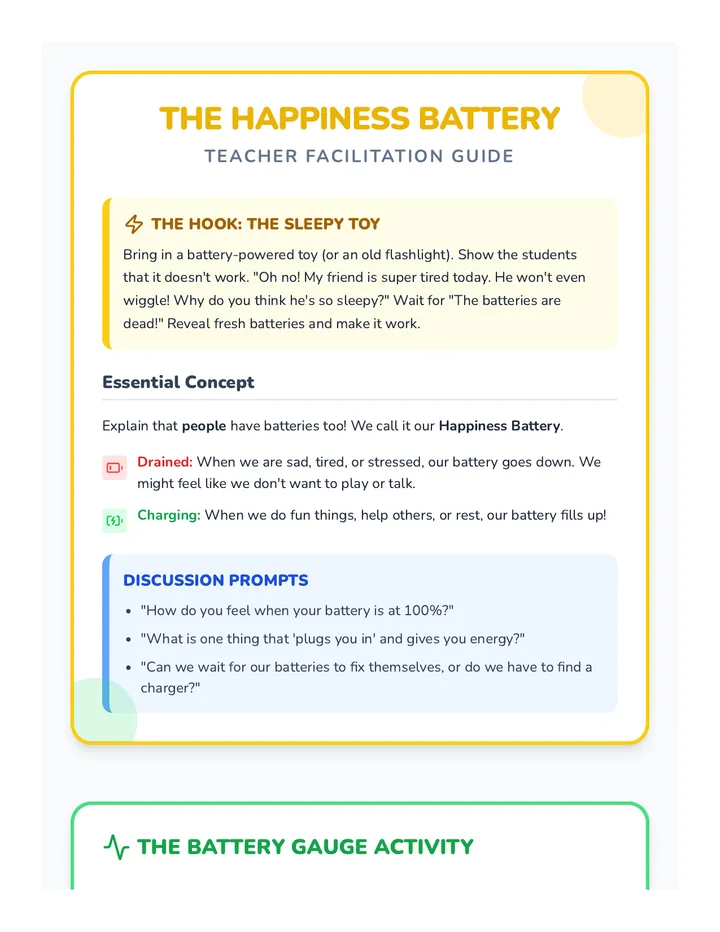
A comprehensive 5-lesson sequence designed to teach 4th-grade students self-regulation through daily emotional check-ins, goal setting, and non-verbal communication. Students learn to identify their internal state using a battery metaphor and connect it to their readiness for learning.
A 90-minute intensive Tier 3 intervention for 7th grade students with ADHD, focusing on the Stop-Think-Act strategy to build impulse control and self-regulation skills.
A 45-minute lesson for 9th-grade students to master the Eisenhower Matrix, learning to distinguish between urgent and important tasks to boost efficiency and reduce stress.
A 45-minute lesson for 6th graders on executive functioning and study skills, using the 'Inner CEO' metaphor to help students master organization, planning, and task management.
A 45-minute lesson for 9th-grade students on the importance of punctuality, meeting deadlines, and effective task management in vocational careers. Students explore key concepts of professionalism and collaboration through interactive activities like creating a project timeline for a trade show.
A comprehensive simulation-based lesson for 10th-grade students to practice essential adulting skills, including budgeting, career selection, and managing unexpected life events.
A single, consolidated lesson containing the 8th Grade PGP Success Roadmap transition tracker document, designed specifically for counselors and secondary staff to guide students and parents through high school pathways and graduation planning.
This lesson introduces adults to the core concepts of Social-Emotional Learning (SEL) through the lens of 'superpowers.' Participants explore the five SEL competencies—Self-Awareness, Self-Management, Social Awareness, Relationship Skills, and Responsible Decision-Making—and identify practical applications for personal and professional well-being.
A 35-minute lesson for 6th graders to celebrate personal growth, reflect on learning journeys, and foster a positive classroom community through guided reflection and a celebration ceremony.
A 30-minute Tier 2 lesson for 8th graders transitioning to high school, focusing on organizational skills, study strategies, and SMART goal setting to build confidence and reduce transition anxiety.
Students will explore and practice time management techniques to help them balance academics, extracurricular activities, and personal life. Mastering time management is critical for their current and future success as students and professionals.
This lesson equips 10th-grade students with strategies to confidently and constructively answer challenging interview questions about personal weaknesses or failures by focusing on a growth mindset.
A 90-minute workshop for parents on understanding childhood separation anxiety and implementing practical, evidence-based strategies to ease transitions and build confidence.