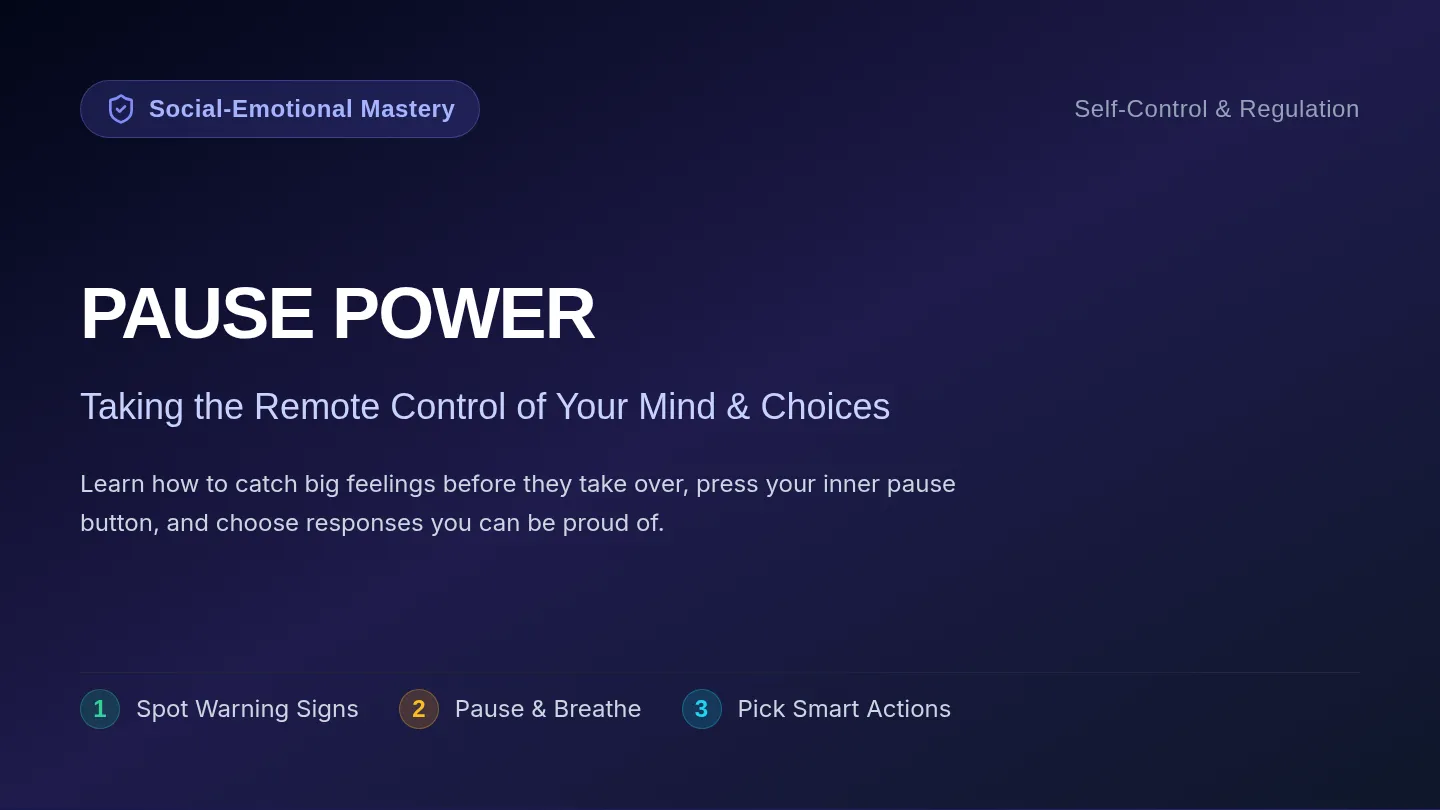
Pause Think Act Lesson Plan Pause, Think, Act!
Impulse Control Foundations
Secondary 1 & 2
60 Minutes • Tier 1 Lesson
Why This Matters
Developing impulse control is crucial for making informed decisions, managing emotions effectively, building positive relationships, and achieving personal goals. It empowers students to navigate challenging situations with greater self-awareness and foresight.
Learning Objective
Students will define impulse control, identify situations requiring it, and practice strategies to improve their ability to pause, think, and act intentionally.
Preparation (15 min)
Set up projector for Slide Deck.
Print "The Power of the Pause" Reading (1 per student).
Print "My Impulse Toolkit" Worksheet (1 per student).
Prepare large paper and markers for Consequence Web activity.
Lesson Delivery
Phase & Time Key Instructions Warm-Up 5 Minutes Distribute Quick Impulse Check . Students jot down initial thoughts on acting without thinking. Brief class discussion on immediate reactions. Introduction 10 Minutes Use Slide Deck (1-3) to define impulse control. Discuss internal "stop" buttons and relevance to secondary life. Introduce "Pause, Think, Act!" Video & Reading 15 Minutes Show "Amygdala Hijack" video (Slide 4). Distribute The Power of the Pause reading. Discuss the brain's role in reactions and the power of conscious pausing. Consequence Web 10 Minutes Small groups map impulsive vs. thoughtful actions for given scenarios. Focus on long-term outcomes and secondary-level social situations. My Impulse Toolkit 10 Minutes Students complete individual worksheets brainstorming personal strategies (breathing, walking away, counting) for each step of the framework. Game & Reflection 10 Minutes Play Stop, Think, Choose! (rapid-fire scenarios). Conclude with One-Word Reflection cool-down.
Included Materials
• Slide Deck & Script
• Quick Impulse Check (Warm-Up)
• Power of Pause (Reading)
• My Impulse Toolkit (Worksheet)
• Real-Life Challenges (Discussion)
• Consequence Web (Activity)
• Stop Think Choose (Game)
• Quiz & Answer Key
• One-Word Reflection (Cool Down)
• Project Guide & Rubric
Pause Think Act Presentation Pause,
Think, Act!
Mastering Impulse Control in Everyday Life
Secondary 1 & 2 Life Skills
What is Impulse Control?
It is your internal "STOP" button! It gives you the ability to:
Stop and think before you act.Resist urges or immediate desires.Consider consequences of your actions.
"Making thoughtful choices instead of reacting automatically."
Why Does It Matter?
Stronger Relationships
Prevent unnecessary conflicts, show empathy, and build trust with friends and family.
Better Decisions
Avoid regrettable choices and stay focused on your long-term goals.
Personal Well-being
Manage your emotions calmly and reduce stress by staying in control of your reactions.
Take Control
It empowers you to take control of your actions and your life!
Your Brain & Impulses
[Amydgala Hijack Video Placeholder]
Understanding the science behind our reactions helps us gain control. Watch how our brain responds to sudden urges!
The Pause, Think, Act! Strategy
1
Pause
"Take a breath. Count to 5. Interrupt the automatic reaction."
2
Think
"What are my options? What are the consequences? How will this affect others?"
3
Act
"Choose the best option. Act intentionally, aligned with your values."
Real-Life Impulse Challenges
Social Media Reaction
Seeing a post that makes you angry and wanting to comment immediately.
Shopping Urges
Wanting to buy the latest trend even if you can't afford it.
Classroom Frustration
Getting annoyed with a group member during a big project.
Peer Pressure
Being pressured by friends to do something risky for "fun".
How would the "Pause, Think, Act!" strategy help here?
Your Impulse Toolkit
Physical
• Deep breathing
• Counting to ten
• Walking away briefly
Social
• Ask a trusted friend
• Delay your response
• Explain you need a minute
Pause Think Act Script Pause, Think, Act!
Instructional Script & Facilitation Guide
Lesson 1
5 MIN
1. Warm-Up: Quick Impulse Check
SAY:
"Good morning/afternoon everyone! Today, we're going to talk about something super important for navigating daily life – impulse control. To kick things off, let's do a quick warm-up. Please take out your Quick Impulse Check and answer the question: 'What was a time you acted without thinking and wished you hadn't?' Just jot down the first thing that comes to mind. You have about 2 minutes."
[PAUSE FOR STUDENTS TO WRITE]
"Alright, does anyone feel comfortable sharing a brief example? No pressure at all, but sometimes hearing from others helps us realize we're not alone."
Facilitator Note: Validate shared experiences briefly to build safety. Transition to Slide Deck.
10 MIN
2. Introduction: What is Impulse Control?
[DISPLAY SLIDE 2]
SAY:
"So, what IS impulse control? When you hear that phrase, what comes to your mind? Turn and talk to a partner for 30 seconds and share your ideas."
"Great ideas! Impulse control is your ability to stop and think before you act. It’s about resisting those immediate urges, considering consequences, and making thoughtful choices instead of just reacting automatically. Think of it as your internal ‘stop’ button. Why do you think having a good ‘stop’ button is important?"
[DISPLAY SLIDE 3]
"Exactly! Good impulse control leads to better decisions, stronger relationships, and generally contributes to your personal well-being. It helps you take control of your actions and your life."
15 MIN
3. Video & Reading: The Power of Pause
[DISPLAY SLIDE 4 & PLAY VIDEO]
"Sometimes we act impulsively because of how our brains are wired. We're going to watch a short video that explains 'Amygdala Hijack'. After the video, we'll read a short article that ties into this."
"Now, I'm handing out the reading. As you read, think about why that 'pause' is so powerful."
10 MIN
4. Activity: Consequence Web
[DISPLAY SLIDES 5-6]
"Let's focus on the 'how.' Our strategy is Pause, Think, Act! In your groups, you'll map out two paths for a scenario: an impulsive reaction path and a thoughtful reaction path. You'll see how different the results can be."
10 MIN
5. Worksheet: My Impulse Toolkit
[DISPLAY SLIDE 7]
"Great work! Now, let's create your personal toolkit. On this worksheet, brainstorm strategies you can use to Pause, Think, and Act. Think about what works for you personally—breathing, walking away, or maybe visualizing a goal."
Quick Impulse Check Warm Up Quick Impulse Check
NAME: _________________________________
Immediate Reflection
"Quickly answer the question below. Don't overthink it—just write the first thing that comes to mind!"
What was a time you acted without thinking and wished you hadn't?
Be honest with yourself. This check-in is just for you to get started!
The Power of the Pause Reading Science of Self-Control
THE POWER OF THE PAUSE
Why a Moment Can Change Everything
Have you ever regretted something you said or did immediately after doing it? We've all been there. It usually happens when we act on impulse—a sudden urge or feeling that makes us want to do something right now , without fully considering the consequences.
The "Hijack"
Our brains are amazing, but sometimes they work a little too fast for our own good. When we experience strong emotions like anger, excitement, or fear, a part of our brain called the amygdala can take over. This is sometimes called an "amygdala hijack."
It's designed to protect us in emergencies, giving us a rapid "fight, flight, or freeze" response. In dangerous situations, this is fantastic! But in everyday life, it can lead us to react impulsively in ways we later regret, like yelling at a friend, sending a hasty message, or spending money we don't have.
Creating the Gap
The good news is that we're not just creatures of impulse. We also have the prefrontal cortex , the front part of our brain, which is responsible for reasoning, planning, and understanding consequences. The key to impulse control is to create a small but mighty gap between the initial impulse and our action.
"This gap gives our prefrontal cortex a chance to catch up and engage."
Think about it like this: An impulse is a fast-moving train. If you jump on it immediately, you're along for the ride, wherever it goes. But if you see the train coming and take a moment to decide if it's the right train for your destination, you can choose to let it pass or board it intentionally.
How to "Pause"
Try these techniques to give your brain those crucial few extra seconds:
1
Take a Deep Breath
Inhaling slowly calms your nervous system and gives you a moment.
2
Count to Ten
Forces you to redirect your focus, however briefly.
3
Walk Away
Physically removing yourself from a triggering situation creates immediate distance.
4
Ask a Question
Instead of reacting, ask: "What's really going on here?"
5
Visualize
Imagine the positive consequences of NOT acting impulsively.
Remember:
Mastering the "pause" isn't about suppressing your feelings; it's about giving yourself the power to choose how you respond to them. It's about being in control of YOU.
Real-Life Impulse Challenges Discussion Guide Real-Life Impulse Challenges
Discussion Facilitation Guide
Teacher Resource
Objective
To encourage students to identify and discuss real-life scenarios where impulse control is challenging and to explore the potential impacts of impulsive versus thoughtful actions.
Facilitator Note: Use these prompts to spark dialogue. Encourage students to share personal experiences without identifying individuals. Remind them this is a safe space for growth.
1 Social Media Pressure
"Think about a time you (or someone you know) acted impulsively regarding social media—maybe a comment or a post. What happened? How might taking a moment to Pause, Think, and Act have changed the situation?"
2 Spending & Urges
"When it comes to spending money, what are some common impulsive purchases teenagers make? What are the short-term and long-term consequences of these actions? How does 'Instant Gratification' play a role?"
3 Group Dynamics
"Imagine you're working on a group project, and one member isn't pulling their weight. What's an impulsive way you might react? What would be a more thoughtful, controlled response, and what positive outcomes could that lead to?"
4 Peer Influence
"Have you ever felt pressured by friends to do something you weren't comfortable with? How does a lack of impulse control play a role in giving in to peer pressure? What strategies can help you pause in such moments?"
5 Life Skills Connection
"How does practicing impulse control in one area of your life (like managing anger) potentially help you in another area (like sticking to a study schedule)?"
Encourage students to use the "Pause, Think, Act!" terminology during their answers.
Consequence Web Activity Consequence Web
Small Group Cooperative Activity
Activity Guide
Goal
To visually demonstrate the vastly different outcomes of impulsive versus thoughtful actions using real-world scenarios.
Materials
Large poster paper or whiteboard space
Colored markers (Red for Impulsive, Blue/Green for Thoughtful)
Scenario Cards
HOW TO BUILD YOUR WEB
1
Set the Center
Draw your Scenario in a circle right in the middle of your paper. (e.g., "Friend posts an untrue rumor about you online").
2
Path 1: The Impulsive Reaction
"Acting without the Pause..."
Draw a line out from the center labeled Impulsive Action. Branch out from that action to list all the potential negative short-term and long-term consequences.
3
Path 2: The Thoughtful Reaction
"Pause, Think, THEN Act..."
Draw a separate line from the center labeled Thoughtful Action. Branch out from this action to list all the positive short-term and long-term outcomes.
Scenario Cards (Choose One)
"Getting angry and yelling at a sibling over a borrowed item."
"Buying something expensive you don't need with saved money."
"Procrastinating on a big project until the night before."
"Reacting defensively to constructive criticism from a coach."
Group Share
Prepare to present your web. Be ready to explain: Why was the 'Thoughtful Path' harder to choose initially, but better in the long run?
My Impulse Toolkit Worksheet My Impulse Toolkit
NAME: _________________________________
Objective: To identify and personalize strategies for improving your impulse control using the "Pause, Think, Act!" framework. Write down at least two ideas for each section that would work for you .
1
PAUSE
How can you create a moment to stop and interrupt an automatic reaction? (e.g., Take three deep breaths)
1. ____________________________________________________________________________________
2. ____________________________________________________________________________________
3. ____________________________________________________________________________________
2
THINK
What questions can you ask yourself to consider consequences? (e.g., "What will happen if I do this?")
1. ____________________________________________________________________________________
2. ____________________________________________________________________________________
3. ____________________________________________________________________________________
3
ACT
What are intentional, positive actions you can choose? (e.g., Walk away for 10 minutes)
1. ____________________________________________________________________________________
2. ____________________________________________________________________________________
3. ____________________________________________________________________________________
My Top 3 Strategies
Choose the three strategies you think will be most helpful in your daily life. Why did you choose these?
Stop Think Choose Game Guide Stop, Think, Choose!
Rapid-Fire Application Game
Game Guide
Objective
Practice applying the "Pause, Think, Act!" strategy in fast-paced, common scenarios. The goal is to choose a conscious action over an automatic reaction.
Step 1
Teacher reads scenario.
Step 2
Students silently Pause & Think.
Step 3
"Choose!"
1
Social Media Post
"You see your friend post something online that is untrue about you. Your first reaction is to comment angrily."
Impulsive: Comment back immediately, escalating the situation.
Thoughtful: Pause, breathe. DM privately to clarify or talk in person.
2
Gaming Frustration
"You're playing a video game and lose unfairly. You want to throw your controller."
Impulsive: Throw it, breaking it or hurting someone.
Thoughtful: Count to 5, put it down gently, walk away for a minute.
3
Shopping Spree
"You see a cool item. You have just enough money, but you're supposed to save for a bigger goal."
Impulsive: Buy it immediately, depleting your savings.
Thoughtful: Pause, remember your goal. Decide to wait or compare prices.
4
Chore Conflict
"A parent asks you to do a chore you hate right now. You feel a wave of frustration."
Impulsive: Yell, complain loudly, or refuse flat out.
Thoughtful: Pause. Say, "Okay, I'll do it after I finish this," or just do it calmly.
5
Mean Humor
"A classmate tells a mean joke about someone. Everyone is laughing and you want to join."
Impulsive: Laugh along, even if it feels wrong inside.
Thoughtful: Pause, think of the person. Don't laugh or walk away.
6
Phone Distraction
"Studying for a test, but your phone keeps buzzing with social media notifications."
Impulsive: Check every notification immediately, losing all focus.
Thoughtful: Pause, recognize distraction. Put phone in another room.
"Remember: The goal isn't always NOT to do something, but to CHOOSE to do it consciously."
Impulse Control Check In Quiz Impulse Control Check-In
NAME: _________________________________
Check your understanding of the concepts and strategies we've discussed today. Choose the best answer for each question or provide a short written response.
1 Which of the following best defines impulse control?
Acting immediately on every urge you have.
The ability to pause, think, and choose your actions instead of reacting automatically.
Ignoring your feelings and never showing emotion.
Always doing what others tell you to do.
2 The "Pause" step in the "Pause, Think, Act!" strategy primarily helps you to:
Forget about the situation entirely.
Create a brief moment to interrupt an automatic reaction.
Make a decision instantly.
Avoid all consequences.
3 Describe a real-life situation where practicing impulse control would be beneficial for a secondary school student. How would the "Pause, Think, Act!" strategy apply?
4 What is a potential negative consequence of lacking impulse control?
Improved relationships.
Achieving goals faster.
Making regrettable decisions.
Increased self-confidence.
5 On a scale of 1 to 5, how confident do you feel in applying the "Pause, Think, Act!" strategy in a challenging situation?
Not at all Confident
1
2
3
4
5
Very Confident
Impulse control is a skill. The more you practice, the stronger your "stop button" becomes!
Impulse Control Quiz Answer Key Answer Key
Impulse Control Check-In
Question 1: Definition
Correct Answer: The ability to pause, think, and choose your actions instead of reacting automatically.
Reasoning: Impulse control is precisely about gaining conscious control over our immediate reactions. It's not about ignoring feelings, but managing responses effectively.
Question 2: The "Pause" Step
Correct Answer: Create a brief moment to interrupt an automatic reaction.
Reasoning: The pause is the crucial first step to break the automatic reaction cycle, allowing for conscious thought (the prefrontal cortex) to enter the process.
Question 3: Real-Life Application
Expected Response Elements:
Answers will vary but should include a relevant scenario (social media, peer pressure, anger) and demonstrate all three steps:
Pause: Deep breath, count to 5, or step away.Think: Consider consequences or identify desired outcomes.Act: Choose a response aligned with personal goals/values.
Reasoning: Assesses the student's ability to synthesize the strategy and apply it to age-appropriate contexts.
Question 4: Negative Consequences
Correct Answer: Making regrettable decisions.
Reasoning: Lacking impulse control often leads to hasty actions taken without full consideration, resulting in regret or strained relationships.
Question 5: Confidence Scale
Correct Answer: N/A (Self-Reflection)
Reasoning: This is a metacognitive question designed to gauge student confidence. Teachers should look for thoughtful self-assessment rather than factual recall.
Teacher Review Note
Use this key to guide feedback on the quiz. Focus on the student's ability to articulate the "how" and "why" of the strategies in their open response.
One Word Reflection Cool Down One-Word Reflection
NAME: _________________________________
"Reflect on today's lesson about impulse control. In the space below, write down ONE word that summarizes your biggest takeaway, a new insight, or how you feel about developing this skill."
My One Word
Why did you choose this word?
Carry this word with you this week as a reminder to Pause, Think, and Act.
My Impulse Control Plan Project Guide My Impulse Control Plan
Project Guide & Portfolio
Personal Mastery
Project Objective
To design a personalized plan for improving impulse control in a specific area of your life, applying the "Pause, Think, Act!" strategy. You will identify triggers, track progress, and reflect on your growth.
1
Project Proposal
DUE: _________
Area of Focus
e.g., Screen time, anger, study habits
Impulsive Behavior
What specific impulsive actions do you tend to take?
Why This Area?
What benefits do you hope to gain?
Desired Behavior
What thoughtful actions do you want to take instead?
2
Impulse Control Plan
DUE: _________
Personal Framework
My Triggers
My PAUSE Strategies
My THINK Questions
My ACTion Options
Support System
3
Progress Log
DUE: _________
Date/Sit. Initial Impulse Applied PTA? Outcome & Reflection
4
Final Reflection
DUE: _________
A brief essay (250-400 words) or presentation summarizing your experience. Consider your learning, effective strategies, and future application.
Assessment Focus: Completeness, Thoughtfulness, and Application of "Pause, Think, Act!"
My Impulse Control Plan Rubric Rubric: My Impulse Control Plan
Secondary Life Skills Assessment
STUDENT PORTFOLIO
Student Name: ____________________________
Teacher Name: ____________________________
Criteria 4 - Exceeds 3 - Meets 2 - Approaches 1 - Needs Imp. Project Proposal Clearly identifies specific, relevant area; insightful reasoning and precise behavior descriptions. Identifies specific area; sound reasoning and clear descriptions of behaviors. Identifies area but lacks specificity; reasoning or descriptions are somewhat vague. Area is unclear or not relevant; descriptions are vague or missing. Control Plan Details Triggers, pause strategies, questions, and support are thoroughly developed and highly personalized. All elements are clearly developed, specific, and personalized. Most elements are present but lack specificity or personalization. Many elements are missing or too general to be effective. Progress Log Consistently maintained with detailed entries; shows clear strategy application and reflective insights. Consistently maintained with clear entries; shows strategy application and some reflection. Somewhat inconsistent or entries are brief; limited evidence of reflection. Log is incomplete or rarely maintained; little evidence of application. Reflection Comprehensive, insightful reflection; articulates learning and future application with strong evidence. Clear reflection; articulates learning, strategies, challenges, and future application. Reflection is present but lacks depth or clarity; limited discussion of learning. Reflection is minimal, superficial, or missing key components. "Pause, Think, Act!" Strategy is integrated seamlessly throughout, demonstrating deep understanding and success. Strategy is clearly applied in the plan and discussed in the reflection. Strategy is mentioned but application is inconsistent or not fully evident. Little to no evidence of the strategy being applied or understood.
Overall Feedback
Total Proficiency Score
/ 20
Pause Process Proceed Lesson Plan Pause, Process, Proceed!
Advanced Impulse Control & Long-Term Thinking
Secondary 1 & 2
60 Minutes • Lesson 2
Why This Matters
Developing impulse control is crucial for making responsible decisions, managing emotions, and achieving long-term goals. This lesson helps students build a foundational skill for success in school, relationships, and future endeavors by shifting from reaction to reflection.
Learning Objective
Students will define impulse control, identify situations where it is beneficial, and practice the "Pause, Process, Proceed" strategy in real-life and group-based scenarios.
Teacher Prep (20 min)
Review Slide Deck and Activity Guide.
Prepare Marshmallow Challenge kits (spaghetti, string, tape, marshmallow).
Print "My Impulse Control Toolkit" Worksheet and Reading passage.
Gather dice for the "Decision Dilemma" game.
Delivery Roadmap
Phase & Time Key Instructions Warm-Up 5 Minutes Present Quick Choices scenarios. Ask students to reflect on why they made their choices (reaction vs. intention). The Strategy 10 Minutes Use Slide Deck to introduce Pause, Process, Proceed . Lead discussion on impulse control in action and its impact on grades and friendships. Reading 10 Minutes Distribute The Power of Pause . Discuss key strategies: deep breathing, counting to ten, and identifying personal triggers. The Challenge 15 Minutes Execute The Marshmallow Challenge (Modern Twist) . Observe impulse control during the build phase. Facilitate reflection on planning vs. rushing. Application 15 Minutes Complete My Impulse Control Toolkit worksheet. Play Decision Dilemma Dice to practice quick decision-making under pressure. Cool Down 5 Minutes Students record One Big Takeaway on their reflection slip. Collect as a formative check.
Included Lesson 2 Materials
• Quick Choices Warm-Up
Pause Process Proceed Presentation Pause, Process,
Proceed!
Leveling Up Your Impulse Control
Secondary 1 & 2
Session 2
What is it?
It's choosing to THINK, not just react.
THINK
Stopping to consider consequences.
FEEL
Managing strong emotions in the moment.
DO
Making thoughtful, intentional decisions.
The Secret Power
"The ability to delay instant gratification for a bigger, better reward later."
Why Practice It?
Academic
Better focus, less procrastination, and higher grades.
Social
Stronger friendships and fewer arguments with family.
Personal
Safer choices and feeling more in control of your future.
Pause, Process, Proceed!
1
Pause
Stop. Take a breath. Don't act immediately.
2
Process
Think. What are the pros and cons? What are my options?
3
Proceed
Choose. Make your best choice based on your thoughts.
Impulse Control in Action
[Video: Impulse Control Challenge]
"Every situation is a chance to practice your superpower."
Practice Makes Progress!
Impulse control isn't a trait you're born with—it's a muscle you build. Let's start building our "Pause, Process, Proceed" muscles right now!
Challenge Mode: ON
Pause Process Proceed Script Pause, Process, Proceed!
Instructional Script & Facilitation Guide
Lesson 2
5 MIN
1. Warm Up: Quick Choices
SAY:
"Good morning/afternoon everyone! Let's start with a quick warm-up. I'm going to give you a few scenarios, and I want you to quickly decide what you would do. Don't overthink it, just go with your gut feeling. Raise your hand if you'd choose option A, and clap once if you'd choose option B."
[TEACHER PRESENTS SCENARIOS FROM WARM UP]
"Now, take a moment to think about why you made those choices. Was it a quick decision? Did you think about what might happen next? Keep these thoughts in mind as we move forward."
10 MIN
2. Intro to Impulse Control
[DISPLAY SLIDE 1 & 2]
SAY:
"Impulse control is all about pausing before you act . It's choosing to think , not just react . It involves stopping to consider the consequences, managing strong emotions, and ultimately making thoughtful decisions."
[DISPLAY SLIDE 3]
"So, why does this matter? Better grades, stronger friendships, and feeling really good about your decisions. Can you think of a time when controlling an impulse helped you?"
10 MIN
3. Strategy & Reading
[DISPLAY SLIDES 4 & 5]
"We're going to learn 'Pause, Process, Proceed.' I'm handing out 'The Power of Pause' now. Read it quietly and look for specific tools you can add to your toolkit—like deep breathing or counting to ten."
15 MIN
4. The Marshmallow Challenge
[DISPLAY SLIDE 6]
"Sometimes, seeing is believing. We're going to watch a short clip or discuss a scenario that really highlights impulse control. Then, we'll do the Marshmallow Challenge. It’s about how you work together, plan, and resist the urge to just start building without thinking."
15 MIN
5. Toolkit & Game
"Great work! Now, use the 'My Impulse Control Toolkit' worksheet to identify your personal triggers. Then we'll wrap up with 'Decision Dilemma Dice' to practice these skills under pressure."
5 MIN
6. Cool Down
[DISPLAY SLIDE 7]
"Before you go, write down your One Big Takeaway. Remember: Impulse control is a skill. The more you practice, the better you become!"
Quick Choices Warm Up Quick Choices
Lesson 2 Warm-Up
"For each scenario, quickly decide what you would do. Don't overthink it—go with your gut!"
01
You see a notification pop up on your phone during class that looks really interesting.
A) Look at it immediately
B) Wait until a break
02
You have a delicious snack that you love.
A) Eat it all right now
B) Save some for later
03
A friend says something that makes you feel annoyed.
A) Say something back right away
B) Take a breath and think
04
Big assignment due tomorrow, but your favorite show just started.
A) Watch the show first
B) Work first, then watch
Reflection
Which choices were easy for you? Which were harder?
Did you notice yourself wanting to pick an option without thinking? What made you feel that way?
The Power of Pause Reading Session 2: Mastering the Moment
THE POWER OF PAUSE
Why Taking a Moment Matters
Have you ever said or done something in the heat of the moment, only to regret it later? We all have! That immediate urge to act without thinking is what we call an impulse. While some impulses are harmless, others can lead to problems that affect our relationships and our future.
This is where impulse control comes in. It's your ability to resist an urge to do something, especially when that urge might lead to negative consequences. It's like having a tiny, internal stop sign that you can put up before you rush forward.
Why is it so important?
Many decisions we make every day require us to pause. Controlling an impulse allows you to make more thoughtful, beneficial choices. Good impulse control helps you:
Make Better Decisions: Weigh pros and cons.
Manage Emotions: Don't let anger dictate actions.
Achieve Goals: Stay focused on long-term rewards.
Build Relationships: Think before you speak.
Mastering the Pause, Process, Proceed!
It sounds simple, but it takes practice. Here are strategies to help you strengthen your impulse control muscle:
1
Stop and Breathe
Literally stop. Take a deep breath. This gives your brain a moment to catch up and signals your body to calm down.
2
Count to Ten (or Twenty!)
This creates a short delay, allowing the initial intensity of the impulse to fade slightly.
3
Think of the Consequences
Ask: "What will happen if I do this? What will happen if I don't?" Consider short and long-term outcomes.
4
Distract Yourself Temporarily
If an urge is very strong, a brief distraction can help. Get water, stretch, or shift focus for 60 seconds.
5
Identify Your Triggers
Pay attention to when and where you tend to be most impulsive. Stress? Tiredness? Being with specific people?
Impulse control isn't about never acting spontaneously; it's about having the choice to act thoughtfully. It's a superpower. Start practicing your pause today!
Marshmallow Challenge Activity Guide The Marshmallow Challenge
Modern Twist: Focus on Control
Team Activity
The Goal
Build the tallest freestanding structure that can support a marshmallow at the top using only the provided materials.
Materials (Per Group)
• 20 Spaghetti sticks
• 1 Yard of String
• 1 Yard of Tape
• 1 Large Marshmallow
CHALLENGE RULES
!
NO EATING THE MARSHMALLOW: This is your primary test of impulse control!
Phase 1: Planning (3 min)
"Do not touch materials yet. Pause and Process your design as a team."
Phase 2: Build (10 min)
"Assemble your structure. Remember to Proceed intentionally, not impulsively."
Group Reflection
1. The Plan
Did your group make a plan before starting? How did that help or hinder your progress?
2. Impulse Actions
Did anyone immediately grab materials without thought? What was the outcome?
3. Pivot Moments
What challenges required you to PAUSE and RE-THINK your approach?
4. Control
How did resisting the urge to just 'do something' play a role in your success?
Structure must be freestanding for at least 5 seconds!
My Impulse Control Toolkit Worksheet My Impulse Toolkit
NAME: _________________________________
Part 1: Identifying My Triggers
"What makes you want to act without thinking? Be honest!"
Emotional Triggers
(e.g., Anger, boredom, excitement, stress)
Situational Triggers
(e.g., Online, late at night, with certain friends)
Physical Triggers
(e.g., Tiredness, restlessness, hunger)
Part 2: Applying "Pause, Process, Proceed"
"Choose TWO triggers from Part 1 and plan your response."
Trigger 1:
Impulsive Action (The Reaction)
Pause
Process
Proceed
Trigger 2:
Impulsive Action (The Reaction)
Pause
Process
Proceed
My Top 5 Tools
Impulse Control Action Discussion Guide Impulse Control in Action
Classroom Facilitation Guide
Discussion Guide
Facilitation Notes
"Encourage an open and honest environment. Remind students that impulse control is a skill that everyone—including adults—is constantly working on. Use these questions to bridge theory with their lived experiences."
Opening Questions
1. Can you recall a time when you acted on impulse and it led to a positive outcome? What happened?
2. Can you recall a time when it led to a negative or challenging outcome? What did you learn from it?
Exploring the Concept
3. Why do you think it's often so difficult to control our impulses? What makes those urges feel so powerful?
4. How might practicing impulse control impact your friendships or relationships with family members?
5. In what school situations (e.g., during group projects, on tests) is impulse control particularly important?
Real-World Connections
6. Think about social media. How does impulse control (or lack thereof) play a role in what people post or comment online?
7. When you see characters in movies or TV shows act impulsively, what are the typical consequences?
Personal Application
8. What is one specific situation in your life where you would like to improve your impulse control?
9. What is one strategy from today's lesson that you think you could realistically try to use this week?
"Listen, validate, and bridge to the 'Pause, Process, Proceed' framework."
Decision Dilemma Dice Game Guide Decision Dilemma Dice
Rapid-Response Strategy Game
Game Guide
How to Play
1. Form Teams: Small groups of 3-4 students.
2. Draw & Roll: Draw a scenario card and roll a standard 6-sided die.
3. Apply Strategy: Based on the roll, explain how you would use that specific tool for the scenario.
Dice Key
1: Pause & Breathe
2: Count to Ten
3: Think Consequences
4: Distract & Re-focus
5: Seek Advice
6: Your Choice!
"Your friend texts you a mean message about another classmate. You want to text back agreeing."
Scenario 1
"You're hungry and see a snack on the counter. You aren't sure who it belongs to."
Scenario 2
"Working on a hard math problem. You feel frustrated and want to just quit and play games."
Scenario 3
"In a store, you see something cool but you don't have enough money for it right now."
Scenario 4
"Teammate keeps interrupting you during a project. You want to snap at them."
Scenario 5
"Angry post on social media. You want to type a harsh comment immediately."
Scenario 6
"Someone cuts in front of you in line. You want to yell at them."
Scenario 7
"Big exam tomorrow. Friends invite you out tonight."
Scenario 8
"You spilled a drink. First thought is to hide it and pretend it didn't happen."
Scenario 9
"Challenge your teammates to find the most creative way to apply the tool!"
One Big Takeaway Cool Down One Big Takeaway
NAME: _________________________________
Lesson Reflection
"What is one important thing you learned about impulse control today, or one strategy you plan to try in the next few days?"
Small steps lead to big changes. Practice your pause!
Check Your Control IQ Quiz Check Your Control IQ
NAME: _________________________________
Let's see what you've mastered! This check-in covers the core concepts of the "Pause, Process, Proceed" strategy.
1 Which of the following best defines 'impulse control'?
Acting on your first thought without hesitation.
The ability to resist an urge or temptation.
Always doing what your friends do.
Ignoring your feelings and emotions.
2 The 'Pause, Process, Proceed' strategy encourages you to:
Act quickly, then think later.
Stop, think about options and consequences, then make a choice.
Ignore difficult situations and hope they go away.
Always ask someone else to make decisions for you.
3 Which is an example of a POSITIVE outcome of good impulse control?
Getting into a fight because you said something mean.
Spending all your money on something you don't need.
Achieving a long-term goal because you stayed focused.
Feeling regret after a hasty decision.
4 Name one technique you can use to 'pause' when you feel an impulsive urge. Explain how it helps.
5 Rate your belief: "Practicing impulse control can help me make better decisions."
Strongly Disagree
1
2
3
4
5
Strongly Agree
Check Your Control IQ Answer Key Answer Key
Check Your Control IQ
1. Definition of Impulse Control
Correct Answer: B) The ability to resist an urge or temptation.
Explanation: Impulse control is about the power to stop and think before acting. It's not about always acting, but having the choice to be intentional.
2. The Framework
Correct Answer: B) Stop, think about options and consequences, then make a choice.
Explanation: This strategy is a step-by-step guide: 'Pause' is the stop, 'Process' is the evaluation, and 'Proceed' is the intentional action.
3. Positive Outcomes
Correct Answer: C) Achieving a long-term goal because you stayed focused.
Explanation: Resisting immediate distractions (instant gratification) is key to reaching meaningful goals. Options A, B, and D are results of poor impulse control.
4. Pause Techniques
Expected Responses:
Deep Breathing: Physically calms the body and creates a delay for the thinking brain to engage.Counting to Ten: Simple act that forces a delay, allowing initial intensity to fade.Stepping Away: Physically breaks the impulse cycle and offers a change of perspective.
5. Belief Rating
Expected Answer: Agree or Strongly Agree (Self-Reflection)
Explanation: This measures student buy-in. While all honest answers are accepted, agreement indicates the core message has been understood.
"Use this key to facilitate a quick self-correction session or to guide formal grading."
My Impulse Control Journey Project Guide My Impulse Control Journey
Advanced Personal Growth Project
Self-Mastery
Project Objective
To design a personalized plan for improving impulse control in a specific area of your life, applying the "Pause, Process, Proceed" strategy. You will identify triggers, track your growth, and reflect on the power of choosing your actions.
1
The Focus Area
Target Area
Why this area matters to me:
Common Impulsive Urges:
2
The Growth Strategy
Pause Tools
Process Questions
Proceed Options
3
The Journey Log
Track 4 key moments over the next week. Note the situation, the urge, and how you used your tools.
Day / Situation
Initial Impulse
Used Strategy?
The Outcome
4
Final Journey Reflection
Summarize your experience. What was the hardest part? What strategies were most effective? How has your "IQ" for self-control improved?
"Impulse control is not about perfect; it's about progress."
My Impulse Control Journey Rubric Rubric: My Impulse Control Journey
Advanced Self-Control Project Assessment
Rubric 2.0
Student Name: ____________________________
Assessed By: ____________________________
Level Plan & Strategy Journey Log Growth Reflection Application 4 - Exceeds Triggers and tools are exceptionally specific and highly personalized. Entries are detailed, consistently tracked, and show profound self-awareness. Insightful reflection on challenges, breakthroughs, and future goal alignment. Seamless integration of "Pause, Process, Proceed" in all logged moments. 3 - Meets Clear triggers and relevant tools for each stage of the framework. Entries are clear, completed for the week, and show strategy use. Solid reflection on learning, effective strategies, and common obstacles. Clear application of the framework in most logged instances. 2 - Approaches Some triggers identified; tools may be generic or incomplete. Log is partially completed; entries lack detail or strategy specifics. Reflection is brief or mostly descriptive rather than analytical. Framework is mentioned but application is inconsistent. 1 - Needs Imp. Plan elements are vague or missing key sections. Log is incomplete or shows little effort to track behavior. Reflection is minimal or missing key growth insights. Little to no evidence of using the framework.
Growth Feedback
Strengths & Successes
Areas for Next Steps
Total Mastery Score
/ 16
Mastering Self Control Test Mastering Self-Control
NAME: _________________________________
Summative Assessment
Showcase your understanding of impulse control frameworks and how to apply them to navigate challenging situations.
1 Which scenario best demonstrates a LACK of impulse control?
Studying for an hour before playing video games.
Taking a deep breath before responding to an angry text message.
Immediately buying an expensive item without checking your bank account.
Saving half of your lunch for a snack later.
2 Explain in your own words how 'processing' is different from 'pausing' in the strategy.
Consider physical vs. mental actions...
3 Identifying your personal 'triggers' for impulsive behavior is helpful because it:
Makes you feel guilty about your impulses.
Helps you avoid situations where you might be impulsive.
Allows you to prepare and apply strategies effectively when situations arise.
Means you will never have an impulsive thought again.
4 Scenario Application: Describe a personal situation (hypothetical is fine) where you would benefit from better impulse control. Outline your steps using "Pause, Process, Proceed."
My Response:
How can impulse control impact academic success?
When is it NOT appropriate to control an impulse?
5 Combining Tools: You hear a secret and want to share it. How would you combine multiple "Pause" techniques to stay in control?
Final Proficiency Score
____ / 100