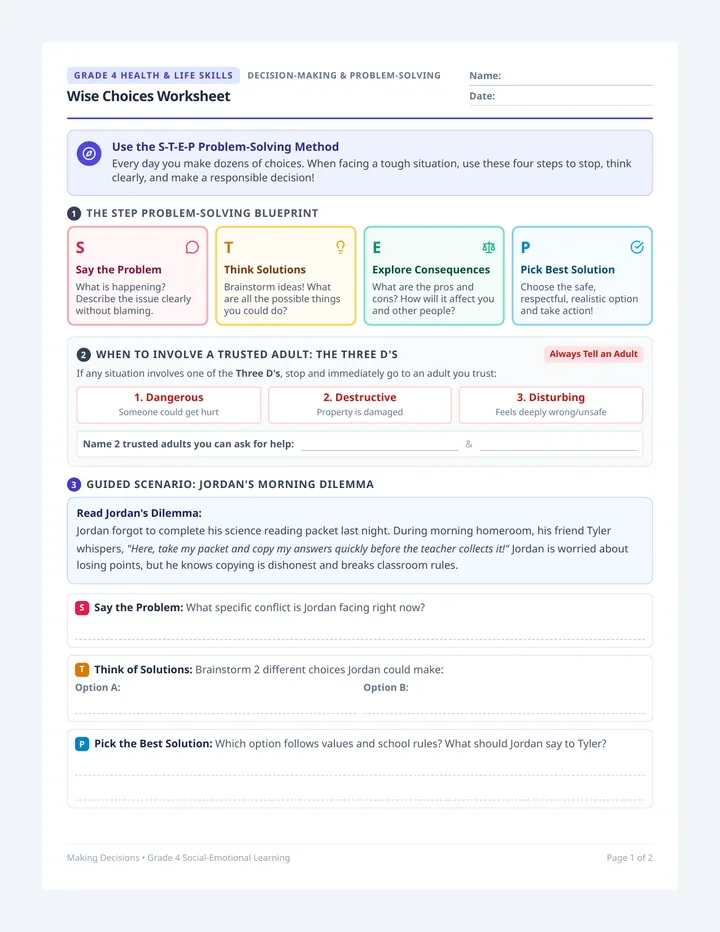
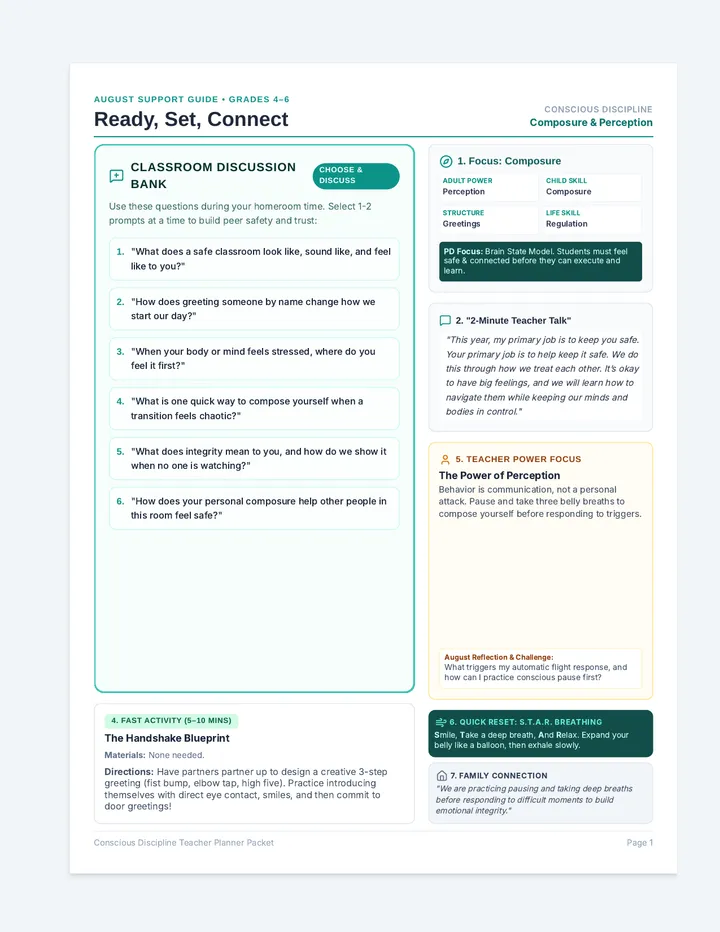
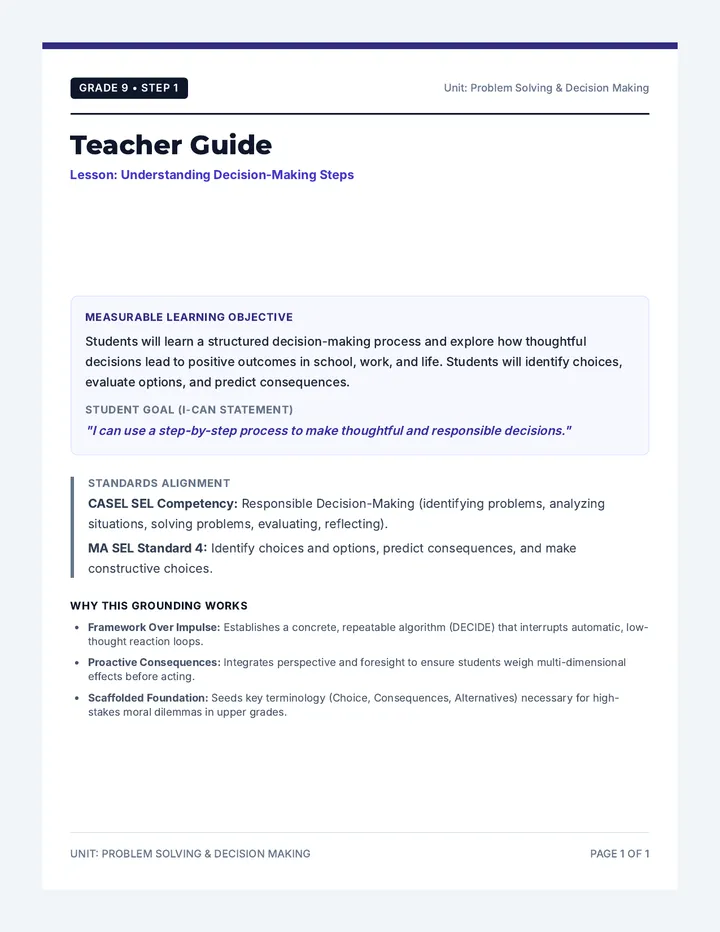
Root cause analysis and brainstorming techniques for everyday problem-solving. Equips learners with ethical frameworks and risk-benefit evaluation skills to predict consequences and make informed choices.
A comprehensive sequence for 9th-grade students exploring the legal definitions, impacts, and identification of sexual harassment and hostile work environments in the professional world. Students move from basic legal definitions to nuanced evaluations of intent versus impact and digital professional conduct.
This sequence provides 10th-grade students with a comprehensive understanding of federal anti-discrimination laws in the workplace, covering protected classes, major legislative acts, legal theories of discrimination, and practical compliance application.
A 5-lesson sequence for 7th grade students focusing on restorative practices, the difference between intent and impact, crafting genuine apologies, and the long-term process of rebuilding trust after conflict.
This sequence trains 9th-grade students to facilitate peer mediation. It covers the ethics of neutrality, the structural stages of a mediation session, summarizing complex issues into actionable agendas, and drafting sustainable, SMART agreements, culminating in a mock mediation certification.
A comprehensive high school unit on interest-based negotiation and formal mediation. Students move from understanding individual interests to facilitating multi-party resolutions using the Harvard Negotiation Project framework and professional mediation stages.
This sequence uses the FAST framework (DBT) to analyze professional social dynamics, helping undergraduate students identify and mitigate the erosion of self-respect in high-stakes environments like internships and early careers. Students progress from diagnostic analysis of professional failure scenarios to prescriptive intervention design.
A graduate-level inquiry into the role of quantitative metrics in admissions, exploring the technical mechanics of GPA recalculation and the ethical implications of standardized testing through an equity lens.
A comprehensive project-based sequence for graduate students focusing on the strategic curation and management of third-party application materials. Students learn to select recommenders, draft 'brag sheets', navigate ethical considerations like FERPA, and audit application packets for narrative consistency.
A graduate-level exploration of the admissions 'black box,' where students act as admissions officers to navigate the complexities of holistic review, institutional priorities, and systemic bias in post-secondary gatekeeping.
A project-based sequence for 6th graders to develop self-respect using FAST skills. Students explore personal values, digital authenticity, boundaries, and assertive communication to create a comprehensive 'Personal Code of Conduct' manifesto.
A 12th-grade sequence on FAST skills for self-respect, focusing on personal ethics, integrity in communication, and maintaining values in the face of external pressure and digital influence.
A comprehensive guide for graduate students on navigating the complexities of post-interview logistics, recruitment cycles, and managing multiple job offers with professional etiquette.
A Pre-K sequence focused on building self-esteem and positive experiences through mastery, growth mindset, and persistence. Students learn to navigate challenges and celebrate their own progress.
A 5-lesson unit for 3rd graders focused on building emotional resilience through habit formation. Students learn to audit their time, identify small 'micro-moments' of joy, and design balanced daily schedules that prioritize positive experiences.
This sequence introduces 3rd-grade students to identifying personal sources of joy and satisfaction. It guides them through recognizing physical emotional shifts, inventorying interests, exploring sensory joy, categorizing activities by energy levels, and creating a personalized 'menu' of coping strategies for emotional regulation.
A simulation-based sequence where 10th-grade students act as 'Student-Consultants' to master schedule management and adaptive resiliency. Students learn to handle 'Chaos Factors', negotiate deadlines, and manage energy levels to maintain balance amidst competing demands.
A comprehensive 5-lesson unit for 10th-grade students focusing on executive functioning skills to balance multiple commitments. Students learn time auditing, the Eisenhower Matrix, task batching, and weekly triage systems to develop a personalized priority protocol.
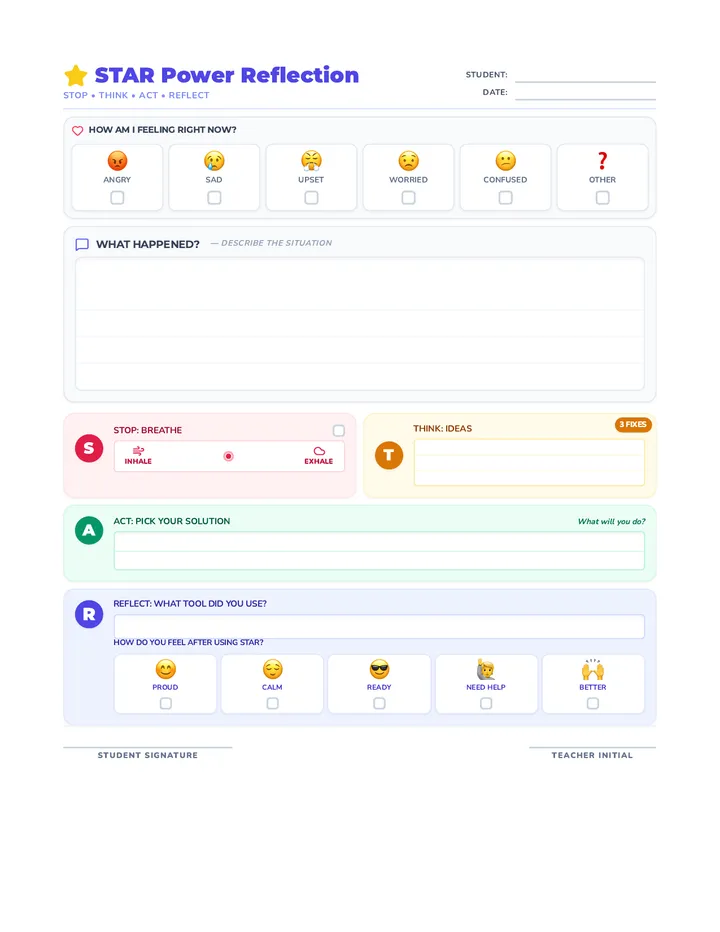
A Kindergarten sequence focused on teaching students a structured problem-solving routine (Stop, Think, Do) and applying it to multi-step challenges through games, sequencing activities, and a final detective project.
A Kindergarten sequence focused on teaching students how to use visual supports and environmental tools to solve problems independently. Students learn to use checklists, picture schedules, and reference charts to navigate obstacles in task completion.
A 5-lesson sequence for Kindergarten students focusing on cognitive flexibility. Students learn to transition from rigid thinking ('Rock Brain') to flexible thinking ('Rubber Band Brain') through structured play, creative problem-solving, and social role-playing.
A sequence for Kindergarten students focusing on self-advocacy and problem-solving. Students learn a graduated prompting hierarchy (Try Three Rule), identify appropriate helpers, use specific scripts to ask for help, and distinguish between being helped and being taught.
This sequence transforms students into 'Trap Detectives' who can identify and eliminate common distractors in academic tests. Students learn to spot extreme language, half-right traps, and out-of-scope answers through gamified lessons and role-reversal activities.
A comprehensive sequence for 9th-grade students focusing on self-advocacy, communication skills, and boundary setting to manage schedule conflicts and prevent burnout. Students learn to recognize stress signals, draft professional requests, negotiate deadlines, and prioritize tasks during crises.
This sequence empowers 2nd-grade students with self-advocacy skills to navigate obstacles. It moves from recognizing when help is needed to choosing the right helper and using specific, actionable language or non-verbal signals.
Synthesis of skills to create personal reframing guides, shifting from anxious spiraling to balanced, realistic internal narratives.
Exploration of perfectionism's role in undergraduate stress, utilizing the Pareto Principle to find balance in academic pursuits.
Application of Socratic questioning and evidence-based analysis to challenge and dismantle automatic negative thoughts (ANTs).
Deep dive into the Activating event, Belief, and Consequence (ABC) model to analyze the internal interpretations that trigger anxious responses.
Introduction to common cognitive distortions like filtering, polarization, and catastrophizing through interactive scenarios and a technical cheat sheet.
Students take a short assessment and immediately apply their error analysis protocol. They verify if their 'Watch Out' list helped them avoid previous habitual mistakes.
Students aggregate their error data to find personal patterns (e.g., 'I always miss inference questions' or 'I rush the last 5 minutes'). They create a personal 'Watch Out' list for future exams.
Instead of just marking correct answers, students must write a sentence explaining *why* their original answer was wrong and *why* the new answer is right. This ensures deep processing of the error.
Working in pairs, students vocalize their thinking process while solving a problem while a partner records their steps. They analyze these recordings to identify where their logic deviated from the correct path.
Students review a past assessment and categorize every incorrect answer as a 'Careless Error,' 'Content Gap,' or 'Strategy Failure.' This taxonomy helps them understand that not all mistakes are created equal.
A cumulative assessment where students produce a final 'Consultancy Report' prescribing a comprehensive organizational plan for a client or themselves.
In this capstone lesson, students synthesize their learning into a 'User Manual' for their own brain. They document personalized strategies for physical, digital, and temporal organization to build self-advocacy and long-term habits.
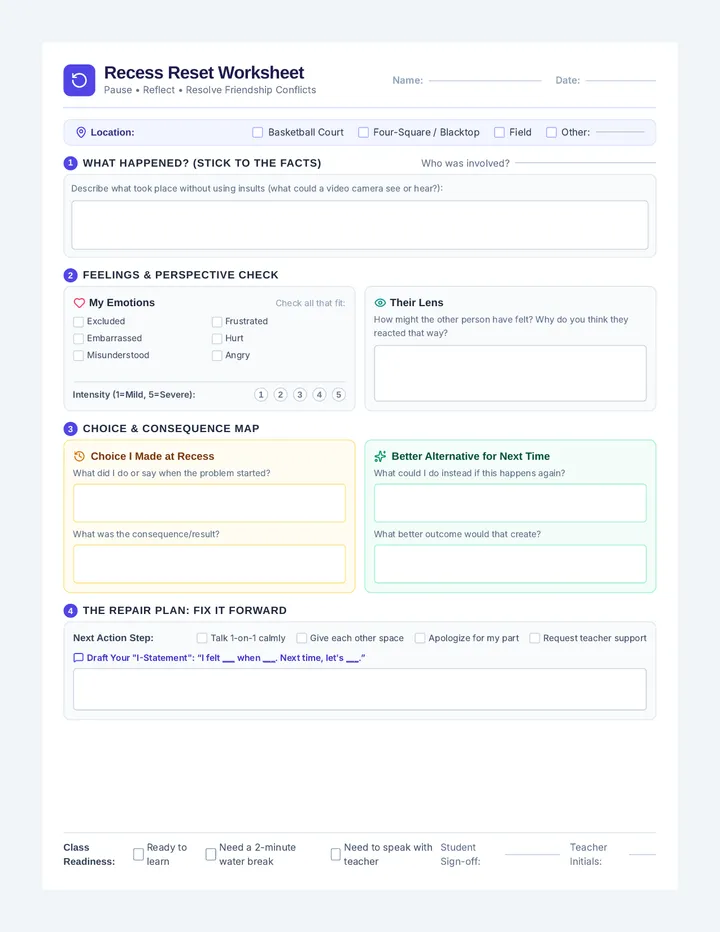
Students learn to use constructive 'I-statements' and collaborative problem-solving scripts to de-escalate and resolve minor conflicts with peers.
Students master conversational turn-taking by staying on topic, active listening, and practicing alternating conversation 'serves' and 'returns'.
Students learn to read emotional clues using facial expressions, body language, and situational contexts to understand how peers feel.
Students learn to set healthy boundaries, navigate peer pressure, and establish what authentic trust looks like in real-world friendships.
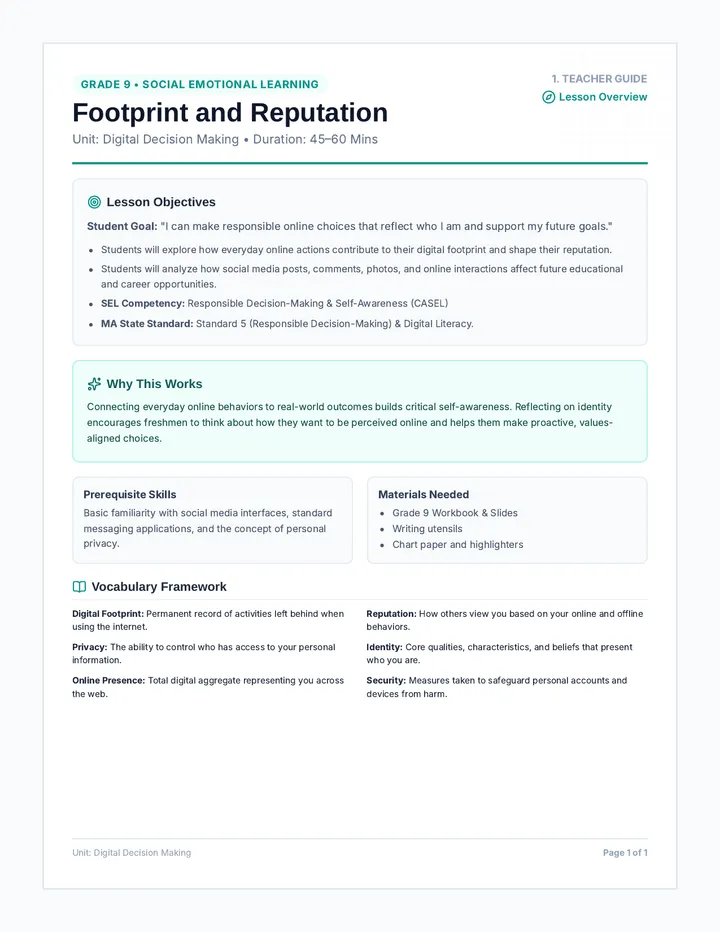
Students analyze their digital footprint, discuss modern social media pressures, and learn how to align their online actions with their offline values.
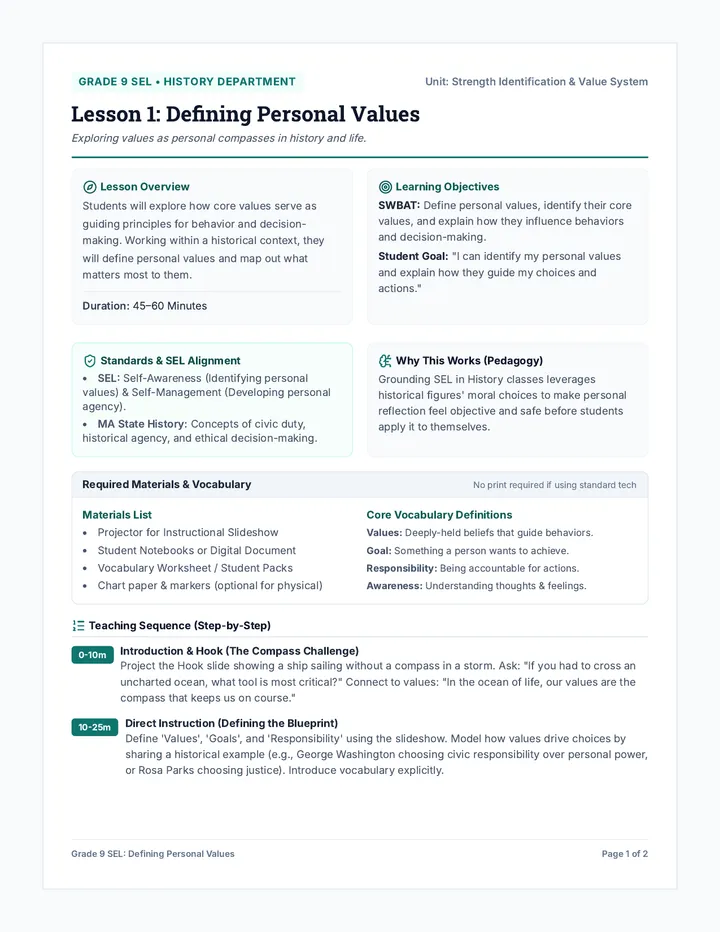
Students explore their personal identity, core values, and what healthy masculinity looks like in their daily lives.
An at-home extension lesson designed for the student to work on independently or with a family member tonight, focusing on practicing guitar techniques as emotional outlets and setting positive household commitments.
A transformative mentoring curriculum designed for a student transitioning to high school, using his passion for heavy metal and guitar to guide reflection on peer pressure, resist hate symbols, and channel his influence into positive leadership.
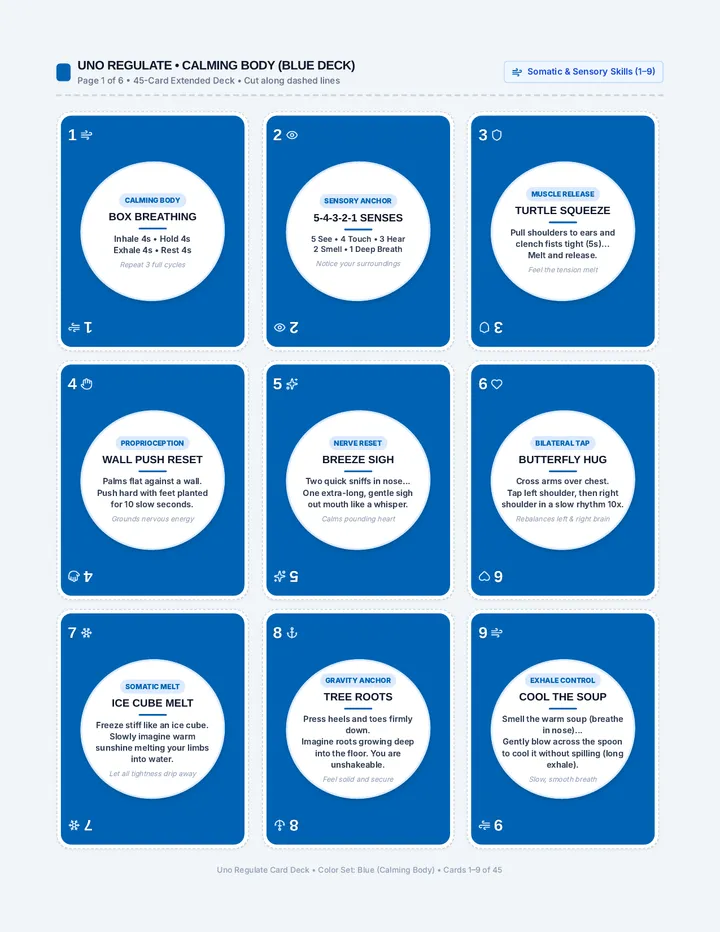
A hands-on, table-play counseling lesson for 3rd graders to master self-regulation by matching social-emotional problem scenarios to their appropriate problem size (Small, Medium, Big) and corresponding reaction size. Includes sorting mats, cut-out scenario/reaction cards, and a counselor facilitation guide.
A lesson designed to transition 3rd grade students to 4th grade technology responsibilities, focusing on restorative practices, digital citizenship, and the 'Make Kindness Your Superpower' initiative.
A counseling unit focused on helping 3rd graders identify the size of everyday problems and match them with appropriate emotional reactions.
A comprehensive, highly engaging lesson that translates the core principles of Atomic Habits into practical academic, executive functioning, and social strategies for 7th graders. Through interactive slides, concrete worksheets, and structured small-group discussions, students learn to design and track habits that lead to continuous improvement.
Focuses on creating a sustainable positive culture through daily small actions, prompting students to track their leadership and reflect on how positive behavior spreads. Features read-and-respond profiles of real student leaders.
Students explore what it means to be a 'shield' for peers in middle school rather than a passive bystander or an instigator. Features narrative read-and-respond case studies on standing up to social exclusion and rumors.
A restorative leadership module designed for a 5th-grade student transitioning to middle school. Focuses on channeling natural social influence into positive leadership, specifically protecting and looking out for others, rather than leading peers into conflict.
A restorative behavior intervention lesson designed for sixth-grade students in conflict, focusing on empathy, setting clear boundaries, and learning healthy reporting habits.
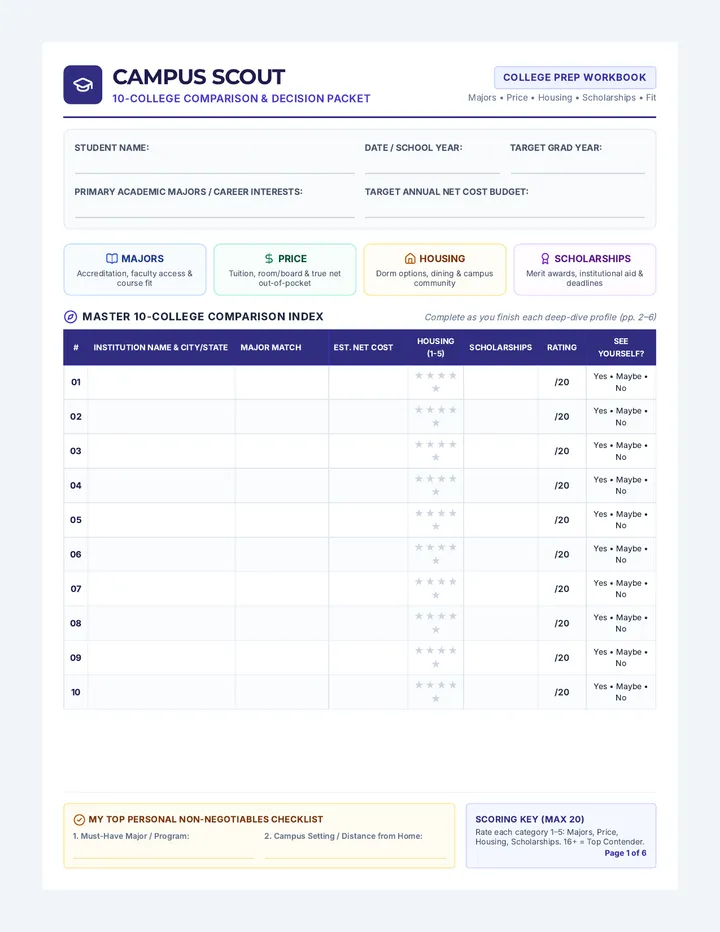
A highly engaging 1-page student playbook for Lesson 3: Line in the Sand. Helps students audit friendships, draft personalized peer-pressure refusal scripts, and declare their non-negotiable boundaries.
An interactive 6-slide presentation to guide Lesson 3: Line in the Sand. Covers establishing peer boundaries, identifying toxic friendship traits, and practicing refusal scripts.
A comprehensive 2-page facilitator guide for Lesson 3: Line in the Sand. Covers establishing peer boundaries, identifying toxic friendship traits, and practicing refusal scripts.
A highly engaging 1-page student journal for Lesson 2: Digital Armor. Helps students audit screen time, contrast their digital mask with their true self, and lock in daily device boundaries.
An interactive 6-slide presentation to guide Lesson 2: Digital Armor. Covers daily screen averages, the digital mask vs true identity, group chat dynamics, and lock-in habits.
A comprehensive 2-page facilitator guide for Lesson 2: Digital Armor. Covers managing social media validation, group chat dynamics, digital footprint awareness, and phone boundary-setting.
A highly engaging, themed 1-page personal reflection log for students to declare their core values, inventory personal strengths, and draft their personal commitment statement.
An interactive 6-slide presentation to guide the first group session, featuring bold discussion prompts, deconstructing social expectations, and setting up the core values activity.
A comprehensive 2-page facilitator guide for Lesson 1: Own Your Code. Includes group guidelines, pacing, step-by-step instructions, discussion prompts, and debrief questions.
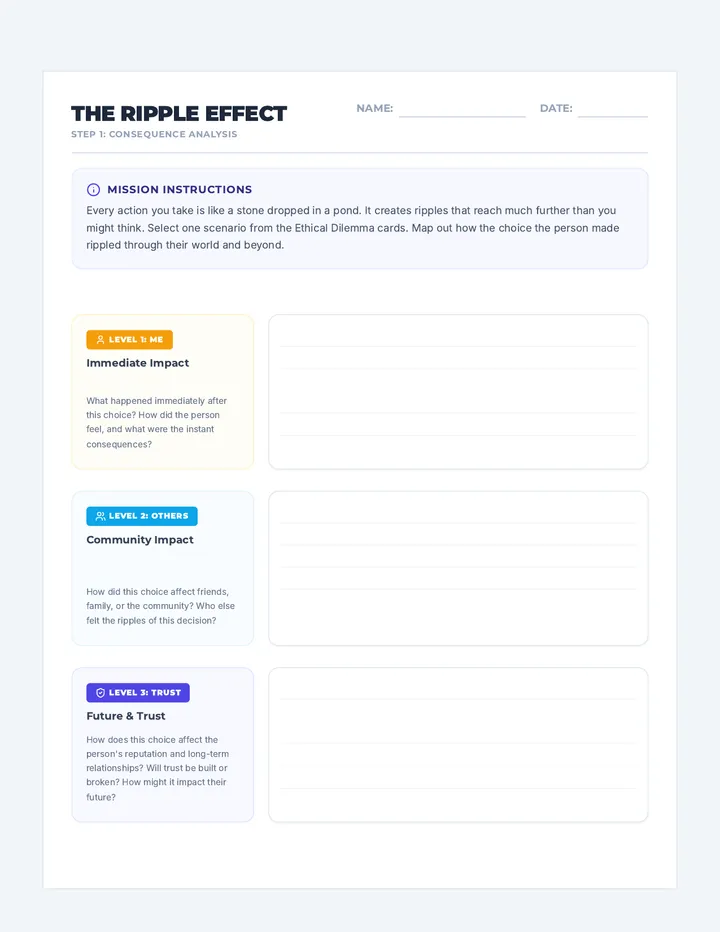
A 5-slide presentation matching the Ripple Effect lesson. It introduces students to the physics of school culture, walks through Maya's hallway story, and details the 5 leadership tracker actions.
A 2-page print-ready student-centered Read & Respond workbook detailing the physics of the ripple effect in school culture, featuring biographical vignettes of youth advocates and daily leadership tracking sheets.
A 5-slide presentation matching the Peer Shields lesson. It helps teachers guide a classroom debate on instigators vs. bystanders vs. shields, analyzing real-life lunchroom and digital chat situations.
Grading rubric and evaluation guide for teachers to assess the final "Reframing Guide" projects while maintaining student confidentiality.
Final project guide and template for students to create their personalized "Reframing Guide," applying CBT techniques to their three most recurring stressors.
Final synthesis presentation showing the shift from anxious narratives to balanced reframing, preparing students for their final project.
Discussion prompts on cards designed to spark dialogue about academic pressure, "Duck Syndrome," and the relationship between grades and self-worth.
The final instructional slide deck for Lesson 5, guiding students through synthesizing their research into a "Joy Menu" and practicing their new skills through role-play.
A worksheet for auditing academic effort using the Pareto Principle, helping students identify over-invested tasks and define "good enough" for better mental balance.
Facilitator guide for Lesson 5, outlining the instructional flow, discussion prompts, and key concepts for the maintenance contract and habit formation.
Visual presentation on the "Perfectionist Paradox," utilizing the Pareto Principle to discuss academic anxiety and the diminishing returns of perfectionist striving.
A student-facing restaurant-style menu template for synthesizing and illustrating personal mood-lifting activities and coping strategies.
A formal maintenance contract for students to commit to their regulation protocols, establishing maintenance schedules and accountability partners.
Final slide deck for Lesson 5, focusing on habit formation, maintenance schedules, and the commitment to protocol adherence.
A teacher guide for Lesson 5, focusing on synthesis of learned coping strategies into a personalized "Joy Menu" and providing instructions for role-play scenarios.