Launch Map PlanLaunch Map 10-Day SEL Scope & Sequence 9th Grade 10 Sessions × 60 Min Program Objective Provide a detailed 10-day SEL scope & sequence for 9th graders, aligning each session to a CASEL competency with daily objectives, activities, materials, assessments, and biweekly project checkpoints. A clear, day-by-day plan helps students build self-awareness, self-management, social awareness, relationship skills, and responsible decision-making as they transition to high school. Teacher Prep Review full 10-day scope Print/project all materials Arrange flexible seating Strategize project teams Days 1–5: Foundations 01 Day Self-Awareness: Strengths & Expectations Self-Awareness Introduce the 10-day plan. Students create a "Strengths Collage" illustrating personal strengths and high school expectations. Exit Ticket: one strength and one goal. Launch Poster 02 Day Self-Management: Stress Awareness Self-Management Explain stress triggers. Complete the Stress Map to identify stressors. Lead a guided breathing exercise. Journal entry on one new coping strategy. Stress Map 03 Day Social Awareness: Perspective-Taking Social Awareness Introduce empathy. In small groups, use "Walk-in-My-Shoes" cards to role-play scenarios. Debrief: How did it feel to see another's perspective? Empathy Cards 04 Day Relationship Skills: Active Listening Relationship Skills Teach active listening techniques. Run "Speed-Friending" with prompt cards. Practice paraphrasing and asking follow-up questions. Speed-Friending Cards 05 Day Responsible Decision-Making: Values & Project Kickoff Decision-Making Checkpoint 1: Team topic and draft plan outline due. Values Continuum activity. Form semester project teams. Distribute Planning Template. Submit initial team topics. Values Poster Project Template Days 6–10: Growth 06 Day Self-Awareness: Emotional Triggers Self-Awareness Review emotional trigger theory. Complete Emotion Wheel handout in journaling. Pair-share insights and coping strategies. Emotion Wheel 07 Day Self-Management: SMART Goal Planning Self-Management Teach SMART framework. Set personal and project goals using the worksheet. Peer review in dyads for clarity and achievability. SMART Worksheet 08 Day Social Awareness: Service Project Brainstorm Social Awareness Introduce community service concepts. In teams, use Brainstorming Sheet to generate ideas. Groups present 2-3 potential activities. Service Brainstorming 09 Day Relationship Skills: Conflict Resolution Relationship Skills Teach conflict resolution steps. Teams role-play using Conflict Scenarios cards. Discuss best practices and challenges as a class. Conflict Cards 10 Day Responsible Decision-Making: Reflection & Checkpoint Decision-Making Checkpoint 2: Updated project plan and reflection journal due. Finalize project plans. Groups share progress. Complete guided reflection journal on growth across all five competencies. Reflection Journal Assessment Strategy Daily Journals: Ongoing reflection on competency application. Project Checkpoints: Formative feedback on teamwork and planning. Observation: Skills checklists during role-plays and speed-friending. Project Integration The biweekly project is the core "real-life application" component. It transforms abstract SEL concepts (like conflict resolution and goal setting) into concrete actions within the school community.
Launch Overview SlidesHIGH SCHOOL LAUNCH A 10-day journey to build your skills, strengthen your community, and master your transition to 9th grade. Duration 10 Days Focus SEL Competencies Action Community Project DAILY FOCUS CASEL Competencies Self-Awareness Days 1 & 6 Self-Management Days 2 & 7 Social Awareness Days 3 & 8 Relationship Skills Days 4 & 9 Responsible Choices Days 5 & 10 PROJECT TIMELINE 05 Checkpoint 1: Kickoff • Form teams & choose your impact topic • Submit your draft plan outline 10 Checkpoint 2: Finalize • Update and submit your detailed plan • Reflect on your personal growth cycle MOMENTUM MATTERS Reference Daily Check off each day's focus together to see our progress across the competency wheel. Access Materials Handouts, activity cards, and templates are linked to each daily focus area. Let's Dive In! Everything starts with Day 1: Self-Awareness. Get ready to discover your strengths.
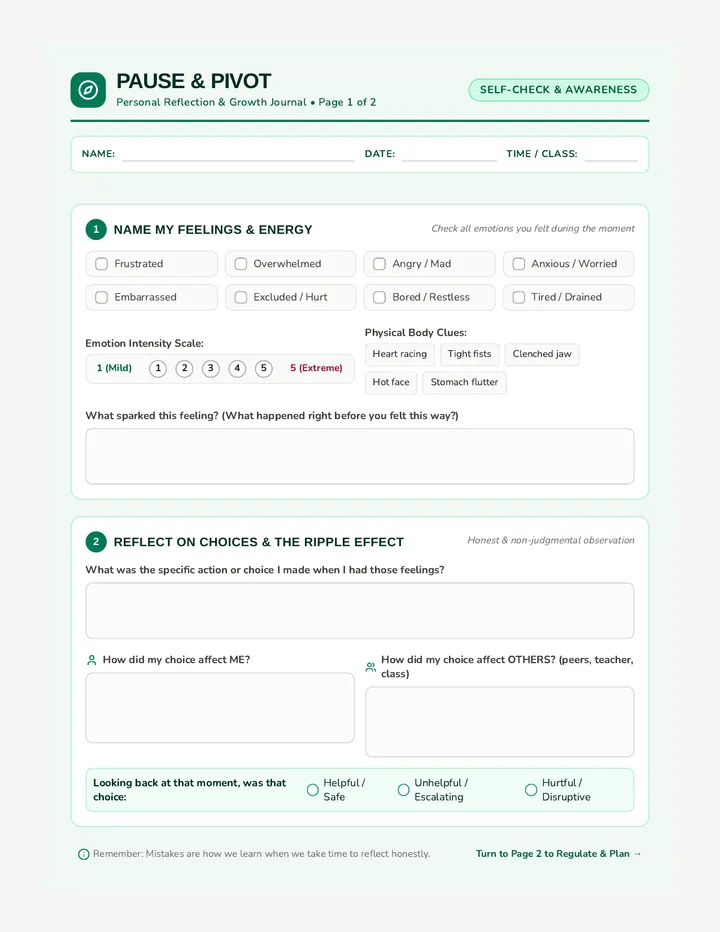
Stress Mapping WorksheetSelf-Management Cycle Stress Map Student Name: ____________________________________ Date: __________________ Objective: Identify your personal stress triggers and map how you respond physically, emotionally, and behaviorally. 1 The Trigger Describe a situation, event, or thought that often leads to feelings of stress for you. 3 Inside & Out A. Emotion(s) e.g., anxious, frustrated, sad B. Behavioral Response(s) e.g., avoidance, outbursts, withdrawal 4 Intensity Rating Rate how strongly you experience this stressor (1-5). 1 2 3 4 5 Explain your rating: 2 Physical Response Label or circle the areas of your body where you notice tension, pain, or other sensations when stressed. 5 Coping Strategies Brainstorm Strategy Plan for Implementation 6 Reflection Think about a recent time you dealt with this stress trigger. What worked? What will you do differently next time?
Empathy Scenario CardsPerspective Cards Walk-in-My-Shoes Empathy Activity Social Awareness Activity Goal Develop social awareness by stepping into someone else’s perspective and practicing empathic responses. Learn to identify feelings and needs in challenging social situations. Instructions Form Small Groups: Join 3–4 peers and arrange yourselves in a circle. Assign Roles: Person A (Scenario Speaker), Person B (Active Listener), and Observers. Role-Play: Speaker describes the situation. Listener uses "I hear you..." statements and asks clarifying questions. Debrief: Observers share notes on nonverbal cues and empathetic language used. Empathy Rubric Feeling Identification Correctly names the emotion behind the scenario. Reflective Listening Uses "It sounds like you feel..." or "I hear that..." Open Questions Asks "How did that happen?" or "What do you need?" Body Language Eye contact, nodding, and open posture. Scenario 01 New Student in Cafeteria "I just moved here and don’t know anyone. Lunch feels lonely. I see everyone in their groups and I don't know where to sit." Focus: Loneliness & Belonging Scenario 02 Stressed Friend "My heart races whenever I try to study for this bio test. I'm scared I'm going to fail and my parents will be so disappointed." Focus: Performance Anxiety Scenario 03 Sibling Frustration "My brother borrowed my favorite headset without asking and now one side doesn't work. He won't even apologize or admit it." Focus: Conflict & Boundaries Scenario 04 Team Project Pressure "My partner hasn't replied to my texts for three days. The project is due tomorrow and I feel like I'm going to end up doing it all." Focus: Responsibility & Stress
Speed-Friending Prompt CardsSpeed Friending Active Listening & Relationship Skills Relationship Skills The Mission Build relationship skills through quick, focused conversations. Practice Active Listening: staying present, showing interest, and responding thoughtfully. Protocol Setup: Sit facing a partner. Each pair gets one prompt card. Minute 1: Student A asks the question. Student B shares. Student A listens and nods. Minute 2: Student A asks a follow-up question. Student B responds. Rotate: When the buzzer sounds, move one seat to the right and swap cards. Listening Checklist Self or Peer Assessment Maintains eye contact / open posture Nods or uses vocal affirmations ("Mm-hmm") Asks a relevant follow-up question Summarizes what they heard correctly 01 Prompt What’s one hobby you’ve picked up recently and what made you interested in it? 02 Prompt Describe a movie or book that inspired you. What was the most impactful part? 03 Prompt What’s a personal goal you have for this school year? How can friends support you? 04 Prompt Tell me about a place you’d love to visit. What draws you to that location? 05 Prompt Who is someone you admire? What qualities do they have that you respect? 06 Prompt Share something that made you laugh recently. What happened?
Values Continuum SlidesVALUES CONTINUUM Where do you stand? Explore the values that guide your decisions and shape your character as you start this new chapter. Responsible Decision-Making THE SPECTRUM There are no "right" or "wrong" answers—only honest ones. Strongly Disagree Neutral Strongly Agree Your Task: As each statement is read, place yourself on the line. Be prepared to explain why you chose your position to your group. STATEMENTS Statement 01 “I believe honesty is the most important quality in a friendship.” Statement 02 “Helping others in my community matters to me more than personal gain.” Statement 03 “Academic success is the primary key to my future happiness.” Statement 04 “Taking risks and trying new things is worth the potential for failure.” REFLECT & CONNECT The Big Question Which value spoke to you most strongly? How might this shape your upcoming project? Action Item Think of one decision you’ll make this week that will be guided by your top value. Project Kickoff! Use your values to choose a mission that matters.
Project Planning TemplateSemester Impact Project Project Blueprint Team ID #_______ 1 Project Summary Project Title The Mission (What is the project about?) 2 Team Members & Roles Member 1 Name: Primary Responsibility: Member 2 Name: Primary Responsibility: Member 3 Name: Primary Responsibility: Member 4 Name: Primary Responsibility: 3 Project Objectives (SMART Goals) Specific • Measurable • Achievable • Relevant • Time-bound 1 2 3 4 Action Steps & Timeline #Action StepLead PersonDeadline01020304 5 Resources Needed 6 Potential Challenges Challenge / Solution Project Milestones Day 05 Checkpoint 01: Initial Pitch Submit your team topic and draft blueprint outline for teacher review. Team Progress Summary Teacher Initials: _______ Date: ______________ Day 10 Checkpoint 02: Launch Ready Finalize and submit your updated plan and team reflection journal. Final Next Steps & Adjustments Teacher Initials: _______ Date: ______________
Emotion Wheel HandoutSelf-Awareness: Triggers The Emotion Wheel Day 06 Navigation Objective: Identify and label a range of emotions to deepen self-awareness and recognize emotional triggers. Joy Surprise Anger Sadness Fear Disgust Instructions 1. Circle a primary emotion in the center of your wheel. 2. Follow the wedge outward to a more specific feeling. 3. Record your findings in Section 1 below. 1. Your Discovery Primary Emotion Specific Feeling 2. Triggers & Signals A. What triggered this? B. Physical Signals (Body Response) 3. Reflect & Plan How did you respond when you felt this emotion? Was it helpful or would you try something different next time? List one healthy strategy you could use if this emotion arises again. Describe how you would apply it. 4. Connection to Goals How might understanding this emotion and its trigger help you achieve one of your SMART goals or support your project team?
SMART Goals WorksheetSelf-Management: Goals SMART GOALS Day 07 Growth Objective: Learn to set Specific, Measurable, Achievable, Relevant, and Time-bound goals for personal growth and your team project. 1. What is a SMART Goal? S Specific M Measurable A Achievable R Relevant T Time-Bound 2. Personal SMART Goal Goal Statement Specific: Measurable: Achievable: Relevant: Time-Bound: 3. Project Team SMART Goal Team Goal Statement Specific: Measurable: Achievable: Relevant: Time-Bound: 4. Peer Review & Reflection Partner’s Feedback Is the goal clear? Is it actually achievable in 10 days? Your Reflection What will you adjust based on this feedback?
Service Brainstorming SheetSocial Awareness: Service Impact Ideas Project Team 1 Brainstorming Session List at least five possible service activities your team could undertake. Consider needs in your school or local community. 01 02 03 04 05 2 Initial Evaluation: Idea #1 Idea Title Community Need Addressed Who Will Benefit? Feasibility Rating (1-5) Potential Challenge & Solution 3 Select Top Two Projects Outline the specific details for your two most impactful and achievable ideas. Project A Title: _____________________ Purpose / Goal Initial Action Steps 1 2 Estimated Resources Project B Title: _____________________ Purpose / Goal Initial Action Steps 1 2 Estimated Resources 4. Team Decision Which of these two projects best aligns with your team’s goals and values? Why?
Conflict Scenario CardsConflict Resolve Relationship Skills & Decision-Making Relationship Skills The 5-Step Model 1 Calm Down Breathe, lower your tone, and center yourself. 2 Define the Problem Use "I" statements to share your perspective. 3 Brainstorm Solutions List 3+ ideas without judging them yet. 4 Agree on a Plan Find a compromise that meets top needs. 5 Reflect & Follow Up Check in later: Did the solution work? Role-Play Protocol • Group: Form pairs or triads. • Roles: Person A, Person B, and Observer. • Action: Work through the 5 steps for your assigned scenario. Aim for a specific, shared agreement. • Review: Observer provides feedback using the checklist below. Rubric Checklist Used "I" statements effectively Maintained a calm, respectful tone Brainstormed multiple solutions Reached a clear compromise Card 01 Group Project Stall "My partner never completes their share on time, and the deadline is tomorrow. I feel stuck doing all the work, but they say they've been busy with sports." Key Challenge: Accountability Card 02 Friendship Fallout "I told my friend a secret about my crush, and now I heard other people in the hall whispering about it. My friend says it was an accident." Key Challenge: Trust Card 03 Classroom Disagreement "Two classmates are arguing loudly over which strategy to use for a team review game. The teacher says if they don't resolve it, the whole team sits out." Key Challenge: Teamwork Card 04 Lunchroom Tension "Someone you don't know well is sitting in the seat your group has used all year. When you ask them to move, they say 'First come, first served.'" Key Challenge: Social Space
Reflection Journal HandoutGrowth Journal 10-Day SEL Launch Log Name: ____________________________________ Advisor: __________________________________ 01 Self-Awareness: Strengths What personal strength did you recognize today, and how might it support your transition to high school? 02 Self-Management: Stress Describe one stress trigger you identified and a coping strategy you plan to practice this week. 03 Social Awareness: Empathy What perspective did you step into during the role-play, and how did that shift your understanding? 04 Relationship Skills: Listening Reflect on a moment when you felt truly listened to today. What made that exchange effective? 05 Decision-Making: Values Which value on the continuum resonated most with you today, and how might it guide your team’s choices? 06 Self-Awareness: Triggers Identify an emotional trigger you discovered on the Wheel. How will you respond differently next time? 07 Self-Management: Goals What SMART goal did you set? Why is it meaningful and how will you measure your progress? 08 Social Awareness: Service Which community service idea inspired you most, and what impact do you hope your project will have? 09 Relationship Skills: Conflict Describe a conflict you role-played and which resolution step you found most helpful. Why? 10 Decision-Making: Reflect Summarize your team’s project progress and one decision you made that reflects your values. Semester Launch Review Looking back on the 10-day launch, summarize your growth in each of the five CASEL competencies. How will you apply these skills in future challenges and projects?