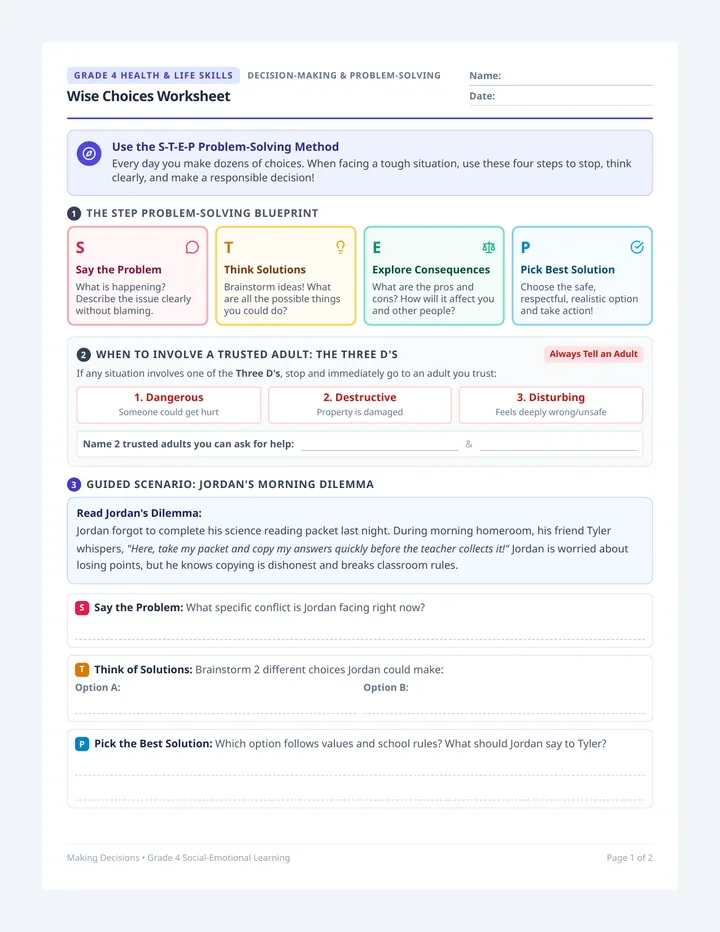
Techniques for generating diverse options and evaluating potential outcomes during problem-solving. Strengthens divergent thinking to identify multiple paths before selecting a final course of action.
A Pre-K sequence focused on building self-esteem and positive experiences through mastery, growth mindset, and persistence. Students learn to navigate challenges and celebrate their own progress.
A 5-lesson unit for 3rd graders focused on building emotional resilience through habit formation. Students learn to audit their time, identify small 'micro-moments' of joy, and design balanced daily schedules that prioritize positive experiences.
This sequence introduces 3rd-grade students to identifying personal sources of joy and satisfaction. It guides them through recognizing physical emotional shifts, inventorying interests, exploring sensory joy, categorizing activities by energy levels, and creating a personalized 'menu' of coping strategies for emotional regulation.
A simulation-based sequence where 10th-grade students act as 'Student-Consultants' to master schedule management and adaptive resiliency. Students learn to handle 'Chaos Factors', negotiate deadlines, and manage energy levels to maintain balance amidst competing demands.
A comprehensive 5-lesson unit for 10th-grade students focusing on executive functioning skills to balance multiple commitments. Students learn time auditing, the Eisenhower Matrix, task batching, and weekly triage systems to develop a personalized priority protocol.
A Kindergarten sequence focused on teaching students a structured problem-solving routine (Stop, Think, Do) and applying it to multi-step challenges through games, sequencing activities, and a final detective project.
A Kindergarten sequence focused on teaching students how to use visual supports and environmental tools to solve problems independently. Students learn to use checklists, picture schedules, and reference charts to navigate obstacles in task completion.
A 5-lesson sequence for Kindergarten students focusing on cognitive flexibility. Students learn to transition from rigid thinking ('Rock Brain') to flexible thinking ('Rubber Band Brain') through structured play, creative problem-solving, and social role-playing.
A sequence for Kindergarten students focusing on self-advocacy and problem-solving. Students learn a graduated prompting hierarchy (Try Three Rule), identify appropriate helpers, use specific scripts to ask for help, and distinguish between being helped and being taught.
This sequence transforms students into 'Trap Detectives' who can identify and eliminate common distractors in academic tests. Students learn to spot extreme language, half-right traps, and out-of-scope answers through gamified lessons and role-reversal activities.
A comprehensive sequence for 9th-grade students focusing on self-advocacy, communication skills, and boundary setting to manage schedule conflicts and prevent burnout. Students learn to recognize stress signals, draft professional requests, negotiate deadlines, and prioritize tasks during crises.
This sequence empowers 2nd-grade students with self-advocacy skills to navigate obstacles. It moves from recognizing when help is needed to choosing the right helper and using specific, actionable language or non-verbal signals.
Reflecting on achievements and celebrating the internal feeling of pride through a classroom showcase.
Empowering students to share their mastered skills with peers, building leadership and reinforcing their own learning.
Learning emotional regulation tools and positive self-talk to manage frustration when learning something new.
Focusing on persistence and tracking small improvements through repeated practice of simple skills.
Introduction to the growth mindset using the word 'yet' to transform frustrations into future goals.
Students reflect on their routine changes and practice 'flexible thinking' for when plans go awry, building resilience and adaptability.
Students create personal trackers to monitor their consistency in engaging with positive habits, learning the power of 'streaks' and self-monitoring.
Students design a balanced afternoon routine using 'Grandma's Rule' to sequence chores and rewards, creating a sustainable and motivating schedule.
Students explore the concept of 'micro-moments' of joy and learn that frequency of positive experiences is more important than intensity for building long-term happiness.
Students audit their current daily schedules to distinguish between 'must-do' tasks and 'choose-to-do' activities, identifying gaps where positive experiences can be added.
Students synthesize their findings to create a personalized, illustrated menu of 'Go-To' activities and role-play scenarios where they might order from their menu.
Students organize activities into categories based on energy levels: 'High Energy' for releasing frustration and 'Low Energy' for calming anxiety. They learn to strategically select activities based on current emotional needs.
The final instructional slide deck for Lesson 5, guiding students through synthesizing their research into a "Joy Menu" and practicing their new skills through role-play.
A decorative cover for the student's final 'Star Power' portfolio, featuring space for a self-portrait and recognition of their growth mindset journey.
A student-facing restaurant-style menu template for synthesizing and illustrating personal mood-lifting activities and coping strategies.
Comprehensive teacher guide for the final celebration lesson, outlining the 'Soapbox of Pride' activity, gallery walk facilitation, and portfolio assembly.
Colorful slides for the final lesson celebration, focusing on internal pride, self-reflection, and the ongoing journey of growth for Pre-K students.
A teacher guide for Lesson 5, focusing on synthesis of learned coping strategies into a personalized "Joy Menu" and providing instructions for role-play scenarios.
Printable medals for Pre-K students to color and wear, celebrating their achievements as 'Little Leaders' and 'Kind Teachers'.
A student worksheet for sorting personal joy activities into High Energy (Drain) and Low Energy (Fill) categories for strategic emotional regulation.
A teacher implementation guide for the Strategic Prioritization sequence. Includes an instructional arc, facilitation tips, common misconceptions, Special Education accommodation strategies, and answer keys.
Facilitation guide for Lesson 4, teaching Pre-K students how to engage in peer-to-peer coaching and leadership through skill sharing.
An instructional slide deck for Lesson 4 that teaches students how to strategically match activities to their current emotional energy levels.
A comprehensive teacher guide for the Joy Architect sequence, outlining the instructional arc, key concepts for each lesson, and the core skills developed.