Traffic Light Teacher Guide Traffic Light Tactics
Teacher Facilitation Guide
Lesson Overview
This lesson introduces the "Stop-Think-Do" routine using a familiar traffic light metaphor. Students learn to inhibit impulsive reactions (Stop), brainstorm possibilities (Think), and execute a chosen solution (Do).
Red: Stop Yellow: Think Green: Do
Objectives
Identify traffic light colors with steps.
Practice deep breathing (Stop).
Identify 1 solution (Think).
The Hook: Red Light, Yellow Light, Green Light
The Setup:
Clear a space for movement. Have physical color markers (red/yellow/green cards) or use the slide deck.
RED LIGHT
Freeze! Take 3 deep belly breaths.
YELLOW LIGHT
Wiggle in place and shout a solution to: "I can't find my shoe!"
GREEN LIGHT
Hop or skip toward the finish line!
Discussion & Guidance
Step 1: STOP
"Why do we stop when something goes wrong?"
Guidance: Explain that stopping keeps our bodies safe and our brains calm so we can think better.
Step 2: THINK
"What are some things we can do if we lose our crayon?"
Guidance: Encourage multiple ideas. No idea is a 'bad' idea in the thinking phase.
Step 3: DO
"How do we know which plan is the best one to try?"
Guidance: Focus on the easiest, safest, or fastest choice to try first.
Supporting Every Learner
For High Support Needs:
Use physical hand-over-hand breathing cues. Provide 2 picture choices for "Think" phase rather than open-ended brainstorming.
For Advanced Learners:
Challenge them to think of two DIFFERENT solutions before moving to Green Light. Ask "Why did you choose that plan?"
Traffic Light Slides Traffic Light Tactics
Master the Stop-Think-Do Routine!
What is a Problem?
🧱
A problem is like a roadblock in our way.
🤔
It's something that makes us feel stuck or frustrated.
RED: STOP
Take a breath. Calm your body.
✋
Hands to yourself.
🌬️
3 Big Breaths.
YELLOW: THINK
What can I do? brainstorm ideas!
🙋♂️
Ask for help.
🤝
Trade a toy.
🚪
Try another way.
GREEN: DO
Pick your best plan and try it!
"I am a problem solver! I can do it!"
Your Turn!
Scenario: You are building a tower of blocks, and it falls down! 🏢💥
Stop
Think
Do
Traffic Light Routine Worksheet Name:
Date:
Traffic Light Tactics
Routine Practice
Color the Routine
Color Red
STOP
Breathe & Calm
Color Yellow
THINK
Brainstorm Plans
Color Green
DO
Try Your Best
What happens when?
"I can ask a teacher for help."
Circle the light color
"I take 3 slow belly breaths."
Circle the light color
I am a calm and smart problem solver!
Solution Steps Teacher Guide Solution Steps
Teacher Facilitation Guide
Lesson Overview
This lesson shifts from the traffic light routine to the logic of sequencing . Students learn that solving a problem happens in a specific order: Problem → Plan → Solution.
1. Problem 2. Plan 3. Fixed!
Objectives
Identify cause and effect in a problem.
Sequence 3 picture cards correctly.
Use "First, Then, Last" language.
The Hook: The Backward Story
Teacher Script:
"Listen to my story and tell me if it sounds right: 'I ate a delicious apple. Then I washed it. Then I picked it from the tree.' ... Wait, does that make sense? No! Let's fix it."
Ask students to help you put the events in the right order. Explain that problem solving is the same—we have to follow the steps in order for it to work.
Sequencing Activity
1
Identify the Mess (Problem)
Give students the 'Messy' card. Ask: "What happened here? How do they feel?"
2
Choose the Tool (Plan)
Give students the 'Tool' card. Ask: "What can we use to fix this mess?"
3
See the Shine (Fixed)
Give students the 'Clean' card. Ask: "What does it look like now that we solved it?"
Deep Thinking Questions
The "Why" Question:
"What happens if we try to fix the problem before we know what it is?"
The "Order" Question:
"Can we have a clean room before we use our cleaning plan? Why not?"
Solution Steps Activity Sheet Name:
Date:
Solution Steps
Sequence Activity
How to Solve:
What happens first, next, and last? Write the numbers 1, 2, and 3 in the circles.
A The Spilled Water
✨
The floor is dry
?
💧
A big spill!
?
🧻
Get a paper towel
?
B The Broken Crayon
🩹
Tape the pieces
?
🖍️
Ready to color
?
💔
Snapped in half!
?
My Solution Squad Rule:
Problem Plan Fixed!
Solution Steps Slides Solution Steps
Putting our plans in order!
1
2
3
Does this sound right?
1
I ate a delicious apple. 🍎
2
Then I washed it. 🚰
3
Then I picked it from the tree. 🌳
WAIT! STOP!
Problem Solving Order
❗
First
The Problem
🛠️
Next
The Plan
✨
Last
Fixed It!
Can you fix this one?
🥣
I pick a snack
😋
My tummy is full
😫
I am hungry
Where is #1? Where is #2? Where is #3?
What Comes Next Teacher Guide What Comes Next
Teacher Facilitation Guide
Lesson Overview
This lesson focuses on Future Thinking . Before picking a solution, students practice predicting the result. We use "If-Then" thinking to decide if a plan is safe and helpful.
"If I do this..." "...then this happens."
Objectives
Predict one outcome for a choice.
Identify "safe" vs "unsafe" plans.
Use conditional language (If/Then).
The Hook: The Oops! Pause
Scenario to Act Out:
Hold a full cup of water tilted over a plant. Stop right before it spills. Ask: "If I tip this cup, what will happen next?"
Extension: "If I pour it on the carpet, what happens? If I pour it on the plant, what happens?" Show that different choices have different results.
Conditional Storytelling
Scenario: "I want a turn on the swing."
Choice A: Push the person off. → Then someone gets hurt and I get in trouble.
Choice B: Ask and wait. → Then I get a turn when they are done.
Scenario: "My shoe is untied."
Choice A: Keep running. → Then I might trip and fall.
Choice B: Stop and ask for help tying. → Then my feet are safe.
The Safety Check
Always ask students: "Is it safe? Is it kind? Does it fix the problem?" If the answer to any is "No", then the solution is an "Oops Choice" and we need a new "Yellow Light" idea.
Word of the Day
CONSEQUENCE
What happens after we make a choice.
Best Practice
VISUALS
Use the slide deck to show the split paths of choices.
What Comes Next Activity Sheet Detective Name:
Date:
What Comes Next?
Predict the Result!
IF I... THEN...
Path A
IF I...
Leave my toys all over the floor...
👟💥
Someone might trip
🏆
I win a trophy
Circle the result that makes sense!
Path B
IF I...
Ask my friend to trade blocks nicely...
😭
Everyone gets sad
🤝
We share and play
Circle the result that makes sense!
Is your plan safe and kind?
👍
Yes
👎
No
What Comes Next Slides What Comes Next?
Thinking Ahead to Solve Problems!
The Magic Words
IF I...
Pick a choice
THEN...
This happens next!
The Oops! Pause
[Video Placeholder: A messy choice]
Wait! Stop the video!
"If they drop the juice box, what will happen next?"
Messy Sad Sticky
Which Path?
A
I grab the toy
"Then my friend gets sad and cries." 😭
B
I ask to share
"Then we both play together!" 🤝
The Solution Test
Before we do it, ask...
IS IT SAFE?
IS IT KIND?
Fix the Glitch Teacher Guide Fix the Glitch
Teacher Facilitation Guide
Lesson Overview
This lesson introduces Error Analysis (Debugging). Students learn that sometimes a plan doesn't work because of a "glitch"—a small mistake in the steps. We practice finding and fixing these glitches.
Detect the Glitch Repair the Step
Objectives
Identify a mistake in a 3-step sequence.
Propose a replacement step (the "fix").
Follow literal instructions.
The Hook: Program Your Teacher (Sandwich Edition)
The Challenge:
Tell the teacher how to make a jelly sandwich. The teacher acts like a robot and follows instructions exactly as said.
Instruction Glitch
"Put the jelly on the bread."
(Teacher puts the whole jar on the bread.)
The Repair
"Open the lid. Use a spoon to scoop jelly."
(Teacher follows the fixed step.)
The Repair Manual
1
WATCH: Follow the steps and see where it breaks.
2
STOP: When you see the "Oops," shout "GLITCH!"
3
FIX: Change just that one step to make it work.
Facilitation Tips
For Students Who Struggle:
Use physical manipulatives (e.g., actual bread/jelly) to make the error visible. Focus on one glitch at a time.
For Early Finishers:
Challenge them to intentionally "glitch" a 3-step sequence for a friend to fix. (e.g., washing hands but putting soap on after drying).
Fix the Glitch Activity Sheet Glitch Fixer:
Date:
Fix the Glitch!
Find the Error & Repair It
System Scan:
One step in each plan is a GLITCH! Circle the glitch step, then draw the right step in the box.
Task: Washing Hands
🧼
1. Get Soap
🧣
2. Wear a Scarf
🚰
3. Rinse
Draw the
Fix here
New Step 2
Task: Coloring
📄
1. Get Paper
🖍️
2. Pick Crayon
💤
3. Go to Sleep
Draw the
Fix here
New Step 3
GLITCH FIXED! MISSION COMPLETE!
Fix the Glitch Slides Fix the Glitch
Finding Mistakes and Making Repairs!
System Error!
👾
A GLITCH is a mistake in the plan.
🛠️
When we find it, we can FIX IT!
Game: Program Your Teacher
Instruction:
"Teacher, put on your shoes!"
The Glitch
Teacher puts shoes on their hands!
The Fix
"Put them on your feet!"
Find the Glitch!
STEP 1
🎨
Dip brush in paint
STEP 2
🥣
Paint on your soup
GLITCH!
STEP 3
🚰
Wash the brush
How do we fix Step 2?
I am a Glitch Fixer!
"When a plan doesn't work, I don't give up. I find the glitch and try again!"
Watch
Find
Fix
Detective Squad Project Guide Detective Squad
Culminating Project Guide
The Grand Mission
Students apply the full Stop-Think-Do routine to a real-world problem in the classroom. This project moves from guided practice to independent application, building mastery and community responsibility.
Find Plan Fix Report
Supplies
Detective Badges (provided)
Magnifying glasses (optional)
Case File worksheets
Markers/Clipboards
The Hook: Induction Ceremony
Gather students in a circle. Explain that they are no longer just students—they are the Solution Squad Detectives . Hand out the badges and magnifying glasses.
The Detective's Oath:
"I promise to STOP and breathe, THINK of a plan, and DO my best to fix it!"
Project Phases
1
The Search (Stop)
"Detectives, search the room for a 'glitch'. Is something messy? Is a marker dry? Is a chair not pushed in?"
2
The Case File (Think)
"Draw your problem on the Case File. What is your plan to fix it? Write or draw your steps."
3
Execution (Do)
"Go solve it! Use your tools and your team. Once it's fixed, check off the 'Case Closed' box."
Case Briefing (Debrief)
Have students sit in the "Squad Room" (meeting rug) and present their Case Files.
Presentation Prompt:
"I found a ____. My plan was to ____. Now the problem is ____!"
Peer Feedback:
Class shouts: "CASE CLOSED!" and performs a special squad salute or clap.
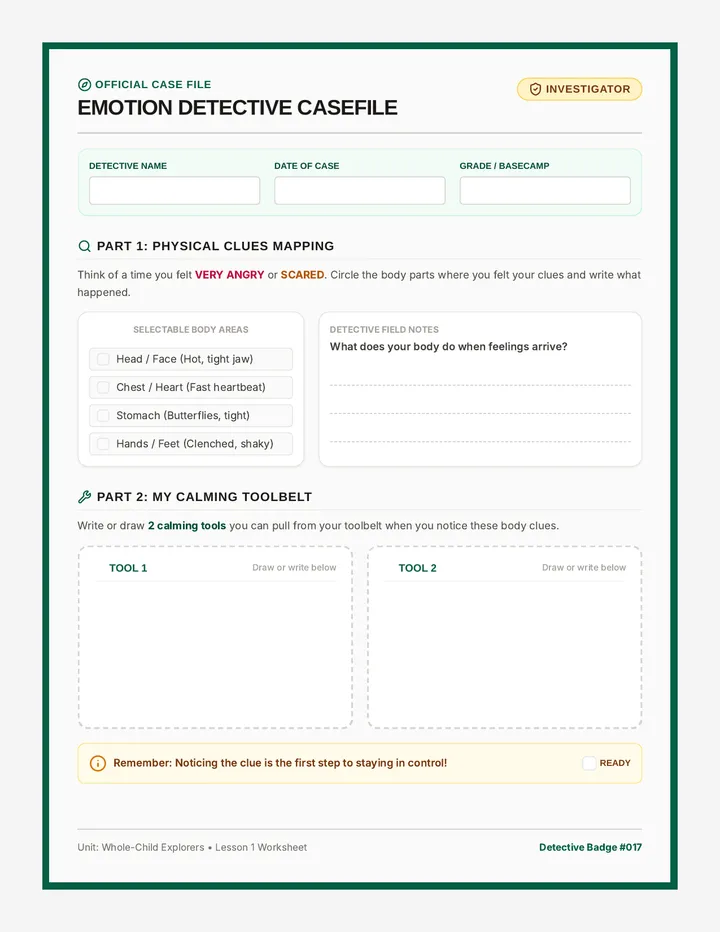
Detective Squad Case File Squad Case File
OFFICIAL SOLUTION SQUAD REPORT
No. ________
Lead Detective:
Date:
1
The Discovery (STOP)
Draw the problem you found in the classroom:
2
The Plan (THINK)
What tool do I need?
Who can help me?
3
The Solution (DO)
Case Closed!
Reward Earned:
Solution Squad Internal Use Only • Confidential Report
Detective Badges Handout Detective Badges
Solution Squad Official Gear
Teacher Instructions:
Print on heavy cardstock for durability.
Students write their names on the white line.
Cut along the solid black lines.
Laminate and attach to a clip or lanyard.
Lead Detective
Squad Name:
Stop • Think • Do
Lead Detective
Squad Name:
Stop • Think • Do
Lead Detective
Squad Name:
Stop • Think • Do
Lead Detective
Squad Name:
Stop • Think • Do
Detective Squad Slides Top Secret Mission
Detective Squad
Official Project Briefing
The Detective's Oath
"I promise to STOP and breathe,"
"THINK of a plan,"
"and DO my best to fix it!"
Squad Induction: Complete
The Assignment
🔍
Find one GLITCH in our classroom.
📁
Fill out your CASE FILE report.
Closing the Case
When you are finished, report to the rug:
"I found a ____.
My plan was to ____.
Now the problem is FIXED!"
🏃♂️💨
GO!
Detective Squad: Deploy!