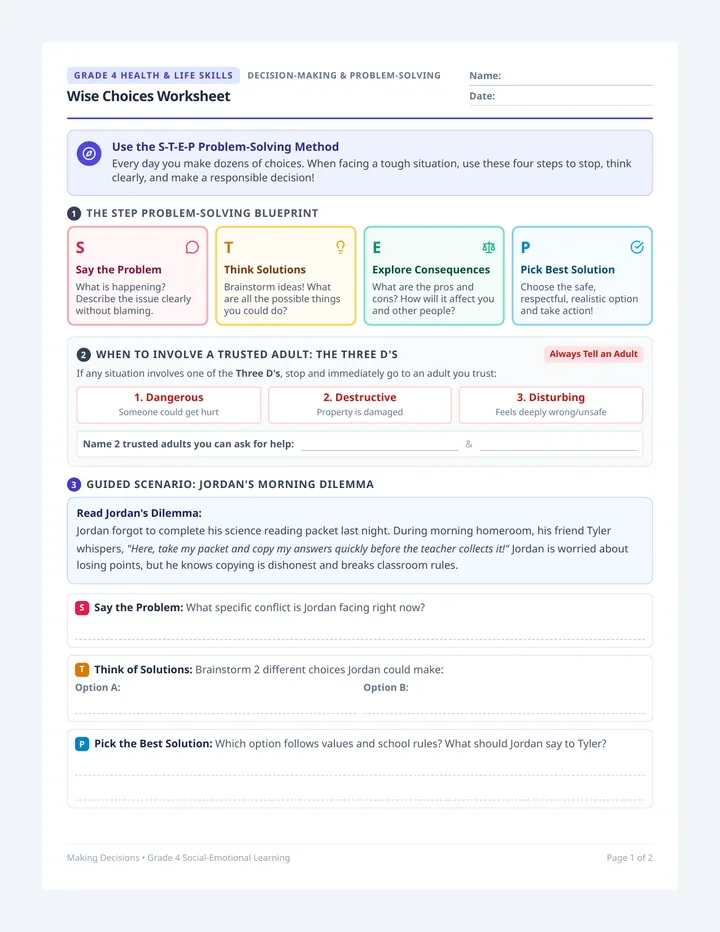
Systematic analysis of positive and negative outcomes for potential actions. Strengthens judgment by comparing short-term gains against long-term consequences.
Synthesis of skills to create personal reframing guides, shifting from anxious spiraling to balanced, realistic internal narratives.
Exploration of perfectionism's role in undergraduate stress, utilizing the Pareto Principle to find balance in academic pursuits.
Application of Socratic questioning and evidence-based analysis to challenge and dismantle automatic negative thoughts (ANTs).
Deep dive into the Activating event, Belief, and Consequence (ABC) model to analyze the internal interpretations that trigger anxious responses.
Introduction to common cognitive distortions like filtering, polarization, and catastrophizing through interactive scenarios and a technical cheat sheet.
Students reflect on their routine changes and practice 'flexible thinking' for when plans go awry, building resilience and adaptability.
Students create personal trackers to monitor their consistency in engaging with positive habits, learning the power of 'streaks' and self-monitoring.
Students design a balanced afternoon routine using 'Grandma's Rule' to sequence chores and rewards, creating a sustainable and motivating schedule.
Students explore the concept of 'micro-moments' of joy and learn that frequency of positive experiences is more important than intensity for building long-term happiness.
Students audit their current daily schedules to distinguish between 'must-do' tasks and 'choose-to-do' activities, identifying gaps where positive experiences can be added.
Students synthesize their findings to create a personalized, illustrated menu of 'Go-To' activities and role-play scenarios where they might order from their menu.
Students organize activities into categories based on energy levels: 'High Energy' for releasing frustration and 'Low Energy' for calming anxiety. They learn to strategically select activities based on current emotional needs.
A comprehensive workshop-style sequence for undergraduate students to master cognitive reframing techniques. Students progress from identifying distortions to deconstructing beliefs and building resilient internal narratives.
A 5-lesson unit for 3rd graders focused on building emotional resilience through habit formation. Students learn to audit their time, identify small 'micro-moments' of joy, and design balanced daily schedules that prioritize positive experiences.
This sequence introduces 3rd-grade students to identifying personal sources of joy and satisfaction. It guides them through recognizing physical emotional shifts, inventorying interests, exploring sensory joy, categorizing activities by energy levels, and creating a personalized 'menu' of coping strategies for emotional regulation.
A mastery-focused sequence where undergraduate students audit their current stress responses and design a personalized, tiered emotional regulation protocol. Students use systems thinking to build resilient habits and prepare for future distress.
A 5-lesson sequence for 10th-grade students focusing on project management skills like backward design, task deconstruction, and time estimation to balance multiple commitments.
A simulation-based sequence where 10th-grade students act as 'Student-Consultants' to master schedule management and adaptive resiliency. Students learn to handle 'Chaos Factors', negotiate deadlines, and manage energy levels to maintain balance amidst competing demands.
A comprehensive 5-lesson unit for 10th-grade students focusing on executive functioning skills to balance multiple commitments. Students learn time auditing, the Eisenhower Matrix, task batching, and weekly triage systems to develop a personalized priority protocol.
A comprehensive graduate-level sequence focused on the psychological and logistical aspects of high-stakes testing, including time management, anxiety reduction, and strategic decision-making.
A sequence for 3rd Grade ESL students focused on developing executive functioning skills for timed testing. Students learn time perception, prioritization strategies, and review techniques to manage anxiety and improve performance.
A Kindergarten sequence focused on teaching students a structured problem-solving routine (Stop, Think, Do) and applying it to multi-step challenges through games, sequencing activities, and a final detective project.
A 5-lesson sequence for Kindergarten students focusing on cognitive flexibility. Students learn to transition from rigid thinking ('Rock Brain') to flexible thinking ('Rubber Band Brain') through structured play, creative problem-solving, and social role-playing.
A sequence for Kindergarten students focusing on self-advocacy and problem-solving. Students learn a graduated prompting hierarchy (Try Three Rule), identify appropriate helpers, use specific scripts to ask for help, and distinguish between being helped and being taught.
Grading rubric and evaluation guide for teachers to assess the final "Reframing Guide" projects while maintaining student confidentiality.
Final project guide and template for students to create their personalized "Reframing Guide," applying CBT techniques to their three most recurring stressors.
Final synthesis presentation showing the shift from anxious narratives to balanced reframing, preparing students for their final project.
Discussion prompts on cards designed to spark dialogue about academic pressure, "Duck Syndrome," and the relationship between grades and self-worth.
The final instructional slide deck for Lesson 5, guiding students through synthesizing their research into a "Joy Menu" and practicing their new skills through role-play.
A worksheet for auditing academic effort using the Pareto Principle, helping students identify over-invested tasks and define "good enough" for better mental balance.
Facilitator guide for Lesson 5, outlining the instructional flow, discussion prompts, and key concepts for the maintenance contract and habit formation.
Visual presentation on the "Perfectionist Paradox," utilizing the Pareto Principle to discuss academic anxiety and the diminishing returns of perfectionist striving.
A student-facing restaurant-style menu template for synthesizing and illustrating personal mood-lifting activities and coping strategies.
A formal maintenance contract for students to commit to their regulation protocols, establishing maintenance schedules and accountability partners.
Final slide deck for Lesson 5, focusing on habit formation, maintenance schedules, and the commitment to protocol adherence.
A teacher guide for Lesson 5, focusing on synthesis of learned coping strategies into a personalized "Joy Menu" and providing instructions for role-play scenarios.