Prioritization Secrets Lesson Plan Prioritization Secrets
Lesson Plan • 9th Grade
45 Minutes
Tier 1 Classroom
Objective
Students will be able to categorize a list of personal and academic tasks using a prioritization chart (Eisenhower Matrix) to determine the most effective order of completion.
Why This Matters
This lesson equips students with a critical life skill to manage their time effectively, reduce stress, and achieve their goals by focusing on what truly matters rather than just what is loudest.
Prep & Materials
• Review script and slides
• Projector/Interactive Whiteboard
• Print: Warm-Up, Task Sort, Worksheet, Exit Ticket
• Scissors and markers/pens
Time Required
15m Prep / 45m Delivery
Instructional Steps
10 Min
Warm-Up Discussion
Display Warm-Up Discussion Questions on screen.
Ask: "What does it mean to be busy? Is being busy always productive?" (2 min)
Prompt for responses and facilitate a brief discussion on the difference between "busy" and "effective." (3 min)
Transition: State that today's lesson helps them move from busy to effective. (5 min)
10 Min
Introduce Matrix
Use Slide Deck to introduce "Urgent vs. Important." (2 min)
Explain the four quadrants: Do First, Schedule, Delegate, Eliminate . (5 min)
Provide real-world examples and solicit student input for each category. (3 min)
10 Min
Interactive Sort
Distribute Prioritization Sort task cards to small groups. (2 min)
Students cut and sort tasks into the four matrix categories. (5 min)
Circulate to facilitate debate and provide support. (3 min)
15 Min
Application & Reflection
Distribute My Priority Chart Worksheet . (1 min)
Students list 3-5 personal tasks and categorize them. (10 min)
Wrap up with the Exit Ticket for final reflection. (4 min)
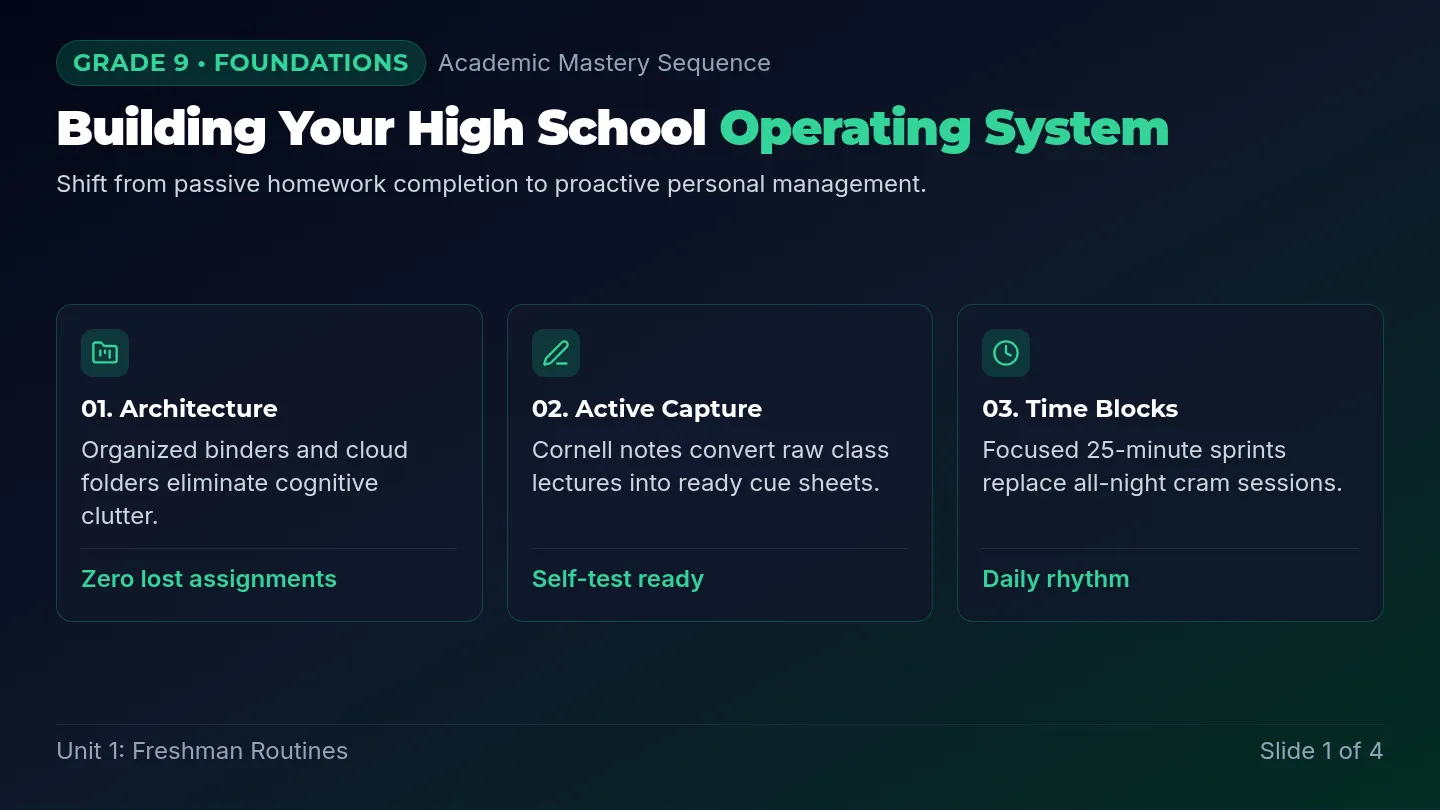
Self-Management Executive Function
Strategy Code: Eisenhower-01
Prioritization Secrets Script Mission Protocol
Teacher Script: Prioritization Secrets
Confidential Script
01
Warm-Up: The Busy Trap (10 Minutes)
Say
"Good morning, everyone! Let's start with a thought experiment. What does it actually mean to be 'busy'? Raise your hand if you've ever felt like you have a million things to do, but at the end of the day, you're not sure what you actually accomplished."
Action
Wait for responses. Encourage 2-3 brief student anecdotes.
Say
"That feeling is the 'busy trap.' Now, follow-up: Is being busy always productive? Can you be frantic but not actually effective? Think for a minute, then we'll share."
Action
Facilitate class discussion. Guide students toward differentiating activity from progress.
02
Introduction to the Chart (10 Minutes)
Setup
Display Slide 3: Urgent vs. Important
Say
"To become experts, we use a tool called the Prioritization Chart. Look at the screen. Urgent means it demands attention NOW—like a fire alarm. Important means it affects your long-term goals—like studying for finals. Sometimes they overlap, sometimes they don't."
Action
Go through Slides 4-8. For each quadrant, ask students for one specific example from their own lives (social media, homework, family chores, etc.).
03
Tactical Sorting Activity (10 Minutes)
Action
Distribute Prioritization Sort . Explain the instructions for cutting and sorting.
Say
"Talk with your group about WHY you're placing each task where you are. There's no single 'right' answer, but there is logic. Is a phone call during homework urgent? Is it important? Debate it."
04
Final Deployment (15 Minutes)
Action
Hand out My Priority Chart Worksheet . Give 10 minutes for individual completion.
Say
"Now, map your own life. List 3-5 things you actually have to do this week. Be honest. Is scrolling TikTok a Quadrant 4 activity? Probably. Put it there."
Finish
Collect Exit Tickets as students depart.
Sort Activity Answer Key Answer Key
Sorting Protocol: Prioritization Task Sort
Teacher Resource
Q1: Do First
03 Surprise pop quiz announced for end of period.
07 Final group project due tomorrow morning.
15 Managing an unexpected family emergency.
16 Returning a library book due today.
Q2: Schedule It
02 Studying for major test scheduled for next month.
05 Planning personal career goals for five years out.
08 Cleaning and organizing messy backpack/locker.
10 Researching colleges or trade schools.
12 Practicing musical instrument (3 months away).
14 Routine dentist check-up and cleaning.
Q3: Delegate / Minimize
01 Phone ringing while doing focused homework.
04 Replying to non-urgent email about next month's meeting.
09 Friend's request to play video game right now.
11 Helping classmate with simple question during work time.
Q4: Eliminate
06 Binge-watching TV because you're bored.
13 Scrolling social media for over an hour.
Teacher Discussion Notes
Note: Students may debate the placement of some items (e.g., Task 11 or Task 08). Encourage them to justify their reasoning. If Task 08 (Cleaning) is helping them stay focused, it is Q2. If it is used to avoid doing a harder Task (Procrastination), it belongs in Q4.
Prioritization Slide Deck Executive Function Series
First Things
First
Mastering the Art of Prioritization
Classroom Intelligence briefing
Busy or Productive?
"I have a million things to do, but I don't feel like I've done anything."
— Sound familiar?
What does it mean to be busy?
Is being busy always productive?
Have you ever felt overwhelmed by your "to-do" list?
The Definitions
Urgent
Demands immediate attention. There are consequences for not doing it right now.
Examples
A ringing phone, a fire alarm, a project due in 1 hour.
Important
Has long-term impact. Contributes directly to your big goals and values.
Examples
Studying for finals, health, building relationships, career planning.
The Prioritization Chart
Also known as the Eisenhower Matrix
Urgent & Important
Not Urgent & Important
Urgent & Not Important
Not Urgent & Not Important
Urgency
Importance
Category 01
Do First
Crises, immediate deadlines, and sudden emergencies.
On your list:
• Project due tomorrow morning
• A personal/family emergency
• Fixing a major error on a task
Category 02
Schedule It
This is where growth happens. Planning and prevention.
On your list:
• Studying for next week's test
• Exercising / Relationship building
• Setting personal goals
Category 03
Delegate / Minimize
Things that feel urgent but don't help your specific goals.
On your list:
• Helping a friend with their busywork
• Some emails and notifications
• Popular activities that aren't actually useful
Category 04
Eliminate
The "Time Wasters." Activities that offer zero long-term value.
On your list:
• Endless scrolling on social media
• Binge-watching shows out of boredom
• Busywork / trivial errands
The Power of
Warm-Up Discussion Questions Task Intelligence Briefing
Warm-Up Activity: The Busy Trap
Step 01: Analysis
Agent Name: ________________________________________________
Date: ___________________
01 What does it mean to be busy?
Describe a time when you felt very busy. What was happening? How did it feel?
02 Is being busy always a good thing?
Can you be busy but not productive? Explain your thoughts on the difference.
03 Tactical Decision Scenario
Imagine you have a big project due tomorrow, a friend who really needs help with a breakup, and your favorite show just dropped new episodes. How do you decide what to do first?
"Effective prioritization is the antidote to chaos."
Prioritization Sort Activity Sorting Protocol
Activity: Prioritization Task Sort
Step 02: Classification
Field Instructions
Cut out the 16 task cards below along the dotted lines.
Discuss each task with your group: Is it Urgent? Is it Important?
Place each card into the correct quadrant on the Sorting Mat (Page 2).
Be prepared to defend your decisions during the class briefing!
Task 01
Your phone rings while you're in the middle of focused homework.
Task 02
Studying for a major math unit test that is scheduled for next month.
Task 03
A surprise pop quiz is announced for the end of this class period.
Task 04
Replying to a non-urgent email from a club leader about next month's meeting.
Task 05
Planning out your personal career goals for the next five years.
Task 06
Binge-watching an entire new TV series because you're bored.
Task 07
Finishing a final group project that is due tomorrow morning.
Task 08
Cleaning and organizing your messy backpack and school locker.
Task 09
A friend sends a direct request to play a video game with them right now.
Task 10
Researching potential colleges or trade schools for after graduation.
Task 11
Helping a classmate with a simple question during independent work time.
Task 12
Practicing your musical instrument for a concert three months away.
Task 13
Scrolling endlessly through social media feeds for over an hour.
Task 14
Going to the dentist for a routine cleaning and check-up.
Task 15
Managing an unexpected family emergency that requires your attention.
Task 16
Returning a library book that is officially due by the end of today.
Quadrant Sorting Mat
Urgent & Important
Do First
Crisis, Deadlines, Emergencies
Not Urgent & Important
Schedule It
Goals, Planning, Relationships
Urgent & Not Important
Delegate / Minimize
Interruptions, Some Meetings
Not Urgent & Not Important
Eliminate
Time Wasters, Distractions
My Priority Chart Worksheet Personal Deployment
Worksheet: My Priority Matrix
Step 03: Application
Student Name: ________________________________________________
Date: ___________________
Now that you’ve mastered the chart, it’s time to map your own life. Think about your school assignments, home chores, hobbies, and personal goals for the upcoming week.
Q1: Urgent & Important
The "Do First" List
Q2: Not Urgent & Important
The "Schedule It" List
Q3: Urgent & Not Important
The "Minimize" List
Q4: Not Urgent & Not Important
The "Eliminate" List
Strategic Reflection
Focus on the Future
Choose one task from your Category 2 (Not Urgent & Important). Because it isn't "urgent," it's the easiest to ignore—but it's often the most important for your success.
What is the very first step you will take to schedule and complete this task?
Efficiency Matrix v1.0 // 9th Grade Series
Prioritization Secrets Exit Ticket Exit Ticket
Prioritization Power-Up
Name: _____________________
Date: _____________________
What is ONE key idea or strategy about prioritizing tasks that you learned today and plan to try out in your own life?
Mission Accomplished
9th Grade Executive Function