Freshman Launch Slides Grade 9 • Foundations Academic Mastery Sequence
Building Your High School Operating System
Shift from passive homework completion to proactive personal management.
01. Architecture
Organized binders and cloud folders eliminate cognitive clutter.
Zero lost assignments
02. Active Capture
Cornell notes convert raw class lectures into ready cue sheets.
Self-test ready
03. Time Blocks
Focused 25-minute sprints replace all-night cram sessions.
Daily rhythm
Unit 1: Freshman Routines Slide 1 of 4
Pillar 1 Physical & Digital Architecture
The Daily Reset: Never Lose a Handout
Disorganization wastes up to 2.5 hours each week in stressful searching.
Physical Notebook / Binder
• Color Dividers: One distinct tab per subject course.
• Action Pocket: Front sleeve reserved for papers due tomorrow.
• Evening Purge: Throw out trash and file loose sheets daily.
Rule: If it isn't filed right away, it will be lost by Friday.
Cloud Drive & File Naming
• Folders: Grade09 / Subject / Unit
• Naming Standard: YYYYMMDD_Subject_Title
• Clean Desktop: Move all downloads within 24 hours.
Rule: Never submit a document titled "Untitled doc (1)".
Unit 1: Freshman Routines Slide 2 of 4
Pillar 2 Active Note Architecture
The Cornell Grid: Capture with Purpose
Raw verbatim copying fades in 48 hours; Cornell forces active synthesis.
Cue Column (2.5")
Written after class : key terms, sample quiz questions, and trigger cues.
Cover notes & self-quiz!
Main Notes Column (6")
Written during class : core ideas, diagrams, and shorthand bullet points.
Indent sub-points; leave blank lines between topics.
Focus on main arguments, not verbatim speech.
Bottom Summary (2") Write a 2-3 sentence synthesis in your own words within 24 hours.
+65% Retention
Unit 1: Freshman Routines Slide 3 of 4
Pillar 3 Time & Focus Hygiene
The 25/5 Pomodoro & Distraction Control
Task switching fractures focus and drains mental stamina.
Phase 1: Sprint (25m)
Single task only. Phone face-down in another room. Visible countdown timer.
No non-essential tabs.
Phase 2: Reset (5m)
Physical break: stretch, drink water, breathe. Stay off social feeds and games.
Allows mental recharge.
Phase 3: Shutdown
Pack backpack for tomorrow, update planner, and declare study time complete.
Guilt-free evening rest.
Unit 1: Freshman Routines Slide 4 of 4
Freshman Habit Builder Worksheet Grade 9 • Foundation Toolkit Mindset to Mastery Sequence
Personal Study Operating System
Module 1.1 Practice
Physical & Digital Routines
Name: __________________
Date: ____________
Period: _______
Goal GPA: ______
1 Daily Organizational Checkpoints
Mark status and define your protocol
Binder Architecture
[ ] Tab for every subject course
[ ] Action sleeve cleared nightly
Missing binder item:
Cloud File Naming
[ ] Folders set per subject
[ ] YYYYMMDD_Subject_Title
Rename sample "Doc 1" →
Phone Sanctuary
[ ] Out of physical reach
[ ] Computer notifications silent
Phone study storage spot:
2 Cornell Note-Taking Lab (Live Capture Practice)
Topic: Today's Classroom Lesson
Capture core ideas in notes on the right during class. Add test cues on the left within 24 hours.
Cue Column (Recall Prompts)
Main Notes (In-Class Processing)
24-Hour Summary Box (Synthesize in 2 sentences in your own words):
3 Weekly Focus Commitment (25-Min Sprints)
Goal: 2 Sprints / Day
Monday
Subject:
[ ] [ ]
Tuesday
Subject:
[ ] [ ]
Wednesday
Subject:
[ ] [ ]
Thursday
Subject:
[ ] [ ]
Friday
Subject:
[ ] [ ]
Student Signature: _____________________________________ Evening Reset Done: [ ] Bag Packed [ ] Desk Cleared
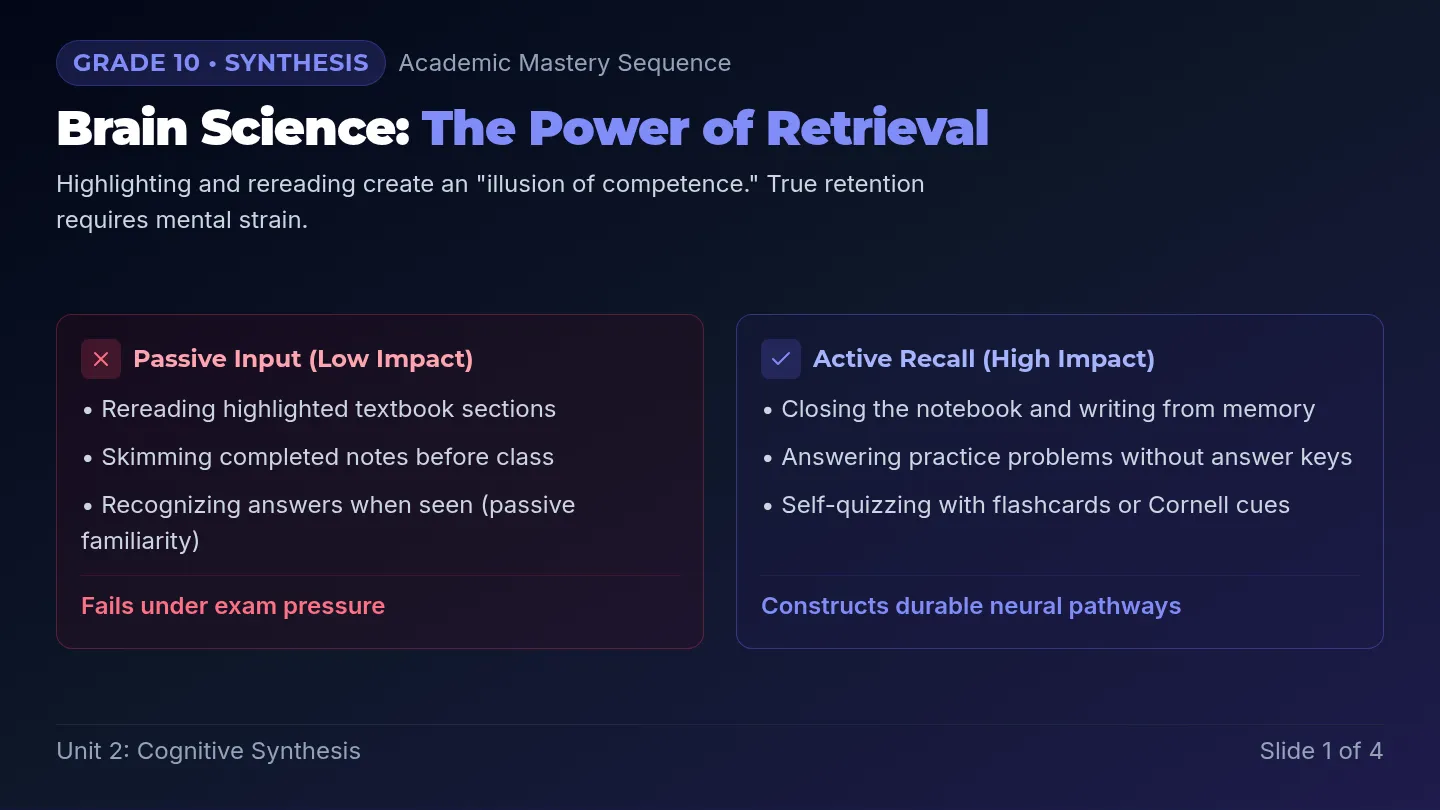
Sophomore Cognition Slides Grade 10 • Synthesis Academic Mastery Sequence
Brain Science: The Power of Retrieval
Highlighting and rereading create an "illusion of competence." True retention requires mental strain.
Passive Input (Low Impact)
• Rereading highlighted textbook sections
• Skimming completed notes before class
• Recognizing answers when seen (passive familiarity)
Fails under exam pressure
Active Recall (High Impact)
• Closing the notebook and writing from memory
• Answering practice problems without answer keys
• Self-quizzing with flashcards or Cornell cues
Constructs durable neural pathways
Unit 2: Cognitive Synthesis Slide 1 of 4
Memory Curve Ebbinghaus Forgetting Curve
Spaced Repetition: The 1-3-7-21 Rule
Interrupt forgetting right as recall becomes difficult to lock in facts.
Day 1
First Review
Review notes within 24 hours. Write 3 cue questions and a 2-sentence summary.
10 min sprint
Day 3
Active Quiz
Cover notes and test definitions or equations without looking at hints.
7 min self-quiz
Day 7
Problem Drill
Solve two unassisted practice problems or prompt an oral explanation.
5 min check
Day 21
Long-Term Lock
Synthesize concept with other units. Memory is now stored in long-term schema.
Permanent storage
Unit 2: Cognitive Synthesis Slide 2 of 4
Flashcard Protocol The Leitner 3-Box Method
Target Weaknesses: Stop Over-Studying Easy Cards
Shift flashcards across compartments based on recall accuracy.
Box 1: Every Day Challenging
New cards and items answered incorrectly. If you miss a card in any box, it immediately returns to Box 1!
Review: Daily (5 mins)
Box 2: Every 3 Days Familiar
Cards answered correctly from Box 1. Reviewed twice per week to reinforce emerging recall.
Review: Tuesday / Friday
Box 3: Weekly Mastered
Cards answered correctly from Box 2. Reviewed only once a week to verify persistent memory retention.
Review: Sunday evening
Unit 2: Cognitive Synthesis Slide 3 of 4
Synthesis Mastery The Feynman Technique
Teach It to Learn It: The 4-Step Test
Active Recall Matrix Worksheet Grade 10 • Cognitive Synthesis Mindset to Mastery Sequence
Active Recall & Memory Matrix
Module 2.1 Practice
Evidence-Based Encoding
Name: __________________
Date: ____________
Subject: ____________
Topic: ____________
1 Leitner 3-Box Flashcard Interval Tracker
Schedule cards by mastery status
Box 1: Daily Focus Struggling
Missed items. Review everyday.
Current Card Count:
Days Checked: M [ ] T [ ] W [ ] Th [ ] F [ ]
Box 2: Every 3 Days Developing
Got right once. Review 2x/wk.
Current Card Count:
Days Checked: Tue [ ] Fri [ ]
Box 3: Weekly Audit Mastered
Consistent recall. Review 1x/wk.
Current Card Count:
Day Checked: Sunday [ ]
2 The Feynman Concept Decomposition
Deconstruct a complex idea without technical jargon
Target Concept / Law / Mechanism: ____________________________________________________
Step A: Explain to an 8th Grader (Simple Words Only)
Step B: Real-World Analogy / Metaphor
Step C: Knowledge Gap Audit (Where did you hesitate or need notes?)
3 Timed "Blurting" Brain-Dump Drill (3 Minutes)
Close all notebooks. Dump everything you recall below.
After 3 mins: Open textbook with red pen to add missing facts Red-Pen Additions Count: [ ]
Self-Assessment: [ ] Emerging [ ] Competent [ ] Mastered Spaced Review Cadence: Day 1 [ ] Day 3 [ ] Day 7 [ ]
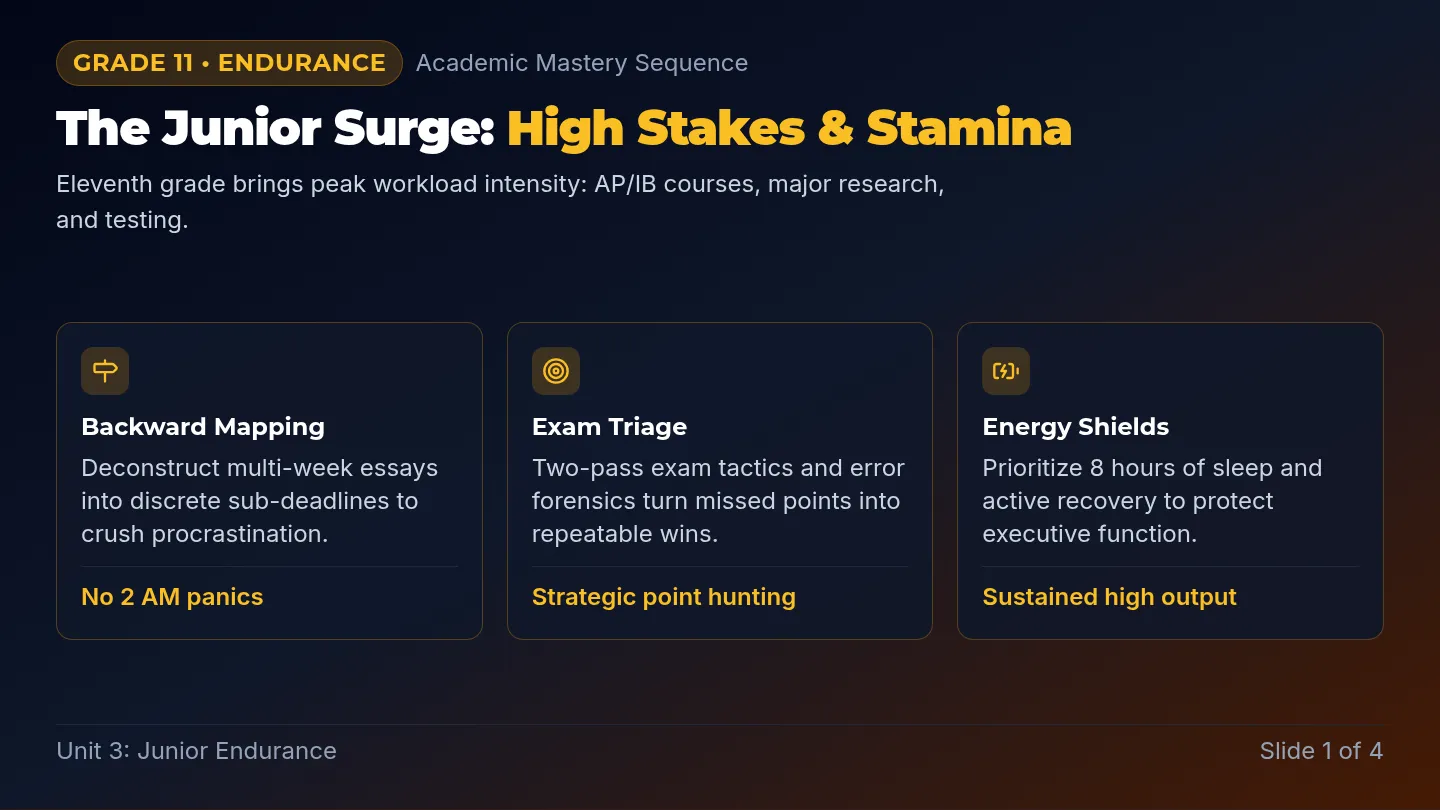
Junior Stamina Slides Grade 11 • Endurance Academic Mastery Sequence
The Junior Surge: High Stakes & Stamina
Eleventh grade brings peak workload intensity: AP/IB courses, major research, and testing.
Backward Mapping
Deconstruct multi-week essays into discrete sub-deadlines to crush procrastination.
No 2 AM panics
Exam Triage
Two-pass exam tactics and error forensics turn missed points into repeatable wins.
Strategic point hunting
Energy Shields
Prioritize 8 hours of sleep and active recovery to protect executive function.
Sustained high output
Unit 3: Junior Endurance Slide 1 of 4
Project Strategy Long-Range Execution
Backward Mapping: The 4-Week Milestone Waterfall
Never write a 10-page paper in a single weekend. Reverse-engineer the finish line.
Week 1
Scope & Sources
Lock down topic thesis, find 6 credible sources, and write annotated citations.
Deliverable: Bibliography
Week 2
Detailed Outline
Create Roman numeral framework with direct quotes paired to each claim.
Deliverable: Bullet Map
Week 3
Ugly First Draft
Write without editing. Focus on flow and speed; do not stop to polish grammar.
Deliverable: Full Body Text
Week 4
Refine & Polish
Read aloud, complete rubric self-check, verify citations, and submit 24 hours early.
Submission Ready
Unit 3: Junior Endurance Slide 2 of 4
Test Strategy Exam Execution
The Two-Pass Exam System & Error Forensic Log
Points are often lost to time mismanagement, not lack of knowledge.
The Two-Pass Test Sweep
• Pass 1 (Instant Wins): Answer all straightforward questions first. Star questions requiring heavy calculation or deliberation.
• Pass 2 (Deep Problem Solving): Return to starred items with banked time and built-up confidence.
Guarantees you never leave easy questions unread at the test end.
The 3 Error Types
• 1. Careless Slip: Misread question or arithmetic typo. Fix with pencil underlines.
• 2. Concept Gap: Fundamental lack of content schema. Fix via Feynman breakdown.
• 3. Time Panic: Rushed work under clock pressure. Fix with timed practice drills.
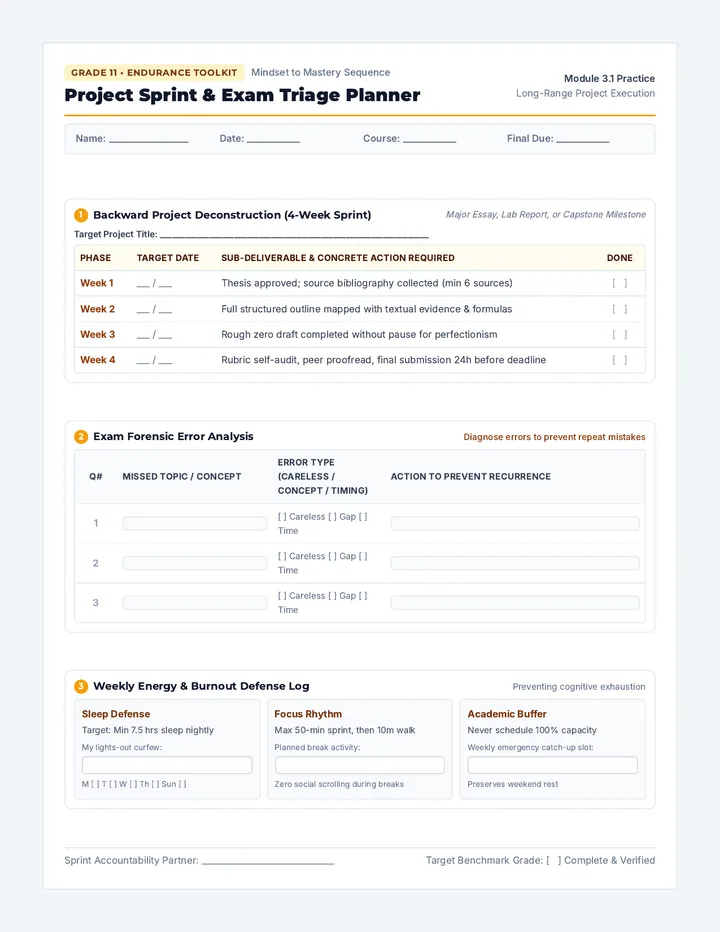
Project Sprint Planner Worksheet Grade 11 • Endurance Toolkit Mindset to Mastery Sequence
Project Sprint & Exam Triage Planner
Module 3.1 Practice
Long-Range Project Execution
Name: __________________
Date: ____________
Course: ____________
Final Due: ____________
1 Backward Project Deconstruction (4-Week Sprint)
Major Essay, Lab Report, or Capstone Milestone
Target Project Title: _________________________________________________________________
Phase Target Date Sub-Deliverable & Concrete Action Required Done Week 1 ___ / ___ Thesis approved; source bibliography collected (min 6 sources) [ ] Week 2 ___ / ___ Full structured outline mapped with textual evidence & formulas [ ] Week 3 ___ / ___ Rough zero draft completed without pause for perfectionism [ ] Week 4 ___ / ___ Rubric self-audit, peer proofread, final submission 24h before deadline [ ]
2 Exam Forensic Error Analysis
Diagnose errors to prevent repeat mistakes
Q# Missed Topic / Concept Error Type (Careless / Concept / Timing) Action to Prevent Recurrence 1 [ ] Careless [ ] Gap [ ] Time
|
| 2 |
| [ ] Careless [ ] Gap [ ] Time |
|
| 3 |
| [ ] Careless [ ] Gap [ ] Time |
|
3 Weekly Energy & Burnout Defense Log
Preventing cognitive exhaustion
Sleep Defense
Target: Min 7.5 hrs sleep nightly
My lights-out curfew:
M [ ] T [ ] W [ ] Th [ ] Sun [ ]
Focus Rhythm
Max 50-min sprint, then 10m walk
Planned break activity:
Zero social scrolling during breaks
Academic Buffer
Never schedule 100% capacity
Weekly emergency catch-up slot:
Preserves weekend rest
Sprint Accountability Partner: ______________________________ Target Benchmark Grade: [ ] Complete & Verified
Senior Scholar Slides Grade 12 • Independence Academic Mastery Sequence
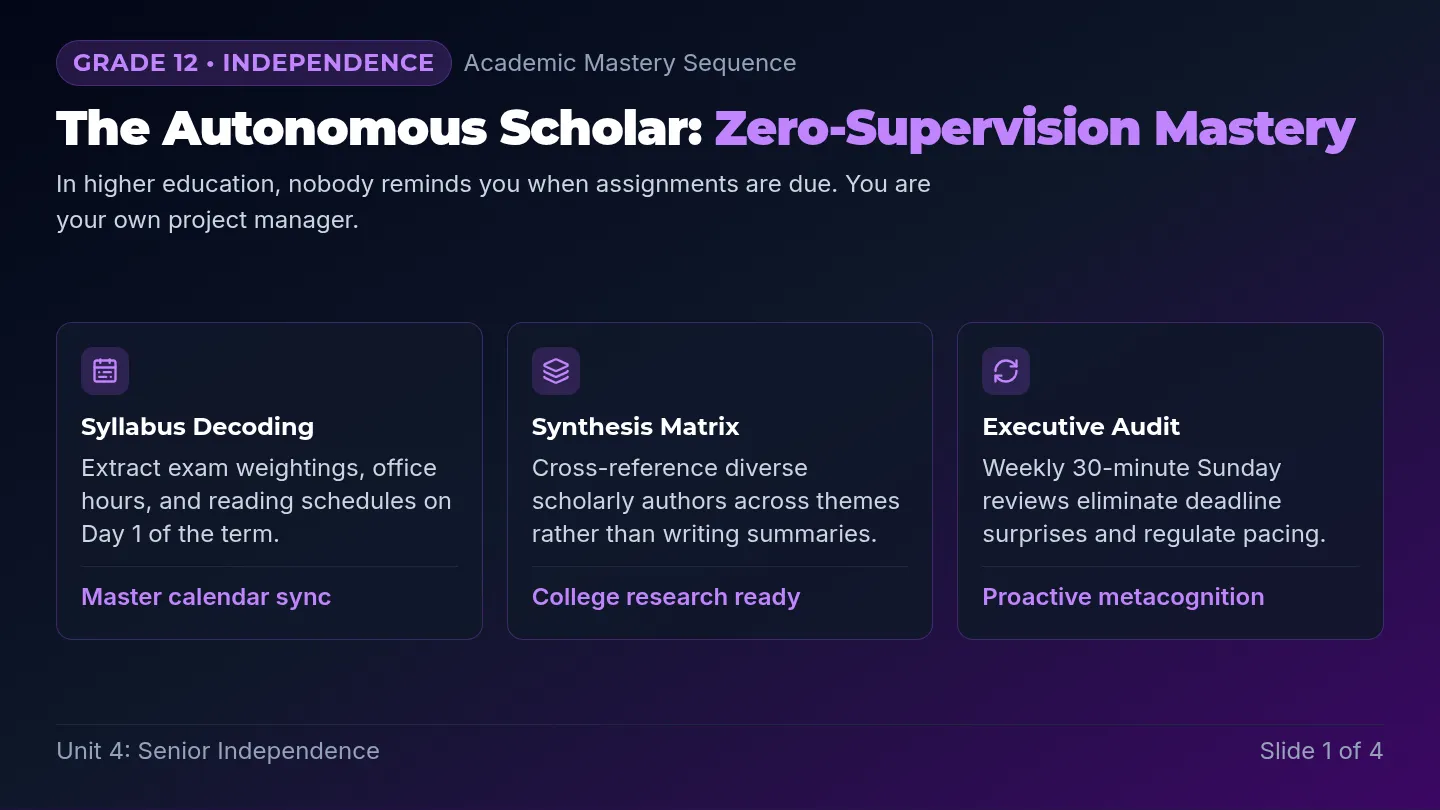
The Autonomous Scholar: Zero-Supervision Mastery
In higher education, nobody reminds you when assignments are due. You are your own project manager.
Syllabus Decoding
Extract exam weightings, office hours, and reading schedules on Day 1 of the term.
Master calendar sync
Synthesis Matrix
Cross-reference diverse scholarly authors across themes rather than writing summaries.
College research ready
Executive Audit
Weekly 30-minute Sunday reviews eliminate deadline surprises and regulate pacing.
Proactive metacognition
Unit 4: Senior Independence Slide 1 of 4
College Protocol Syllabus Dissection
The 3-Step Syllabus Dissection: Day One Prep
A syllabus is not just course policies—it is an academic contract and road map.
1. Grade Weight Audit
Identify high-leverage evaluation items. A final worth 40% demands 3x more advance preparation than weekly discussion boards worth 5%.
Align effort to weights
2. Milestone Ingestion
During week one, map every single exam, paper, and reading milestone across all classes onto one combined calendar.
Identify "Hell Weeks" early
3. Office Hours Strategy
Schedule professor and teaching assistant office hours before you fall behind. Introduce yourself with a specific reading question by Week 3.
Build academic advocates
Unit 4: Senior Independence Slide 2 of 4
Research Synthesis Advanced Literature Review
The Synthesis Matrix: Put Scholars in Conversation
Do not write book reports about individual articles. Map the intellectual debate.
Core Theme / Argument
Scholar A (Empirical)
Scholar B (Theoretical)
Your Thesis Synthesis
Theme 1: Cause of Outcome
Argues economic factors drive shifts (Data set: 2010-2020)
Argues institutional policy drives shifts (Qualitative case)
Both interact: policies succeed only under fiscal stability.
Theme 2: Policy Remedy
Proposes top-down federal regulation
Advocates decentralized local incentives
Reconcile via hybrid regional governance models.
Unit 4: Senior Independence Slide 3 of 4
Metacognition Executive Routine
The Sunday Executive Review: 30 Minutes to Clarity
High performers don't react to their week; they design it before Monday arrives.
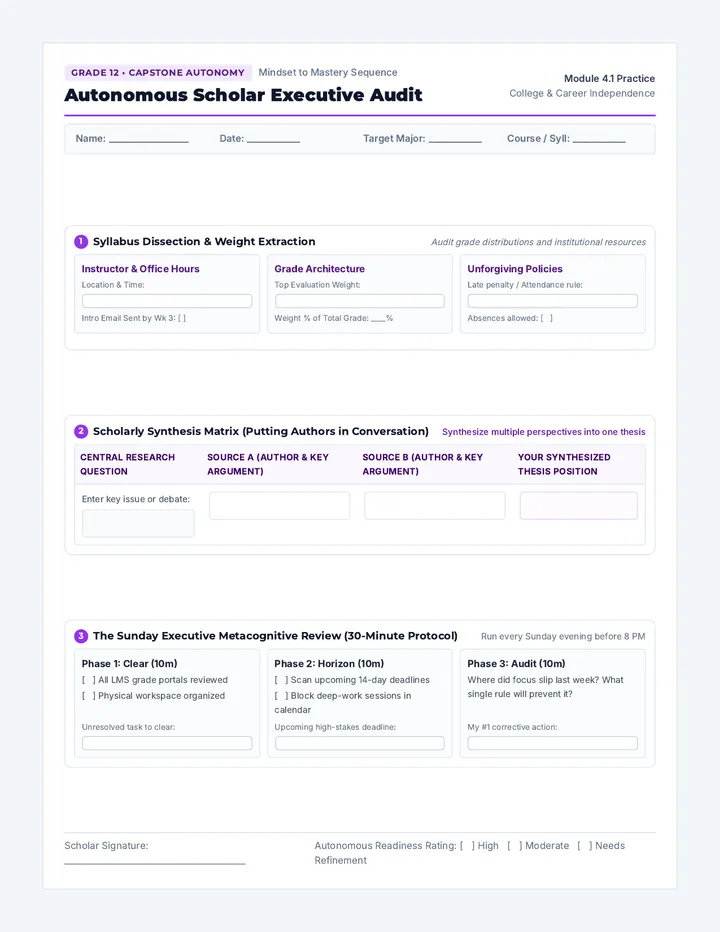
Autonomous Scholar Audit Worksheet Grade 12 • Capstone Autonomy Mindset to Mastery Sequence
Autonomous Scholar Executive Audit
Module 4.1 Practice
College & Career Independence
Name: __________________
Date: ____________
Target Major: ____________
Course / Syll: ____________
1 Syllabus Dissection & Weight Extraction
Audit grade distributions and institutional resources
Instructor & Office Hours
Location & Time:
Intro Email Sent by Wk 3: [ ]
Grade Architecture
Top Evaluation Weight:
Weight % of Total Grade: ____%
Unforgiving Policies
Late penalty / Attendance rule:
Absences allowed: [ ]
2 Scholarly Synthesis Matrix (Putting Authors in Conversation)
Synthesize multiple perspectives into one thesis
Central Research Question Source A (Author & Key Argument) Source B (Author & Key Argument) Your Synthesized Thesis Position Enter key issue or debate:
|
|
|
3 The Sunday Executive Metacognitive Review (30-Minute Protocol)
Run every Sunday evening before 8 PM
Phase 1: Clear (10m)
[ ] All LMS grade portals reviewed
[ ] Physical workspace organized
Unresolved task to clear:
Phase 2: Horizon (10m)
[ ] Scan upcoming 14-day deadlines
[ ] Block deep-work sessions in calendar
Upcoming high-stakes deadline:
Phase 3: Audit (10m)
Where did focus slip last week? What single rule will prevent it?
My #1 corrective action:
Scholar Signature: _________________________________________ Autonomous Readiness Rating: [ ] High [ ] Moderate [ ] Needs Refinement