Fresh Start Reflection Worksheet
Fresh Start Reflection
Part 1: Understanding our reactions and processing perspectives
Self-Reflection & Advocacy
Student Name:
Date:
Turning Misunderstandings Into Growth
It is frustrating to feel misjudged or have your honesty questioned. It's completely normal to feel defensive when a communication breakdown occurs. This worksheet is not about blaming you or making you feel guilty. It is a supportive tool designed to help you process your reactions, view the situation from all angles, and build a positive path forward.
1 Processing My Thoughts & Feelings
A. Initial Reaction: How did you feel when you heard the word "lying" or felt your actions were misunderstood? Why is it important to you to clear your name?
The Mirror Check: Radically Honest Reflection
When we are stressed about a late assignment, a part of us might feel relieved when an obstacle pops up (like not seeing the teacher). Honestly ask yourself: Did you leave purely because you couldn't find the teacher, or was a part of you relieved to avoid facing the difficult assignment? (Both feelings are very normal, but honesty starts with yourself.)
2 Expanding the Lens (Three Perspectives)
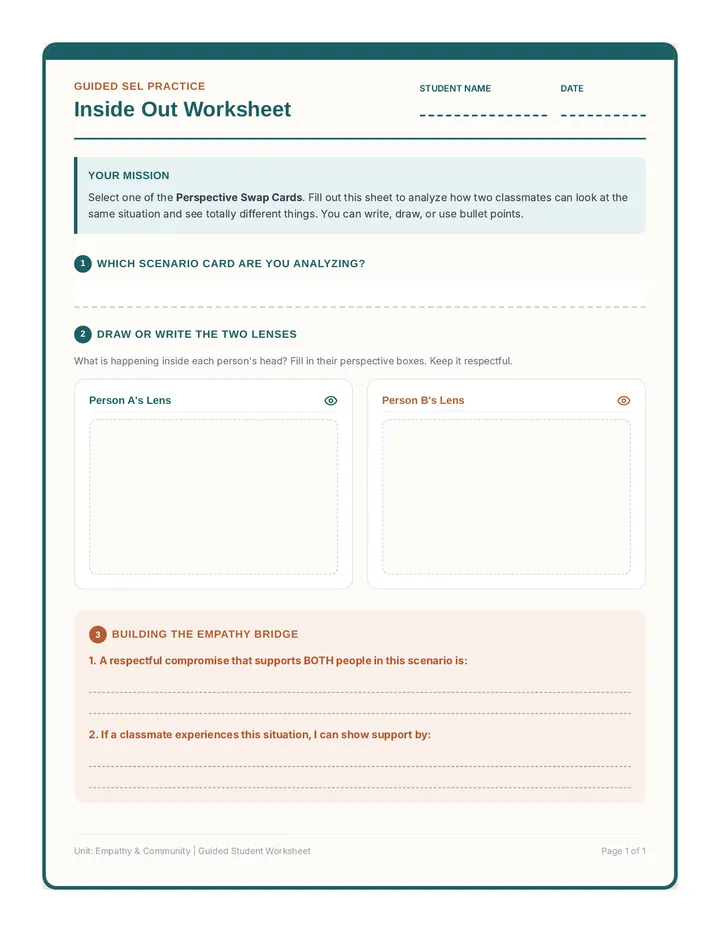
My Lens
"I showed up to get help, didn't see the teacher in the room, and left. I felt like I did my part by showing up."
Intent: To get support
The Teachers' Lens
"We set aside time for a late assignment. When the student didn't wait or follow up, it felt like they avoided the commitment."
Goal: Complete late work
The Break in Trust
Even if we disagree on exactly who was where, leaving without reaching out looks like avoidance. The priority is solving the late work.
Goal: Restore relationship
Focus Area: Accountability & Mutual Understanding
Page 1 of 2
Fresh Start Reflection
Part 2: Proactive choices and bridge-building communication
Self-Reflection & Advocacy
3 Proactive Power-Ups (My Next-Time Strategy)
Taking ownership means focusing entirely on what you can control. If you ever show up to a meeting or a classroom and do not see your teacher, which of these proactive steps will you commit to taking next time? (Check at least two options):
The 5-Minute Hallway Wait Stay right outside the closed door. Teachers often step out briefly to grab materials, make copies, or talk to colleagues.
The Digital Paper Trail (Email) Send a polite, timestamped email instantly: "Hi Mr./Ms. [Name], I'm at your room for our meeting but don't see you. I will wait outside!"
The Buddy or Neighbor Check Ask a nearby teacher or front-office staff if they know where your teacher went. This shows you are actively looking.
Independent Draft Progress Go to the library or a study hall and finish whatever parts of the assignment you can do alone, proving effort.
Preventative Advocacy: The Timing Shift
Waiting until an assignment is overdue to ask for help causes maximum stress for both you and your teachers. Seeking help before the deadline shows high accountability and gives teachers plenty of time to support you.
🛑 Reactive (Too Late) Asking after the due date. Looks like an excuse; results in late penalties and high stress.
âš¡ Proactive (Just Right) Asking 2 to 3 days before it is due. Shows genuine effort; leaves plenty of room to reschedule.
4 Drafting My Conversation (Rebuilding the Bridge)
We build trust by taking ownership of results, not by arguing over details. Draft a short, professional email or a face-to-face script to send/say to your teachers to set up a new plan and repair the relationship.
1. The Opening & Acknowledgement (Be clear and direct)
Example: "I wanted to reach out to apologize for leaving yesterday without waiting or emailing when I didn't see you in the room..."
2. The Solution & Commitment (Show that you want to complete the work)
Example: "My priority is still finishing this assignment. I have completed [part X] on my own. Can we meet to look at it?"
3. The Schedule Proposal (Suggest a concrete action)
Example: "Would it be okay if I stayed after school today, or should we schedule a time during study hall?"
Focus Area: Proactive Communication & Restoring Trust
Page 2 of 2