Conflict Compass Worksheet CONFLICT COMPASS
Navigating Friction • Perspective-Taking • Respectful Disagreement
Name:
Date:
Period:
1. Pause & Regulate Breathe before reacting
2. Listen to Learn Hear without defending
3. Own Your Voice Use clear "I-Statements"
4. Seek the Bridge Solve shared problems
1
The De-Escalation Lab: Reframe to "I-Statements"
Formula: I feel [emotion] when [action] because [impact].
Blame Trigger
"You always slack off on our team slides and force me to do every single thing myself!"
Rewrite using a calm, assertive I-Statement:
Blame Trigger
"You never listen to my opinions in our group meetings and just talk right over me!"
Rewrite using a calm, assertive I-Statement:
2
The Perspective Bridge: Case Breakdown
Case Study: Jordan altered the shared project schedule without telling Maya because the event supervisor moved up the submission deadline. Maya arrived, felt blind-sided, and accused Jordan of trying to control the entire team.
Jordan's View & Hidden Need
What urgency was Jordan solving for?
Maya's View & Hidden Need
Why did Maya feel devalued?
The Collaborative Bridge: What is one practical step that respects both the deadline and partner trust?
3
Respectful Disagreement: Response Evaluation
A teammate proposes a strategy you know exceeds your deadline. Check the box next to the constructive response:
Option A: "Fine, let's just do it your way so we don't waste time arguing about it."
Option B: "I see what you're aiming for, but our time limit is tight. Could we test a simplified version?"
Option C: "That plan won't work at all if you actually checked the project schedule."
Write your own go-to phrase to disagree respectfully while keeping collaboration open:
Conflict Compass Slides Communication Mastery
Lesson 1
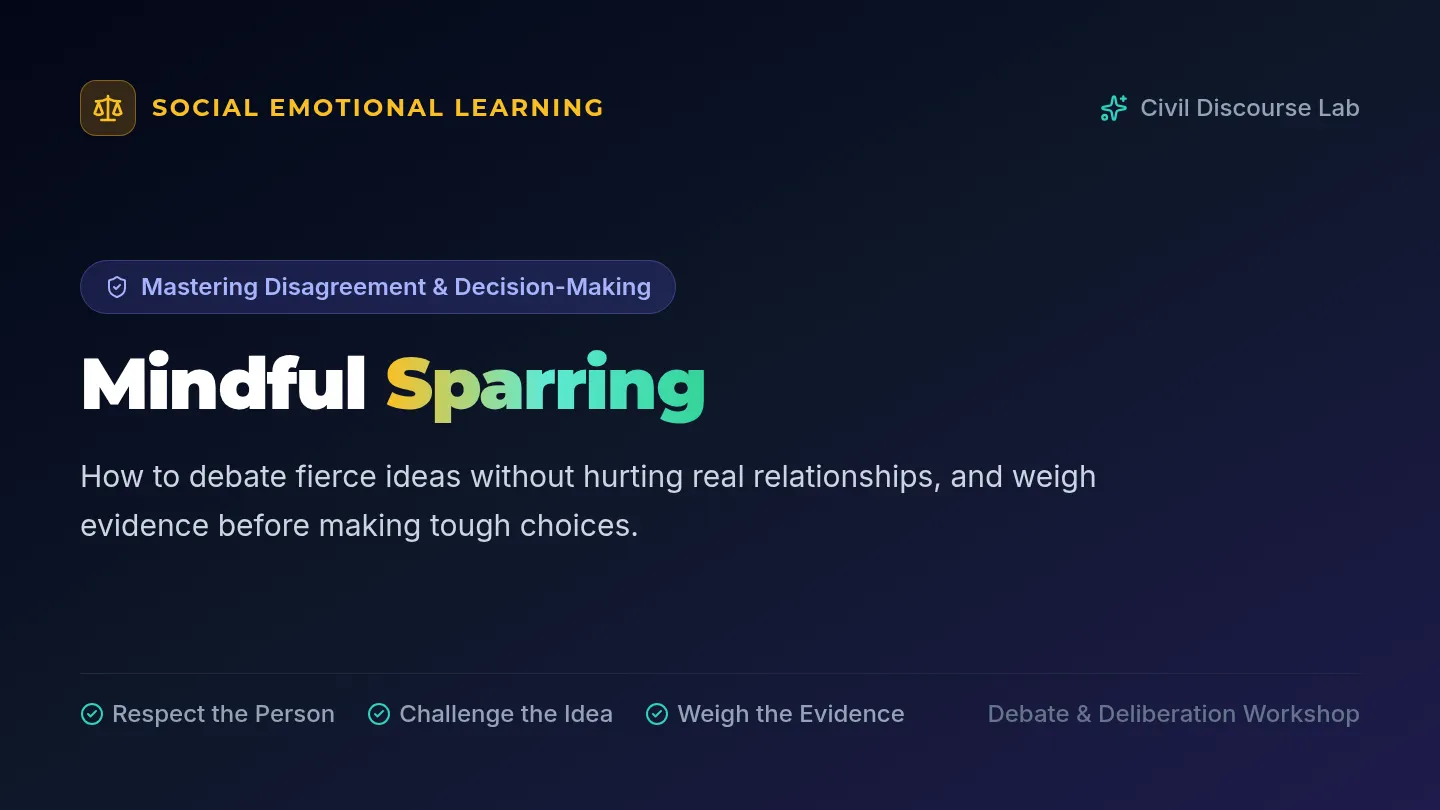
CONFLICT COMPASS
Mastering de-escalation, perspective-taking, and respectful disagreement when tensions rise.
Emotional Regulation Assertive "I-Statements" Perspective Bridging
The Human Reaction
When Conflict Ignites
The Reactive Reflex
Brain perceives an attack and shifts to survival mode:
Fight: Blaming, yelling, sarcasmFlight / Freeze: Shutting down, ghosting
The Compass Pivot
Conscious de-escalation shifts focus to problem solving:
Pause: Notice tension before speakingCuriosity: Ask what need is unmet
Core Principle: You cannot control someone else's storm, but you control your anchor.
The Framework
The 4 Compass Points
POINT 1
Pause & Regulate
Take a 5-second breath. Release jaw and shoulder tension.
Stop the reflex
POINT 2
Listen to Learn
Listen to understand, not to prepare your next rebuttal.
Hear the emotion
POINT 3
Own Your Voice
Speak from your experience using clear "I-Statements".
No blame triggers
POINT 4
Seek the Bridge
Team up against the obstacle rather than fighting the person.
Win-win mindset
Follow these sequential steps to move from heat to harmony.
Tactical Tool
The "I-Statement" Formula
THE BLUEPRINT
"I feel [Emotion] when [Specific Action] because [Impact]."
Aggressive "You-Statement"
"You always ignore my contributions and you don't care about my time!"
Triggers defensiveness and instant counter-attacks.
Calm "I-Statement" Reframe
"I feel overwhelmed when agendas change without a check-in because I need time to prepare."
Communicates facts and personal needs without attacking.
Notice: Replace "You always / You never" with concrete descriptions of actions.
Deeper Insight
The Conflict Iceberg
Above the Surface (10%)
Positions & Demands
What people say they want: "My way or nothing", yelling, silence, complaints.
Below the Surface (90%)
Underlying Needs & Emotions
What truly drives them: Fear of failure, feeling disrespected, exhaustion, urgency.
The De-escalator Question
"What is this person worried about right now?"
When you address the unspoken concern instead of fighting their sharp words, conflict dissolves rapidly.
Master communicators respond to the need, not just the tone.
Dialogue Tools
Disagreement Without Division
1
Validate First
"I see your point about saving time, and that goal makes total sense..."
Signals respect before offering an alternative.
2
Introduce the Risk
"My main worry is that skipping review might lead to mistakes in our final draft..."
Focuses on objective project risk, not personal flaw.
3
Invite Collaboration
"What if we test your idea on part one, and keep the backup ready?"
Invites joint ownership of the solution.
Your Turn: Move into partner pairs to practice with the Conflict Compass cards.
Conflict Compass Lesson Plan CONFLICT COMPASS LESSON PLAN
Teacher Instructional Facilitation Guide
Duration: 50 Min | Target: Grades 6–12 | Subject: SEL / Communication
Core Objectives: Students will (1) identify physiological stress triggers during disagreement, (2) convert accusatory "You-statements" into de-escalating "I-statements", and (3) apply two-sided perspective-taking to negotiate collaborative win-win solutions.
Lesson Materials
Conflict Compass Slides: Direct instruction & visual modelsStudent Worksheet: I-statement reframing & case analysisPartner Activity Cards: Micro-scenarios for guided roleplayFormative Exit Ticket: Final check for understanding
Key Vocabulary
De-escalation: Actions reducing tension. • I-Statement: Asserting needs without blaming. • Perspective-Taking: Understanding another's internal drivers. • Position vs. Need: Demands vs. root concerns.
Instructional Timeline & Scripted Pacing
00–08m
Hook & The Biological Reaction:
Project Slide 2. Ask: "When you feel wrongly accused, what physical cues appear first?" Guide students to recognize clenched fists, racing heart, or defensive urge to interrupt. Introduce the 4 Compass Points.
08–20m
Direct Instruction & Live Modeling (Slides 3–5):
Break down the I-statement anatomy: Emotion + Action + Concrete Impact. Model converting a toxic critique ("You ruined our group grade!" ) into an actionable request. Introduce the "Conflict Iceberg" concept.
20–35m
Individual Guided Practice (Student Worksheet):
Distribute the Conflict Compass Worksheet. Students independently complete Part 1 (I-Statement Lab) and Part 2 (Jordan & Maya Case Study). Circulate to check that I-statements omit accusatory qualifiers like "I feel that you are selfish."
35–50m
Paired Scenario Roleplay & Formative Exit Ticket:
Pair students with Activity Cards. Partner A presents a grievance; Partner B utilizes the 4 Compass Points to de-escalate. Swap roles. Reserve the final 5 minutes for independent Exit Ticket submission.
Common Pitfalls & Teacher Fixes
Fake "I-Statements":
Conflict Compass Activity Cards CONFLICT COMPASS ACTIVITY CARDS
Partner Roleplay & De-escalation Scenarios
Instructions: Cut along dashed lines. Partner A reads prompt; Partner B applies Compass Points.
Card 1 • Group Project Classroom Friction
The Vanishing Slide Deck
Your final biology presentation is in 2 hours. Partner A discovers that Partner B didn't upload their research slides last night as promised.
Role A (Upset Teammate): "Where are your slides?! You are going to ruin our entire semester grade because you don't care!"
Role B Challenge (De-escalator): Pause. Acknowledge Role A's panic. Explain your obstacle calmly without blaming. Offer an immediate 20-minute fix.
Target: Pause • Acknowledge Emotion Roleplay: 3 min
Card 2 • Workplace Supervisor Communication
The Double Shift Surprise
You work at a local cafe. Your shift lead (Role A) tells you 10 minutes before closing that you have to stay 3 hours late to cover for someone who called out. You have an exam tomorrow.
Role A (Stressed Shift Lead): "I don't have anyone else. You need to be a team player and stay or the store can't open tomorrow."
Role B Challenge (De-escalator): Use an "I-Statement". Validate the supervisor's store dilemma while holding your boundary respectfully with a counter-offer.
Target: I-Statement • Professional Boundary Roleplay: 3 min
Card 3 • Peer Social Trust & Rumors
The Private Conversation
You told a close friend something personal last week. Today, two other students mention it at lunch. You feel betrayed and confront your friend.
Role A (Hurt Friend): "I can't believe you told people my secret. You completely betrayed my trust and lied to me!"
Role B Challenge (De-escalator): Don't shout back or dismiss. Clarify what happened without defensiveness, acknowledge the hurt, and rebuild safety.
Target: Non-defensive Listening • Trust Repair Roleplay: 3 min
Card 4 • Shared Space Respectful Disagreement
The Media Lab Takeover
Both you and another club leader need the high-powered editing computer during the single open period before the weekend.
Role A (Competing Student): "I was here 30 seconds before you, so I get the machine the whole hour. Go find another computer."
Role B Challenge (De-escalator): Reject the all-or-nothing demand. Propose a timed split or workflow sharing solution without escalating.
Target: Collaborative Win-Win • Negotiation Roleplay: 3 min
Conflict Compass Exit Ticket Conflict Compass: Exit Ticket
Name: Period:
1. Convert this trigger into an assertive "I-Statement": "You never tell me when you change the meeting time and it wastes my whole afternoon!"
2. When a classmate snaps, "I don't care, just do whatever you want!", what underlying emotion or need might they be hiding below the surface?
3. Which Compass Point is your personal biggest challenge during a heated disagreement? (Check one & state why):
1. Pausing
2. Active Listening
3. "I" Statements
4. Win-Win Bridging
Self-Check: Turn in to teacher before dismissal.
Cut Line (2 per sheet)
Conflict Compass: Exit Ticket
Name: Period:
1. Convert this trigger into an assertive "I-Statement": "You never tell me when you change the meeting time and it wastes my whole afternoon!"
2. When a classmate snaps, "I don't care, just do whatever you want!", what underlying emotion or need might they be hiding below the surface?
3. Which Compass Point is your personal biggest challenge during a heated disagreement? (Check one & state why):
1. Pausing
2. Active Listening
3. "I" Statements
4. Win-Win Bridging
Self-Check: Turn in to teacher before dismissal.
Conflict Compass Answer Key CONFLICT COMPASS ANSWER KEY
Teacher Reference & Evaluation Guide
Teacher Edition • Confidential
1 Worksheet Part 1: I-Statement Lab Exemplars
Scenario A (Group Slides):
"I feel overwhelmed when tasks are divided unevenly because I worry we will miss our project deadline. Can we review our checklist together?"
Criteria: Names specific feeling (overwhelmed/stressed), notes the action without "you always", states clear consequence.
Scenario B (Meeting Interruptions):
"I feel frustrated when I am spoken over in meetings because I have research to contribute. I need us to let everyone finish their thoughts."
Criteria: Replaces accusatory tone with personal boundary and concrete procedural fix.
2 Worksheet Part 2: Dual Perspective Breakdown
Jordan's Hidden Need:
Under severe pressure from supervisor timeline; prioritized project survival over communication; feared letting the whole team fail.
Maya's Hidden Need:
Felt sidelined, disempowered, and untrusted as a co-leader; feared losing autonomy and equal ownership in the shared venture.
Win-Win Exemplar: Jordan acknowledges the communication lapse; Maya acknowledges the sudden deadline crunch; both establish a rapid 10-minute emergency sync protocol for future shifts.
3 Worksheet Part 3: Response Diagnostic
CORRECT: Option B Validates peer's intent, frames the disagreement around objective time constraint, and invites joint solution.
Distractor Analysis: Option A is passive-aggressive surrender (fosters resentment). Option C is an aggressive, patronizing attack (ignites defensiveness).
4 Exit Ticket Scoring Keys
Q1 Model: "I feel stressed when schedules change without notice because my afternoon is booked. Please text me if hours shift."
Q2 Model: "The classmate likely feels overwhelmed, unheard, or discouraged that their earlier suggestions were dismissed."
Quick Mastery Rubric
Proficient (3 pts) Uses strict I-statement format; identifies root interests; constructive tone.
Developing (2 pts) Attempts I-statement but retains subtle blame (e.g., "I feel you are wrong").
Emerging (1 pt) Relies on accusatory language; unable to identify partner's perspective.