Time Juggler Script Teacher Facilitation Script
Time Juggler: Lesson Guide
Grade 5 • Executive Functioning
30 Minutes Pacing
🎯 Learning Objective: Students sequence an afternoon schedule and commit to 1 time improvement.
🔑 Core Concepts: Prioritizing, Fixed vs. Flexible Scheduling, Accountability.
📦 Needed Supplies: Slide deck, Sorting Cards (1 set per pair), Notes, Planners.
30-Min Fast-Track Arc: 0-5m Hook ➜ 5-13m Mini-Lesson ➜ 13-22m Partner Sort ➜ 22-28m Solo Planner ➜ 28-30m Wrap
1
Hook: The Clock Race Game (5 Minutes)
Verbatim Teacher Prompt
"Imagine you walk in the door at 3:30 PM. Your backpack hits the floor. You have soccer at 5:30, a science diorama due tomorrow, dinner at 6:30, a pet dog begging for a walk, and your best friend just sent you three voice memos. What do you do first? You have 60 seconds at your table: list every single afternoon task on your whiteboard. Go!"
Turn & Talk Debrief: Stop at 60s. Ask 2 students: "Which task felt urgent, and which was truly important?" Transition: "When we treat everything like an emergency, we become clumsy jugglers. Today, you become master Time Jugglers."
2
Direct Teach: The 4-Zone Matrix (8 Minutes)
Project Taming the Clock Slides (Slides 3–5) . Have students record key words on their Time Juggler Notes .
Zone 1: MUST DO (Urgent & Important)
Deadlines tonight/tomorrow, fixed practices, family commitments. Rule: Lock these into concrete time blocks first!
Zone 2: SHOULD DO (High Value, Flexible)
Studying for Friday's quiz, reading 20 mins, packing lunch ahead. Rule: Best done during high energy hours.
Zone 3: COULD DO (Recharge & Fun)
Outdoor play, hobbies, calling friends. Rule: Scheduled rewards, NOT default stall tactics.
Zone 4: DROP / LIMIT (Time Thieves)
Mindless scrolling, gaming rabbit holes before homework is done. Rule: Shrink or delay until tasks are done.
Time Juggler Lesson Facilitation Script Page 1 of 2 • Next: Group Sort & Independent Planners
Time Juggler • 5th Grade Facilitation Guide Part 2: Application & Close
3
Guided Practice: Schedule Sorting Cards (9 Minutes)
Distribute Schedule Sorting Cards to student pairs. Project Slide 6 with the challenge timer (6 mins).
Pair Mission: 1. Sort the 12 activity cards onto the 4 Quadrants.The Catch: Soccer practice is locked at 5:15–6:15 PM, and family dinner is locked at 6:45–7:15 PM!
Teacher Circulating Prompt: "I see you put 1 hour of video games right before bed. How will that affect your morning routine? Where does the 30-minute math project fit best?"
4
Independent Practice: Daily Planner Template (6 Minutes)
Pass out the Daily Planner Template . Students map their own upcoming afternoon and articulate one specific habit upgrade.
Step A: Fixed Rocks Students plug in afterschool practices, chores, and family dinners first.
Step B: Power Hour Schedule academic homework before leisure screen time.
Key Target: The "My One Time-Management Improvement" box must be SMART (e.g., "I will put my phone on airplane mode from 4:00–4:45 while doing homework" ).
5
Debrief & Partner Sign-Off (2 Minutes)
Pairs swap planners. Each student reads their partner's "One Improvement" aloud and signs the Accountability Stamp .
"A plan kept in your head is just a wish. A plan written down and shared with a peer becomes a promise."
Differentiation & Supports
Support: Provide pre-filled time blocks for students who struggle with clock intervals; limit sort cards to 6 key tasks.Extension: Challenge students to build in 15-minute "Buffer Zones" for unexpected homework roadblocks.
Common 5th Grade Pitfalls
Planning zero downtime: Kids burn out. Insist on at least 30 mins of scheduled relaxation.Vague goals: Guide them away from "Do better" toward "Pack backpack right after dinner."
Time Juggler Lesson Facilitation Script Page 2 of 2 • Ready for Classroom Execution
Taming the Clock Slides Grade 5 • Executive Functioning
30-Minute Masterclass
Taming The Clock
How to stop juggling chaos and take command of your afternoon hours.
Prioritize Tasks
Sequence Your Time
Own Your Habits
Warm-Up Challenge Time: 60 Seconds
The Afternoon Clock Race
It’s 3:30 PM. You just walked in the door. How many tasks are fighting for your attention before bedtime?
Homework & Projects
Sports & Activities
Screens & Relaxation
⚡ Question: When everything feels urgent, how do you decide what happens first?
Key Concept #1 Urgent vs. Important
The Juggling Dilemma
Not all tasks are created equal. Master jugglers separate the noise from what counts.
Urgent
Demands immediate attention right now. Loud, noisy, and fast-paced.
Example: A buzzing phone or math worksheet due tomorrow morning!
Important
Contributes to long-term goals and health. Quiet, but makes a huge impact.
Example: Getting 8 hours of sleep or studying for a test next week!
💡 The Secret: If you only react to urgent things, important things get dropped.
The Core Tool The 4-Zone Priority Matrix
ZONE 1 MUST DO
Do It Today
Critical deadlines, fixed practices, health & family needs.
ZONE 2 SHOULD DO
Plan It Ahead
Reading, big project steps, prepping tomorrow's backpack.
ZONE 3 COULD DO
Reward & Recharge
Fun hobbies, riding bikes, gaming only when work is finished.
ZONE 4 DROP / LIMIT
Time Thieves
Endless video scrolling, group chat rabbit holes, stalling.
✍️ Follow along and fill in your Time Juggler Notes sheet now!
Case Study Spot The Trap
Maya's Afternoon Crunch
Look at Maya’s real schedule from yesterday. What went wrong?
3:30 - 4:45 PM
Video Games
"Just 15 minutes" turned into 75 minutes of gaming.
4:45 - 6:00 PM
Soccer Practice
Fixed time! Had to rush out without doing math.
6:00 - 7:30 PM
Dinner & Chores
Tired, hungry, and getting sleepy after eating.
7:30 - 9:00 PM
Time Juggler Notes Guided Notes Executive Functioning • Grade 5
Time Juggler Notes
Name: ________________
Date: __________
Class: ________________
Goal: Be in Control
The Golden Rule: You cannot juggle every ball at once. Master jugglers choose what to catch first!
Fill in during slides
1 Part 1: The Two Types of Tasks
URGENT TASKS
Demands attention RIGHT NOW! Often feels loud, stressful, or rushed.
Example from your day:
IMPORTANT TASKS
Matters for your FUTURE GOALS and health. Quiet, but makes a big difference.
Example from your day:
2 Part 2: The 4-Zone Priority Matrix
ZONE 1 MUST DO (Urgent & Important)
Action: Do it TODAY before anything else!
Examples (e.g. math due tomorrow, practice):
ZONE 2 SHOULD DO (High Value, Flexible)
Action: SCHEDULE it into your peak focus window!
Examples (e.g. 20 min reading, project prep):
ZONE 3 COULD DO (Recharge & Fun)
Action: Save as a REWARD when work is done!
Examples (e.g. gaming, riding bike with friends):
ZONE 4 DROP / LIMIT (Time Thieves)
Action: SET A TIMER or delay until later!
Examples (e.g. mindless phone scrolling, stalling):
3 Part 3: 3 Golden Rules for Afternoon Success
1. Fixed Rocks First
Schedule practices, dinner, and buses before adding anything else.
2. The 15-Min Buffer
Never pack schedules back-to-back. Leave space for traffic or tough math.
3. Work Before Screen
Recharge breaks feel 10x better when your backpack is already zipped!
Self-Check Keep this sheet in your binder to guide your weekly planning!
Time Juggler Student Notes • Grade 5
Schedule Sorting Cards Hands-On Activity Pair Challenge
Schedule Sorting Cards
12 Scenario Cards
Cut or place directly on Page 2
Partner Mission: 1. Sort cards into the 4 Zones. 2. Place approved cards on the timeline to build an ideal afternoon!
DUE TOMORROW 25 Min
Math Worksheet
Fractions review page. Teacher checks it first thing in morning homeroom.
High Focus Required Card #1
FIXED TIME 60 Min
Soccer Practice
Coach starts drills promptly at 5:15 PM at Miller Field. Cannot be moved.
5:15 - 6:15 PM Card #2
DUE IN 2 WEEKS 30 Min
Solar System Diorama
Science project research. Need to choose 3 planets and write notes.
Flexible / Step 1 Card #3
RECHARGE 15 Min
Snack & Brain Break
Wash hands, eat an apple and peanut butter, hydrate after bus ride.
Low Stress Card #4
FIXED TIME 30 Min
Family Dinner
Everyone sits down together at 6:45 PM. Help clear plates afterward.
6:45 - 7:15 PM Card #5
DAILY HABIT 20 Min
Independent Reading
Read 2 chapters of your chapter book to log on the reading tracker.
High Value Card #6
RESPONSIBILITY 15 Min
Walk Family Dog
Dog has been inside since morning and needs fresh air and water.
Afterschool Duty Card #7
ENTERTAINMENT 45 Min
Gaming (Roblox)
Playing with friends online. Fun, but can easily suck you in for hours.
Reward / Chill Card #8
TIME THIEF 45 Min
Endless Short Videos
Mindless clip scrolling. You said "just 5 mins" but lost 45 mins.
Trap Alert! Card #9
PREPARATION 10 Min
Pack Backpack for AM
Put signed forms, completed math, and library books inside by door.
Morning Saver Card #10
DISTRACTION 30 Min
Group Chat Gossip
Sending emojis and memes back and forth with 4 friends during study time.
Delay or Mute Card #11
NIGHT ROUTINE 20 Min
Shower & Wind Down
Warm shower, brush teeth, dim bedroom lights to get ready for sleep.
Health & Sleep Card #12
Time Juggler Activity • Schedule Sorting Cards (Cut along dashed lines) Page 1 of 2
Sorting Mat & Sequence Board
Afternoon Master Plan Mat
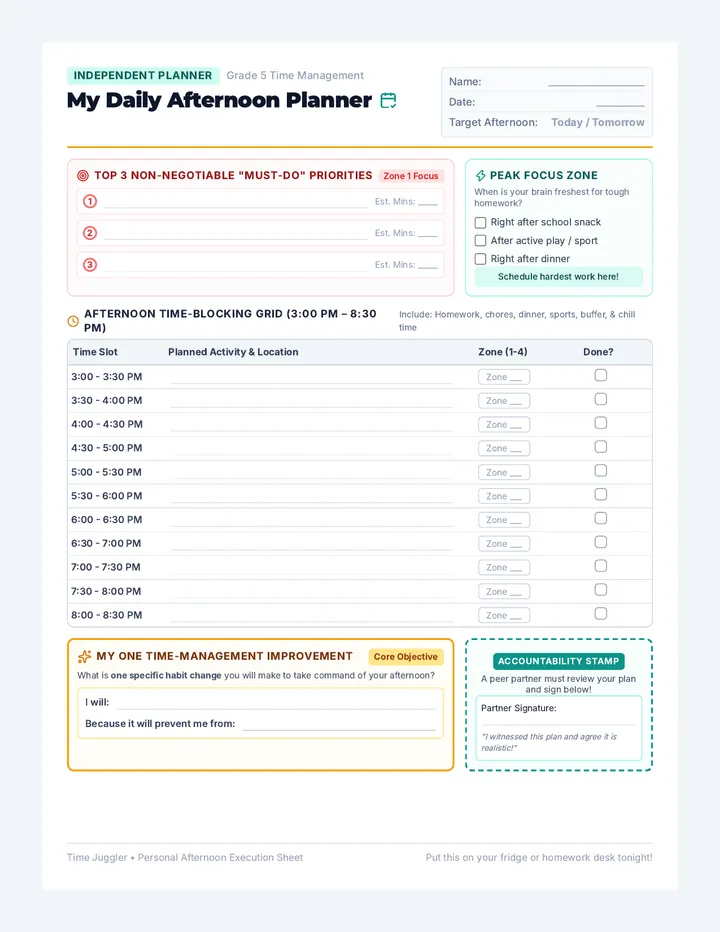
Daily Planner Template Independent Planner Grade 5 Time Management
My Daily Afternoon Planner
Name: ____________________
Date: __________
Target Afternoon: Today / Tomorrow
Top 3 Non-Negotiable "Must-Do" Priorities
Zone 1 Focus
1
Est. Mins: _____
2
Est. Mins: _____
3
Est. Mins: _____
Peak Focus Zone
When is your brain freshest for tough homework?
Right after school snack After active play / sport Right after dinner
Schedule hardest work here!
Afternoon Time-Blocking Grid (3:00 PM – 8:30 PM)
Include: Homework, chores, dinner, sports, buffer, & chill time
Time Slot
Planned Activity & Location
Zone (1-4)
Done?
3:00 - 3:30 PM
Zone ___
3:30 - 4:00 PM
Zone ___
4:00 - 4:30 PM
Zone ___
4:30 - 5:00 PM
Zone ___
5:00 - 5:30 PM
Zone ___
5:30 - 6:00 PM
Zone ___
6:00 - 6:30 PM
Zone ___
6:30 - 7:00 PM
Zone ___
7:00 - 7:30 PM
Zone ___
7:30 - 8:00 PM
Zone ___
8:00 - 8:30 PM
Zone ___
My One Time-Management Improvement
Core Objective
What is one specific habit change you will make to take command of your afternoon?
I will:
Because it will prevent me from:
Accountability Stamp
A peer partner must review your plan and sign below!
Partner Signature:
"I witnessed this plan and agree it is realistic!"
Time Juggler • Personal Afternoon Execution Sheet Put this on your fridge or homework desk tonight!