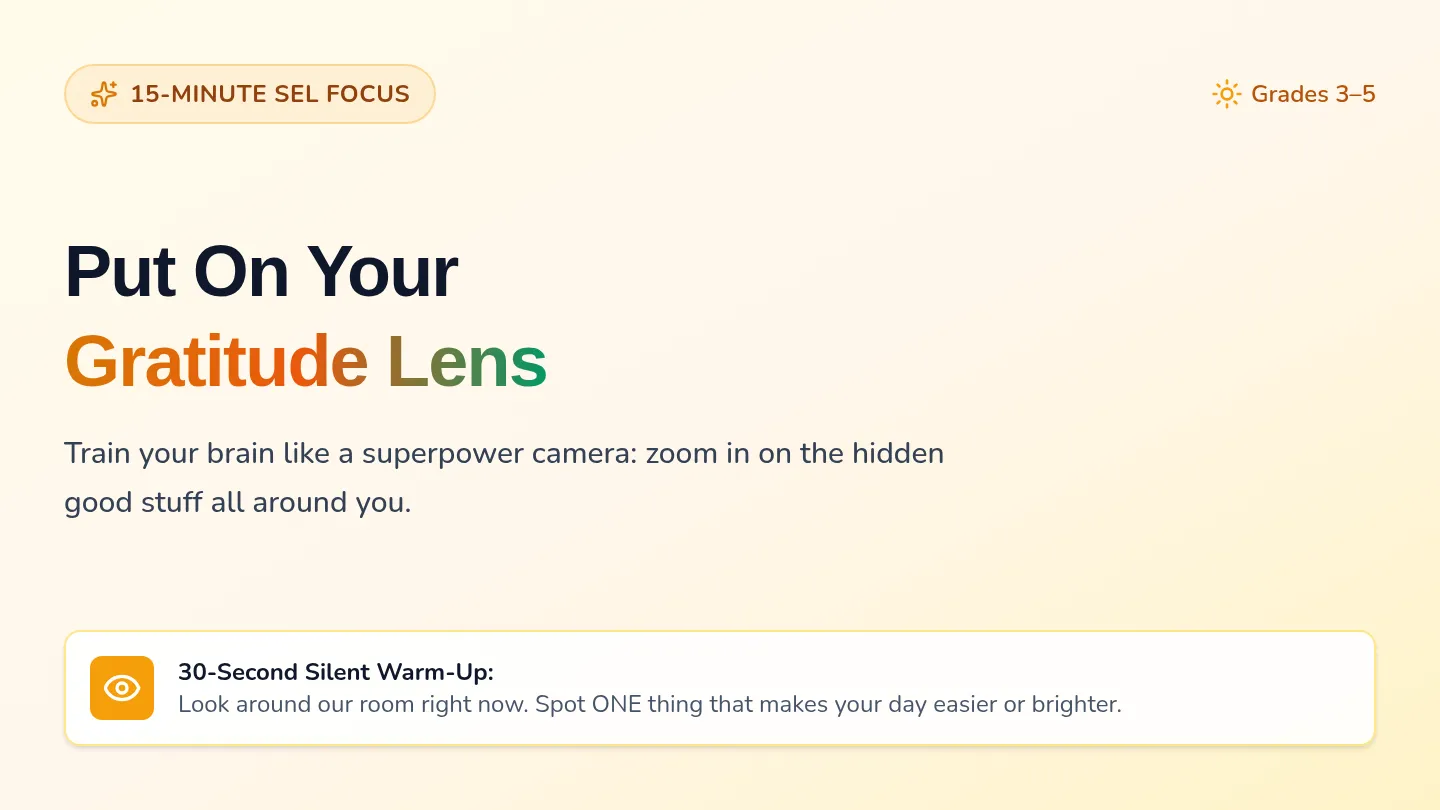
Gratitude Lens Slides 15-Minute SEL Focus
Grades 3–5
Put On Your
Gratitude Lens
Train your brain like a superpower camera: zoom in on the hidden good stuff all around you.
30-Second Silent Warm-Up:
Look around our room right now. Spot ONE thing that makes your day easier or brighter.
Step 1 • Focus
The 3 Zoom Modes
1. A Helper
Someone who helped, listened, smiled, or shared a kind word with you.
e.g., A friend, teacher, or bus driver
2. A Tiny Joy
A small moment that felt peaceful, funny, tasty, or cozy today.
e.g., Warm toast, a funny joke, fresh air
3. Everyday Tools
Ordinary objects we forget to notice that quietly make life work.
e.g., Running water, sneakers, books
Gratitude isn't pretending everything is perfect. It's noticing what is still good right now.
Step 2 • Science
The Gratitude Brain Boost
What Happens Inside
The 'Feel-Good' Wave
When you name something you are truly thankful for, your brain releases dopamine and serotonin .
Instant result: Heart rate slows down, anxiety shrinks, and focus sharpens.
The Muscle Rule
Neurons That Fire Together...
Your brain strengthens whatever you practice looking for. If you practice spotting kindness, your brain spots it automatically !
Just 60 seconds a day physically rewires your neural pathways.
Ready to train your brain right now? Let's use the G.I.F.T. formula!
Step 3 • Action
The 4-Step G.I.F.T. Practice
3 Minutes
G
Give It a Name
Pick one specific person, moment, or object from today.
I
Identify Detail
Why does it matter? What did it feel or sound like?
F
Feel the Warmth
Pause for 5 seconds and let that warm feeling settle in your chest.
T
Tell or Record
Write it on your worksheet or whisper it to a partner.
Grab your Gratitude Lens Worksheet now!
Fill in your 3 lenses silently (3 minutes)
Step 4 • Closing Circle
Gratitude Spotlight Whip-Around
3 Minutes
Pick ONE frame below to share quickly with the group:
A
"Through my gratitude lens, I noticed [person/thing] because [reason]."
B
"One tiny joy from my day so far was [moment]."
C
"I want to shout out [classmate's name] for [kind act]."
✨ Challenge: Deliver your tear-off Gratitude Telegram before the school day ends!
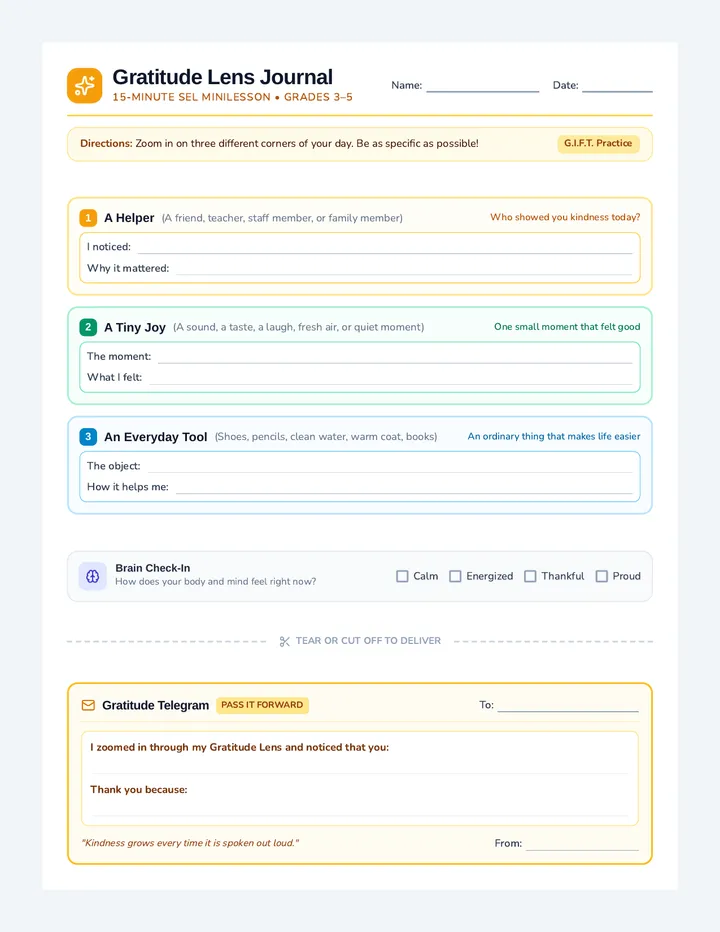
Gratitude Lens Worksheet Gratitude Lens Journal
15-Minute SEL Minilesson • Grades 3–5
Name:
Date:
Directions: Zoom in on three different corners of your day. Be as specific as possible!
G.I.F.T. Practice
1 A Helper (A friend, teacher, staff member, or family member)
Who showed you kindness today?
I noticed:
Why it mattered:
2 A Tiny Joy (A sound, a taste, a laugh, fresh air, or quiet moment)
One small moment that felt good
The moment:
What I felt:
3 An Everyday Tool (Shoes, pencils, clean water, warm coat, books)
An ordinary thing that makes life easier
The object:
How it helps me:
Brain Check-In
How does your body and mind feel right now?
Calm
Energized
Thankful
Proud
TEAR OR CUT OFF TO DELIVER
Gratitude Telegram Pass It Forward
To:
I zoomed in through my Gratitude Lens and noticed that you:
Thank you because:
"Kindness grows every time it is spoken out loud."
From:
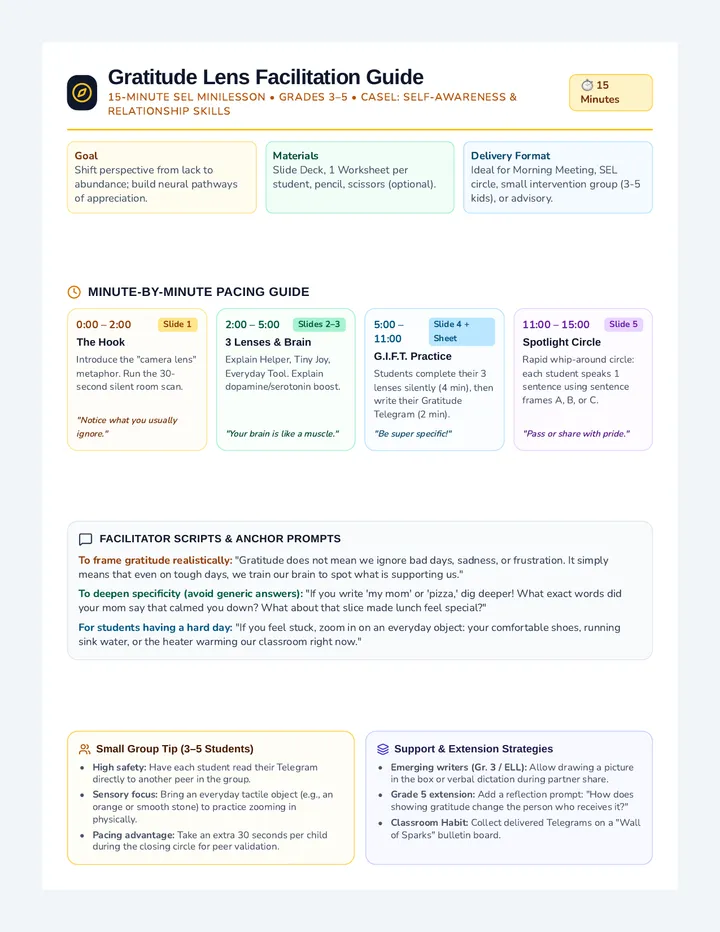
Gratitude Lens Facilitation Guide Gratitude Lens Facilitation Guide
15-Minute SEL Minilesson • Grades 3–5 • CASEL: Self-Awareness & Relationship Skills
⏱ 15 Minutes
Goal Shift perspective from lack to abundance; build neural pathways of appreciation.
Materials Slide Deck, 1 Worksheet per student, pencil, scissors (optional).
Delivery Format Ideal for Morning Meeting, SEL circle, small intervention group (3-5 kids), or advisory.
Minute-by-Minute Pacing Guide
0:00 – 2:00 Slide 1
The Hook
Introduce the "camera lens" metaphor. Run the 30-second silent room scan.
"Notice what you usually ignore."
2:00 – 5:00 Slides 2–3
3 Lenses & Brain
Explain Helper, Tiny Joy, Everyday Tool. Explain dopamine/serotonin boost.
"Your brain is like a muscle."
5:00 – 11:00 Slide 4 + Sheet
G.I.F.T. Practice
Students complete their 3 lenses silently (4 min), then write their Gratitude Telegram (2 min).
"Be super specific!"
11:00 – 15:00 Slide 5
Spotlight Circle
Rapid whip-around circle: each student speaks 1 sentence using sentence frames A, B, or C.
"Pass or share with pride."
Facilitator Scripts & Anchor Prompts
To frame gratitude realistically: "Gratitude does not mean we ignore bad days, sadness, or frustration. It simply means that even on tough days, we train our brain to spot what is supporting us."
To deepen specificity (avoid generic answers): "If you write 'my mom' or 'pizza,' dig deeper! What exact words did your mom say that calmed you down? What about that slice made lunch feel special?"
For students having a hard day: "If you feel stuck, zoom in on an everyday object: your comfortable shoes, running sink water, or the heater warming our classroom right now."
Small Group Tip (3–5 Students)
High safety: Have each student read their Telegram directly to another peer in the group.Sensory focus: Bring an everyday tactile object (e.g., an orange or smooth stone) to practice zooming in physically.Pacing advantage: Take an extra 30 seconds per child during the closing circle for peer validation.
Support & Extension Strategies
Emerging writers (Gr. 3 / ELL): Allow drawing a picture in the box or verbal dictation during partner share.Grade 5 extension: Add a reflection prompt: "How does showing gratitude change the person who receives it?"