Chill Skills Facilitation Guide Chill Skills
Unstress Your Best | Comprehensive Lesson Plan
Tier 2 Small Group • 9th Grade
Why This Matters
Learning to manage stress and anxiety is a crucial life skill that empowers students to navigate academic pressures, social challenges, and personal growth more effectively.
Program Structure
6 Sessions, 30 minutes each
Approach: Interactive discussions, practical exercises, and reflective activities.
Preparation Checklist
Review the Chill Skills Facilitation Guide, Presentation, and all supporting materials.
Ensure the classroom or group space is calm and conducive to discussion.
Print copies of the Warm-Up Journal and Cool-Down Reflection for each student.
Prepare materials for Session 3: Stress Busters Worksheet .
Session Facilitation
Session 1: What is Stress and Anxiety?
Time: 30 mins Slides: 1-7
Introduction (5 mins)
Welcome students. Emphasize that everyone experiences these feelings and this is a safe space.
Warm-Up Activity (5 mins)
Distribute Warm-Up Journal . Prompt students to write one word describing how they feel. Share in a round-robin.
Understanding Stress vs. Anxiety (10 mins)
Discuss definitions. Ask for examples of situations that cause stress/anxiety (briefly).
Physical/Emotional Signs (5 mins)
Identify how these feelings manifest in their own bodies and minds.
Cool-Down (5 mins)
Distribute Cool-Down Reflection . Write down one new thing learned.
Session 2: Triggers and Thoughts
Time: 30 mins Slides: 8-12
Recap: Briefly review Session 1 definitions. (5 mins)
Warm-Up: Journal entry: "One thing that ALWAYS makes you feel stressed." (5 mins)
Discussion: Brainstorm common triggers (school, friends, family). (10 mins)
Concept: Introduce how thoughts impact feelings (Power of Thoughts). (5 mins)
Cool-Down: Reframing a situation with a different thought. (5 mins)
Session 3: Stress-Busting Strategies
Time: 30 mins Slides: 13-17
Recap: Discuss triggers and thoughts from last time. (5 mins)
Warm-Up: Journal entry: "Your go-to way to relax/cope." (5 mins)
Discussion: Introduce various coping strategies (physical, creative, social). (10 mins)
Activity: Stress Busters Worksheet . Brainstorm new strategies. (5 mins)
Cool-Down: Commit to trying one new strategy this week. (5 mins)
Session 4: Mindfulness and Breathing
Time: 30 mins Slides: 18-23
Recap: Review coping strategies from Session 3. (5 mins)
Warm-Up: Silent one-minute breath observation. Write down feelings. (5 mins)
Concept: Define mindfulness (paying attention to the present without judgment). (10 mins)
Practice: Lead Mindfulness Moment Script breathing exercise. (5 mins)
Cool-Down: Describe the feeling of the breathing exercise. (5 mins)
Session 5: Healthy Habits for a Calm Mind
Time: 30 mins Slides: 24-29
Recap: How can mindful breathing help in the real world? (5 mins)
Warm-Up: Self-care snapshot: 3 things that made you feel good this week. (5 mins)
Concept: Discuss sleep, nutrition, activity, and connection. (10 mins)
Goal-Setting: Set one small, realistic healthy habit goal. (5 mins)
Cool-Down: Write a "well-being wish" for yourself. (5 mins)
Session 6: Building Your Resilience Toolkit
Time: 30 mins Slides: 30-34
Recap: Share updates on the healthy habit goals. (5 mins)
Warm-Up: Identify one personal strength/superpower. (5 mins)
Review: Summarize all 5 previous sessions. Resilience is ongoing. (10 mins)
Activity: List or draw the top 3-5 tools from the program. (5 mins)
Cool-Down: Message to future self about managing stress. (5 mins)
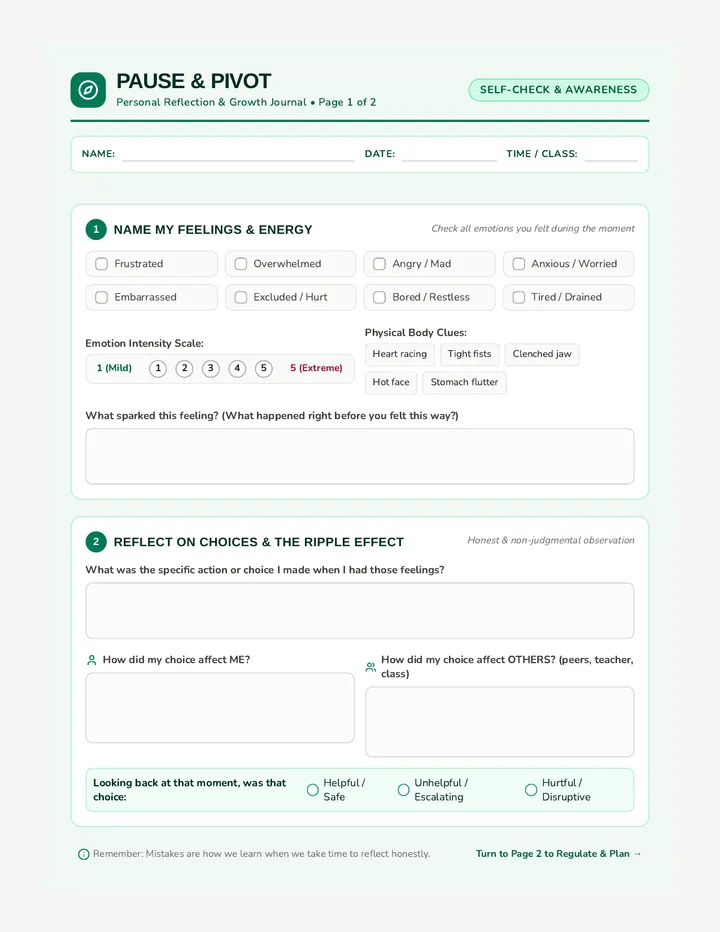
Chill Skills Warm Up Journal Chill Skills
Warm-Up Journal
Name: ____________________________________
Date: _____________________________________
This journal is for your quick reflections at the beginning of each session. Be honest with yourself – there are no right or wrong answers!
1
How Do You Feel?
In one word, how are you feeling right now?
2
What Fires You Up?
What is one thing that always makes you feel stressed or anxious?
3
My Go-To
What is one thing you currently do when you feel stressed or anxious that helps you relax or cope?
4
Notice Your Breath
Take one minute to simply notice your breath. Where do you feel it most? What is its rhythm? Write down what you observed.
5
My Self-Care Snapshot
Think about the last week. What are three things you did that made you feel good, physically or mentally? (Small or big!)
6
My Superpower
What is one strength you have that helps you get through tough times? (e.g., kindness, resilience, humor, creativity, problem-solving?)
Chill Skills Cool Down Reflection Chill Skills
Cool-Down Reflection
Name: ____________________________________
Date: _____________________________________
This journal is for your quick reflections at the end of each session. Think about what resonated with you today.
1
One New Idea
What is one new thing you learned or found interesting today about stress or anxiety?
2
A Shift in Perspective
Can you think of one situation where you might try to reframe a negative thought into a more helpful one?
3
My Next Step
From your Stress Busters Worksheet , what is ONE new strategy you will try this week?
4
Inner Calm
How did you feel during the mindful breathing exercise? What did you notice about your body or mind?
5
My Well-being Wish
What is one wish you have for your own well-being this week?
6
Forward Focus
Write a short message to your future self about managing stress and anxiety. What advice or reminder would you share?
Chill Skills Presentation Chill Skills
Unstress Your Best
A safe space to talk about feelings
Learn how your mind and body react
Discover tools to feel better
What's Our Goal?
Understand what stress and anxiety are
Identify your personal triggers
Learn effective coping strategies
Build resilience for daily life
Warm-Up
How do you feel?
In one word, how are you feeling right now?
What is
Stress?
Your body's reaction to a challenge or demand.
It's a normal, physical response.
Can be short-term (like a test).
Can even be positive (excitement)!
What is
Anxiety?
Worrying about future events or things you can't control.
More persistent than stress.
Feelings of dread or unease.
Often a reaction to perceived threats.
How does it show up?
Physical
• Fast heartbeat, tense muscles
• Headaches or stomach aches
• Difficulty sleeping
Emotional
• Irritability or restlessness
• Difficulty concentrating
• Feeling overwhelmed
Cool-Down
What is one new thing you learned today about stress or anxiety?
Reflect | Journal
Session 2
Triggers & Thoughts
Last time: Definitions and body signs.
Today: We explore why we feel them and how our minds react.
Warm-Up
What Fires You Up?
What is one thing that always makes you feel stressed or anxious?
Identifying Triggers
🏫 School
Tests, presentations, grades, homework
👥 Social
Friend drama, fitting in, peer pressure
🚀 Future
College, jobs, what comes next
🏠 Family
Expectations, arguments, chores
The Power of Your Thoughts
How you think about a situation can change how you feel about it.
Negative Thought
"I'm going to fail this test."
Stress Busters Worksheet Stress Busters
Your Personal Coping Toolbox
Name: __________________________
Sometimes stress and anxiety can feel overwhelming, but there are many things you can do to help yourself feel better! This worksheet will help you think about what you already do, and what new strategies you might want to try.
1 My Current Coping Strategies
Think about times you feel stressed or anxious. What do you currently do to help yourself cope or feel better? List as many as you can!
2 New Strategies to Try!
Read through these common stress-busting ideas. Circle any that sound interesting to you, then choose 3-5 to add to your list below.
Physical Activities
• Go for a walk or run
• Stretch or do yoga
• Dance to your favorite music
• Play a sport
Mindfulness & Calm
• Deep breathing exercises
• Listen to calming music
• Spend time in nature
• Practice meditation (5 mins)
Creative Outlets
• Draw, paint, or color
• Write in a journal or story
• Play a musical instrument
• Sing along loudly
Social Connection
• Talk to a trusted friend
• Spend time with a pet
• Join a club or group
• Volunteer your time
Distraction & Fun
• Watch a funny movie
• Read a book
• Play a game (board/video)
• Do a puzzle
Healthy Habits
• Get 8-10 hours of sleep
• Eat healthy snacks
• Limit screen time
• Help someone else
My Top 3-5 New Stress Busters to Try:
Which ONE will you try first?
Mindfulness Moment Script Mindfulness Moment
Teacher Script: Guided Breathing Practice
Facilitator Note
Read this script in a calm, slow, and steady voice. Pause where indicated to allow students time to experience the sensations. This exercise is best practiced in a quiet environment with minimal distractions.
Introduction: "Alright everyone, let's take a few moments to practice mindful breathing. This is a simple exercise to help us calm our minds and bring our attention to the present moment. You don't need to do anything special, just follow my voice."
"First, find a comfortable position in your chair. You can sit upright with your feet flat on the floor, or if it feels more comfortable, you can lean back slightly. Allow your hands to rest gently in your lap or on your desk."
"Now, if you feel comfortable, gently close your eyes, or you can soften your gaze by looking down at a spot in front of you. This helps to reduce distractions."
(Wait for everyone to get settled and close their eyes.)
"Let's take a few deep breaths together to start. Inhale slowly through your nose... filling your lungs... and exhale slowly through your mouth... letting go of any tension."
"Again, inhale deeply... and exhale completely."
"Now, return to your natural breath. You don't need to change anything about it. Just observe it. Notice the sensation of the air as it enters your nostrils... cool and fresh... and as it leaves your body... perhaps a little warmer."
"Feel your belly gently rise with each inhale... and fall with each exhale. You might place a hand on your stomach if that helps you feel this movement."
"Just focus on the rhythm of your breath. If your mind starts to wander, that's perfectly normal. Our minds love to think! When you notice your thoughts drifting, gently guide your attention back to the sensation of your breath."
[Pause for 1-2 minutes of quiet practice]
"Now, slowly bring your awareness back to the room. Wiggle your fingers and toes. If your eyes were closed, gently open them."
"Take one last deep breath, and on the exhale, release any lingering tension."
Debrief: "How does everyone feel? What did you notice during that short practice? Don't worry if it felt strange, it's a skill we build over time."