Session 1 Lesson Plan Teacher Guide The Spark
Session 1 Lesson Plan: Identifying Triggers
Duration 30 MIN
Objective
Student will identify personal anger triggers and increase self-awareness by completing a worksheet and discussing feelings.
Why This Matters
Recognizing what makes us angry and how it feels is the first step to managing emotions. This session builds the foundation for healthy coping strategies.
Prep & Materials
Review the Anger Triggers Worksheet and the Feelings Thermometer Chart .
Print one copy of each student worksheet.
Have pens and a quiet, comfortable space ready.
Session Timeline
0-5
min
Greeting and Rapport
Welcome the student and engage in brief small talk to build trust.
Explain confidentiality and the session's purpose: understanding emotions.
Introduce goal: exploring what triggers anger and body sensations.
5-15
min
Define Anger and Identify Triggers
Ask: "What does anger feel like for you?"
Define anger: an emotion signaling discomfort or injustice.
Distribute Anger Triggers Worksheet .
Guide the student through listing situations or people that trigger anger.
15-25
min
Introduce Feelings Thermometer
Explain the Feelings Thermometer Chart as a tool for emotional intensity.
Model marking levels (1 = calm, 10 = explosive).
Ask student to mark current state and connect triggers to thermometer levels.
25-30
min
Wrap-Up and Reflection
Summarize takeaways: key triggers and intensity awareness.
Preview next session: deep breathing as a calming skill.
Ask student to notice one angry situation before next meeting.
Facilitator Notes
Keep the tone supportive and validate the student's feelings. Use the Discussion Guide for deeper prompts. If the student struggles to identify triggers, suggest common ones like "feeling unheard" or "unfair rules" to help jumpstart the conversation.
Anger Triggers Worksheet Anger Triggers
Session 1: Exploring what sparks your emotions.
Name:
Date:
Use this worksheet to explore what makes you feel angry. Be as honest and detailed as you can.
Part 1: Situations that Make Me Angry
Describe what happens, rate your anger, and note any physical signs (like a racing heart or clenched fists).
1. Situation
What did you notice in your body or emotions?
Anger Level
____
2. Situation
What did you notice in your body or emotions?
Anger Level
____
3. Situation
What did you notice in your body or emotions?
Anger Level
____
Part 2: People or Places That Trigger Me
List at least three people or places that often trigger your anger.
1
2
3
Part 3: Thoughts and Feelings
What thoughts or self-talk run through your mind when you feel angry?
Reflection
Which trigger surprised you the most, and why do you think it affects you so strongly?
Feelings Thermometer Chart Worksheet Feelings Thermometer
Measuring the heat of your emotions.
Name:
Date:
10
Very Angry / Furious Complete loss of control, screaming, physical outburst.
9
Almost Exploding Feeling "seeing red" or ready to snap.
8
Extremely Upset
7
Very Upset
6
More Frustrated
5
Frustrated Hard to focus, feeling tense or irritable.
4
Noticeably Upset
3
Mildly Frustrated
2
Slightly Annoyed
1
Calm & Relaxed Feeling peaceful, steady, and in control.
Current Check-In
Circle your current number:
1 2 3 4 5 6 7 8 9 10
Connect to a Situation
Situation:
Level on the Chart:
Quick Reflection
Why did you choose that level for this situation?
Session 1 Discussion Guide Teacher Resource Discussion Guide
Session 1: Decoding the Spark
Teacher Instructions
Use this guide to lead a one-on-one conversation after the student completes the Anger Triggers Worksheet and marks their feelings on the Feelings Thermometer Chart . Encourage honesty, validate feelings, and keep the tone supportive.
1 Warm-Up and Check-In (5 Minutes)
Begin with a calm greeting and thank the student for their effort.
Ask: "How was it for you to think back on those angry situations?"Ask: "What stood out most as you filled in your triggers and body sensations?"Follow-up: "Was there anything surprising or new you learned about yourself today?"
2 Exploring Part 1: Situations (10 Minutes)
Invite the student to choose one situation from Part 1 that felt most significant.
"Tell me more about that situation. What happened, and why do you think it upset you?"
Ask about intensity:
"You rated that anger at [rating]. How did your body feel at that level?"
"Where do you notice that feeling—chest, throat, stomach?"
Validation Prompt: "It makes sense you’d feel that way when..."
Creative Prompt: "If that emotion had a color or a sound, what would it be?"
3 Connecting to the Thermometer (5 Minutes)
Have the student point to where each situation falls on the chart.
Discuss: "What patterns do you see? Which triggers push you close to a 9 or 10?"Discuss: "Is there a common theme—like feeling disrespected or left out—that shows up at higher levels?"
4 Thoughts and Self-Talk (5 Minutes)
Refer to Part 3 of the worksheet.
Ask: "What thoughts ran through your head when you felt angry?"Ask: "How do those thoughts make you feel? Do they calm you or stir you up more?"
Teacher Guidelines
• Use open-ended questions.
• Avoid judgmental responses.
• Keep confidentiality.
Wrap-Up Tip
Affirm their effort. Reminder: Mastering anger takes time and practice. Preview the deep breathing exercise for next time.
Session 2 Lesson Plan Teacher Guide Chill The Chill
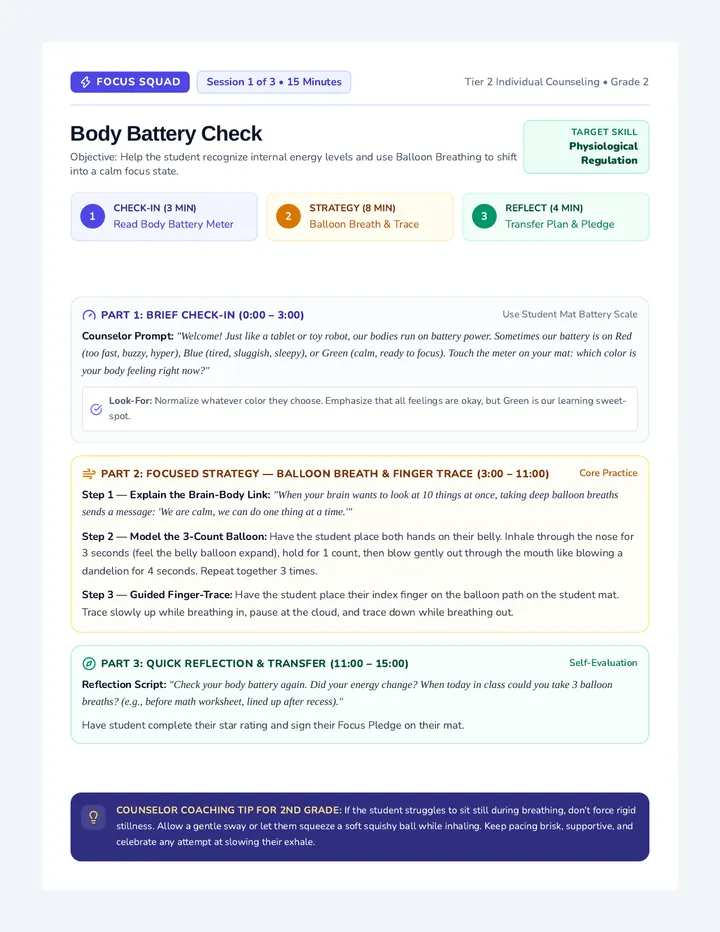
Session 2 Lesson Plan: Deep Breathing
Duration 30 MIN
Objective
Student will learn and practice deep breathing as a coping skill for anger and understand its immediate calming effects on the body.
The "Why"
Deep breathing is a powerful, accessible tool that can be used anywhere, anytime to calm the body and mind, giving students a practical way to respond to anger.
Prep & Materials
Review the Deep Breathing Exercise Guide .
Have the Feelings Thermometer from Session 1 ready.
Plan how to model the breathing technique clearly.
Session Timeline
0-5
min
Check-in & Review
Welcome the student and check in on their week.
Review triggers identified in Session 1.
Use the Feelings Thermometer to check current status.
5-15
min
Introduce Deep Breathing
Explain the science: deep breathing slows heart rate and calms the nervous system.
Ask: "Have you ever noticed your breath changing when you're mad?"
Model the technique (4-7-8 breathing) using the guide.
15-25
min
Guided Practice & Application
Guide student through 3-5 rounds of breathing.
Visualize a mild trigger (3-4 on thermometer) and practice breathing.
Discuss physical changes felt after breathing.
25-30
min
Wrap-Up & Homework
Encourage daily practice, even when calm.
Preview next session: Cognitive Reframing (changing thoughts).
Homework: Notice thoughts during an angry moment.
Coaching Tip
Some students might find slow breathing difficult at first. If 4-7-8 is too long, shorten the counts proportionally (e.g., 2-3-4). The key is making the exhale longer than the inhale to activate the body's relaxation response.
Deep Breathing Guide Student Worksheet The Calm-Down Breath
Your secret superpower for finding your chill.
Name:
Date:
Why it works
When you get angry, your body goes into "Fight or Flight" mode. Your heart beats faster and your breathing gets shallow.
Deep breathing sends a signal to your brain that says, "Hey, we're safe." It slows your heart down and helps you think clearly again.
The Goal
Practice this until it becomes a habit. It works best when you catch the "spark" early!
The Technique: 4-7-8
1
Inhale Slowly
Close your mouth and breathe in through your nose for a count of 4 . Imagine your belly filling like a balloon.
2
Hold Your Breath
Gently hold your breath for a count of 7 . Stay relaxed; no need to squeeze tight.
3
Exhale Completely
Whoosh the air out through your mouth for a count of 8 . Feel your body release tension.
When to use
When you notice a trigger.
Before reacting
Take 3 breaths before speaking.
Every Day
Practice even when you're calm.
Self-Reflection
How does your body feel before and after taking a few "Calm-Down Breaths"?
Session 3 Lesson Plan Pivot The Pivot
Session 3 Lesson Plan: Cognitive Reframing
Duration 30 MIN
Objective
Student will learn to identify "Hot Thoughts" (thoughts that fuel anger) and practice flipping them into "Cool Thoughts" (more balanced, helpful perspectives).
The "Why"
Our thoughts are the fuel for our emotions. By changing how we interpret a situation, we can lower our emotional intensity on the thermometer.
Materials Needed
Thought Detective Worksheet .Student's Trigger list from Session 1.
Red and Blue pens (optional but helpful).
Instructional Steps
0-5
min
Review & Link
Check in on breathing practice. Explain that while breathing calms the body , today we will calm the mind .
5-15
min
Hot vs. Cool Thoughts
Explain Hot Thoughts (exaggerated, "they always...", "it's unfair") and Cool Thoughts (realistic, "this is annoying but I can handle it"). Model flipping a thought.
15-25
min
Detective Work
Complete the Thought Detective Worksheet . Use a real trigger from the student's list and identify the "Hot Thought" behind it.
25-30
min
The Pivot Practice
Practice "Pivoting" in the moment. When they notice a hot thought, they should pause and ask: "Is there another way to look at this?"
Teacher Note
Middle schoolers often feel that "Cool Thoughts" are just making excuses for others. Emphasize that reframing isn't about letting people off the hook—it's about protecting their own peace .
Thought Detective Worksheet Pivot Thought Detective
Session 3: Investigating the "Hot Thoughts" that fuel anger.
Name:
Date:
Hot Thoughts
These make you feel more angry. They use words like always , never , and it's not fair .
Cool Thoughts
These help you stay calm. They focus on facts and solutions rather than blame.
Practice Case
Situation
A friend walks past you in the hall and doesn't say hi.
Hot Thought
"They are ignoring me on purpose! They're so fake."
The Pivot (Cool Thought)
"Maybe they didn't see me or they're having a bad day. I'll check in later."
Investigate Your Thoughts
1. Recent Situation
What was the "Hot Thought"?
Pivot to a "Cool Thought":
2. Potential Trigger (Something that might happen)
Potential "Hot Thought"?
Better "Cool Thought":
Case Dismissed
How does your anger level (1-10) change when you switch from a Hot Thought to a Cool Thought?
Session 4 Lesson Plan Voice The Voice
Session 4 Lesson Plan: Assertive Communication
Duration 30 MIN
Objective
Student will differentiate between passive, aggressive, and assertive communication and practice using "I Statements" to express needs respectfully.
The "Why"
Anger often comes from unmet needs. Assertive communication allows us to speak up for ourselves without creating more conflict through aggression or resentment through passivity.
Prep & Materials
Assertive Communication Toolkit .Examples of common 7th-grade conflicts (social media, teachers, parents).
Instructional Flow
0-5
min
Check-In
Review "Cool Thoughts" from last week. Did any "Hot Thoughts" pop up? How did they pivot?
5-15
min
Communication Styles
Define the 3 styles: Passive (Moth), Aggressive (Bear), Assertive (Human). Use the reference sheet to show the differences in body language and tone.
15-25
min
The "I" Statement Formula
Practice the formula: "I feel [feeling] when [behavior] because [impact]. I would like [request]." Practice with one trigger from the student's list.
25-30
min
Wrap-Up
Encourage using one "I Statement" this week. Preview next session: Real-Life Scenarios (Role Play) .
Pro Tip
Assertiveness isn't just what you say, it's how you say it . Remind the student about eye contact, a steady voice volume, and keeping their body "open" rather than "closed" (folded arms).
Assertive Communication Toolkit Student Worksheet Communication Toolkit
Session 4: Speaking up for yourself with confidence.
Name:
Date:
Step 1: Choose Your Style
Passive
"The Moth"
You don't say what you want. You hope others will guess. You feel ignored.
Aggressive
"The Bear"
You demand what you want. You blame others. You feel like everyone is against you.
Assertive
"The Professional"
You state your needs clearly. You respect yourself and others. You feel heard.
Step 2: The "I Statement" Blueprint
The Start
"I feel..."
The Trigger
"When..."
The Why
"Because..."
The Goal
"I want..."
Example:
"I feel annoyed when you take my pen without asking because I need it for class . I want you to ask me first next time ."
Step 3: Practice Lab
Scenario: A classmate keeps talking over you while you're trying to work.
I Feel...
When...
Because...
I Want...
Choose your own trigger from Session 1:
I Feel...
When...
Because...
I Want...
Session 5 Lesson Plan Rehearsal Integration The Rehearsal
Session 5 Lesson Plan: Skill Integration
Duration 30 MIN
Objective
Student will integrate and practice all learned anger management skills (breathing, reframing, "I" statements) through structured role-playing of real-life scenarios.
Why Practice?
Under stress, we revert to habits. Role-playing builds "muscle memory" for the brain, making it easier for the student to use these skills when real anger strikes.
Session Kit
Scenario Cards (cut and ready).Feelings Thermometer (visual reference).
The Practice Loop
0-5
min
Warm-Up Check-in
Briefly review the 3 pillars: Breathe (Body), Pivot (Mind), Speak (Voice). Rate current mood on the thermometer.
5-25
min
The Practice Lab (Role Play)
Draw a Scenario Card. For each card, follow the "Calm Blueprint":
Analyze: Where would this be on the thermometer?Pause: Model 2 rounds of deep breathing.Pivot: Identify the "Hot Thought" and flip it to a "Cool Thought."Speak: Deliver an assertive "I Statement" to the teacher (acting as the other person).
25-30
min
Feedback & Wrap-up
What felt the hardest? What felt the most natural? Preview final session: Graduation & Maintenance Plan .
Facilitator Note
Don't be afraid to ham it up! If the student is aggressive in the role-play, stay in character (assertively) to show them the impact. If they are too passive, encourage them to "level up" their volume and eye contact. Celebrate every small win!
Scenario Cards Integration Scenario Lab Cards
Practice using your tools in these real-life situations.
Instructions: Cut out these cards. For each card, decide the Thermometer Level , take 3 Calm-Down Breaths , find a Cool Thought , and practice an I Statement .
Scenario 01
The Group Project
You're in a group of three. The other two people are talking about their weekend and aren't doing any of the work, leaving it all to you.
Level: ____
Practiced?
Scenario 02
The Group Chat
You see a message in the group chat where someone is making fun of your new shoes, and everyone else is "reacting" with laugh emojis.
Level: ____
Practiced?
Scenario 03
The Teacher's Mistake
Your teacher gives you a 'C' on an assignment. You're 100% sure you followed the instructions perfectly and deserve an 'A'.
Level: ____
Practiced?
Scenario 04
The Chore War
You just finished a mountain of homework. Your parent walks in and immediately starts yelling at you to clean your room right now.
Level: ____
Practiced?
Scenario 05
The Borrowed Shirt
You go to your closet to find your favorite shirt, only to realize your sibling took it without asking and spilled juice on it.
Level: ____
Practiced?
Scenario 06
The Cafeteria Cut
You've been waiting in the lunch line for 10 minutes. Just as you get to the front, someone cuts right in front of you.
Level: ____
Practiced?
Session 6 Lesson Plan Mastery Review The Mastery
Session 6 Lesson Plan: Review & Maintenance
Duration 30 MIN
Objective
Student will summarize their progress, identify their most effective tools, and create a long-term plan for emotional regulation.
Closing Thoughts
Mastering anger is a lifelong journey. This final session transitions the student from guided practice to independent application, ensuring they have a "blueprint" to follow when challenges arise.
Final Portfolio
Gather all previous worksheets (Triggers, Thermometer, Thoughts, Communication).
My Calm Blueprint (Mastery Sheet).
The Final Meeting
0-5
min
Reflection
Reflect on the past 6 sessions. What was the most helpful thing learned? Where have they seen improvement?
5-20
min
Building the Blueprint
Complete the My Calm Blueprint . This becomes their reference guide. They should choose their "Top 3" triggers and the specific tools they will use for each.
20-30
min
Graduation & Future Planning
Discuss what to do if they have a "Level 10" moment in the future. Who can they talk to? How will they reset? End by celebrating their hard work and dedication.
Teacher Note
Even after 6 sessions, students will still have bad days. Reinforce that progress is not linear . A slip-up doesn't mean they failed; it just means they need to consult their blueprint and try again.
My Calm Blueprint Summary Sheet My Calm Blueprint
Your personalized architecture for emotional regulation.
Mastery Level
The Chill
Body Regulation
4-7-8 Breathing
The Pivot
Mind Reframing
Hot Thoughts → Cool
The Voice
Clear Communication
Assertive "I" Statements
Action Architecture
Trigger Project 01
When this happens...
I will use this tool...
Trigger Project 02
When this happens...
I will use this tool...
Trigger Project 03
When this happens...
I will use this tool...
Emergency Reset
If I feel a Level 10, I will...
A safe person I can talk to is...
Design Certified / Anger Architecture / Session 06 Graduation