Temper Tiger Lesson Plan Taming the Temper Tiger
Tier 3 Individual Intervention Guide
IEP Support
Duration
6 Sessions × 20 Min
Audience
Individual Student
Core Goal
Self-Regulation & Trigger Awareness
Why This Matters
Understanding the physical and emotional cues of anger and anxiety is the first step towards managing them. This lesson helps students build self-awareness, which is crucial for preventing future outbursts and developing healthier coping mechanisms.
Preparation
Review Materials: Spend 5 minutes before each session reviewing the slide deck, readings, and worksheets.Environment: Ensure a comfortable, private space for the individual session.Props: Gather a small mirror (for expressions), paper, coloring supplies, a "breathing buddy" (stuffed animal), and scenario cards.Personalization: For Week 2, have relevant (but anonymous) examples ready to help illustrate triggers.
Weekly Intervention Flow
Week 1: Understanding My Feelings 20 Min
Objective: Identify physical manifestations of anger/anxiety.
Use slide deck to intro concepts; Read "What's Happening Inside Me?"; Play Emotion Charades; Complete "My Anger & Anxiety Meter".
Week 2: Identifying My Triggers 20 Min
Objective: Recognize personal triggers and early warning signs.
Read "What Makes My Tiger Roar?"; Complete Trigger Tracker; Use Scenario Cards to practice identification.
Week 3: My Calming Toolbox 20 Min
Objective: Build and practice a set of coping strategies.
Introduce strategies; Reading "Calm Down Corner"; Practice "Breathing Buddies"; Fill out Toolbox Worksheet.
Week 4: Thoughts and Choices 20 Min
Objective: Explore the link between thoughts, feelings, and actions.
Read "Think Before You Act"; Become a "Thought Detective"; Role-play different solutions to scenarios.
Week 5: Communicating My Needs 20 Min
Objective: Develop assertive communication and self-advocacy.
Read "Talking It Out"; Practice "I" Statements on worksheet; Activity: "How to Ask for Help".
Week 6: Celebrating Growth & Planning 20 Min
Objective: Reflect on progress and create a future success plan.
Read "Self-Regulation Superpowers"; Complete Progress Journal; Create "Future Me" maintenance plan.
Temper Tiger Slide Deck Taming the Temper Tiger
Understanding our feelings helps us be in charge!
Teacher Note: Set a calm, supportive tone. Recap the purpose of learning to manage big feelings.
Big Feelings, Little You?
Everyone gets angry or anxious sometimes. It's okay to feel!
It's what we do next that matters.
Teacher Note: Explain that these feelings are normal, but our reactions matter. Use simple, direct language.
How Do Feelings Feel?
Heart racing?
Tummy ache?
Clenched fists?
Fast breathing?
Our bodies tell us a lot!
Teacher Note: Discuss physical cues. Ask student about their own experiences. Relates to Week 1 Worksheet.
What Makes Feelings Grow?
Sometimes things happen that make our feelings bigger. These are called "triggers."
Can you think of any triggers?
Teacher Note: Introduce recognition of triggers as a key step to managing reactions.
Tools For Our Feelings
We can learn ways to feel better when feelings get too big.
Tools
Superpowers
Teacher Note: Briefly introduce coping strategies. Emphasize learning many tools throughout the sessions.
You're Doing Great!
Every time we talk about our feelings, we get better at understanding them. Keep up the good work!
Teacher Note: Encourage reflection on today's session. Reinforce that practice makes perfect.
Inside Me Reading What's Happening Inside Me?
Week 1: Body Cues Reading
Have you ever felt a rumble in your tummy when you're nervous about something? Or maybe your hands get tight when you're super frustrated?
These are your body's ways of telling you how you feel! Our feelings aren't just in our heads; they show up in our bodies too. When we learn to listen to our bodies, we can catch big feelings before they get too loud.
When you feel ANGRY...
Your body might feel like a volcano ready to erupt!
Heart beats fast like a drum
Muscles get tight and stiff
Face feels hot or red
Wanting to shout or stomp
When you feel ANXIOUS...
That's a fancy word for worried or nervous.
Butterflies in your stomach
Hands feel sweaty or shaky
Breathing faster
Mind racing with "What ifs?"
Your body is a smart detective! What cues do you notice most?
Feelings Meter Worksheet My Anger & Anxiety Meter
Week 1: Body Cue Investigation
Name: __________________________
Date: __________________________
How does anger or anxiety feel in YOUR body? Draw or write what you notice at each level.
Level 1: Green Zone Calm & Happy
How do I feel?
My body feels like...
Level 2: Yellow Zone A Little Uncomfortable
How do I feel?
My body feels like...
Level 3: Orange Zone Getting Bigger
How do I feel?
My body feels like...
Level 4: Red Zone Out of Control!
How do I feel?
My body feels like...
Emotion Charades Activity Emotion Charades
Week 1: Physical Expression Activity
Objective
Help the student recognize and express different emotions through body language and facial expressions, building the connection between feeling and physical appearance.
Teacher Prep
Gather a small mirror. Review the emotion list below. Ensure a private space where the student feels comfortable acting out feelings.
How to Play
1
The teacher secretly chooses an emotion from the list. Act it out without speaking, using only your face and body.
2
The student guesses the emotion. Ask: "What did you notice about my face or hands that gave it away?"
3
Switch roles! Let the student choose an emotion to act out. Have them use the mirror to see their own expression if they wish.
Emotion List
Happy
Sad
Angry
Scared
Surprised
Excited
Anxious
Frustrated
Calm
Discussion Prompts
• "What did you notice about my face when I was acting out frustration?"
• "How did your body feel when you acted out being anxious?"
• "Is it easy or hard to tell how someone feels just by looking at them?"
• "When we feel the 'Temper Tiger' starting, what do our hands often do?"
Feelings Reflection Guide Talking About Feelings
Week 1: Reflection & Review
Teacher: Use this guide to facilitate a reflective conversation at the end of the session. Focus on validating the student's experience and reinforcing the concept of body cues.
01. What was one new thing you learned today about anger or anxiety?
02. Can you tell me about a time you felt angry? What did your body feel like?
03. Can you tell me about a time you felt anxious or worried? What did your body feel like then?
04. Why is it important to notice how our bodies feel when we're starting to get angry or anxious?
05. What's one thing you want to remember about your feelings this week?
Teacher Notes & Strategy
Reiterate that all feelings are okay . Noticing them is a strength.
Noticing early signs is a superpower that helps us make better choices.
Trigger Reading Passage What Makes My Tiger Roar?
Week 2: Emotion Detective Skills
Last week, we talked about how anger and anxiety feel inside our bodies. This week, we're going to be 'Emotion Detectives' and find out WHAT makes those feelings start.
Just like a real tiger might roar when it's hungry or scared, our "temper tigers" (our angry or anxious feelings) also have reasons why they show up. These reasons are called triggers .
A trigger is something that happens that makes a strong feeling start to grow inside you.
Words: When someone makes fun of you or says something mean.
Actions: When someone takes your things without asking.
Sights: Seeing something scary or seeing someone being unfair.
Sounds: Loud noises, yelling, or sudden sounds.
Internal: Being super tired, hungry, or just not feeling well.
Thinking about what happened before you started feeling angry or anxious can help you find your triggers. When you know your triggers, it's like having a superpower!
You can start to predict when your tiger might want to roar, and you can get ready to calm it down BEFORE it gets too big!
Trigger Tracker Worksheet My Trigger Tracker
Week 2: Emotion Detective Case File
Name: __________________________
Think about recent times you felt angry or anxious. What happened right before that feeling started?
Case #01
What happened? (The Trigger)
How did I feel?
How did my body feel?
Case #02
What happened? (The Trigger)
How did I feel?
How did my body feel?
Case #03
What happened? (The Trigger)
How did I feel?
How did my body feel?
Case Reflection
What did you notice about your triggers? Are they usually about people, things that happen, or how you feel inside?
Trigger Scenario Cards Scenario Cards
Week 2: Trigger Detective Practice
Objective
Practice identifying potential triggers in different situations. For each card, the student will identify the feeling (Anger, Anxiety, or Both) and explain why it's a trigger for them.
Scenario A
You are building a tall tower with blocks, and your little brother/sister comes and knocks it down without asking.
Feeling:
Why?
Scenario B
You have a big test tomorrow in a subject you find difficult, and you haven't finished studying yet.
Feeling:
Why?
Scenario C
You are playing a game with friends, and one friend keeps changing the rules to make themselves win.
Feeling:
Why?
Scenario D
You are going to a new place you've never been before, and you don't know anyone there.
Feeling:
Why?
Scenario E
Your favorite TV show is on, and your parent tells you it's time to turn it off and do chores.
Feeling:
Why?
Teacher Tips
• Connect scenarios to the student's own life.
• Emphasize that different things trigger different people.
• There are no wrong answers in trigger identification.
Unpacking Triggers Discussion Guide Unpacking Triggers
Week 2: Reflection & Review
Teacher: Gently connect the concept of triggers to the student's personal experience. Frame it as learning about the "Tiger's" habits, not blaming the student.
1. What does the word "trigger" mean in our 'Temper Tiger' lesson?
2. Based on our activity today, what are some triggers you noticed for yourself?
3. Why is it important to know our triggers? How does it help us stay in charge?
4. Can you think of a trigger that might have led to the situation at home recently?
(Discuss only if student is comfortable. Focus on the moment BEFORE the outburst.)
5. What is ONE trigger you want to be extra aware of this week?
Key Takeaway
"Knowing the trigger gives you the lead time to use a calming tool before the 'roar' happens."
Growth Mindset
Praise the student for the courage it takes to look at difficult moments with curiosity.
Calming Toolbox Reading Calm Down Corner
Week 3: Building Your Toolbox
Last week, we found out what makes our "temper tiger" start to roar – our triggers! That's a huge step. But what do we do when our tiger DOES start to get big?
This week, we're building your Calming Toolbox ! This is a special set of "tools" or strategies that help you feel better when anger or anxiety bubbles up. Think of it like putting ice on a stubbed toe—different feelings need different tools!
Deep Breaths
Smell the flower (3 counts), blow out the candle (5 counts).
Count to Ten
Take a moment to count slowly. Let the big feeling pass by.
Movement
Go for a walk, do jumping jacks, or stretch your muscles.
Talk About It
Find a trusted grown-up and tell them how you're feeling.
Distraction
Read, draw, listen to music, or play with a favorite toy.
Safe Space
Go to a quiet place where you can be by yourself for a bit.
It's important to find what works best for YOU. Your toolbox will be special because it's full of your favorites!
My Calming Toolbox Worksheet My Calming Toolbox
Week 3: Choice & Practice
Name: __________________________
Pick 3 to 5 tools you want to try when anger or anxiety gets big. Draw or write them in the boxes below!
1 Tool Name:
How I will use it:
2 Tool Name:
How I will use it:
3 Tool Name:
How I will use it:
4 Tool Name:
How I will use it:
Commit to Practice
Which tool are you MOST excited to try this week?
Where is a "Safe Place" you can go at home or school?
Personal Calming Plan • Tier 3 Intervention Resource
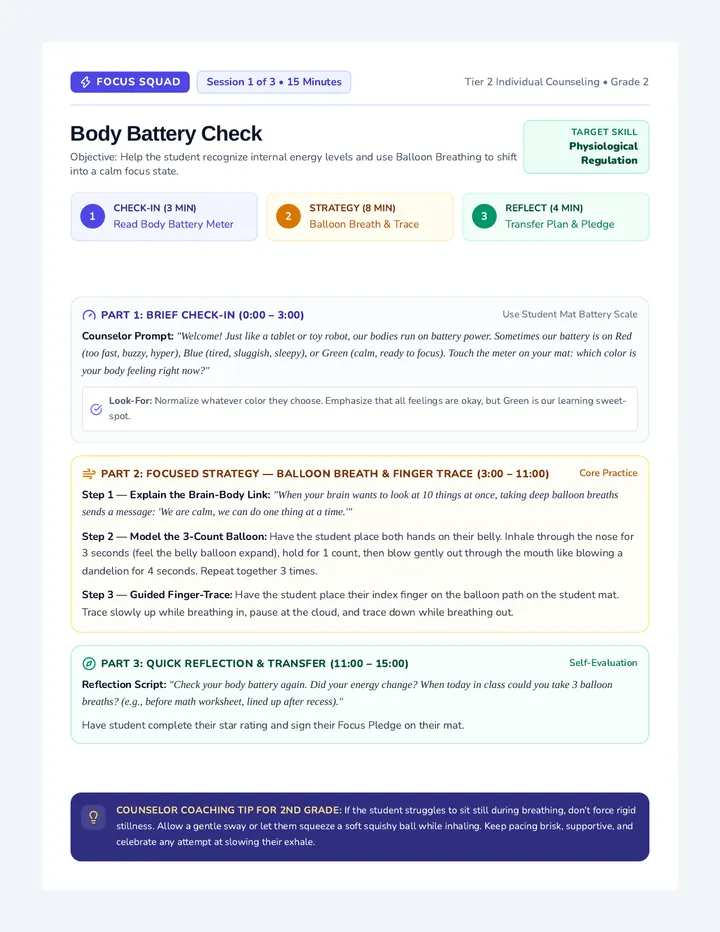
Breathing Buddies Activity Breathing Buddies
Week 3: Deep Breathing Practice
Objective
To practice deep, diaphragmatic breathing as a calming strategy. Using a "buddy" provides a visual and tactile cue for the student to focus on their breath.
Materials
A small, soft toy (like a stuffed animal, beanbag, or even a small pillow). This is the "Breathing Buddy."
The Steps
1
Find a Comfy Spot
Have the student lie down on their back on a rug or floor, or sit very comfortably in a chair with their feet flat.
2
Place Your Buddy
Gently place the Breathing Buddy on the student's tummy (around the belly button area).
3
Breathe with Your Buddy
Ask the student to take a slow, deep breath in through their nose. Watch the buddy RISE up. Then, breathe out slowly through their mouth, watching the buddy FALL down.
4
Rock the Buddy to Sleep
"Imagine you are rocking your buddy to sleep with your gentle breathing. Keep the movements smooth and slow."
Reflection Questions
• "Did you see your buddy moving up and down?"
• "How does your tummy feel when you take a big breath?"
• "Does your body feel more like a Level 1 or Level 4 right now?"
• "Where could you use this buddy at home?"
Calming Toolbox Discussion Guide Trying Our Tools
Week 3: Reflection & Review
Teacher: Focus on the student's personal preferences. Reinforce that practicing these tools when CALM makes them more effective when ANGRY or ANXIOUS.
1. What are some of the calming tools we talked about today?
2. How did it feel to do the "Breathing Buddies" activity? Did it help your body feel calmer?
3. From your Calming Toolbox, which tool are you going to try first this week?
4. Who is a grown-up you can talk to or ask for help if you need to use your tools?
5. Why is it important to have DIFFERENT tools in our toolbox?
(Hint: Does every tool work for every situation?)
Key Concept
"You are the craftsman building your own emotional safety. Each tool you master makes you more powerful."
Encouragement
Encourage the student to commit to trying at least one new strategy this week. Praise their effort and self-awareness.
Think Before You Act Reading Think Before You Act
Week 4: The Power of Thoughts
We've learned how our bodies feel, found our triggers, and built a toolbox. This week, we're talking about something super important: our THOUGHTS .
Our thoughts are like little voices in our heads. Sometimes, when we're angry or anxious, these voices can get loud and tell us things that aren't always helpful or even true.
Unhelpful Thought
"They bumped me on purpose! They're trying to make me mad!"
Result: Bigger Anger
Helpful Thought
"Maybe it was just an accident? I'll ask if they're okay."
Result: Staying Calm
The Feeling Chain
Situation
Thought
Feeling
Action
If we can catch our unhelpful thoughts, we can choose a different, more helpful thought. It's like being a Thought Detective , looking for clues to see if our thoughts are helping us or hurting us.
"Remember the incident at home? Changing our thoughts changes our reactions. You are the boss of your brain!"
Thought Detective Worksheet Thought Detective
Week 4: Case Investigation
Name: __________________________
Investigate a thought from this week. Let's see if we can transform it!
Case Evidence: The Situation
What happened? (Just the facts, like a photo):
My First Thought:
My Action (What I did):
Detective Questions
Was my first thought helpful or unhelpful?
Search for a NEW Thought: What is a more helpful way to think about this?
If I had the NEW thought, how would I feel?
What action would I take instead?
Detective Bonus
Why do you think changing our thoughts can change our actions?
Role-Playing Solutions Activity Role-Playing Solutions
Week 4: Choice Practice
Teacher: Present each scenario. Discuss an unhelpful response first, then brainstorm a helpful one. Role-play both options and talk about how each one feels.
Scenario 1: The Accusation
"You are playing a game with a friend, and they accuse you of cheating, even though you know you didn't."
Unhelpful
"They always think I cheat! They're so mean!"
Action: Yelling back, stomping away, pushing game pieces.
Helpful
"My friend is frustrated. I know I didn't cheat."
Action: Take a breath. Say "I didn't cheat. Let's check the rules."
Scenario 2: The Correction
"You made a mistake on your homework, and your teacher points it out in front of the class."
Unhelpful
"Everyone thinks I'm dumb now! I hate school!"
Action: Putting head down, getting angry, refusing to work.
Helpful
"Everyone makes mistakes. I can learn from this."
Action: Quiet breath. Ask for help after class. Remind self it's okay.
Debrief
• "Which response felt better in your body?"
• "Which response helped solve the problem?"
• "Was it hard to think of the helpful thought?"
• "How can we remember the helpful thought next time?"
Changing Our Thoughts Discussion Guide Changing Our Thoughts
Week 4: Reflection & Review
Teacher: Help the student see that thoughts are not "facts." We can choose which thoughts to listen to and which ones to change.
1. What did we learn today about how thoughts affect our feelings?
2. What does it mean to be a "Thought Detective"?
3. What's an unhelpful thought you've had? What's a helpful one you could replace it with?
4. How did it feel to role-play the helpful reactions versus the unhelpful ones?
5. When you feel a BIG feeling this week, what helpful thought will you try to remember?
Thought Reframing
"It's hard work to change thought patterns. Praise the student's insight and persistence."
Connection
Connect this back to the "Tiger." Changing thoughts is how we keep the tiger calm.
Talking It Out Reading Passage Talking It Out
Week 5: Your Voice is a Superpower
We've learned about our feelings, what triggers them, how to calm down, and how to catch our thoughts. This week, we're adding another superpower: TALKING ABOUT OUR NEEDS .
When we feel angry or anxious, it can be hard to use our words. Sometimes we might yell, shut down, or do things we regret (like breaking a chair). But using your words to tell people how you feel can change everything.
Assertive Communication
Speak Clearly: Use a calm voice. Say exactly what you mean.
Use "I" Statements: Say "I feel..." instead of "You always..."
Say What You Need: Ask for help or a break. Tell them what would help.
Listen: Give others a chance to speak too. This solves problems!
Using your words helps others understand you better, and it helps YOU feel more in control. It's much stronger than yelling!
"It takes practice, but being a Communication Captain is one of the best ways to solve problems before they get too big."
Communication Power-Ups Worksheet Communication Power-Ups
Week 5: Using Your Words
Name: __________________________
Let's practice your new communication superpowers! Turn "blaming" sentences into helpful "I" statements.
Power-Up 1: "I Feel..."
Instead of: "You never listen to me!"
Try: "I feel
when
. I need
."
Instead of: "That's a dumb idea!"
Try: "I feel
when
. I need
."
Instead of: "You always mess up my game!"
Try: "I feel
when
. I need
."
Power-Up 2: "What Do I Need?"
Situation: You're trying to read, but your sibling is making a lot of noise.
"I feel ________ when ________. I need ________."
Situation: A friend borrowed your pencil and didn't give it back.
"I feel ________ when ________. I need ________."
Communication Reflection
How did it feel to change those sentences? Do you think using "I" statements helps people understand you better?
How To Ask For Help Activity How To Ask For Help
Week 5: Practicing Assertiveness
Teacher: Present each scenario. For each one, the student will practice using an "I" statement to express a feeling and a specific need. Role-play the other person to make it interactive.
Scenario 1: The Homework Struggle
Teacher (as parent/teacher): "How's your homework coming along?"
Student Practice
"I feel
because
. I need
."
Example: "I feel frustrated because I don't understand this math problem. I need help with number 3."
Scenario 2: The Loud Sibling
Teacher (as sibling): (Humming loudly) "La la la! This is so fun! VROOM VROOM!"
Student Practice
"I feel
when
. I need
."
Example: "I feel annoyed when you play loudly because I'm reading. I need you to play in the other room."
Scenario 3: The Party Worry
Teacher (as parent): "Are you excited for the birthday party this weekend?"
Student Practice
"I feel
about
. I need
."
Speaking Our Needs Discussion Guide Speaking Our Needs
Week 5: Reflection & Review
Teacher: Acknowledge that speaking up can be difficult, especially when feelings are strong. Praise courage and effort.
1. What is "assertive communication," and why is it a superpower to have?
2. How do "I" statements help us communicate without blaming others?
3. What was challenging about asking for help in our activity today? What felt easy?
4. Who are some trusted grown-ups you can practice talking to about your needs?
5. When a big feeling starts this week, how will you use your words to express what you need?
Captain's Log
"Encourage the student to try using ONE 'I' statement this week in a real-life situation. Celebrate the attempt regardless of the outcome."
Self-Management
Clear communication builds stronger relationships and helps resolve conflicts peacefully.
Self-Regulation Superpowers Reading Self-Regulation Superpowers
Week 6: You Are the Boss of Your Feelings
Wow! We've made it to our last session of 'Taming the Temper Tiger.' You've learned so many amazing things. You're building a whole set of SUPERPOWERS !
Life will still have moments where you feel angry or anxious, but now you have tools and skills to handle them. Let's remember the superpowers you've gained:
Emotion Detective
You can notice how anger and anxiety feel in your body before they get too big.
Trigger Tracker
You know what things make your feelings grow. This helps you get ready!
Calming Craftsman
You have a toolbox full of breathing, movement, and distraction tools to stay calm.
Thought Transformer
You can catch unhelpful thoughts and choose better ones to stay in control.
Communication Captain
You use "I" statements to tell people how you feel and what you need.
Every time you use one of these superpowers, you get stronger. You are becoming the boss of your feelings! Be proud of yourself!
My Progress Journal Worksheet My Progress Journal
Week 6: Reflecting on My Journey
Name: __________________________
Congratulations on completing your journey! Let's look back and see how much you've grown.
1 How has your understanding of anger and anxiety changed since Week 1?
2 What are 2-3 of your favorite calming tools? Why do you like them?
3 Tell me about a time you used a tool or a helpful thought recently.
What happened?
What did you do?
How did it feel?
4 What is one thing you still want to work on?
Advice for others
If someone was just starting these lessons, what advice would you give them?
Future Me Planning Activity Future Me Planning
Week 6: Keeping My Superpowers Strong
Create your personal plan for using your skills in the future. You are the boss of your feelings!
My Top 3 Calming Tools
A.
B.
C.
Triggers to Watch For
1
2
My Go-To People
At Home:
At School:
How I Will Practice
Ex: "I will take 3 deep breaths before reacting when I'm frustrated."
My Self-Care Reward
What is something fun or relaxing you can do for yourself when you've successfully used your tools?
Teacher Note
Help the student make their plan realistic and actionable. Encourage them to share this with a trusted adult at home. This plan is a living document!
Celebrating Growth Discussion Guide Celebrating Growth
Week 6: Graduation & Future Outlook
Teacher: This is a celebration! Offer specific praise for the student's participation, effort, and demonstrated growth. Provide positive encouragement for their future.
1. Thinking back to our very first session, what is the biggest change you've noticed in yourself?
2. What was the MOST helpful thing you learned during our lessons?
3. What are you most PROUD of regarding your progress?
4. When big feelings come up in the future, what will you remind yourself?
5. What is one goal you have for continuing to use your superpowers?
Final Word
"You have the tools. You have the heart. You are ready to be the boss of your feelings."
Confidence Building
Express your genuine confidence in their ability to continue managing their feelings effectively. End on a high note!