Internal Alarm Slides INTERNAL ALARM
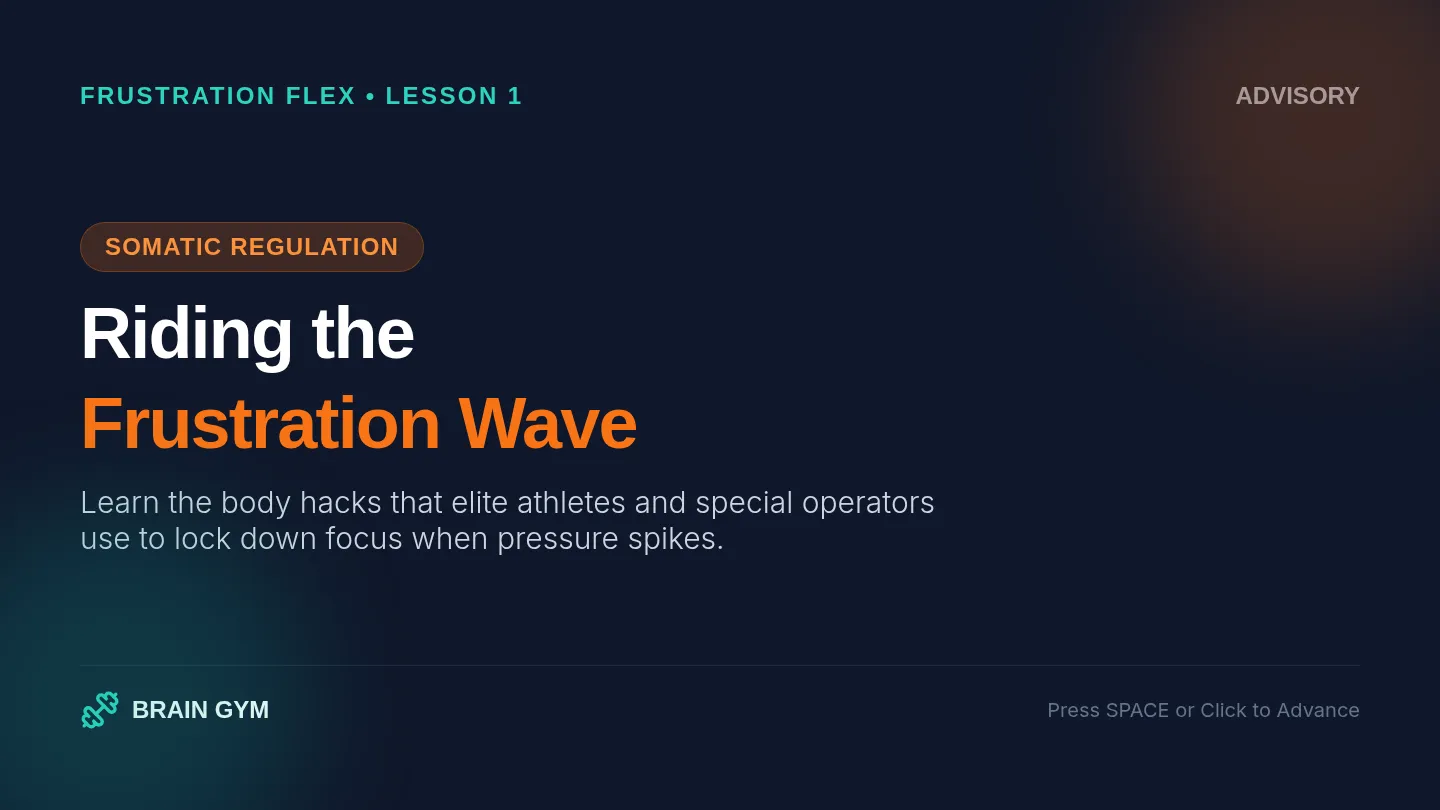
The Physiology of Agitation
System Threat Detected
The Amygdala
Your brain's 24/7 security guard. When it senses danger, it hits the panic button before you even "think" about it.
The Command
"Survival Mode: Engaged."
THE SURVIVAL TRIAD
FIGHT
Facing the threat head-on with aggression or dominance.
FLIGHT
Moving away from the source of stress as quickly as possible.
FREEZE
Becoming still, silent, or unable to act while processing the threat.
CHEMICAL OVERDRIVE
Adrenaline
The immediate surge. Speeds up heart rate, pumps blood to muscles, and sharpens focus.
Cortisol
The endurance hormone. Increases sugar in the bloodstream to keep the energy going.
Biological Priority
Muscle Energy MAX
Reaction Speed MAX
Logic & Reasoning LOW
Digestion OFF
THE GAP
There is a window of time between your body reacting and your mind exploding.
If you catch the signal here, you win.
Fight Flight Freeze Worksheet Survival Mode Diagnostics
Unit: System Diagnostics | Lesson 1
Name:
Date:
Lab 1.1: Resting vs. Active Status
1. Baseline Pulse
Sit quietly for 30 seconds, then count your pulse for 15 seconds. Multiply by 4.
____
BPM (Beats Per Minute)
2. "Stress" Pulse
Perform the teacher's challenge (e.g., rapid-fire mental math or jumping jacks) then count again.
____
BPM (Beats Per Minute)
Reflection: Describe how your body felt the moment the teacher started the timer for the "Stress" challenge.
Chemical Cascade
Hormone System Role Physical Sign Adrenaline Instant burst of energy; "Go" signal. _________________________ Cortisol Sustained energy; releases glucose. _________________________
Survival Modes
Identify which survival mode (Fight, Flight, or Freeze) is being described in each scenario below.
Scenario A: You see someone post something mean about you online. Your heart races, your face gets hot, and you immediately start typing a brutal comeback.
Mode: ____________
Scenario B: A teacher calls on you to answer a question in front of the whole class. Your mind goes blank, you can't move your mouth, and you just stare at your desk.
Mode: ____________
Scenario C: You walk into the cafeteria and see a group of people you're arguing with. You immediately turn around and walk the long way to class to avoid them.
Mode: ____________
The Critical Link
Why does your heart beat faster before you feel "angry"? Knowing the biology helps you realize that your body is just trying to protect you. It's a system alert—not a command to act.
Physiology Lab Teacher Guide Teacher Resource Lesson 1: The Physiology of Agitation
Physiology Lab Guide
Instructional strategy and facilitation notes for understanding the stress response.
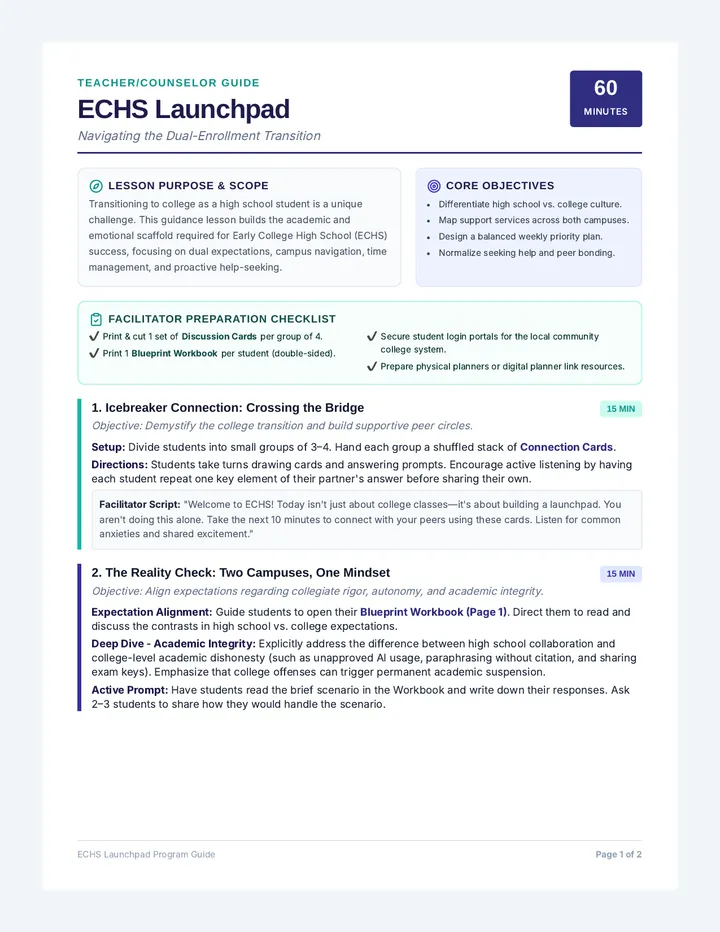
Lesson Objectives
Identify the three primary survival modes (Fight, Flight, Freeze).
Explain the roles of adrenaline and cortisol in the sympathetic nervous system.
Connect physiological changes (increased heart rate) to emotional escalation.
The "Pulse Spike" Challenge
The goal of the hook is to create a safe, controlled "mini-stressor" to visualize biological shifts.
Option A: The Rapid Math Blitz
Give students 60 seconds to solve a list of increasingly difficult multiplication problems while playing high-tempo music or "distracting" sounds.
Option B: The Physical Burst
Have students do 30 seconds of intense jumping jacks or high-knees. (Explain that the body reacts similarly to physical and emotional threats).
Discussion Prompt: "When you knew the timer was starting, what did you feel in your chest? Your hands? Your focus?"
Points to Emphasize
Body First, Mind Second
Remind students that the amygdala is faster than the prefrontal cortex. By the time we feel "mad," the body has already been reacting for seconds.
Biological Neutrality
Stress hormones aren't "bad"—they are tools for survival. The problem is when they trigger in response to social conflicts rather than physical danger.
Worksheet Answer Key
Chemical Match Examples:
Adrenaline Sign: Shaking hands, pounding heart, wide eyes, sweating.
Cortisol Sign: Feeling "on edge" or jumpy, heat in the face, muscle tension.
Scenario Analysis:
Scenario A (Brutal comeback): FIGHT
Scenario B (Mind goes blank): FREEZE
Scenario C (Avoiding conflict): FLIGHT
Common Misconceptions
"I'm just a hothead."
Reframe this as a high-sensitivity alarm system. It's not a personality trait; it's a biological process that can be managed.
"Freeze means I'm scared."
Freeze is often misinterpreted as laziness or disrespect in classrooms. Explain that it is an involuntary "shutdown" to protect the system from overload.
Standard Operating Status Slides OPERATING STATUS
Establishing Personal Baselines
Status Check: Green
The Baseline
Your "Standard Operating Condition." This is how you act, think, and feel when your environment is safe and predictable.
"If you don't know what 'Normal' looks like, you won't know when you've left it."
Voice Volume & Tone
Body Language
Humor & Social Style
THE USER MANUAL
Every complex system comes with a manual. You are the most complex system on Earth.
Specs
How I process info when calm.
Calibration
My social "default" settings.
Maintenance
What keeps me in baseline.
Calibration Check
Baselines look different for everyone. There is no "right" way to be calm.
HIGH ENERGY BASELINE
• Talkative and expressive
• Moving around frequently
• Uses humor often
• Thinks "out loud"
LOW ENERGY BASELINE
• Quiet and observant
• Content sitting still
• Serious or neutral expression
• Processes internally
Which profile fits you more closely today?
Diagnostic Alert
THE DRIFT
Escalation isn't a cliff; it's a drift away from your baseline.
Baseline
Drifting...
User Manual for Me Worksheet System User Manual
Personal Baseline Documentation
Owner:
Date:
"This manual describes your system's normal operating conditions. Fill this out as if you were explaining how your 'calm' version works to a technician (or a new friend/teacher)."
1. Audio Output (Voice)
When I am in my calm baseline, my voice usually sounds like...
Loud, energetic, and fast-paced
Quiet, soft-spoken, and measured
Sarcastic, joking, or humorous
Other/Details:
2. Physical Stance
In baseline, my body language and movement look like...
3. Processing Style
When I'm calm, how do I handle new information or small problems?
4. Optimal Power Source
What activities or conditions keep me in my "Green" baseline?
Activity 1
Activity 2
Activity 3
Activity 4
The "Red Line" Predictor
Think of a time you got really upset recently. What was the very first thing that changed in your "User Manual" before you exploded? (Example: Did you stop joking? Did you start pacing?)
Baseline Briefing Teacher Guide Teacher Resource Lesson 2: Establishing Personal Baselines
Baseline Briefing Guide
Helping students define their "Standard Operating Status" through self-reflection.
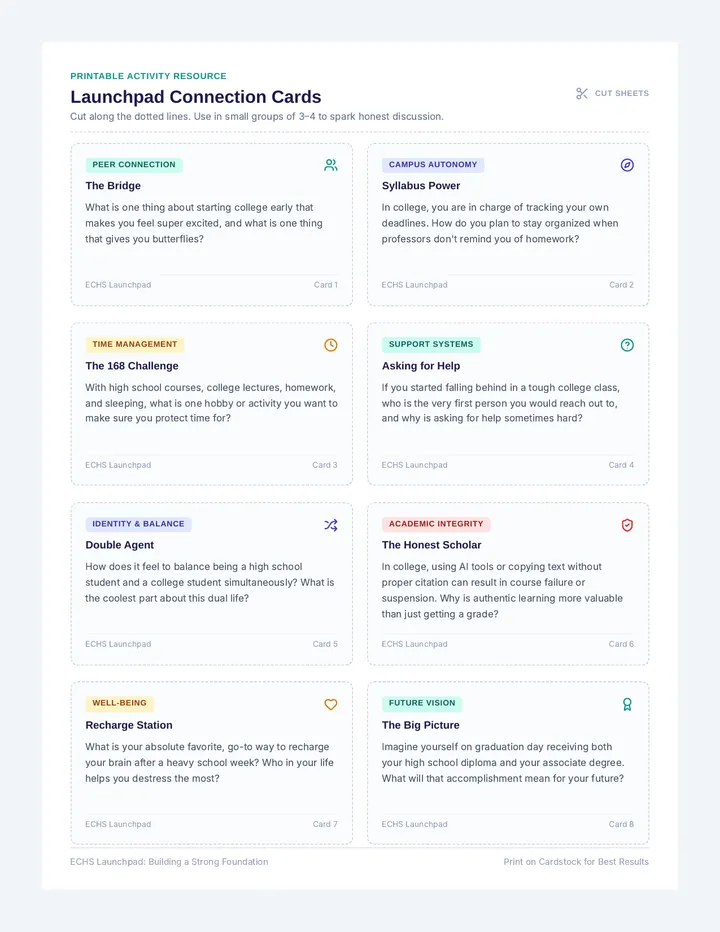
The Concept
Many students struggle with de-escalation because they don't realize they are escalating until they have already reached a crisis point. This lesson shifts the focus from "anger" to "deviation from baseline." By defining what they look like when they are regulated, students can more easily spot the subtle "drift" into agitation.
Hook Activity: The New Best Friend
The Scenario: Tell students: "Imagine you are getting a brand new roommate or a new best friend. To make sure you get along, you need to give them a 'Quick Start Guide' to how you work when things are going well. This isn't about your hobbies; it's about your vibe."
Teacher Tip: Share your own baseline first!
Example: "My baseline is that I talk a lot, I use big hand gestures, and I usually have a cup of coffee. If you see me sitting perfectly still and being very quiet, that's a sign I'm drifting away from baseline."
Guiding Questions
Social Style
"Are you a 'high energy' calm person or a 'low energy' calm person?"
Thinking Pattern
"When you're calm, can you easily see the other person's side of a story?"
Body Clues
"What do your hands do when you're just hanging out?"
Humor
"Do you use jokes more when you're calm, or more when you're nervous?"
Teaching Tips
1
Normalization: Some students feel that "baseline" must mean "perfectly behaved." Remind them that a baseline is simply who they are when they aren't stressed. If they are naturally sarcastic, that is their baseline.
2
The "Early Warning" connection: The final question on the worksheet is the most important. It bridges Lesson 2 to Lesson 3. Make sure students spend time identifying that first "shift."
3
Support for "Freeze" students: Students who "freeze" often have a very quiet baseline. Help them look for internal shifts like "I stop hearing what the teacher is saying" even if they look the same on the outside.
Body Signal Slides BODY SIGNALS
Identifying Somatic Warning Signs
System Hardware
SOMATIC
Relating to the body, especially as distinct from the mind.
"Your body speaks in sensations long before your mind speaks in words."
Heat
Tension
Movement
Breath
Pressure
INTENSITY LEVELS
Cool
Baseline Status
Simmer
Initial Drifting
Boil
Imminent Threat
Meltdown
System Failure
COMMON WARNING LIGHTS
Jaw Clenching
Tightness in the face or gritting teeth.
Fist Tightening
Curling fingers or tapping legs rapidly.
Shallow Breath
Chest moving fast; feeling "stuck."
Tunnel Vision
Staring intensely or avoiding eye contact.
MAPPING THE SYSTEM
We are going to map exactly where your stress hides.
"Once you can see the signal, you can change the channel."
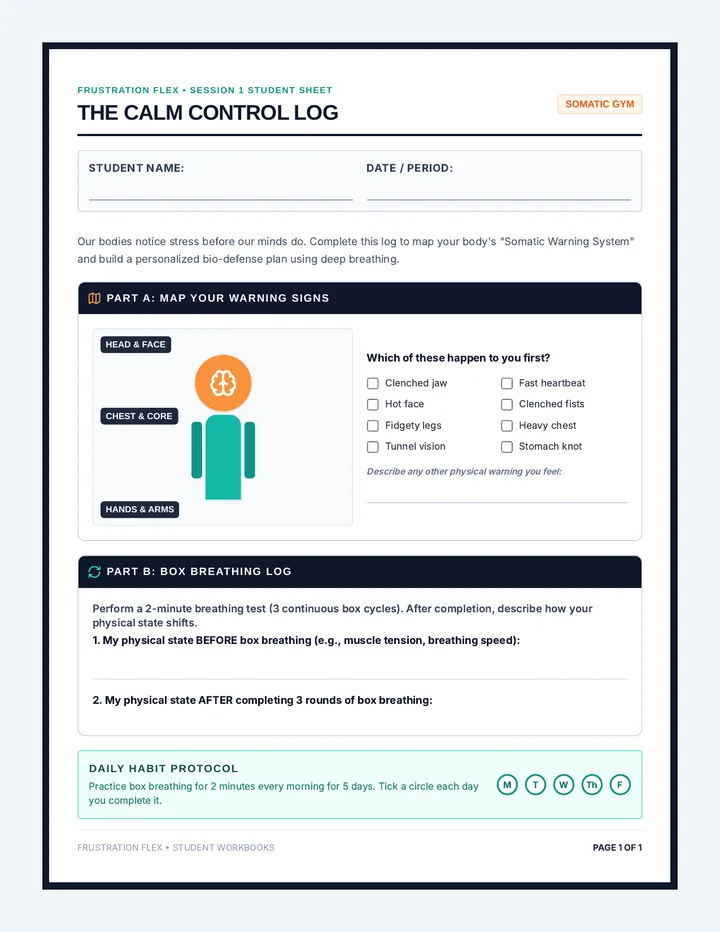
Somatic Mapping Activity Somatic Stress Map
Diagnostic Level 2.0
Subject:
Date:
Hardware Scan
Color code where you feel tension, heat, or movement.
Intensity Legend
Level 1: YELLOW (The Simmer)
Subtle changes (e.g., tapping feet, dry mouth)
Level 2: ORANGE (The Boil)
Active physical reaction (e.g., clenched fists, hot face)
Level 3: RED (The Meltdown)
Loss of control (e.g., shouting, shaking, "blacking out")
Signal Specifics
List exactly what you feel in each category as you escalate:
Muscles
Temperature
Breathing
Vision/Hearing
The "Early Warning" Target
Look at your map. Which signal appears first (at the Yellow level)? This is your "System Alert." Describe it in detail below.
Somatic Signs Answer Key Teacher Resource Lesson 3: Identifying Somatic Warning Signs
Somatic Signs Key
Examples and patterns of physical emotional escalation to guide student mapping.
The Somatic Connection
This activity is highly personal, but most students will follow common physiological patterns. Use these examples to prompt students who struggle to "feel" their emotions physically.
Yellow (Low)
Bouncing leg
Dry mouth
Pacing
Avoiding eye contact
Fidgeting with hands
Orange (Mid)
Hot face/ears
Clenched jaw
Tight shoulders
Short, fast breaths
Fist-clenching
Red (High)
Shaking hands
Chest pain/pressure
Tunnel vision
Loud/shouting voice
"Buzzing" ears
Troubleshooting Facilitation
Student says: "I don't feel anything until I'm just mad."
Challenge them to think about a "freeze" response. Does their brain feel "foggy"? Does their body feel "heavy" or "numb"? Numbness is still a somatic cue.
Student says: "I always feel hot in this classroom."
Encourage them to differentiate between environmental heat and "internal heat" (e.g., face, neck, or chest feeling like they are on fire).
Key Vocabulary to Reference
Proprioception
The sense of where your body is in space.
Interoception
The sense of internal bodily states (hunger, heart rate, tension).
Mental Overload Slides MENTAL OVERLOAD
Cognitive Tunneling & Fatigue
System Bottleneck
Cognitive Tunneling
A state where the brain focuses exclusively on a single perceived threat, ignoring all other information.
"You stop seeing options. You only see the exit or the enemy."
DATA LOSS IN PROGRESS
Social Blindness
You can't "read the room" or tell how others are feeling.
Time Distortion
Seconds feel like minutes, or hours feel like seconds.
Option Loss
You forget that "walking away" or "asking for help" are options.
System Fatigue
5% BATTERY
Decision Fatigue
The more stress you process, the worse your brain becomes at making choices. This is why you make "dumb" choices when you're overwhelmed.
Reduced Willpower
Increased Impulsivity
THE SIMULATION
We are going to purposefully overload your "processor" to see how your decision-making changes.
Initialization...
Cognitive Tunneling Simulation Guide Simulation Guide Lesson 4: Cognitive Tunneling
The Stress Simulation
Instructions for facilitating the "Annoying Rules" puzzle competition.
The Objective
Students will attempt a complex task while being subjected to "Cognitive Load Injectors." The goal is not to stress them out completely, but to let them observe the exact moment they lose focus and begin to "tunnel."
Phase 1: Setup
Required Materials:
• Jigsaw puzzles (100 pieces) OR
• Complex Logic Worksheets
• Timers for each group
• High-tempo background music
Group Structure:
3-4 Students per group. One student acts as the "System Observer" (taking notes on signs of stress in teammates).
Phase 2: The Rules Injection
Start the timer. Every 60 seconds, announce a new "Software Patch" (rule change) that adds cognitive load.
01:00
Patch 1.1: "Communication Failure. You can no longer speak. Only hand signals are allowed."
02:00
Patch 1.2: "Hardware Restriction. You can only use your non-dominant hand to touch the puzzle pieces."
03:00
Patch 1.3: "Sensor Overload. (Increase volume of music). You must now stand while working."
04:00
Patch 1.4: "Critical Error. Every piece you touch must be described out loud by its color before moving it."
Diagnostic Debrief
The Moment of Tunneling
"At which Patch (1.1, 1.2, 1.3...) did you stop caring about winning and start feeling frustrated or bored?"
Option Blindness
"Did anyone think to ask for a 'System Reset' (a break)? Why not?"
Safety Protocol
The goal is simulated stress. If a student shows genuine distress, immediately allow them to step out or assign them the role of "Observer."
Decision Making Under Pressure Worksheet System Stress Reflection
Diagnostic 4.1: Post-Simulation Analysis
Name:
Date:
Data Log: The Simulation
1. Cognitive Load Threshold
Look at the "Patches" from today's simulation. At which point did your brain feel like it was starting to "error out"? What was your first mental sign of frustration?
2. Perspective Loss
During the height of the simulation, were you still aware of other things in the room? Or were you "tunneled" exclusively on the task?
The Cost of Fatigue
"Decision Fatigue happens when you have used up your 'mental battery' on stress, leaving no energy for making good choices. This is when we say things we regret or act impulsively."
Real-World Analysis
Think of a real-life situation where you were under high stress. Analyze your decision-making in that moment:
The Choice I Made
Better Choice (Missed)
Why was the "Better Choice" invisible to you in that moment?
Diagnostic Conclusion
Once tunneling starts, logic is offline. The goal is to catch the "body signals" from Lesson 3 before the tunnel closes. If you wait until you are tunneled to decide to calm down, it's already too late.
Early Warning System Slides SYSTEM DEFENSE
Your Personal Warning Protocol
Full System Integration
Lesson 1-2
Your Baseline & Biology
Lesson 3
Your Somatic (Body) Signals
Lesson 4
Your Cognitive (Mind) Limits
THE PROTOCOL
Your personal manual for staying in baseline when things get hard.
SYSTEM RED FLAGS
01
The First Tick
What is the exact first somatic change you feel?
02
The Line
At what point do you know you are drifting too far to turn back?
03
The Override
What is your Emergency Stop command?
System Forensics
The "Sudden" Outburst
We often call emotional explosions "sudden." But forensics show the body was sending signals for 10-15 minutes before the "event."
"If you miss the whisper, you'll have to deal with the scream."
MISSION DEPLOYMENT
You are now the Lead Engineer of your own emotional system. Create your Early Warning Protocol.
Analyze
Codify
Deploy
My Warning Protocol Project Early Warning Protocol
Operational Security Plan
User ID:
Auth Date:
01. Critical Somatic Indicators
Identify your three "Top Tier" physical warning signs. These are the signals that, if ignored, lead directly to system failure (escalation).
SIG-A
Primary Alert
SIG-B
Secondary Alert
SIG-C
Terminal Alert
02. Cognitive Bypass Protocols
Once you detect the "SIG-A" or "SIG-B" above, what is your Emergency Override? What specifically can you say to yourself or do physically to prevent cognitive tunneling?
A. Internal Command (Self-Talk)
Ex: "System check. Logic is fading. I need to step out now."
B. Tactical Maneuver (Action)
Ex: Stand up and walk to the back of the room; get a drink of water.
Protocol Authorization
I recognize that these body signals are my system trying to protect me. I commit to listening to the "whisper" of the somatic alert so I don't have to experience the "scream" of a meltdown.
System Owner Signature
Protocol Presentation Rubric Assessment Rubric Lesson 5: Personal Early Warning Protocol
Protocol Assessment
Grading criteria for the Early Warning Protocol project.
Category Level 4: Mastered Level 3: Proficient Level 2: Developing Somatic Precision Identifies 3 highly specific somatic cues that show a clear progression of intensity. Identifies 3 somatic cues, though intensity levels may slightly overlap. Identifies general feelings (e.g., "mad," "annoyed") instead of physical signals. Override Strategy Strategies are realistic, actionable in a classroom, and directly address the identified cues. Strategies are actionable but may be generic or disconnected from the cues. Strategies are missing or unrealistic (e.g., "just stop being mad"). Cognitive Awareness Clearly explains how the protocol prevents "tunneling" or perspective loss. Mentions cognitive limits but does not connect them to specific actions. Shows little understanding of how stress impacts decision-making. System Integrity Work is complete, reflects deep self-reflection, and uses technical vocabulary correctly. Work is complete and generally accurate. Work is incomplete or lacks personal reflection.
Evaluator Notes
Strengths
Areas for Calibration
Grading Tip: Since this is a personal behavioral support document, focus less on "correctness" of the signals and more on the specificity and actionability of the protocol. If a student can clearly explain their first "whisper," they have met the core objective.