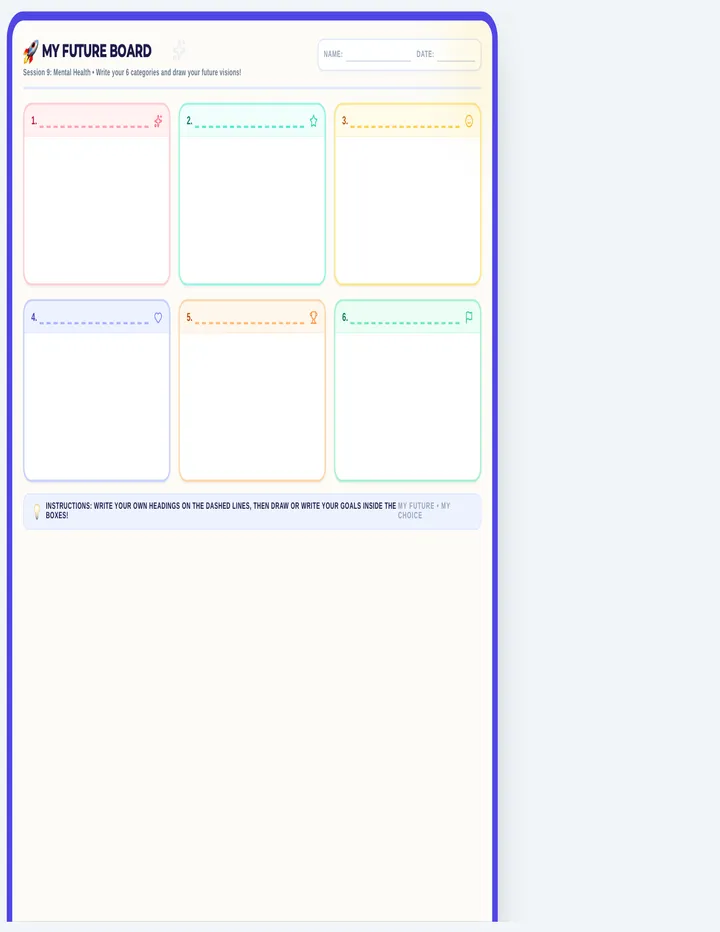
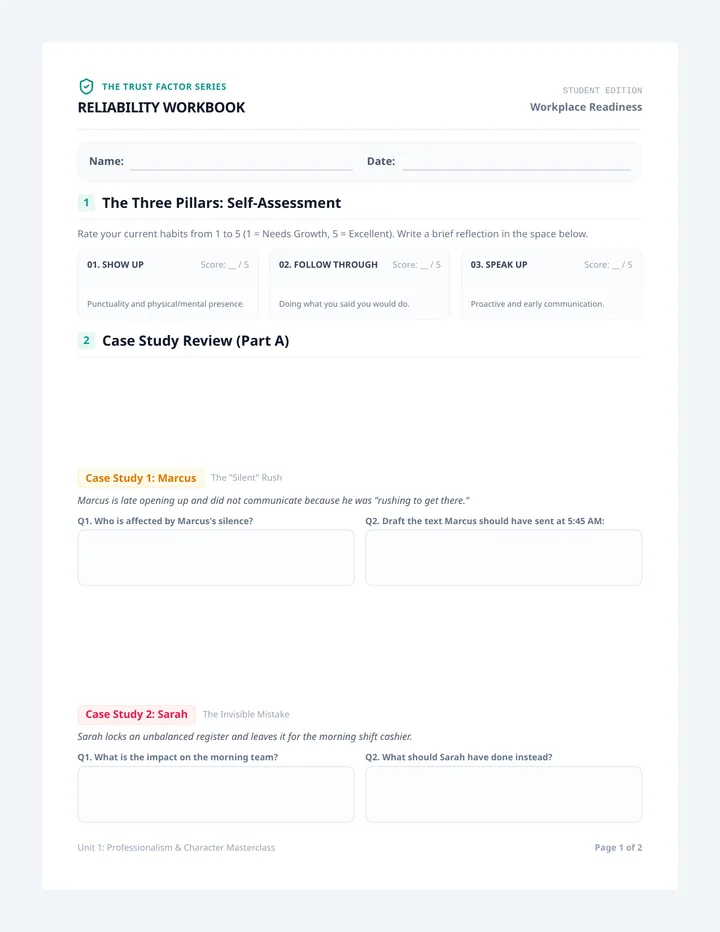
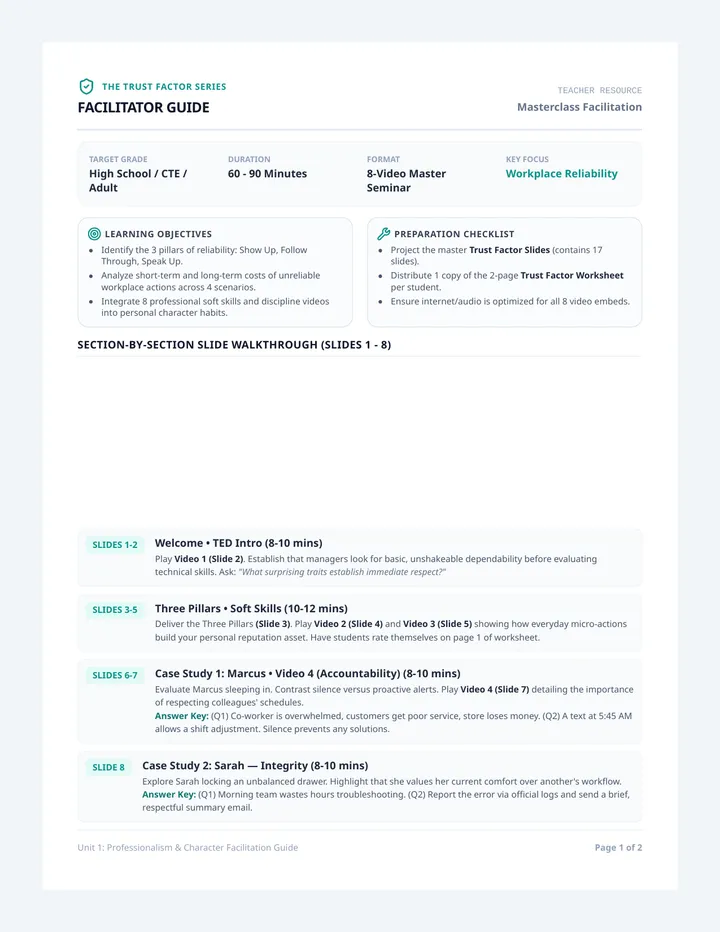
Baseline Blueprint Worksheet The Baseline Blueprint
Teacher Lesson Guide
Lesson 1
Learning Objectives
Define "baseline" behavior as the state of being calm, focused, and regulated.
Identify personal physical and emotional characteristics of their own baseline state.
Contrast baseline behaviors with "deviation" behaviors caused by minor stressors.
Key Vocabulary
Baseline
Deviation
Regulation
Agitation
Hook: Spot the Difference (10 mins)
Show two short, neutral clips (or describe two scenarios) of a person doing a mundane task like reading or typing. Clip A: Person is calm, moving steadily, breathing normally. Clip B: Person is slightly annoyed, tapping a pen faster, shifting in their chair, sighing.
"What did you notice changed between Clip A and Clip B? Was the person 'angry' yet? No—but they moved away from their baseline ."
Direct Instruction (15 mins)
Explain the Baseline Concept : In engineering or medicine, a baseline is the starting point used for comparison. In behavioral support, it's our "Normal Operating Mode."
Baseline Is:
Calm, ready to learn, steady heart rate, controlled voice, logical thinking.
Deviation Is:
The first shift away from baseline. Minor physical or verbal changes that signal stress.
Guided Practice: The Blueprint Workshop (20 mins)
Distribute the Baseline Blueprint Worksheet . Guide students through a "Self-Audit." Ask them to think about how they feel on a typical "good" morning.
Body: Are your muscles relaxed or tight?
Thoughts: Are they jumping around or staying on track?
Social: Are you making eye contact? Using a quiet or loud voice?
Baseline Blueprint
Mission Control: Personal Status Report
Name: __________________________
Date: ___________________________
What is a Baseline?
Your baseline is your "neutral gear." It is how you look, act, and feel when you are calm, safe, and ready to handle your day. Knowing your baseline helps you notice the second you start to drift toward agitation.
Physical Status
Muscles (Face, shoulders, hands):
Breathing & Heart Rate:
Energy Level (1-10):
Social Outflow
Voice Tone & Volume:
Eye Contact & Body Posture:
Reaction to Jokes/Feedback:
Spotting the Deviation
Think of a small annoyance (e.g., a broken pencil, a loud noise). What is the very first thing that changes in your body or behavior? This is your "Early Warning Signal."
Baseline Blueprint Slides Mission Control: System Check
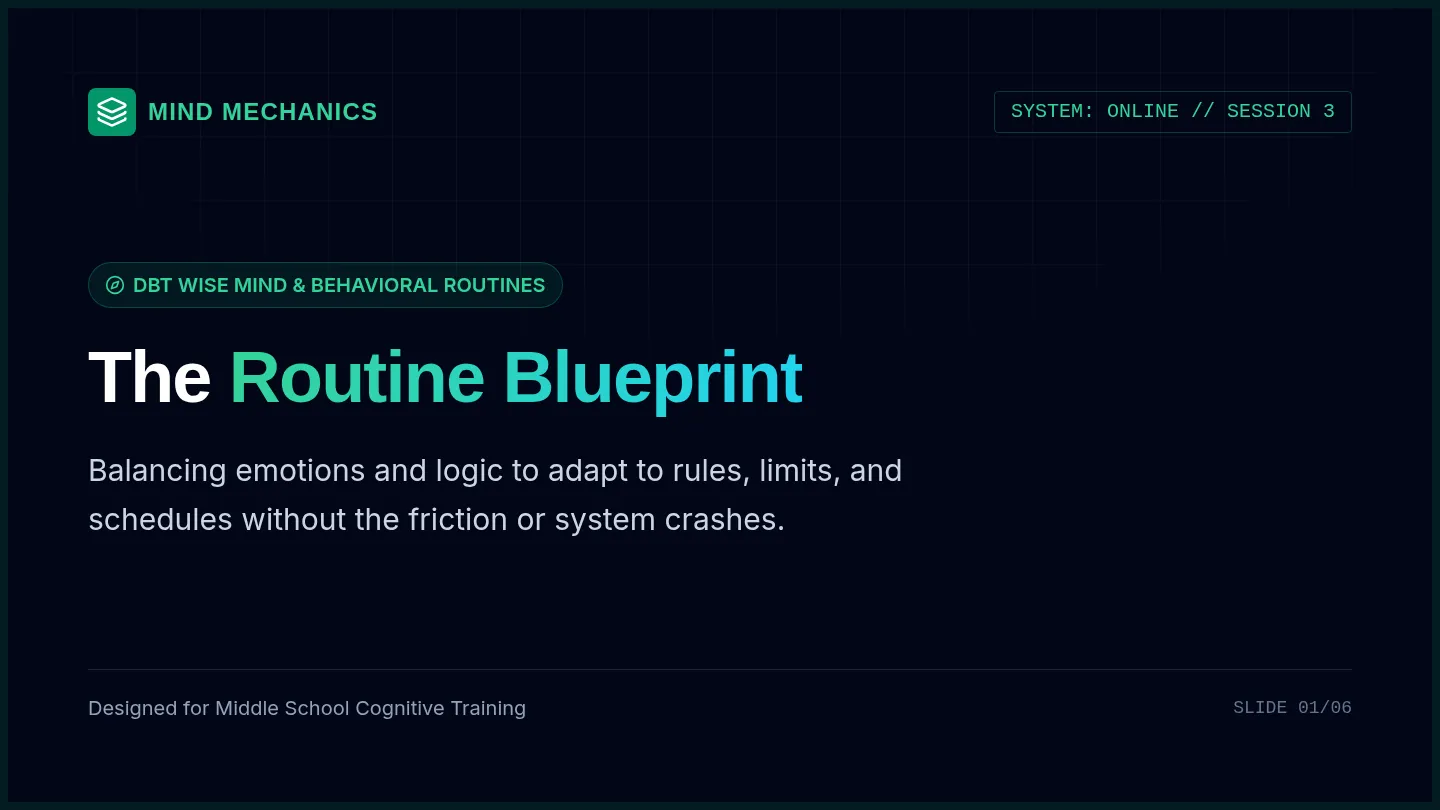
THE BASELINE BLUEPRINT
Understanding your "Normal Operating Mode" to detect emotional deviations early.
SYSTEM STATUS: OPTIMAL
Spot the Difference
State A
Sitting still. Shoulders down. Breathing is deep and steady. Eye contact is comfortable.
State B
Tapping a foot. Looking at the clock. Tucking hair back repeatedly. Sighing.
What changed? Are they "exploding" yet?
What is a Baseline?
Your Baseline is your starting point. It's how you look, act, and feel when you are regulated—meaning you are calm, safe, and ready to learn.
Thoughts
Clear & Focused
Feelings
Steady & Calm
Social
Kind & Patient
The Deviation
A deviation is the very first shift away from your baseline. It's like the "Check Engine" light in a car. It doesn't mean the car has crashed—it means something needs attention.
Your Blueprint Task
STATUS: PENDING
The Audit
Use your worksheet to document your baseline "Normal Operating Mode":
Muscle tension levels
Voice volume & tone
Eye contact habits
Your #1 early warning sign
WORK AREA
Body Scan Diagnostic Worksheet Internal Sensor Check
Teacher Lesson Guide
Lesson 2
Learning Objectives
Identify the physiological signs of the "Fight, Flight, or Freeze" response.
Practice interoception —noticing internal bodily sensations.
Connect physical sensations (e.g., tight chest, hot face) to early emotional escalation.
Key Concepts
Interoception
Amygdala Hijack
Cortisol/Adrenaline
Hook: The Lemon Test (5 mins)
Have students close their eyes. Walk them through a vivid visualization: "Imagine holding a bright yellow lemon. Feel the textured skin. Now, imagine cutting it open. Smell the sharp citrus. Now, take a big, juicy bite into the center..."
"Did your mouth water? Did your jaw tighten? Your body reacted physically to a thought . Agitation works the same way—your body signals stress before your brain even says 'I'm mad'."
The Biofeedback Simulation (15 mins)
To help students feel physical "agitation" in a safe way, lead them through these 3 quick states. After each, they should notice their breathing and heart rate.
State 1: Baseline
Sit perfectly still. Close eyes. Take 3 slow breaths.
State 2: High Energy
Run in place or do jumping jacks for 45 seconds.
State 3: Tension
Tense every muscle in the body as hard as possible for 15 seconds.
Body Scan Diagnostic
SENSOR LOG: INTERNAL STATUS
Name: __________________________
Date: ___________________________
Sensation Mapping
Head/Face
Shoulders
Chest/Heart
Stomach
Hands/Fists
DIRECTIONS: Mark where you feel stress first. Use symbols like ⚡ (energy), 🔥 (heat), 🪢 (tension), or 🌊 (nausea).
Detailed Sensor Log
The "Heater":
When you get frustrated, do you feel heat in your face, ears, or chest?
The "Pump":
What does your heart do? Fast thumping? A "fluttery" feeling?
The "Grip":
Do your hands clench? Do your toes curl? Does your stomach knot up?
The "Filter":
Does your vision get blurry or "tunnel"? Do sounds get too loud or fade away?
Interoception Challenge
Next time you feel a minor deviation (boredom, slight annoyance, hunger), stop and do a "3-second scan." What is the signal your body sends?
Internal Sensor Slides Sensor Log: Active
INTERNAL SENSOR CHECK
Decoding the biological signals of stress before they become behaviors.
The Lemon Test
Close your eyes. Imagine biting into a sour, juicy lemon. What did your body do?
"Your body reacts to your thoughts long before you take an action."
The Amygdala Control
Deep in your brain is a small almond-shaped part called the Amygdala . Its only job is to look for danger.
The Alarm
It detects stress (even a broken pencil!).
The Chemical Surge
It pumps adrenaline and cortisol into your blood.
The 3 Survival Modes
FIGHT
Body gets ready to push back. Heart beats fast. Hands clench.
FLIGHT
Body gets ready to escape. Fast breathing. Looking for exits.
FREEZE
Body shuts down to hide. Muscles go stiff. Brain feels "stuck."
MISSION: BODY SCAN
Diagnostic Phase in Progress...
1. Locate the Heat
Where do you feel hot? (Ears, face, neck?)
2. Find the Grip
Where do you feel tight? (Shoulders, fists, stomach?)
3. Monitor the Pump
Is your heart beating in your chest? In your ears?
MARK YOUR MAP
Use the Body Scan Diagnostic worksheet to pinpoint your specific "Hot Zones."
INTERNAL SCAN: 84% COMPLETE
Behavioral Snapshot Worksheet Body Language Radar
Teacher Lesson Guide
Lesson 3
Learning Objectives
Differentiate between objective observation and subjective judgment.
Identify common external indicators of emotional escalation (e.g., pacing, fidgeting).
Analyze case studies to pinpoint the "Escalation Inflection Point."
Key Concepts
Objective Observation
Non-Verbal Cues
Body Orientation
Hook: The Silent Shift (10 mins)
Show a muted clip of a movie or a silent film scene (e.g., Charlie Chaplin or a modern silent skit). Ask students to watch for the exact second a character becomes frustrated.
"How did you know they were mad? They didn't say a word. Their body did the talking. That's the Body Language Radar in action."
Observation vs. Judgment (10 mins)
Teach the difference between Judging (Assigning a feeling) and Observing (Stating a fact).
Judgment (DON'T)
"He looks mean and aggressive."
Observation (DO)
"His chin is down and his fists are tight."
Case Study Scenarios
Case A: The Desk-Drummer. A student gets a hard math problem. They start tapping their pencil, then drum their fingers, then begin shaking their leg rapidly. Finally, they drop their head into their hands.
Case B: The Pacer. A student is waiting for a meeting. They start by looking at their phone, then stand up and walk to the window, then begin walking in small circles, wringing their hands together.
BEHAVIORAL SNAPSHOT
EXTERNAL SIGNAL MONITOR
Name: __________________________
Date: ___________________________
The Detective's Checklist: What to Look For
Movement
Pacing, tapping, fidgeting, sudden stillness.
Posture
Shoulders raised, chin down, leaning away, arms crossed.
Facial Cues
Tight jaw, narrowed eyes, lip biting, staring.
Case Study Analysis
SCENARIO
OBJECTIVE OBSERVATIONS (FACTS)
PREDICTION
The Desk-Drummer
The Pacer
Personal Radar Check
When YOU are starting to feel agitated, what is your most obvious external movement? (e.g., "I start to click my pen" or "I bounce my left leg")
Body Language Radar Slides Scanning Perimeter
BODY LANGUAGE RADAR
Detecting external signals through the art of objective observation.
LIVE FEED
"The Silent Shift"
Watch the clip. Find the EXACT second the character shifts from calm to agitated.
How did you know?
Identify the specific movements that gave it away.
The Observer's Rule
JUDGING
"He's being mean."
"She's having a tantrum."
Judging assigns a label to a person. It usually makes things worse.
OBSERVING
"His shoulders are up by his ears."
"She is tapping her pencil fast."
Observing looks at the FACTS. It helps us help the person.
Scanning for Signals
Posture
Leaning in, tensing up, or "closing" the body.
Hands
Clenching, wringing, or repetitive tapping.
Movement
Pacing, shifting weight, or sudden stillness.
Face
Eye narrowing, lip biting, or fixed staring.
SIGNAL CLUSTERS
When you see 3 or more of these at once, the radar is at HIGH ALERT .
READY FOR SNAPSHOTS?
We are going to analyze two "targets" (Case Studies). Your job is to list the Facts , not the feelings.
Start Analysis
Open Logbook
Tone and Volume Worksheet Tone and Volume Alert
Teacher Lesson Guide
Lesson 4
Learning Objectives
Identify vocal shifts in volume, tone, and cadence that signal escalation.
Distinguish between Rational Communication and Emotional Venting .
Practice interpreting neutral phrases with varied emotional intensities.
Vocal Indicators
Tone (Sarcastic, Sharp)
Volume (Loud, Sudden Silence)
Cadence (Rapid-fire, Clipped)
Hook: Tone Twister Game (15 mins)
Students use a neutral phrase (e.g., "Pass the salt," "The bus is late," "I found your pencil" ). One student is assigned a "Frequency Level" (1-5) and must say the phrase with that level of emotional intensity. The class guesses the level.
1: BASELINE (Calm)
2: ANNOYED (Sigh)
3: AGITATED (Sharp)
4: ANGRY (Loud)
5: CRISIS (Yelling)
Direct Instruction: Venting vs. Communication
Rational
Seeking a solution. Slower pace. Listening to the other person. Moderate volume.
Venting
Releasing emotion. Rapid speech. Interrupting. Repetitive phrases. Sudden silence.
TONE TWISTER CARDS
AUDIO FREQUENCY CALIBRATION
Team: __________________________
PHRASE A
"I'm not doing that."
Level 1: Flat, monotone.
Level 3: Short, sharp, loud.
Level 5: Strained, teeth clenched.
PHRASE B
"That's just great."
Level 1: Genuinely happy.
Level 3: Heavy sarcasm.
Level 5: Silent, staring.
THE AUDITORY DEBRIEF
1. Rapid-Fire Speech: Why does a person's speed of talking increase when they get upset?
2. The "Silence" Warning: How can sudden silence be a sign of escalation?
Personal Sound Check
Think about your own voice. When you are moving away from your baseline, what is the FIRST change in your voice? (Circle one and explain below)
I get louder I get quieter I get sarcastic I talk faster
Tone and Volume Slides Audio Spectrum: Active
TONE & VOLUME ALERT
Detecting the shifts in vocal frequency that signal emotional escalation.
"It's not WHAT you say..."
"...it's HOW you say it."
The same 4 words can be a compliment, a joke, or a declaration of war.
Rational Comm
Moderate Volume
Balanced Pace
Question & Answer
Logical Flow
Goal: Solve a problem together.
Emotional Venting
Volume Spikes
Rapid-Fire Speed
Repetitive Phrases
Sudden "Stone" Silence
Goal: Release intense emotion.
GAME: TONE TWISTER
1
Pick a Neutral Phrase from your card.
2
Match your voice to the Frequency Level assigned.
3
Class must guess: Baseline, Annoyed, Agitated, or Angry?
WATCH OUT FOR:
Sarcasm (Opposite meaning)
Clipped words (Short sounds)
High pitch (Stress indicator)
Listen to the Signals
Agitation doesn't always LOOK like a fight. Sometimes it SOUNDS like one first. Let's calibrate our ears.
Start Calibration
Personal Escalation Map Project The Personal Escalation Map
Final Mission: Self-Mastery Project
Lesson 5
Project Objective
You have analyzed your Baseline , your Internal Sensors , your Body Language , and your Vocal Tone . Now, you will combine these into a single roadmap. This map will help you see an explosion coming before it happens, so you can choose a different path.
Step 1: Identify Your Triggers
What "sparks" your engine? Check all that apply or add your own.
Feeling ignored or unheard
Losing at a game/competition
Difficult schoolwork / Confusion
Loud environments / Too much noise
Being told "No"
Unexpected changes in schedule
Physical hunger or tiredness
Other: _________________________
Step 2: Signal Review
Look back at your previous worksheets. What are your TOP 3 most reliable warning signs?
Signal #1 (Internal)
Signal #2 (External)
Signal #3 (Vocal)
Mission Status Roadmap
NAME: __________________________
Crisis
Out of Control (Loss of Logic)
DESCRIBE BEHAVIORS HERE (e.g., Yelling, throwing, shutting down totally)
Agitated
Warning Level High (The Point of No Return?)
DESCRIBE SIGNALS HERE (e.g., Clenched fists, rapid speech, heat in face)
Annoyed
The Deviation (First Signs)
DESCRIBE SIGNALS HERE (e.g., Pencil tapping, heavy sighing, stomach knot)
Baseline
Normal Operating Mode
DESCRIBE STATE HERE (e.g., Calm, breathing easy, focused)
Self-Reflect
Looking at your map, what is the best level to use a coping strategy (like deep breathing or taking a break)? Why is it harder to use them once you reach Level 3?
Personal Roadmap Slides Final Mission: Complete
THE PERSONAL ROADMAP
Synthesizing your internal and external data into a master control plan.
The Emotional Engine
Think of yourself like a high-performance car. You have dashboard lights for a reason.
Green: Smooth driving.
Yellow: Low fuel / Check engine.
Red: Overheating / Danger.
TEMP
RPM
Your Diagnostic History
Baseline
Normal Ops
Internal
Heat & Heart
External
Body Language
Vocal
Tone & Vol
Today, we map them together.
Phase 5: The Project
1 Identify Triggers
What pushes you away from your baseline?
2 Plot Your Signals
Where do you feel it? What do you look like? How do you sound?
3 Plan the "Exit"
At which level is it SMARTEST to take a break?
Hint: It's before the "Check Engine" light starts flashing red.
MISSION COMPLETE
Knowing yourself is your greatest defense.
Your map is your superpower .
SELF-AWARENESS: 100% DETECTION: READY INTERVENTION: ACTIVE