Session 1 Flight Plan Session 1: Feeling Our Feelings
Regulation Rocket Mission Log
Duration 30 min
Why This Mission?
Understanding how emotions feel in the body helps Cooper recognize early signs of dysregulation, laying the foundation for effective self-regulation across settings.
Mission Objective
Cooper will identify at least two physical signs of emotions (e.g., tight muscles, fast heartbeat) with adult prompting in 4 out of 5 opportunities to establish a baseline for recognizing dysregulation.
Audience
Fourth Grade Individual Student (Tier 3 Support)
Pre-Flight Checklist
Review Emotion Introduction Slides and Session 1 Script
Print and cut Feeling Cards
Print one copy of The Wiggly Feeling Story
Prepare props or open space for Body Signals Charades
Print Body Signals Worksheet and Quick Quiz
Flight Path (Procedure)
5 min
Warm-Up: Name That Feeling
Goal: Build emotional vocabulary
Show one Feeling Card at a time
Ask Cooper to name the emotion and share a time he felt it
Reinforce correct answers and prompt when needed
5 min
Discussion: Body Talk
Goal: Connect emotions to physical sensations
Display the face of a feeling on the slide deck
Ask: “How might your body feel when you’re [emotion]?”
List responses (e.g., tight chest, fast heartbeat) on the board
4 min
Reading: The Wiggly Feeling Story
Goal: Identify signals in narrative
Read The Wiggly Feeling Story aloud
Pause to point out descriptions of body signals
Ask Cooper to point out any signals he’s experienced
7 min
Activity: Body Signals Charades
Goal: Active recognition of signals
Explain rules: silently act out one body signal (e.g., shaking hands, clenched jaw)
Cooper guesses the signal and names the related emotion
Switch roles so Cooper acts and teacher guesses
4 min
Worksheet: Body Signals Mapping
Goal: Independent application
Give Cooper the Body Signals Worksheet
Have him draw or write two physical signs for two emotions
Provide prompts but encourage independent thinking
3 min
Quiz: Quick Body Signals Check
Goal: Assessment of baseline
Administer the Body Signals Quick Quiz
Ask 3 short questions (e.g., “What might your shoulders feel like when you’re anxious?”)
Record responses for baseline measurement
2 min
Cool Down: Reflection
Guide Cooper through two deep breaths together
Ask: “How does your body feel now?”
Note any changes in body signals in behavior log
Session 1 Presentation Slides Session 1:
Feeling Our Feelings
Mission Objective
Identify at least two physical signs of emotion in your body.
Launch Materials
Feeling Cards
Body Signals Worksheet
Mission Quick Quiz
Teacher Notes: Welcome to Session 1! Today's goal is to introduce body signals. Reference Feeling Cards and Worksheet.
Warm-Up: Feeling Faces
Phase 1
😊 Happy
😢 Sad
😠 Angry
😰 Anxious
Let's Discuss:
"What is this feeling called?"
"When have you felt this way before?"
Teacher: Show each Feeling Card as you discuss.
Body Diagram: Spot Your Signals
Jaw (Clench)
Chest (Heart)
Hands (Shake)
Stomach (Flutter)
Where do you feel it?
Your body is like a rocket ship with sensors. When an emotion starts, your "sensors" go off!
Fast Heartbeat
Shaking Hands
Tense Muscles
Butterflies
Discussion: Body Talk
Mission Questions:
“How does your body feel when you are happy / sad / angry / anxious?”
“Where exactly in your body do you feel those changes?”
Mission Observations
Tight chest...
Fast heartbeat...
Butterflies...
Teacher: List Cooper's actual responses on the whiteboard!
The Wiggly Feeling Story
Listen closely for body signals in the story!
Listen
Signal
When you hear a body signal described, point to that spot on your own body!
Activity: Body Signals Charades
The Rules:
1
One person acts out a signal silently (e.g., shaking hands)
2
The other guesses the signal and the emotion
3
Switch roles!
Your turn to act!
Worksheet: Body Signals Mapping
Your Mission:
1 Pick two emotions.
2 Draw/write 2 signs for each.
Think about how YOUR body feels!
Body Signals Worksheet Body Signals Mapping
Mission 1: Feeling Our Feelings
Astronaut:
Stardate:
Mission Instructions
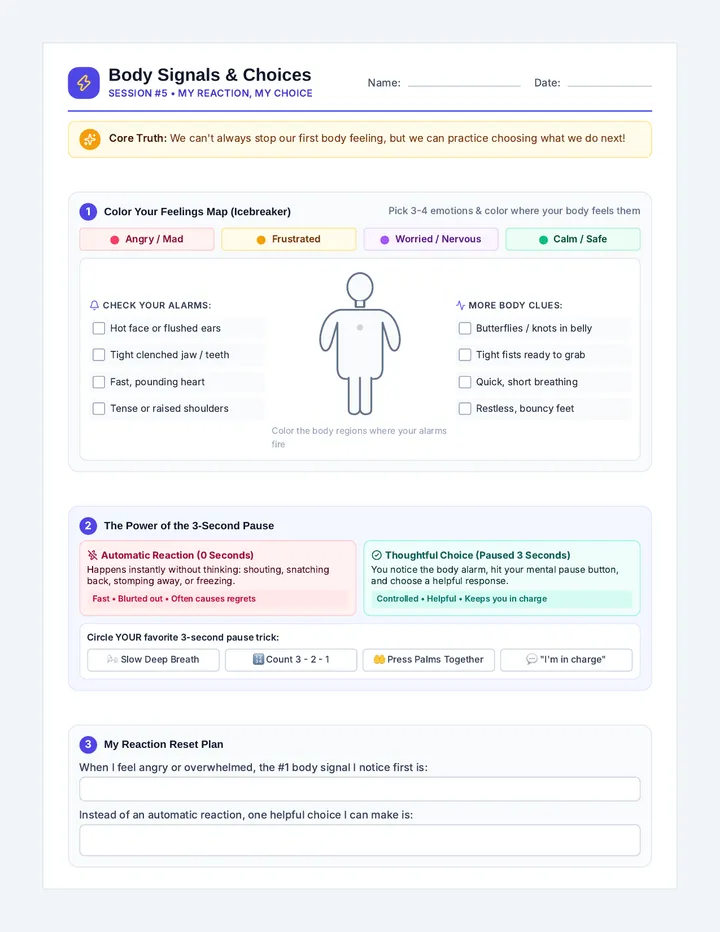
Pick two emotions we talked about today. For each emotion, draw where you feel it in your body and write two physical signs you notice. Think of your body like a rocket—what are your "sensors" telling you?
1
Emotion: ___________________________
Body Sensor Map (Draw Here)
Sketch physical signals
Physical Signal Log
Signal 1:
Signal 2:
"When I feel this way, my body is trying to tell me..."
2
Emotion: ___________________________
Body Sensor Map (Draw Here)
Sketch physical signals
Physical Signal Log
Signal 1:
Signal 2:
"Recognizing my body signals helps me stay in control."
Feeling Cards Resource Feeling Cards
Mission 1: Training Tools
😊
Happy
Mission Status: Go!
😢
Sad
Sensors: Low Power
😠
Angry
Warning: Overheating
😰
Anxious
Alert: Turbulence
Cut along the outer borders to create individual cards for Mission use.
The Wiggly Feeling Story The Wiggly Feeling Story
Session 1 Mission Briefing
Every morning, Sam bounced out of bed feeling a little wiggly. Today was Science Fair day. As Sam walked into the classroom, butterflies fluttered in the stomach. Sam’s legs tapped on the floor and the chest felt all warm and buzzing.
When it was time to present, Sam’s heart pounded like a drum. The palms felt sweaty, and the voice trembled just a bit. Sam took a deep breath and remembered how a wiggle in the tummy could mean excitement, too.
Later at recess, Sam joined a soccer game and kicked the ball hard—but then tripped over a friend’s shoe. A tight knot formed in the jaw and fists clenched at the sides. The face turned hot, and shoulders rose up near the ears. Sam realized these were the body’s signals for anger.
After a quick break on the bench, Sam rested hands on the knees and closed the eyes. Inhaling slowly, the heartbeat steadied and shoulders softened. With a calm breath, the wiggles in the tummy quieted down.
Mission Findings
Sam noticed how each feeling made the body speak:
Excitement: Butterflies in the stomach.
Nervousness: Sweaty palms and a pounding heart.
Anger: A clenched jaw and tight fists.
Sam smiled, knowing that paying attention to these body signals could help turn big wiggles into gentle calm.
Body Signals Charades Game Body Signals Charades
Mission 1 Training Game
Players 2+
Mission Objective
Reinforce the ability to identify and associate physical body signals with corresponding emotions through acting and guessing.
The Rules
Player A draws a card (don't show anyone!).
Player A silently acts out the body signal.
Player B guesses the signal and the emotion it's linked to.
Switch roles and repeat!
Signal Log (For Review)
Shaking hands Anxious
Clenched fists Angry
Butterflies in stomach Excited
Wide eyes Surprised
Discussion: When have you felt these signals in class?
Signal Mission Cards
Signal Shaking Hands
Signal Clenched Fists
Signal Fast Heartbeat
Signal Tight Chest
Signal Clenched Jaw
Signal Tense Shoulders
Signal Butterflies
Signal Wide Eyes
Signal Flushed Cheeks
Body Signals Quick Quiz Mission Quick Quiz
Session 1: Body Signal Check
Mission Log No. 001
Pilot Name
Stardate
1
How do your shoulders feel when you’re anxious?
2
What happens to your heartbeat when you’re angry?
3
Where in your body might you feel butterflies when you’re excited?
Mission Control (Teacher Use Only)
Baseline data point for Cooper's signal recognition.
Score / 3
Prompting Min / Mod / Max
Session 2 Flight Plan Session 2: Knowing Our Triggers
Regulation Rocket Mission Log
Duration 30 min
Why This Mission?
Recognizing what sets off his dysregulation and noticing early body signals empowers Cooper to catch his emotions quickly and choose strategies before they escalate.
Mission Objective
Cooper will identify at least two personal triggers of dysregulation (e.g., loud noise, frustration) and describe two early body signals (e.g., fast heartbeat, tight muscles) with adult prompting in 4 out of 5 opportunities.
Audience
Fourth Grade Individual Student (Tier 3 Support)
Pre-Flight Checklist
Review Triggers and Body Signals Slide Deck
Print and cut Trigger Cards
Print one copy of Trigger Scenarios Reading
Prepare role-play space for Trigger Tactics Role-Play Game
Print Trigger Identification Worksheet and Early Signals Quiz
Flight Path (Procedure)
5 min
Warm-Up: Trigger Hunt
Show one Trigger Card at a time
Ask Cooper: “What might make you feel this way?”
Confirm correct identification and prompt if needed
5 min
Discussion: Mapping Triggers
Display slide deck mapping triggers to body signals
Ask: “When you experience this trigger, what do you feel in your body?”
List responses (e.g., clenched jaw, racing heart) on the board
4 min
Reading: Trigger Scenarios
Read aloud the Trigger Scenarios Reading
Pause at each scenario: ask for the trigger and body signal mentioned
Encourage him to share similar experiences
7 min
Activity: Trigger Tactics Role-Play
Teacher mimes a trigger (e.g., covering ears for loud noise)
Cooper identifies trigger and body signal
Switch roles: Cooper acts out a trigger; teacher names the signal
Repeat for 4–5 scenarios
4 min
Worksheet: Identify Your Triggers
Give Cooper the Trigger Identification Worksheet
Have him write two triggers and draw the early body signals
Offer prompts but encourage independent thinking
3 min
Quiz: Early Signals Check
Session 2 Presentation Slides Session 2:
Knowing Our Triggers
Mapping the signals before the launch!
Mission Objective
Identify two personal triggers and two early body signals.
Mission Tools
Trigger Cards
Trigger Worksheet
Early Signals Quiz
Warm-Up: Trigger Hunt
Crowded Hallway
Loud Noise
Losing a Game
Waiting in Line
Mission Question:
"What could make you feel this way?"
Teacher: Show each Trigger Card.
Discussion: Triggers & Signals
When a trigger happens (like a loud noise)...
What do you feel in your body?
Early Signals:
Fast Heartbeat
Tight Chest
Shaky Hands
Teacher: Record Cooper's answers on the board.
Reading: Trigger Scenarios
Listen to each short story.
1. Loud Alarm
2. Surprise Question
3. Sudden Bump
Activity: Trigger Tactics Role-Play
The Mission:
Act out a trigger silently .
Partner names the Trigger and Signal .
Switch roles!
Practice catching the signals early!
Mission Report: Triggers
Your Turn:
1. Write two triggers.
2. Draw the early signals.
Independent Launch!
Quick Early Signals Check
What’s a trigger and signal for you when you feel frustrated?
How does your chest feel when you’re startled?
Where do you feel tension when you’re annoyed?
Mission Recovery
Shoulder Rolls
Neck Stretches
"How does your body feel now? Did any signals change?"
Trigger Cards Resource Trigger Mission Cards
Session 2 Training Tools
Crowded Hallway
Mission Trigger Alpha
Loud Noise
Mission Trigger Beta
Losing a Game
Mission Trigger Gamma
Waiting in Line
Mission Trigger Delta
Teacher Instructions:
Print, cut, and use these cards to help identify situations that trigger big feelings. Discuss each one with Cooper.
Trigger Scenarios Reading Trigger Scenarios Reading
Session 2 Mission Briefing
1. The Loud Alarm
As Cooper sat at his desk, the fire alarm suddenly blared through the halls. His chest tightened and his hands began to shake involuntarily. He covered his ears and took a quick breath, noting how his heart thumped loudly in his chest.
What was the trigger?
What was the signal?
2. The Surprise Question
During math class, the teacher pointed to Cooper and asked him to solve a problem on the board without warning. Cooper’s eyebrows furrowed, and his jaw felt clenched. He felt his pulse race, and his stomach churned as he stood up.
What was the trigger?
What was the signal?
3. The Sudden Bump
At lunch, a friend accidentally bumped into Cooper’s tray, spilling milk. Cooper’s eyes grew wide and his shoulders shot up toward his ears. He noticed a quick flutter in his stomach and a hot flush across his face.
What was the trigger?
What was the signal?
Trigger Identification Worksheet Identify Your Triggers
Mission 2: Signal Mapping
Pilot:
Mission Data Sheet
Think of two situations (triggers) that make you feel upset, anxious, or frustrated. For each trigger, draw where you feel the early body signals and write what you notice.
1
Trigger: ___________________________
Body Signal Map (Draw)
Sketch signals here
Early Signal 1:
Early Signal 2:
2
Trigger: ___________________________
Body Signal Map (Draw)
Sketch signals here
Early Signal 1:
Early Signal 2:
Trigger Tactics Role-Play Game Trigger Tactics Role-Play
Session 2 Strategy Training
Status Active
Mission Objectives
Name a Trigger (e.g., loud noise)
Describe a Body Signal (e.g., racing heart)
Choose a regulation strategy to stay calm
Game Instructions
Player A draws a Trigger Card (keep it secret!).Player A silently acts out the trigger.Player B identifies the Trigger and Body Signal .Player B picks a Strategy Card, names it, and demonstrates how to use it.Switch roles and repeat for 6–8 rounds!
Tactics Toolbox
Deep
Counting to
Stretch
"Have you felt this trigger in real life? What strategy helps you most in class?"
Early Signals Quick Quiz Mission Quick Quiz
Session 2: Early Signals Check
Mission Log No. 002
Pilot Name
Stardate
1
What is one trigger that can make you feel upset, and what early body signal do you notice?
2
When you hear a loud noise trigger, what happens to your body?
3
Name a trigger you’ve experienced in class and describe where you feel it in your body.
Mission Control (Teacher Use Only)
Track Cooper's ability to map personal triggers to signals.
Score / 3
Prompting Level Min / Mod / Max
Session 3 Flight Plan Session 3: Practicing Coping Strategies
Regulation Rocket Mission Log
Duration 30 min
Why This Mission?
Teaching concrete strategies and giving repeated practice helps Cooper link body signals to coping skills, moving him toward independent self-regulation across settings.
Mission Objective
Cooper will describe and practice two self-regulation strategies (deep breathing and movement breaks), selecting and using each with no more than one adult prompt in 4 out of 5 opportunities.
Audience
Fourth Grade Individual Student (Tier 3 Support)
Pre-Flight Checklist
Review Self-Regulation Strategies Slide Deck
Print and cut Strategy Practice Cards
Print one copy of Strategy Stories Reading
Prepare props: yoga mat or floor space for movement breaks
Print Strategy Selection Worksheet and Strategies Quick Quiz
Flight Path (Procedure)
5 min
Warm-Up: Strategy Match
Lays out Strategy Practice Cards. Cooper picks one, names it, and tells when he might use it.
5 min
Discussion: Why Strategies Work
Explain how deep breathing and movement help calm body signals. Record Cooper's thoughts.
4 min
Reading: Strategy Stories
Read aloud Strategy Stories. Pause to identify strategy used and body signal effect.
7 min
Activity: Strategy Role-Play
Model four deep breaths and movement breaks. Cooper leads the next rounds.
4 min
Worksheet: Strategy Selection
Cooper writes situations and sketches "before/after" body sensations.
3 min
Quiz: Strategies Quick Check
Administer 3 quick questions. Record responses for progress monitoring.
2 min
Cool Down: Choose & Reflect
Cooper picks favorite strategy to practice. Reflect on current body state.
Session 3 Presentation Slides Session 3:
Practicing Coping Strategies
Equipping your rocket with the best defense systems!
Mission Objective
Practice 2 strategies: Deep Breathing & Movement Breaks.
Mission Toolbox
Strategy Practice Cards
Selection Worksheet
Strategies Quiz
Warm-Up: Strategy Match
Deep Breathing
Movement Break
Your Task:
Pick a card
Name the strategy
Tell when you'd use it
Discussion: Why Strategies Work
Deep breathing slows your heartbeat and eases tension.
Movement breaks release energy and relax muscles.
Mission Question:
"Which body signal does this strategy help?"
Reading: Strategy Stories
Listen closely to the two stories about Jamie and Alex.
Questions:
1. Which strategy was used?
2. How did it change their body signals?
Activity: Strategy Practice
1. Deep Breathing
Model 4 breaths together. Then YOU lead!
2. Movement Break
Model a stretch or march. Then YOU lead!
Strategy Selection
Independent Launch:
Write 2 situations for each.
Sketch Before & After signals.
Strategies Quick Check
When your heart races, which strategy could you use?
How can a movement break help when you feel tense?
Why does deep breathing work?
Mission Recovery
Pick your favorite strategy and practice it one more time!
"How do you feel now? Any changes in your body signals?"
Mission 3 Complete
Strategy Practice Cards Strategy Practice Cards
Session 3 Mission Toolbox
Deep Breathing
Oxygen Intake Activated
"Inhale for 4 seconds... Exhale for 4 seconds..."
Movement Break
Energy Release Sequence
"Stand up, stretch high, and march in place!"
Mission Support Instructions
Phase 1: Warm-Up
Lay cards face-up. Cooper picks one, names the strategy, and explains when or why he would use it.
Phase 2: Demonstration
After naming the card, Cooper must demonstrate the strategy (e.g., take 4 slow breaths or do a quick stretch).
Print on cardstock and laminate for repeated use in the Calm Corner or during missions.
Strategy Stories Reading Strategy Stories Reading
Session 3 Mission Briefing
Story 1: Jamie’s Racing Heart
Jamie sat at his desk, feeling the familiar flutter in the chest and a pounding heart as the teacher called on them to read aloud. Jamie’s hands began to shake and the breath felt short. Remembering their deep breathing strategy, Jamie closed their eyes and placed a hand on their belly. Slowly, Jamie inhaled through the nose for four seconds, then exhaled through the mouth for four seconds—repeating this four times. After breathing, Jamie noticed the heartbeat slowed, shoulders relaxed, and the voice felt calm enough to read the paragraph clearly.
Prompt: How did Jamie's body change after using the strategy?
Story 2: Alex’s Tight Muscles
On a noisy day at lunch, Alex felt tension rise in the neck and shoulders as classmates bumped and laughed nearby. The muscles tightened so much that Alex clenched fists under the table. Alex decided to use a quick movement break: standing up, stretching arms overhead, and marching in place for one minute. As Alex moved, the tightness in the shoulders eased, the legs felt energized instead of jittery, and the mind grew quieter. Returning to the table, Alex felt more in control and ready to join the conversation calmly.
Prompt: Why did Alex choose a movement break for these body signals?
Strategy Selection Worksheet Strategy Selection
Mission 3: Tactics Worksheet
Pilot:
For each self-regulation strategy below, think of a real situation when you might use it. Then draw how your body feels before using the strategy and after using the strategy.
Strategy: Deep Breathing
Situation:
I would use deep breathing when...
Body BEFORE Strategy
Sketch sensations
Body AFTER Strategy
Sketch calmness
Strategy: Movement Break
Situation:
I would use a movement break when...
Body BEFORE Strategy
Sketch sensations
Body AFTER Strategy
Sketch calmness
Strategy Practice Role-Play Game Strategy Practice Role-Play
Session 3 Training Simulation
Status Simulation Live
Mission Objectives
Independently choose a strategy when noticing body signals.
Correctly demonstrate 4 deep breaths.
Correctly demonstrate a 30-second movement break.
Mission Rules
Teacher mimes a stress scenario (e.g., hand on chest for racing heart).Cooper names the signal and chooses the correct Strategy Card .Cooper demonstrates the strategy (4 breaths or 30-sec movement).Verify if strategy matches the signal.
Switch Roles! Cooper mimes the signal, teacher practices.Repeat for 4–6 rounds.
Post-Simulation Debrief
"Have you ever felt this in class? What strategy will you use next time?"
"Which strategy felt more comfortable to you today? Why?"
Strategies Quick Quiz Mission Quick Quiz
Session 3: Strategies Check
Mission Log No. 003
Pilot Name
Stardate
1
When your heart is racing, which strategy would you choose and why?
2
How can a movement break help calm your body when you feel tense?
3
Explain why deep breathing works to help you feel calmer.
Mission Control (Teacher Use Only)
Cooper's grasp of strategy logic and physiological effects.
Success / 3
Strategy Use Independent
Session 4 Flight Plan Session 4: The Calm Corner
Regulation Rocket Mission Log
Duration 30 min
Why This Mission?
Providing a dedicated Calm Corner gives Cooper an accessible, structured way to self-regulate when he notices early signs of dysregulation, supporting independent strategy use.
Mission Objective
Cooper will identify and use a personalized Calm Corner strategy—selecting deep breathing or movement breaks within the calm space—with no more than one adult prompt in 4 out of 5 opportunities.
Audience
Fourth Grade Individual Student (Tier 3 Support)
Pre-Flight Checklist
Review Calm Corner Slides
Print & cut Calm Corner Cards
Set up quiet space with cushions
Gather calming props (timer, ball)
Print worksheet and quiz
Print Setup Guide
Flight Path
5m
Strategy Review: Name breathing/movement strategies and when to use them.
5m
Discussion: Introduce the Calm Corner. Ask: "What tool would you pick first?"
4m
Reading: Calm Corner Story. Pause to identify character actions.
7m
Activity: Explore the Corner. Practice using the cards in the new space.
4m
Worksheet: Draw/write tool used and how body feels after.
3m
Quiz: 3-question quick check on corner tools and effects.
2m
Cool-Down: Use favorite strategy once more. Reflect on feeling change.
Session 4 Presentation Slides Session 4:
Introducing the Calm Corner
Mission Objective
Identify and use a personalized Calm Corner strategy with minimal prompting.
Mission Tools
Calm Corner Cards
Reflection Worksheet
Quick Quiz
Warm-Up: Strategy Review
🧘♂️ Deep Breathing
🤸♂️ Movement Break
Review Check:
1. Name the strategy.
2. Tell when you'd use it.
Discussion: Our Calm Corner
This is a quiet, cozy spot to use coping strategies when you feel upset or overwhelmed.
Mission Question:
"What tool would you pick first when you notice you're getting upset?"
Reading: Calm Corner Story
Listen to stories about Mia and Jayden using their Calm Corner.
Ask Yourself:
1. What did they do?
2. Which strategy did they choose?
Activity: Explore the Corner
1
Go to the Calm Corner area.
2
Pick a card and try the tool.
3
Repeat with the other tool.
"How did you feel after each tool?"
Mission Reflection
Worksheet Task:
1. Draw or write the tool you used.
2. Describe how your body feels.
Calm Corner Quick Check
Name one tool and why you'd use it.
How do you feel after deep breaths?
What will make this space work best for you?
Mission Complete
"How does your body feel now compared to before?"
Return to Base!
Calm Corner Cards Resource Calm Corner Tools
Session 4: Station Visuals
🧘♂️
Deep Breathing
The Routine:
"Inhale for 4 seconds... Exhale for 4 seconds... Repeat 4 times."
🤸♂️
Movement Break
The Routine:
"Reach arms overhead... March in place for 30 seconds."
Mission Control: Calm Corner Setup
Step 1: Location
Choose a low-traffic area with soft seating (beanbag, cushions). Ensure a clear view of the visual timer if used.
Step 2: Utilization
Cooper chooses a card upon entry. He follows the prompt and reflects on his body signals before returning to work.
Keep these cards in the Calm Corner station at all times.
Calm Corner Stories Reading Calm Corner Stories
Session 4 Mission Briefing
🧘♀️
Story 1: Mia’s Quiet Moment
Mia felt her chest tighten and her fists clench as the classroom noise grew louder. She noticed her breathing speed up and her shoulders rise. Mia quietly walked to the Calm Corner, sat on the soft cushion, and picked up the deep-breathing card. She placed a hand on her belly, inhaled slowly for four seconds, and exhaled for four more. Mia repeated this three times. Soon, her shoulders softened, her heartbeat slowed, and she felt calm enough to return to her desk.
Mission Check: What signals did Mia notice?
🤸♂️
Story 2: Jayden’s Energy Release
Jayden’s mind buzzed and legs bounced after sitting through a long lesson. His body felt tense and restless. Remembering the Calm Corner tools, he moved to the quiet space and chose the movement-break card. Jayden stretched his arms overhead, marched in place, and tapped his toes for one minute. As he moved, the restlessness melted away, his muscles relaxed, and his breathing evened out. Jayden smiled, feeling ready to focus on his next task.
Mission Check: Which tool did Jayden choose?
Calm Corner Reflection Worksheet Corner Reflection
Mission 4: Station Log
Pilot:
Mission Data Report
Think about the Calm Corner tool you used today. For each tool, write or draw what you did and how your body felt before and after using it.
1
Tool: Deep Breathing
What I did:
I used deep breathing by...
Body BEFORE
Sketch sensations
Body AFTER
Sketch calmness
How did your body change?
2
Tool: Movement Break
What I did:
I used a movement break by...
Body BEFORE
Sketch sensations
Body AFTER
Sketch calmness
How did your body change?
Calm Corner Quick Quiz Mission Quick Quiz
Session 4: Calm Corner Check
Mission Log No. 004
Pilot Name
Stardate
1
Name one Calm Corner tool and explain why you’d choose it when you feel upset.
2
After using deep breathing in the Calm Corner, how does your body feel? Name two changes you notice.
3
What could help make the Calm Corner work best for you?
Mission Control (Teacher Use Only)
Cooper's preference for tools and station effectiveness.
Accuracy / 3
Prompt Level Min / Mod / Max
Calm Corner Role-Play Game Calm Corner Role-Play
Session 4 Station Drill
Station Ready
Mission Objectives
Recognize an early sign of dysregulation.
Say "I need a break" and move to the Calm Corner.
Select and follow a Station Card independently.
Role-Play Protocol
Teacher mimes an early body signal (e.g., tensing shoulders).Cooper identifies the signal: "My shoulders are tense."Cooper says: "I need a break," and moves to the corner.Cooper picks a Calm Corner Card and follows the steps.Cooper reflects on the change: "I feel calmer now."Switch Roles! Repeat for 4–6 rounds.
"Which tool felt most helpful today? Can you think of a real classroom moment when you could use this break?"
Session 5 Flight Plan Session 5: Noise Overload
Regulation Rocket Mission Log
Duration 30 min
Why This Mission?
Helping Cooper practice initiating strategies amid real classroom distractions builds his confidence and supports generalization of self-regulation across settings.
Mission Objective
Cooper will independently notice rising classroom noise as a trigger and initiate a chosen self-regulation strategy (deep breathing or movement break in the Calm Corner) in 4 out of 5 opportunities.
Materials Need
Noise Cue Cards, Scenario Reading, Reflection Worksheet, Role-Play Game, Quick Quiz.
Pre-Flight Checklist
Review Session 5 Slides
Print & cut Noise Cue Cards
Prep noise simulation (audio)
Print noise scenario reading
Print worksheet and quiz
Set up Calm Corner props
Flight Path
5m
Noise Recognition: Show cue cards (chatter, scraping chairs). Link to feelings.
5m
Discussion: Play noise simulation. Identify physical signals in the moment.
4m
Reading: Noise Overload Scenario. Point out signals in the story.
7m
Activity: Noise Alert Role-Play. Practice saying "I need a break" and using the corner.
4m
Worksheet: Reflect on strategy used and before/after body states.
3m
Quiz: Check strategy choice and independent initiation memory.
2m
Cool-Down: Strategy practice without noise. Reflect on the difference.
Session 5 Presentation Slides Session 5:
Navigating Noise Overload
Mission Objective
Notice rising noise as a trigger and initiate a strategy independently.
Mission Tools
Warm-Up: Noise Recognition
Loud Chatter
Scraping Chairs
Dropped Books
Ringing Phone
Ask Yourself:
"How might these noises make your body feel?"
Discussion: Noise Effects
Static Check
Common Signals:
• Racing Heart
• Tense Shoulders
• Covering Ears
What did YOU notice during the noise simulation?
Activity: Noise Alert Role-Play
The Drill:
1. Teacher simulates noise.
2. Mime a body signal.
3. Say: "I need a break."
4. Use a corner strategy.
Be ready to launch your defense!
Strategies Quick Check
Which strategy would you choose if noise gets too loud?
How does deep breathing or movement break feel afterward?
What will help you remember to take a break next time?
Noise Cue Cards Resource Noise Cue Cards
Session 5 Mission Tools
Loud Chatter
Sound Frequency: High
Scraping Chairs
Vibration Alert
Dropped Books
Sudden Impact Signal
Ringing Phone
Repetitive Alert
Use these cards to practice recognizing noises that send "static" to your body.
Noise Overload Scenario Reading Noise Overload Scenario
Session 5 Mission Briefing
It was mid-morning, and the classroom buzzed with activity. Chairs scraped across the floor as students rearranged desks for group work. A loud chatter filled the air—papers rustled, backpacks zipped, and someone dropped a textbook with a thud. Cooper felt his ears prick with every sound.
Suddenly, his chest tightened and his shoulders drew up toward his ears. His heartbeat pounded like a drum, and his hands flew to his ears to muffle the noise. In that moment, Cooper noticed the tight knot forming in his stomach and the racing pulse in his throat.
Remembering his strategies, Cooper quietly stood and said, “I need a break.” He moved to the Calm Corner, selecting the deep breathing card. Cooper placed a hand on his belly and inhaled slowly for four seconds, then exhaled for four seconds.
Mission Results
After three breaths:
Heartbeat steadied
Shoulders relaxed
Classroom sounds seemed softer
Cooper smiled, knowing he could use this strategy whenever the noise felt too loud.
Noise Overload Reflection Worksheet Noise Reflection
Mission 5: Frequency Check
Astronaut:
Strategy Log
Tactics Used:
I used this strategy by...
Body BEFORE Strategy
Draw Tension
Body AFTER Strategy
Draw Calmness
What changed in my body?
1
2
Strategies Quick Quiz – Session 5 Mission Quick Quiz
Session 5: Noise & Strategies
Mission Log No. 005
1
Which strategy would you choose if the classroom noise gets too loud?
2
How does using deep breathing or a movement break feel in your body afterward?
3
What will help you remember to take a break next time the noise feels overwhelming?
Mission Control (Teacher Use Only)
Cooper's ability to plan for noise-triggered dysregulation.
Score / 3
Independence Prompt Needed?
Noise Alert Role-Play Game Noise Alert Role-Play
Session 5 Defense Drill
Defense Active
Mission Objectives
Notice rising classroom noise as a trigger.
Independently say "I need a break" when static rises.
Choose and use a Calm Corner tool immediately.
The Drill Protocol
Teacher simulates noise (clapping or audio clip).Teacher mimes a body signal (hands over ears).Cooper names the signal: "That noise is making my chest tight."Cooper says: "I need a break" and moves to Station.Cooper selects and uses a Station Card strategy.Switch roles! Cooper simulates noise, teacher models regulation.
Repeat for 4–5 rounds.
"How does your body feel now compared to before the noise?"
Independent initiation achieved in role-play.
Session 6 Flight Plan Session 6: Partner Work
Regulation Rocket Mission Log
Duration 30 min
Why This Mission?
Practicing self-regulation in a social context helps Cooper generalize strategies beyond solo work and supports positive peer interactions.
Mission Objective
Cooper will independently notice stress during partner work and initiate a self-regulation strategy (deep breathing or movement break) in 4 out of 5 opportunities.
Co-Pilot Skill
Collaborative Regulation
Pre-Flight Checklist
Review Partner Work Slides
Print & cut Role Cards
Print partner scenario reading
Clear space for side-by-side work
Print worksheet and quiz
Ensure Calm Corner is ready
Flight Path
5m
Warm-Up: Partnership Preferences. Cooper picks Reader or Recorder role and discusses feelings.
5m
Discussion: Working With Others. Discuss body signals linked to worry or excitement during teamwork.
4m
Reading: Partner Scenario. Pause at stress points to identify signals and helpful strategies.
7m
Activity: Partner Role-Play. Practice short tasks and saying "I need a break" when signals arise.
4m
Worksheet: Partner Reflection. Log the role played and body signal changes after strategy use.
3m
Quiz: Check strategy selection for jittery teamwork moments.
2m
Cool-Down: Favorite strategy practice. Reflect on current comfort level.
Session 6 Presentation Slides Session 6:
Partner Work Regulation
Mission Objective
Notice stress during partner work and initiate a strategy independently.
Collaboration Check
Warm-Up: Co-Pilot Roles
Reader
Recorder
Discussion:
"Which role would you choose? How might you feel working side-by-side?"
Discussion: Working With Others
When you work with a partner, what signals tell you you're worried or excited?
Teamwork Signals:
Sweaty Palms
Jittery Legs
Racing Heart
Reading: Partner Scenario
Listen to the story about Cooper and Mia.
Which strategy helps?
Activity: Partner Role-Play
Team Mission:
1. Take turns as Reader & Recorder .
2. Do a mini-task.
3. Ask: "How do you feel?"
4. If needed, move to the Calm Corner .
Co-Pilot coordination check!
Strategies Quick Check
When you feel jittery working with a partner, which strategy would you choose?
How does a movement break help afterward?
Why might you use deep breathing next time?
Partner Role Cards Resource Partner Role Cards
Session 6: Teamwork Briefing
The Reader
Reads instructions aloud.
Listens for partner feedback.
Checks for understanding.
Co-Pilot Alpha
The Recorder
Writes or sketches responses.
Notes down important ideas.
Shares work for review.
Co-Pilot Beta
Mission Instruction:
"What does this role involve? How might you feel doing this?"
Cut these cards to define roles during collaborative classroom missions.
Partner Scenario Reading Partner Work Scenario
Session 6 Mission Briefing
Cooper and his classmate Mia sat side by side to work on a science poster about the water cycle. At first, Cooper felt calm as Mia read the instructions aloud.
But when Mia asked him to write the first sentence on the poster, Cooper’s palms grew sweaty and his heartbeat sped up. His legs bounced under the table and his chest felt tight.
Cooper remembered his deep breathing strategy. He quietly placed one hand on his belly and took four slow breaths—inhale for four seconds, exhale for four seconds. As he breathed, Cooper noticed his heartbeat slow and his shoulders soften. Feeling more in control, he picked up the marker and wrote the sentence.
Mission Log: New Signals
During the next step, Mia asked Cooper to draw the clouds. Cooper’s stomach fluttered with excitement, and he felt a knot form in his jaw.
He nodded to Mia, excused himself, and walked to the Calm Corner . There, he chose the movement-break card and marched in place for thirty seconds.
Cooper returned to Mia with a smile, ready to finish their poster together.
Partner Work Reflection Worksheet Partner Reflection
Mission 6: Co-Pilot Report
Astronaut:
1. Partner Role
Which role did you play?
What did that role involve?
2. Body Signals BEFORE Strategy
How did your body feel before you used a strategy?
Sketch sensations
3. Strategy Used
Which self-regulation strategy did you choose?
4. Body Signals AFTER Strategy
How did your body feel after using that strategy?
Sketch calmness
5. Mission Findings
Describe one change you noticed in your feelings:
Strategies Quick Quiz – Session 6 Mission Quick Quiz
Session 6: Partner Work Check
Mission Log No. 006
1
When you feel jittery working with a partner, which strategy would you choose and why?
2
How can taking a movement break help your body after you notice stress signals during partner work?
3
Why might you use deep breathing next time your muscles feel tight while working with someone?
Mission Control (Teacher Use Only)
Cooper's ability to apply regulation logic in social scenarios.
Score / 3
Co-Pilot Skill Tier 3 Mastery
Partner Work Role-Play Game Partner Work Role-Play
Session 6 Co-Pilot Drill
Status Active Sync
Mission Objectives
Recognize early body signals during collaborative work.
Verbally acknowledge stress: "I need a break."
Practice returning to tasks after regulation.
Interaction Protocol
Player A draws a Role Card (Reader/Recorder).Player B takes the other role.Complete a 1-minute task (read/write a sentence).
Partner asks: "How do you feel?"
If stress signals exist, Cooper says: "I need a break."
Cooper moves to Corner, uses card, and returns to task.
Switch roles! Repeat for 4–6 rounds.
"Which strategy felt most helpful while working with someone?"
Generalizing skills to social contexts.
Session 7 Flight Plan Session 7: Unexpected Questions
Regulation Rocket Mission Log
Duration 30 min
Why This Mission?
Learning to catch sudden stress signals and apply strategies quickly will help Cooper stay calm when he’s put on the spot, supporting confidence and focus during classroom participation.
Mission Objective
Cooper will independently notice body signals (e.g., racing heart) when called on unexpectedly and initiate a strategy (breathing/movement) in 4 out of 5 opportunities.
Rapid Response Skills
Pre-Flight Checklist
Review Session 7 Slides
Print & cut Question Cards
Print scenario reading
Clear space for role-play
Print worksheet and quiz
Check Calm Corner status
Flight Path
5m
Warm-Up: Recognition. Show cue cards (hand raising, random call). Link to feelings.
5m
Discussion: Sudden Stress. Discuss body signals when called on without warning.
4m
Reading: Unexpected Question Story. Point to body spots described.
7m
Activity: Question Alert Game. Practice being called on, saying "break," and regulating.
4m
Worksheet: Question Reflection. Log the surprise event and how strategy changed feelings.
3m
Quiz: Check recall of signals and strategy choice for call-outs.
2m
Cool-Down: Strategy choice practice. Reflect on current "sensor" levels.
Session 7 Presentation Slides Session 7:
Handling Unexpected Questions
Mission Objective
Notice body signals when called on without warning and initiate a strategy independently.
Comms Check Live
Warm-Up: Question Recognition
Teacher Raising Hand
Random Call-Out
Pointing at Student
Ask Yourself:
"What's happening? How might that make you feel?"
Discussion: Sudden Stress
When someone calls on you without warning, what do you notice in your body?
Common Signals:
Racing Heart
Sweaty Palms
Tight Chest
Reading: Unexpected Question
Listen to the story about Cooper's spelling worksheet.
Comms Response Strategy?
Activity: Question Alert!
The Drill:
1. Teacher simulates call-out.
2. Teacher mimes a signal.
3. Cooper says: "I need a break."
4. Use Calm Corner strategy.
Stay on Frequency!
Strategies Quick Check
What signal do you notice when called on unexpectedly?
Which strategy would you choose?
How do you feel afterward?
Question Cue Cards Resource Question Cue Cards
Session 7 Mission Tools
Teacher Raising Hand
Visual Alert Signal
Pointing at Student
Direct Request Incoming
Random Call-Out
Auditory Surprise Alert
Frequency Shift
Station Alert Sequence
Use these cards to practice identifying when a question is about to reach your station.
Unexpected Question Scenario Reading Unexpected Question Scenario
Session 7 Mission Briefing
Cooper was quietly working on his spelling worksheet when suddenly the teacher pointed directly at him and called, “Cooper—can you share your answer?”
His chest tightened, and his breath became quick and shallow. Cooper felt his heart pound like a drum and his palms grow sweaty. A knot formed in his stomach, and he noticed his shoulders creeping up toward his ears.
Remembering his Calm Corner tools , Cooper took a calm breath and said softly, “I need a break.” He walked to the Calm Corner and picked up the deep-breathing card.
Post-Break Report
Breathing slowed down
Heart settled in chest
Shoulders dropped from ears
Chest tightness eased away
Feeling more centered, Cooper returned to his seat, ready to answer the question with confidence.
Question Reflection Worksheet Question Reflection
Mission 7: Comms Log
Pilot:
1. What Happened?
Describe what the teacher did and how you felt:
2. Signals BEFORE Strategy
How did your body feel initially?
Sketch Signals
3. Signals AFTER Strategy
How did your body feel after regulation?
Sketch Calmness
4. Mission Check
Name one change you noticed in your body or feelings:
Strategies Quick Quiz – Session 7 Mission Quick Quiz
Session 7: Questions & Recovery
Mission Log No. 007
1
What body signal do you notice when you’re called on unexpectedly?
2
Which strategy would you choose when you’re called on suddenly, and why would it help?
3
After using your strategy in the Calm Corner, how does your body feel? Describe two changes .
Mission Control (Teacher Use Only)
Cooper's ability to plan for sudden classroom demands.
Score / 3
Alert Readiness Mission Ready
Question Alert Role-Play Game Question Alert Role-Play
Session 7 Comms Drill
Signal Live Response
Mission Objectives
Recognize sudden stress signals when put on the spot.
Maintain the "I need a break" protocol under pressure.
Execute rapid-response regulation in the Calm Corner.
Response Protocol
Teacher shows a Question Cue Card or calls Cooper's name.Teacher mimes a sudden signal (e.g., hand on chest).Cooper identifies signal: "My heart just started racing."Cooper says: "I need a break" and moves to Station.Cooper uses card strategy, then returns to the task.Switch roles! Cooper calls on teacher.
Repeat for 4–6 rounds.
"Which tool felt most helpful for a sudden call-out?"
Mastering the unexpected participate protocol.
Session 8 Flight Plan Session 8: Tackling Test Jitters
Regulation Rocket Mission Log
Duration 30 min
Why This Mission?
Practicing strategy use right before assessments helps Cooper manage test anxiety and remain focused during real classroom quizzes.
Mission Objective
Cooper will independently notice pre-test jitters and initiate a chosen self-regulation strategy (deep breathing/movement) before a quiz in 4/5 opportunities.
Pressure Tolerance
Pre-Flight Checklist
Review Slides
Cut Test Anxiety Cards
Print Story Reading
Prep mock quiz sheet
Print worksheet & quiz
Calm Corner Ready
Flight Path
5m
Warm-Up: Jitters Recognition. Pick anxiety cards and name sensations (butterflies, etc).
5m
Discussion: Test Feelings. List body signals when thinking about quizzes (racing thoughts).
4m
Reading: Story. Point to where body signals would be felt in the passage.
7m
Activity: Role-Play. Pretend it's quiz time, notice jitters, use Calm Corner, then return.
4m
Worksheet: Test Reflection. Log jitters felt and strategy used before answering.
3m
Quiz: Rapid check on test-signal recognition and strategy choice.
2m
Cool-Down: Final practice. Reflect on current "pre-test" state versus "calm" state.
Session 8 Presentation Slides Session 8:
Tackling Test Jitters
Mission Objective
Notice pre-test jitters and initiate a strategy independently before starting.
System Pressure Check
Warm-Up: Jitters Recognition
🦋 Butterflies
🤲 Sweaty Palms
🤯 Racing Thoughts
💪 Tense Muscles
Mission Task:
"Pick a jitter and describe where you feel it in your body."
Discussion: Test Feelings
When you think about taking a quiz, what do you notice in your body?
Pressure Alert!
Reading: Test Prep Story
Listen to the story about Cooper's blank quiz.
Pre-Launch Checklist?
Activity: Test Time!
Pressure Drill:
1. Get mock quiz.
2. Mime a signal (jitters).
3. Say: "I need a break."
4. Use strategy.
5. Return and answer!
Stay Focused, Stay Calm!
Strategies Quick Check
What body signal do you notice before a quiz?
Which strategy would you use and why?
How do you feel after using it?
Test Anxiety Cue Cards Resource Test Anxiety Cards
Session 8 Mission Tools
🦋
Butterflies
Internal Flutter Check
🤲
Sweaty Palms
Interface Sensor Alert
🤯
Racing Thoughts
CPU Overload Alert
💪
Tense Muscles
Structural Tension Sync
Use these cards to identify "jitters" before a high-pressure launch.
Test Preparation Reading Test Preparation Story
Session 8 Mission Briefing
Cooper sat quietly at his desk, staring at the blank quiz paper in front of him. As he read the first question, a flutter of butterflies danced in his stomach.
His palms grew sweaty, and his mind buzzed with racing thoughts. He noticed his shoulders creeping up toward his ears and felt a tight knot form in his chest. Cooper recognized these as the "pre-launch jitters."
Remembering his Calm Corner tools , Cooper softly said, “I need a break,” and moved to the Calm Corner. He selected the deep-breathing card.
After three slow breaths, his heartbeat slowed and his shoulders dropped. Cooper smiled, turned back to his desk, and confidently answered the quiz question.
Preparation isn't just about the answers; it's about the mission state.
Test Reflection Worksheet Test Reflection
Mission 8: Pressure Log
Pilot:
1. Tactics Report
Strategy Used:
I used this strategy by...
2. Before Strategy
How did your body feel (e.g., butterflies)?
Sketch sensations
3. After Strategy
How did your body feel (e.g., relaxed)?
Sketch calmness
4. Final Change
What changed the most in your feelings?
Strategies Quick Quiz – Session 8 Mission Quick Quiz
Session 8: Pre-Test Regulation
Mission Log No. 008
1
What body signal do you notice when you think about taking a quiz?
2
Which strategy would you choose before starting a quiz, and why would it help?
3
After using your strategy, how does your body feel now ? Name two changes.
Mission Control (Teacher Use Only)
Cooper's ability to plan for high-stakes classroom moments.
Score / 3
Independence Initiated
Test Time Role-Play Game Test Time Role-Play
Session 8 Pressure Drill
Drill Live Test
Mission Objectives
Recognize pre-test jitters (butterflies, sweaty palms).
Independently use strategy BEFORE starting the task.
Execute the "Return to Mission" mindset after regulation.
Pressure Protocol
Teacher hands Cooper a quiz sheet and mimes jitters.Cooper names the signal: "I have butterflies in my stomach."Cooper says: "I need a break" and moves to Corner.Cooper selects card and executes the strategy.Cooper returns to the desk and answers the quiz question.Teacher reviews answer and offers positive feedback.Repeat for 4–6 rounds.
"How did the strategy help you feel ready to answer?"
Mastering pre-launch stabilization.
Session 9 Flight Plan Session 9: Smooth Transitions
Regulation Rocket Mission Log
Duration 30 min
Why This Mission?
Transitions can feel overwhelming and trigger dysregulation. Practicing strategy use at these moments helps Cooper generalize self-regulation across daily routines.
Mission Objective
Cooper will recognize transition cues (e.g., bell) and independently use a chosen strategy (breathing/movement) during routines in 4/5 opportunities.
Navigation Skills
Pre-Flight Checklist
Review Slides
Cut Transition Cards
Print Story Reading
Simulate desks/areas
Print worksheet & quiz
Calm Corner Ready
Flight Path
5m
Warm-Up: Cue Recognition. Show cards (bell, "line up") and discuss body "fidgets."
5m
Discussion: Transition Effects. List signals when switching activities (tense shoulders).
4m
Reading: Story. Cooper identifies the strategy used during the math-to-reading switch.
7m
Activity: Transition Time Game. Practice shifting stations, noticing signals, and regulating.
4m
Worksheet: Reflection. Log the cue noticed and how body felt after using a corner tool.
3m
Quiz: Check recall of transition signals and chosen strategy effectiveness.
2m
Cool-Down: Final practice at "end-of-lesson" cue. Praise independent regulation.
Session 9 Presentation Slides Session 9:
Smooth Transitions
Mission Objective
Recognize transition cues and use a strategy independently to stay regulated.
Orbit Stabilization
Warm-Up: Cue Recognition
Bell Ring
"Line Up"
Clean Up
Announcement
Mission Check:
"What's happening? How might that make you feel?"
Discussion: Transition Effects
When we switch from one activity to another, what do you notice in your body?
Potential Signals:
• Butterflies in Stomach
• Tense Shoulders
• Fidgety Legs
Reading: Transition Story
Listen to the story about the math-to-reading switch.
Waypoint Strategy?
Activity: Transition Time!
The Maneuver:
1. Teacher shows cue (bell).
2. Mime body signal.
3. Say: "I need a break."
4. Use corner tool.
5. Resume next activity!
Navigate the Day!
Strategies Quick Check
What body signal do you notice when you hear the transition bell?
Which strategy would you choose and why?
How do you feel after using it?
Transition Cue Cards Resource Transition Cue Cards
Session 9 Mission Tools
🔔
Bell Ring
Activity Shift Trigger
🚶♂️
"Line Up"
Formation Command
🧹
Desk Clean-Up
Station Reset Sequence
📢
End Announcement
Mission Conclusion Alert
Use these cards to prepare for activity shifts in your daily orbit.
Transition Scenario Reading Transition Scenario Reading
Session 9 Mission Briefing
It was the end of math time, and the teacher announced, “Okay, everyone—please tidy up your desks and line up at the reading corner.” Cooper heard the bell ring and saw classmates shifting and chatting.
His chest tightened, and he felt butterflies in his stomach. His shoulders rose toward his ears, and his legs began to fidget as he stacked his books. Cooper realized he was in "transition turbulence."
Cooper remembered his Calm Corner steps . He quietly whispered, “I need a break,” and slipped away to the Calm Corner at the side of the room. Sitting on the cushion, Cooper reached for the deep-breathing card.
Mission Success
After repeating 3 deep breaths:
Heartbeat slowed down
Shoulders dropped back down
Butterflies settled in stomach
Feeling ready, Cooper returned to the line, placed his books on the shelf, and took his seat. He felt calm and prepared for the next mission.
Transition Reflection Worksheet Transition Reflection
Mission 9: Navigation Log
Pilot:
1. Waypoint Change
Describe what happened during the transition:
2. Body Check BEFORE Strategy
How did your body feel (e.g., tight chest, fidgety)?
Sketch Signals
3. Body Check AFTER Strategy
How did your body feel after regulation?
Sketch Calmness
4. Navigation Success
Name one change you noticed in your feelings:
Strategies Quick Quiz – Session 9 Mission Quick Quiz
Session 9: Transition Control
Mission Log No. 009
1
What body signal do you notice when you hear a transition cue (e.g., the bell)?
2
Which strategy would you choose when you notice that signal, and why would it help?
3
After using that strategy, how does your body feel now ? Name two changes.
Mission Control (Teacher Use Only)
Cooper's ability to maintain regulation during environmental shifts.
Success / 3
Independence Initiated
Transition Time Role-Play Game Transition Time Role-Play
Session 9 Navigation Drill
Maneuver Sync Ready
Mission Objectives
Recognize transition cues (bells, announcements).
Identify body "turbulence" (fidgets, tight chest).
Initiate the Corner protocol during activity shifts.
The Maneuver Protocol
Teacher triggers a cue (rings bell/shows card).Cooper names the cue: "I hear the bell/math is over."Cooper identifies signal: "My chest is starting to feel tight."Cooper says: "I need a break" and moves to Station.Cooper selects strategy card and completes it.Cooper returns and resume next mission phase (e.g. line up).Switch Roles! Repeat for 4–6 rounds.
"Which strategy worked best for a station switch?"
Maintaining regulation across the daily orbit.
Session 10 Flight Plan Session 10: Mission Complete
Regulation Rocket Finale
Duration 30 min
Why This Mission?
Celebrating success reinforces learning and builds self-efficacy. This final session reviews all mastered strategies and honors Cooper's hard work in becoming a master of self-regulation.
Mission Objective
Cooper will review all self-regulation strategies learned and identify his personal "top toolkit" for independent use in the classroom.
Graduation Level
Pre-Flight Checklist
Print Mission Certificate
Review all previous worksheets
Prep "Medal" resource
Print final reflection sheet
Small treat or celebration item
Gather all mission cards
Final Launch Procedure
5m
Warm-Up: Mission Memory Lane. Look through the Mission Log (previous sessions) and recall highlights.
7m
Discussion: Toolbox Review. Review all strategy cards. Cooper selects the 3 most helpful tools for his rocket.
8m
Activity: Final Simulation. A "Mega-Trigger" scenario review where Cooper uses his toolkit flawlessly.
5m
Worksheet: Final Reflection. "What I learned about my rocket (body)."
5m
Ceremony: Presentation of the Mission Complete Certificate and Medal. Final rocket blast-off cheer!
Session 10 Presentation Slides Session 10:
Mission Complete
"You are a master of your Regulation Rocket!"
Final Orbit Achieved
Warm-Up: Mission Log Review
Memory Lane:
Let's look back at all the missions we've finished together!
What was your favorite mission?
Your Master Toolkit
You have learned many tools.
Oxygen (Breathing)
Stabilize (Stretching)
Station (Calm Corner)
Alert (Independence)
Mission Question:
"Which 3 tools work BEST for your rocket?"
Graduation Ceremony
Mission Ace: Cooper
"You are ready to fly solo and use your strategies whenever you need them."
Blast Off!
Mission Complete
REGULATION ROCKET MASTER
Mission Graduation Certificate Regulation Rocket
Mission Complete Certificate
This honors astronaut
Cooper
For mastering the skills of identifying body signals, mapping personal triggers, and independently applying self-regulation strategies to navigate the classroom galaxy.
Signals Ace
Breathing Pro
Calm Master
Mission Control Officer
Official Seal
Stardate
Final Mission Reflection Worksheet Mission Debrief
Final Session: Graduation Report
Master Astronaut:
1. My Rocket's Performance
When my body starts to feel dysregulated (shaking, racing heart), what have I learned to do?
2. Top Toolkit Selection
Draw or name your 3 FAVORITE tools for your mission toolkit:
Tool 1
Tool 2
Tool 3
3. Final Discovery
I am most proud of my ability to:
I will remember to use my Calm Corner when:
Congratulations, Astronaut!
You are ready for independent orbit.