Trigger Detection Slides Project: Coping Kits
Trigger Detection Agency
Identifying the things that make us feel "Red Zone"
What is a Trigger?
A trigger is something that happens in the world around you that causes your body or brain to react strongly.
It might make you feel panicked, scared, angry, or unsafe.
Triggers are like "alarms" that go off in our minds!
Detecting the Zones
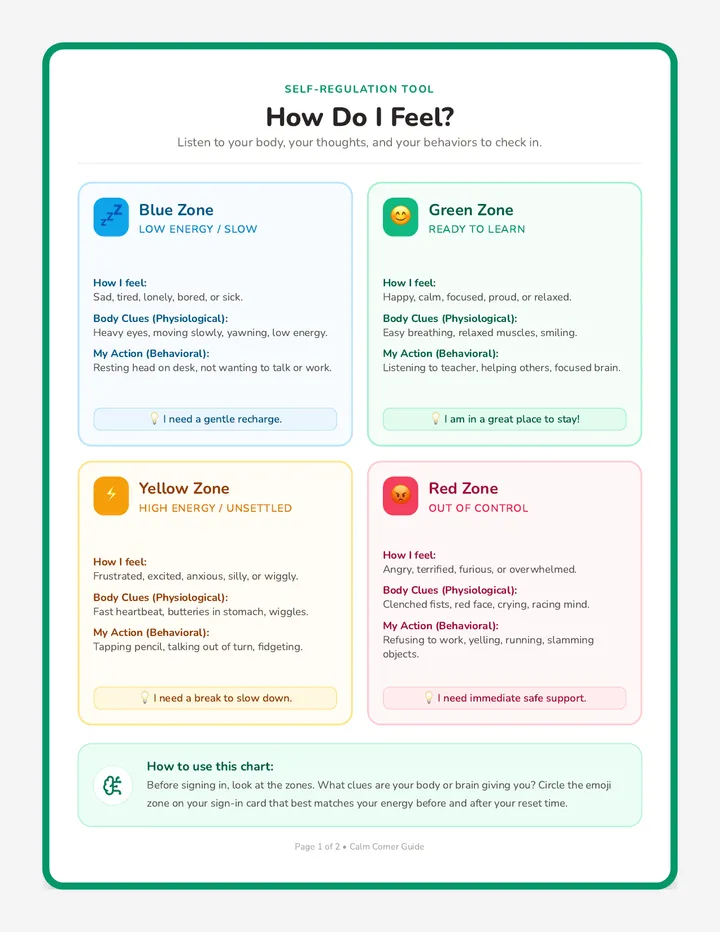
Green Zone
• Situations that feel easy or calm.
• You feel safe and in control.
• Example: Reading your favorite book.
Red Zone
• Situations that feel hard or scary.
• Your heart might beat fast.
• Example: Loud, unexpected noises.
Mission: Situation Sort
Look at your Situation Cards. With your partner, decide which ones belong in the Green Zone and which ones belong in the Red Zone.
Remember: Everyone's "Red Zone" is different. What's easy for you might be hard for someone else, and that's okay!
Your Personal Stress Map
Now it's time to be a detective for yourself.
Think about:
Noises (loud yelling, sirens)
Social (big crowds, being ignored)
School (tests, hard math)
Home (arguments, dark rooms)
Grab your "Stress Map" Worksheet!
Trigger Sorting Cards Situation Sorting Cards
Lesson 1: Trigger Detection Agency • Activity Hook
Cut Along Dotted Lines
A Loud Thunderstorm
Reading Your Favorite Comic
Someone Yelling Nearby
Taking a Hard Math Test
A Huge Crowded Room
Recess with Your Best Friend
A Big Dog Barking at You
Sleeping in a Very Dark Room
Green Zone
Safe • Calm • Easy
Red Zone
Unsafe • Panicked • Hard
Stress Map Worksheet Personal Stress Map
DETECTIVE LOG #001
Agent Name:
Date:
Every agent has different triggers. Your mission is to map out the things that make your brain and body feel like they are in the Red Zone . Be as specific as you can!
Noisy Triggers
Examples: Sirens, yelling, loud chewing
People Triggers
Examples: Big crowds, being ignored, being teased
School Triggers
Examples: Hard math, speaking in front of class, tests
Surprise Triggers
Examples: Lights going out, sudden changes in plans
The Big Three
If you had to pick the THREE things that make you feel the most "Red Zone," what would they be?
1
2
3
Trigger Talk Facilitation Guide Teacher Resource
Lesson 1: Trigger Detection
Trigger Talk Facilitation Guide
Goal
Help students identify internal/external triggers and categorize them using the "Red/Green Zone" framework.
Key Vocabulary
Trigger • Red Zone • Green Zone • Grounding • Coping Kit
Materials
Slides, Sorting Cards, Stress Map Worksheets, Scissors.
Lesson Instructions
1
The Hook: Situation Sort (10 mins)
Students work in pairs with the Situation Sorting Cards . Explain that "Green Zone" situations are easy/calm, while "Red Zone" are hard/scary. Circulate and ask: "Why might this be a Red Zone for you but a Green Zone for your partner?"
2
Instruction: What's a Trigger? (10 mins)
Use the Trigger Detection Slides . Emphasize that a trigger isn't "bad"—it's just information. Use the analogy of a smoke detector: it goes off when it smells smoke to keep us safe, but sometimes it's just burnt toast!
3
Activity: Personal Stress Map (20 mins)
Students complete the Stress Map Worksheet . Encourage them to look back at the categories (Sound, People, School, Surprise). If a student struggles to identify triggers, suggest they think about the last time they felt their "heart thumping."
Questioning Framework
To deepen reflection:
"How does your body feel when a Red Zone trigger happens? Do you feel it in your stomach? Your hands?"
To build empathy:
"Is there a trigger on your map that might be a Green Zone for a friend? Why is that interesting?"
Common Misconception
Students may think they are "wrong" for having certain triggers. Remind them that triggers are personal and connected to our life experiences. There are no "silly" triggers.
Mind Sanctuary Slides Phase 2: Mental Sanctuary
Mind Sanctuary
Building a "Safe Space" you can take anywhere
A Portable World
When things get too loud or scary in the "Real World," you can travel to your Mental Sanctuary.
It is a place only YOU can go. It is always safe. It is always there.
How to Build Your Sanctuary
To make it feel real, you need to use your senses...
SIGHT
What colors do you see? Is it bright or cozy? Are there trees or mountains?
SOUND
Is it quiet? Do you hear ocean waves? Birds? Soft music?
TOUCH
Is the air warm or cool? Are you sitting on soft grass or a fluffy cloud?
Mission: Mental Vacation
Sit comfortably. Close your eyes. Listen to the guide.
Let's build your world together.
Guide Active
Safe Space Blueprint
Now, we must "anchor" your sanctuary by drawing and writing about it.
Your Mission:
Draw your space.
Label the sensory details.
Give it a name (e.g., "The Blue Cave").
Grab your Blueprint Worksheet!
Safe Space Blueprint My Safe Space Blueprint
ARCHITECT LOG #002
Architect Name:
Sanctuary Name:
Drawing Zone
SCALE: 1 HEART = 100% SAFE
What I See:
What I Hear:
What I Feel:
What I Smell:
When will you visit this place?
Guided Visualization Script Teacher Script
Guided Sanctuary Script
Lesson 2: Mental Sanctuary
Preparation
Lower the classroom lights if possible.
Have students sit comfortably with feet flat on the floor or cross-legged.
Play soft, ambient nature sounds or instrumental music in the background.
Remind students that they can open their eyes at any time if they feel uncomfortable.
01
The Setup
"I want everyone to find a comfortable position. You can close your eyes, or look down at your lap. Take a deep breath in through your nose... and out through your mouth. Imagine you are like a tall, strong building with a deep foundation. You are safe here."
02
The Journey
"In your mind, imagine you are walking down a path. This path leads to your very own Mental Sanctuary . This is a place where only YOU can go. As you reach the end of the path, look around... What kind of place is it? Is it a secret garden? A cozy cabin? A beach? A cloud floating in the sky? Take a moment to see the colors of your sanctuary."
03
The Details
"Reach out and touch something in your space. Is it soft? Is it warm? Listen closely... what sounds do you hear? Are there birds? Is there the sound of the wind? Take a deep breath in your mind... what does your sanctuary smell like? Maybe it smells like salt water, or fresh pine trees, or even your favorite cookies."
04
The Exit
"Enjoy this feeling of being completely safe and calm for a moment. Know that this place is always inside your mind, and you can visit it whenever you need a break. Now, slowly wiggle your fingers... wiggle your toes... and when you're ready, open your eyes and come back to the room."
Debrief Questions
"Did anyone find a sanctuary that was very different from what they expected?"
"What was the strongest sense you felt? Sight? Sound? Smell?"
Toolbox Tech Slides Phase 3: Tool Selection
Coping Tool Tech
Testing the tech that helps us stay grounded
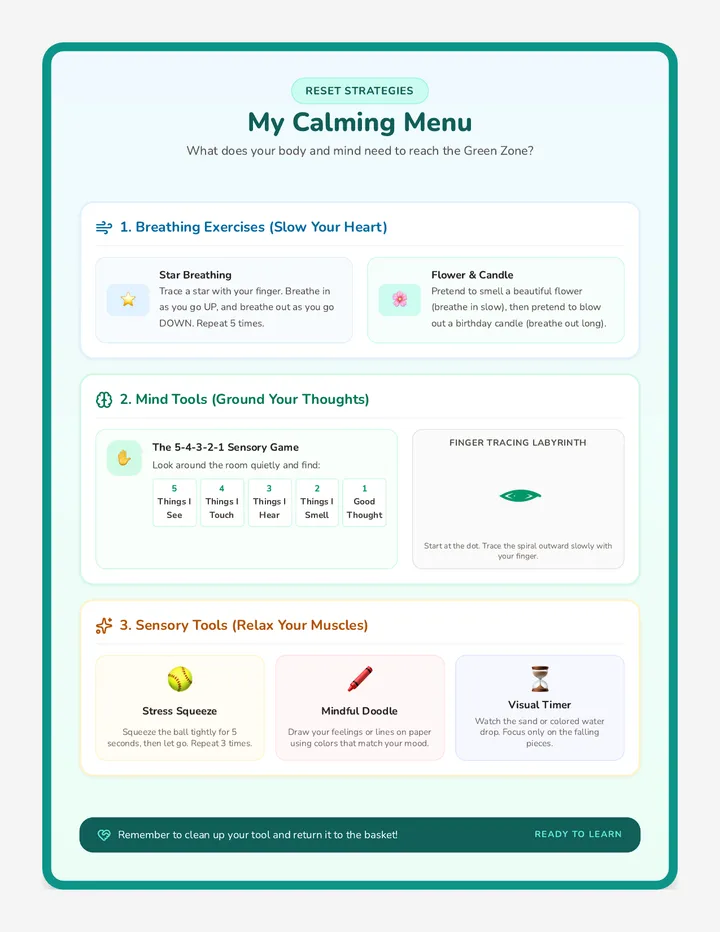
What is Grounding?
When we feel panicked, our minds can feel like they are floating away or racing too fast.
Grounding is using your senses to "anchor" yourself back to the present moment.
The Tool Menu
Movement Tech
Things you can squeeze, spin, or click.
Examples: Fidget spinners, stress balls, infinity cubes.
Focus Tech
Things that are calming to look at.
Examples: Glitter jars, oil timers, kaleidoscopes.
Mission: Tool Tasting
You will rotate through 4 Testing Stations. Try each tool and decide if it helps you feel focused and calm.
Station A: Squeeze
Station B: Watch
Station C: Spin
Station D: Tactile
Tech Review
Not every tool works for every agent. You need to find YOUR best tech.
Review Criteria:
Is it quiet?
Does it feel good in my hands?
Does it help me stop worrying?
Grab your Tool Tasting Review Sheet!
Tool Tasting Review Sheet Tool Tech Review
ENGINEERING LOG #003
Agent:
Lab Station:
Rating Key:
Awesome Just Okay Not For Me
1 Squeeze Tech (e.g. Stress Balls)
Notes:
How it feels:
"It makes my hands feel..."
2 Visual Tech (e.g. Glitter Jar)
Notes:
How it feels:
"My eyes feel..."
3 Spin Tech (e.g. Infinity Cube)
Notes:
How it feels:
"It helps my brain..."
Top Recommendation
If you could only put ONE physical tool in your Coping Kit, which one would it be?
Coping Tool Station Cards Tool Tasting Station Cards
Lesson 3: Coping Tool Tech Workshop • Classroom Signs
Fold or Tape to Table
A
Squeeze Station
"How hard can you squeeze? Feel the pressure in your palm and fingers. Does it help you release stress?"
Suggested Tools:
Stress balls, play-dough, foam shapes
B
Focus Station
"Watch the colors move. Try to follow one single piece of glitter with your eyes. Does it help your brain slow down?"
Suggested Tools:
Glitter jars, oil timers, kaleidoscopes
C
Fidget Station
"Keep your hands busy. Click, spin, or fold the tools. Does the movement help you stay focused on the now?"
Suggested Tools:
Fidget spinners, infinity cubes, pop-its
D
Texture Station
"Feel the different surfaces. Is it fuzzy? Rough? Smooth? Cold? How does your brain react to the touch?"
Suggested Tools:
Sandpaper, velvet, smooth stones, feathers
Mantra Magic Slides Phase 4: Mental Resilience
Power Phrases
Constructing the words that keep us strong
Your Inner Voice
We all have a voice inside our heads. Sometimes it says Negative Thoughts like:
"I can't do this."
"This is too scary."
"Everything is going wrong."
Thought Storms
The Power Phrase Anchor
What it is:
A Power Phrase is a short, strong sentence you say to yourself to "pop" negative thoughts.
"It acts like a shield for your brain!"
"I am safe right now."
"This feeling will pass."
"I can handle this."
Mission: Thought Pop
Write one Negative Thought on your balloon. Then, get ready to POP IT and replace it with a Power Phrase!
READY?
POP!
Construction Zone
You will create 3 personal Power Phrase cards to keep in your kit.
The Rules:
Keep it short (3-5 words).
Use "I" statements.
Make it easy to remember.
Get your Pocket Cards!
Power Phrase Pocket Cards Power Phrase Pocket Cards
Lesson 4: Construction Zone • Pocket Resilience
Cut & Keep
Power Phrase #1
Power Phrase #2
Power Phrase #3
Inspiration Kit
"I am brave and calm."
"I can take deep breaths."
"My feelings are like waves."
"I am safe right now."
Keep these in your pocket!
Architect Tip:
Once you write your phrases, you can decorate the edges of your cards. The more personal they are, the more powerful they become!
Safety Architect Finals Slides Phase 5: Final Installation
Safety Architect
Launching your personal "Coping Kit" and Safety Plan
The Master Plan
1. TRIGGERS
I know what pushes me into the "Red Zone."
2. SANCTUARY
I have a mental space where I am safe.
3. TOOLS
I have physical tech to ground me.
4. PHRASES
I have powerful words to stay strong.
Phase 5: Rehearsal
A plan only works if you practice it.
"When I feel my heart thumping, first I will say my Power Phrase, then I will go to my Mental Sanctuary."
Mission: Safety Walkthrough
Sit with your partner. Show them your Personal Safety Blueprint. Explain how your kit will help you when things get difficult.
Listening is just as important as talking! Give your partner a "thumbs up" when they finish.
Installation Successful
You are now a certified Safety Architect . Keep your plan close, and remember: you have all the tools you need right inside you.
PROJECT: COPING KITS COMPLETE
Personal Safety Blueprint Personal Safety Plan
FINAL INSTALLATION BLUEPRINT
Lead Architect:
Project Date:
Red Zone Triggers
What pushes me into the Red Zone?
Physical Tech
What tool will I use to ground myself?
Mind Sanctuary
Sketch a quick map of your safe space.
Power Phrases
What words will I say to stay strong?
My Installation Vow
When I feel my happening, I will first use my to ground myself.
Then I will say, " " and travel to my mental sanctuary.
Safety Plan Rubric Teacher Assessment
Safety Project Rubric
Project: Coping Kits
Criteria Expert Architect (3) Solid Foundation (2) Early Blueprint (1) Trigger Identification
Self-awareness of personal stressors.
| Clearly identifies 3+ specific personal triggers across different categories. | Identifies 1-2 triggers. May be generic (e.g., "loud noises"). | Struggles to name specific triggers or copies examples from the board. |
|
Mental Sanctuary
Depth of visualization and sensory anchor.
| Sanctuary includes vivid sensory details (sight, sound, touch). Clearly drawn and named. | Sanctuary is present but lacks specific sensory details in writing or drawing. | Drawing is unclear; no sensory details provided. |
|
Coping Tools
Ability to evaluate physical grounding aids.
| Tool selection is purposeful and student explains WHY it helps them ground. | Tool is selected but student is unsure how or when they would use it. | Tool selected randomly; no evaluation provided on the review sheet. |
|
Plan Rehearsal
Ability to communicate the plan strategically.
| Can confidently explain the "Vow" statement and how the steps connect together. | Explains the parts of the plan but misses the connection between trigger and action. | Requires significant prompting to explain any part of the plan. |
Overall Strength:
Next Step for Student:
Total Score: _______ / 12