Neural Conflict Worksheet Neural Conflict
Self-Management Series | Lesson 01
NAME:
DATE:
The Planner
Prefrontal Cortex (PFC)
Responsible for executive function, logic, and long-term consequences. This is the "Cool" system that manages complex simulations of the future.
• Abstract goal maintenance
• Impulse inhibition
The Doer
Limbic System (Amygdala/Ventral Striatum)
Responsible for immediate reward, survival, and emotional processing. This is the "Hot" system reacting to instant visceral cues.
• Immediate gratification focus
• Dopamine-driven response
TASK 1: SYSTEM IDENTIFICATION
Identify a recent moment of internal conflict (e.g., choosing to study vs. scrolling social media). Map the specific "voices" of your two systems in that moment.
The Limbic Urge (What was the immediate sensory pull?)
The PFC Argument (What was the logical long-term reason?)
The Outcome (Which system won, and what triggered the win?)
THE WILLPOWER MYTH
Research suggests willpower acts like a muscle or a finite battery (Ego Depletion). While controversial, the practical implication is clear: raw effort is a high-cost cognitive resource that fails under stress or fatigue.
Current State: Cognitive Fatigue Imminent
Marshmallows & Environment
The original Mischel experiments (1960s) suggested that the ability to wait for two marshmallows predicted lifelong success. However, modern replications (Watts et al., 2018) suggest that environmental reliability and socioeconomic status are far more significant factors.
"If the researcher has been unreliable in the past, or if resources in your environment are scarce, waiting for a 'future' reward is logically irrational. Immediate consumption becomes the strategic choice."
TASK 2: PERSONAL RELIABILITY AUDIT
Evaluate your current study/work environment. Does it signal reliability (future rewards are guaranteed) or instability (distractions and chaos make the future uncertain)?
Reliability Signals (Green Flags)
Instability Signals (Red Flags)
CRITICAL REFLECTION
If willpower is a finite resource, why is "just try harder" poor advice for someone struggling with impulse control?
How might changing your physical environment reduce the load on your Prefrontal Cortex?
Neuroscience Slides Lesson 01: Neuroscience
The Battle for
The Future Self
Understanding the neurological tug-of-war between immediate gratification and long-term goals.
The Marshmallow Hook
The Classic Study (1960s)
Wait 15 minutes = 2 Marshmallows.
Don't wait = 1 Marshmallow.
The Modern Twist (2012+)
It's not just "grit." It's environment . If the researcher is unreliable, waiting is a mistake.
"Is waiting rational if the future isn't guaranteed?"
Inquiry Task
A Tale of Two Systems
The Limbic System
"I want it NOW."
Emotional & Reactive
Dopamine-driven
Hardwired for survival
Prefrontal Cortex
"I want success LATER."
Logical & Strategic
Future Simulation
Impulse Inhibition
Present Bias
The tendency to overvalue immediate rewards and undervalue future rewards, even when the future reward is significantly larger.
TODAY
$10
NEXT MONTH
$100
The Willpower Battery
Willpower is a finite cognitive resource . It is "drained" by:
Decision Fatigue
Emotional Regulation
Physical Tiredness
Stress
The Takeaway:
Relying on "effort" is a recipe for failure. We need Strategy , not just Will .
Neuroscience Teacher Guide Facilitator Guide
Lesson 01: Neuroscience of Choice
Ver: 1.0.2
Objective
Students will be able to describe the neurological tension between the prefrontal cortex and the limbic system and argue why environmental design is more effective than raw willpower for long-term goal achievement.
Key Vocabulary
Intertemporal Choice Executive Function Ego Depletion Present Bias
Required Materials
Neuroscience Slides
Neural Conflict Worksheets
Whiteboard / Markers
Instructional Sequence
10 MIN
The Hook: Marshmallow Re-Examination
Introduce the 1960s study, then pivot to the modern replication. Use the "Reliability" angle.
Discussion Prompt:
"If you're in a neighborhood where things get stolen often, and someone tells you 'Wait 15 minutes and I'll give you two cookies,' is it smart to wait?"
20 MIN
Brain Systems Mapping
Walk through the PFC vs. Limbic System slides. Emphasize that the limbic system is necessary for survival , but poorly suited for the modern world of abundance.
Key Teaching Point:
It's not "Good Brain vs. Bad Brain." It's "Strategic Brain vs. Reactive Brain." We need to stop fighting our biology and start outsmarting it.
20 MIN
Neural Conflict Worksheet
Students complete Task 1 & 2 independently. Circulate and ask students to share their "Instability Signals" (e.g., phone notifications, cluttered desk).
10 MIN
Debrief: The Willpower Trap
Conclude by introducing the concept of Choice Architecture (the bridge to Lesson 3). How can we arrange our room so the PFC doesn't have to work so hard?
Hyperbolic Discounting Slides Lesson 02: Economic Models
Hyperbolic
Discounting
Why we make decisions today that we regret tomorrow—mathematically.
The "Rational" Model
Exponential Discounting
In classic economics, humans are "rational." We discount the future at a constant rate .
Value = Reward / (1 + r)^t
"If I prefer $100 in 31 days over $90 in 30 days, I should also prefer $100 in 1 day over $90 today."
Time
Value
Constant Decay
The Hyperbolic Reality
!
Rapid Immediate Decay
The Present Bias Trap
Values drop violently as the reward nears "now."
Preference Reversal: We pick the long-term option when both are far away, but switch to the short-term option as soon as it's available.
The "Now" Auction
If you could have one of these, which do you bid on?
OPTION A
A high-quality chocolate bar TODAY
OPTION B
A gourmet 3-course dinner IN 3 MONTHS
Why is this hard?
Mathematically, Option B is worth way more. But your brain "hyperbolically discounts" those 3 months into near-zero value.
The Cost of Irrationality
Finance
Credit card debt (spending $100 today vs. paying $120 next month).
Health
Skipping the gym (1 hour of comfort today vs. lifelong mobility).
Academics
Procrastination (1 hour of YouTube today vs. GPA for your dream job).
"We are not lazy; we are mathematically confused."
Discussion Next
Discounting Simulation Worksheet Cost of Now
Self-Management Series | Lesson 02
NAME:
DATE:
The Irrational Auction
In this activity, you will evaluate pairs of rewards. For each pair, choose which reward you would honestly prefer right now. Don't choose the "correct" answer—choose the "human" one.
Scenario Option A (Small/Immediate) Option B (Large/Delayed) 1. Financial $10 cash right now $100 cash in 1 year 2. Academic 3 hours of free time tonight An "A" on the final (3 months away) 3. Health A double cheeseburger now Visible fitness results in 4 months 4. Leisure Watching 4 hours of Netflix now Attending a dream concert in 6 months
ANALYSIS: CALCULATING THE DISCOUNT
1. In which scenarios did you choose Option A? Why was the "Future Reward" not attractive enough to overcome the "Now Reward"?
2. THE PREFERENCE REVERSAL: Imagine Scenario 1 again. If both options were moved into the future (e.g., $10 in 10 years vs. $100 in 11 years), which would you choose? Explain the shift in logic.
Case Study: The Procrastination Curve
The Profile:
"Leo is a junior with a 30-page thesis due in 10 weeks. For the first 8 weeks, he values 'socializing' and 'sleep' higher than 'starting the paper.' In week 9, the value of 'starting' begins to climb. By 48 hours before the deadline, the value of 'starting' finally exceeds 'everything else' because the negative consequence is now immediate ."
Impending Deadline
Hyperbolic Audit
Identify three things in your life that suffer from "Hyperbolic Discounting." Calculate the long-term cost of choosing "Now."
The "Now" Reward
The "Delayed" Loss
The "Regret" Level (1-10)
Strategy Synthesis
If you know your brain will always devalue rewards that are more than 2 weeks away, how can you "hack" your perception of a 3-month goal?
Commitment Device Slides Lesson 03: Strategic Planning
Designing
Ulysses Pacts
Protecting your future self from your current impulses by removing choice entirely.
The Original Pact
Ulysses and the Sirens
Ulysses knew he would be unable to resist the Sirens' song when he heard it. So, he had his men tie him to the mast and plug their own ears with wax.
"Bind me with ropes, as tight as you can, so I cannot move."
A Commitment Device is a Voluntary Restriction on your future self.
You use your PFC today to disable your Limbic System tomorrow.
Historical Case: Victor Hugo
The "No-Clothes" Hack
To finish The Hunchback of Notre Dame , Victor Hugo gave all his clothes to his valet and ordered him to lock them away . He was left with only a giant grey shawl, making it impossible for him to leave the house.
Why it worked:
Digital & Modern Pacts
The kSafe
A physical lock-box with a timer. You put your phone/controller inside and lock it for 2 hours. There is no override.
Physical Hardware
Forest App
You plant a virtual tree. If you leave the app to check social media, the tree dies. Emotional stakes for focus.
Software Friction
Stikk.com
Put money on the line. If you don't reach your goal, the money goes to an "Anti-Charity" you hate.
Financial Stake
Workshop:
Lock the Door
Today, you will design your own "Mast and Rope" system for a current academic goal.
"How can I make my 'Future Distraction' physically, digitally, or financially impossible?"
Get Started
Ulysses Blueprint Worksheet Ulysses Blueprint
Self-Management Series | Lesson 03
NAME:
DATE:
The Commitment Mandate
"Do not rely on your future self to be strong. Your future self will be tired, hungry, and distracted. Design a system today that makes failure impossible tomorrow."
1 TARGET GOAL
Choose one specific academic or personal goal you've been procrastinating on (e.g., "Write Chapter 1", "Study for Midterm").
2 THE "SIREN SONG"
What is the primary impulse that causes you to fail? Be specific (e.g., "Scrolling TikTok", "Napping instead of reading").
3 Commitment Mechanism
Select or design a mechanism to "tie yourself to the mast." How will you remove the option to fail?
Physical/Digital Friction
How can you make the distraction physically difficult to access?
Social Accountability
Who can you give "The Wax" to? How will they enforce your pact?
Financial Stake
What will it cost you (literally) if you fail?
"Master Strategy"
Combine elements above into one clear directive.
"If I [distraction], then [consequence]..."
Vulnerability Analysis
Where is the "leak" in this blueprint? How might your future self try to "cheat" this pact? (e.g., "I'll find my backup phone"). Close that leak below.
Implementation Intentions Slides Lesson 04: Behavioral Design
Automatic
Intentions
Closing the "Intention-Behavior Gap" using if-then algorithms and habit loop analysis.
The Gap
Goal Intention
"I intend to study for 2 hours today."
Behavioral Reality
"I watched 8 episodes of a show I don't even like."
Why we fail:
Knowing what to do is not the same as knowing when, where, and how to do it when faced with a distraction.
Research Note:
Gollwitzer (1999) found that "goal intentions" only account for 20-30% of actual behavior change.
Implementation Intentions
STEP 1
IF
[ SITUATION X ]
STEP 2
THEN
[ RESPONSE Y ]
"If it's 7:00 PM and I'm on the couch, then I will put on my running shoes immediately."
"If my phone buzzes while I'm reading, then I will take 3 deep breaths and leave it face down."
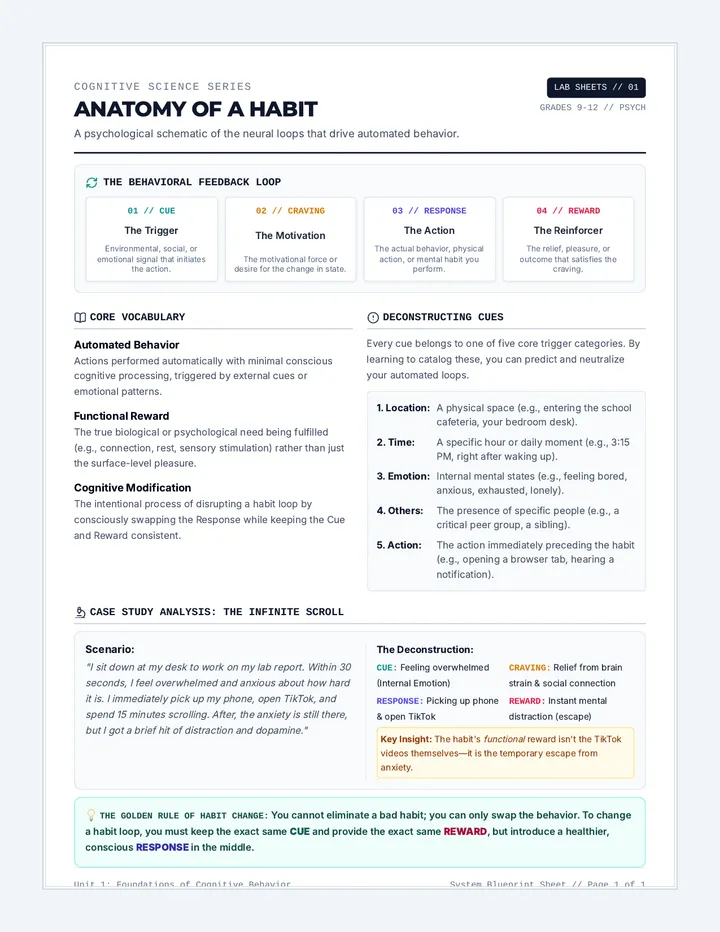
Deconstructing Habits
1. Cue
The trigger (time, location, emotion, or person).
2. Routine
The behavior itself (checking social media, procrastinating).
3. Reward
The dopamine hit or stress relief provided.
"To change a habit, you must keep the Cue and the Reward, but insert a new Routine."
Skill Drill
"Design 3 implementation intentions for your most frequent 'Impulse Loop' identified in Lesson 2."
Go to your workbook page 3
Habit Audit Workbook Habit Audit
Self-Management Series | Lesson 04
NAME:
DATE:
TASK 1: DECONSTRUCTING THE IMPULSE
Select a common distraction or procrastination habit. Break it down into its constituent parts to find the "lever" for change.
The Cue
When? Where? Who? What emotion?
The Routine
What is the exact action you take?
The Reward
What craving does this satisfy?
The "If-Then" Intervention
Using the Cue from above, design an alternative Routine that provides a similar Reward (or reduces the need for it).
IF
I see/feel/am at...
THEN
I will immediately...
TASK 2: SCENARIO MAPPING
Map out implementation intentions for the three most common "goal-blockers" encountered by college students.
Scenario: The Digital Binge (TikTok/IG/YouTube)
Triggering Situation
"When I pick up my phone for 'just a second'..."
Pre-Decided Response
"Then I will [Your Plan]..."
Scenario: The Social "Yes" (Friend asks to hang out)
Triggering Situation
"When a friend texts to grab food but I have work..."
Pre-Decided Response
"Then I will [Your Plan]..."
Scenario: The Fatigue Wall (Feeling 'too tired' to start)
Triggering Situation
"When I get home and feel mentally drained..."
Pre-Decided Response
"Then I will [Your Plan]..."
Final Synthesis Slides Lesson 05: Capstone Synthesis
The Strategy
of Success
Synthesizing neuroscience, economics, and behavioral design into a fail-proof execution plan.
The "Pre-Mortem"
"Imagine it is one year from today. Your long-term goal has failed spectacularly. You did not achieve it."
The Task: Work backwards. What were the exact moments of immediate gratification that killed your goal?
Why do this?
Identifies "Single Points of Failure."
Removes the "Optimism Bias."
Maps the actual hyperbolic curves you'll face.
The Gratification Delay Protocol
Bio-Audit
When is your PFC strongest? Schedule deep work then.
Hyper-Hack
Chunk goals into < 1 week increments to beat discounting.
Ulysses Pact
Remove the physical option to choose the distraction.
If-Then
Pre-decide your response to the 'Sirens' you identified.
The Defense Workshop
A strategy is only as good as its robustness . In your peer review, you must defend your protocol against "The Saboteur."
The Saboteur's Question:
"It's 11 PM on a Tuesday. You're exhausted. Your pact is hard to follow. How do you NOT just override your system?"
The Designer's Answer:
"Because my system doesn't require effort. The phone is in a kSafe at my friend's house. I physically cannot access it."
Build the
Protocol
Use the remaining time to finalize your 3nd-year academic strategy. This is not just an assignment—it's your survival guide.
Gratification Delay Protocol Template The Protocol
Self-Management Series | Lesson 05 Capstone
Final Submission
Design Code: GDP-9000
Target Goal
What is the specific, high-stakes objective for the next 4-12 weeks?
The Reward
Identify the intrinsic or extrinsic reward of the *Future Self*.
PRE-MORTEM ANALYSIS
It is 3 months from now and you have failed. Looking back, what was the "primary infection"? What specific distraction, emotional state, or physical environment led to your defeat?
Defensive Architecture
Ulysses Pact
Removal of Choice
If-Then Logic
Automated Response
Env. Design
Reliability Signaling
Protocol Review Rubric
Exchange protocols with a peer. Use the following criteria to evaluate the robustness of their strategic design. Provide critical feedback to "close the leaks."
Criterion Robust Design (3 pts) Fragile (1 pt) Scientific Literacy Strategies clearly address PFC/Limbic tension or Hyperbolic Discounting. Relies solely on "willpower" or "trying harder." Pact Strength Commitment device makes the distraction physically impossible/very high cost. The pact can be easily broken or ignored when tired. Clarity of Cue If-Then plans identify hyper-specific triggers (Time + Location + Emotion). Triggers are vague (e.g., "when I feel lazy"). Pre-Mortem Depth Identifies the most likely "saboteur" and addresses it directly. Generic analysis; ignores obvious points of failure.
Saboteur Feedback (Peer Review)
SABOTEUR TASK: Find one way the designer could "cheat" their own system. Challenge them to close that loop.
Identified Leak:
Designer's Revision: