Adulting Life Game Lesson Plan Adulting: The Life Game
Lesson Plan • Grade 10 Personal Finance & Life Skills
5 Total Hours
Objective
Students will simulate real-world independent living scenarios, make informed financial decisions, and understand the responsibilities associated with adult life, including budgeting, income, expenses, and managing unexpected events.
Why This Matters
"This lesson provides a low-stakes environment for students to practice critical life skills, fostering financial literacy, problem-solving, and a sense of preparedness for their future independence."
Preparation
Time: 60 minutes
Review all generated materials (Slide Deck, Script, Guide, Worksheet, Rubric).
Print and cut Job, Expense, and Life Event cards. Organize into shuffled piles.
Print one Budget & Tracker Worksheet per student.
Arrange classroom for small groups (3-4 students).
Set up projector for slides.
Required Materials
Digital
• Adulting: The Life Game Slide Deck
• Teacher's Game Script
• The Life Game Simulation Guide
• Life Skills Assessment Rubric
Printables
• My Life Game Budget & Tracker Worksheet
• Job Cards (Cardstock recommended)
• Expense Cards (Cardstock recommended)
• Life Event Cards (Cardstock recommended)
Instructional Steps
Part 1 30 MIN
Introduction & Game Overview
Use Slides 1-3 and the Teacher Script to introduce lesson objectives and the concept of independent living. Explain the premise of "The Life Game" and divide students into groups of 3-4.
Part 2 60 MIN
Getting a Job & Income
Present Slides 4-6 . Each group draws one Job Card . Students record their job and annual salary on their worksheet. Guide students through calculating monthly net income (subtracting ~25% for taxes).
Part 3 90 MIN
Housing & Fixed Expenses
Use Slides 7-9 . Groups choose housing (apartment, shared house, or family) from the Simulation Guide. Introduce fixed bills (utilities, internet) using Expense Cards . Discuss payment methods like digital transfers and checks.
Part 4 60 MIN
Daily Living & Variable Expenses
Use Slides 10-11 . Students budget for variable costs (groceries, transport, personal care) using Expense Cards. Emphasize the "Needs vs. Wants" distinction and calculate remaining discretionary income.
Part 5 90 MIN
Life Events & Adjustments
Present Slides 12-14 . Groups draw Life Event Cards (unexpected repairs, bonuses, etc.). Students must react, adjusting their budget and discussing the importance of an emergency fund.
Part 6 30 MIN
Reflection & Debrief
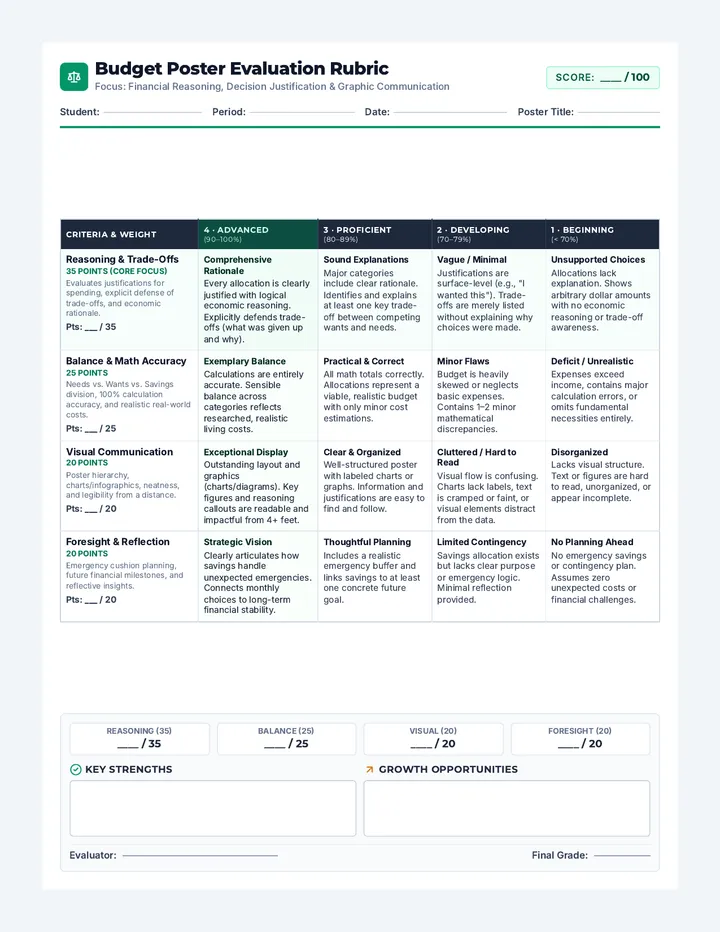
Conclude with Slides 15-16 . Facilitate a class discussion on challenges and lessons learned. Collect worksheets and assess using the Life Skills Assessment Rubric .
Adulting Life Game Slides Adulting:
The Life Game
Are you ready for independent living?
Simulation Module
What is Independent Living?
It's about having the skills and confidence to manage your own life.
Managing your money
Finding a place to live
Buying groceries
Handling the unexpected
Adulting is a mindset of responsibility!
How to Play: The Life Game
01
CHOOSE
Pick a career path and starting salary from the Job Cards.
02
BUDGET
Find housing and decide on your monthly expenses.
03
SURVIVE
React to life events and keep your budget in the green!
Reference your My Life Game Budget & Tracker Worksheet throughout the session.
Your First Big Decision
Income: The Engine
Everything starts with your ability to earn money. Consider:
Trade school or College?
What skills do you enjoy using?
Potential for future raises?
GROUP TASK:
Draw a Job Card. This is your group's career path for the simulation.
Choose Wisely!
Income vs. Taxes
Gross Income
THE TOTAL
What you earned before anything is taken out.
Net Income
TAKE-HOME PAY
What actually lands in your bank account.
The "Tax Slice"
Common deductions include:
Social Security 6.2%
Medicare 1.45%
State/Local Tax ~2-5%
Calculation Time!
Gross Annual Salary: __________
Estimated Taxes (25%): __________
Net Annual Income: __________
Monthly Net Income: __________
Divide your Net Annual Income by 12 to get your Monthly Budget.
Where Will You Live?
Small Apartment
A studio or 1-bedroom unit to yourself.
$1,200 - $1,800
Shared House
Living with roommates to split costs.
$800 - $1,200
Live with Family
Living at home and contributing to expenses.
$300 - $600
Rule of Thumb: Housing should be roughly 30% of your income!
Adulting Life Game Script Teacher's Game Script
Instructional Script & Facilitation Guide • Adulting: The Life Game
This script serves as your narrative guide. Bolded text in brackets indicates slide transitions. Text in "quotes" is meant to be spoken aloud. Prompts for students are highlighted.
1
Introduction & Game Overview
[Display Slide 1]
"Good morning, everyone! Today, we're going to dive into a really exciting and important lesson called Adulting: The Life Game . Have any of you heard the term 'adulting' before? What does it make you think of?"
Teacher Tip: Allow 2-3 students to share. They usually mention bills, laundry, or working.
"Exactly! 'Adulting' is about mastering the skills needed to live independently. Things like managing money, finding a home, and handling life's surprises. Why do you think it's important to start thinking about these skills now, even before you're out on your own?"
[Display Slide 2]
"This lesson is a safe space to learn and even make mistakes without real-world consequences. We'll focus on the big pillars: money, housing, and food."
[Display Slide 3]
"To learn this, we're playing a game! You'll work in groups to track every financial decision on your Budget & Tracker Worksheet . Please get into your assigned groups now."
2
Getting a Job & Income
[Display Slide 4]
"The first step is getting a job. Income pays for everything! I'm giving each group a set of Job Cards . Discuss and choose ONE job for your group scenario. Think about the salary and the type of work."
(Distribute Job Cards. Allow 10-15 minutes.)
[Display Slide 5]
"Has every group chosen? Great! Your salary is your gross income . But we don't take all of it home. Does anyone know why?"
Prompt: Wait for someone to say "taxes."
"Correct! Taxes. What's left is your net income —your actual spending power."
[Display Slide 6]
"On your worksheet, record your job and annual salary. We'll simplify taxes to 25%. Calculate that deduction, find your annual net income, and then divide by 12 to get your monthly budget. This is your group's starting point!"
3
Finding Housing & Fixed Expenses
[Display Slide 7]
"Now you need a place to live. Check your Simulation Guide for housing options. Choose what fits your income and lifestyle. Record that monthly cost now."
Adulting Life Game Simulation Guide The Life Game
Simulation Guide & Rulebook
Version 1.0
Welcome to Adulting!
In this simulation, your group will navigate the exciting and sometimes challenging world of independent living. You will make decisions about your career, housing, and expenses, and learn to manage unexpected life events. Your goal is to keep your budget "in the green" and experience real-world financial choices.
Inventory Checklist
1x Budget Worksheet
1x Job Card Set
1x Expense Card Set
1x Life Event Card Set
1
Phase 1: Secure an Income
Draw a Job Card . Discuss the roles and choose ONE for your group scenario. Record the Gross Annual Salary on your worksheet. Use the 25% tax rule to find your Monthly Net Income .
2
Phase 2: Find a Home
Choose your housing option below. Record the monthly cost on your worksheet.
Small Apartment
$1,200 - $1,800
Privacy and freedom, but higher utility costs.
Shared Housing
$800 - $1,200
Split costs with roommates. Social but less privacy.
Live w/ Family
$300 - $600
Contribution to household. Economical.
3 & 4
Phase 3 & 4: Expenses & Daily Living
Select Expense Cards to build your monthly lifestyle. Remember to prioritize NEEDS before WANTS .
Fixed Expenses (Bills)
• Utilities (Electic, Water, Internet)
• Phone Bill & Insurance
• Car Payments / Transit Pass
Variable Expenses (Choices)
• Groceries & Dining Out
• Gas & Maintenance
• Personal Care & Hobbies
5
Phase 5: React to Life Events
Life isn't a straight line! Your group will draw three Life Event Cards . These describe unexpected situations that will force you to adjust your budget. Document every dollar shift on your worksheet.
"Did you save for an emergency? If your balance hits zero, you must cut variable expenses to survive!"
Pro-Tips for Success
Communicate with your team—every decision affects the group.
Keep your tracker updated after every card you draw.
Adulting Life Game Worksheet My Life Game Budget & Tracker
Student Workbook • Grade 10 Personal Finance
Student Name
Phase 1: Income & Job
Chosen Job
Gross Annual Salary
$
Estimated Annual Taxes (25%)
$
Monthly Net Income (Divide by 12)
$
Phase 2 & 3: Housing & Fixed Expenses
Expense Category Details / Option Monthly Cost Running Balance Starting Monthly Net Income $ Housing $ $ Utilities (Bundle/Package) $ $ Car Payment / Transit Pass $ $ Insurance (Health/Car) $ $ Phone / Subscriptions $ $ Remaining after Fixed: $
Part 2: Daily Living & Unexpected Events
Phase 4: Daily Living & Variable Expenses
Expense Category Details / Tier Monthly Cost Running Balance Groceries $ $ Personal Care / Misc $ $ Discretionary (Wants) $ $ Total Budget Balance $
Phase 5: Life Events & Adjustments
Card Description Impact Type Amount New Balance $ $ $ $ $ $
Reflection
1. What was the most challenging financial decision your group had to make?
2. What is the most important lesson you learned about "Adulting" today?
Adulting Life Game Rubric Life Skills Assessment Rubric
Simulation: Adulting - The Life Game
Student(s)
Group
Date
Total Score
/ 24
Criteria 4 - Exceeds 3 - Meets 2 - Developing 1 - Support Needed Budgeting & Calculation Accurately calculates all income and expenses; demonstrates advanced understanding of trade-offs. Accurately calculates most income and expenses; demonstrates good understanding of budget allocation. Attempts calculations with some errors; struggles with specific allocation categories. Struggles with basic calculations; minimal understanding of net vs. gross income. Decision-Making (Housing) Highly realistic and well-justified housing decisions; consistently aligns with net income levels. Realistic and appropriate decisions for housing and expenses based on group income. Makes some realistic decisions but prioritizes "wants" over "needs" disproportionately. Makes unrealistic or impulsive decisions that do not align with available income. Problem-Solving (Life Events) Effectively and creatively navigates events; demonstrates proactive adaptability and foresight. Responds to life events appropriately, making reasonable adjustments to the tracker. Responds to events with difficulty; requires teacher guidance to adjust budget. Struggles to react to events; cannot adjust budget to account for new costs. Teamwork & Collaboration Actively contributes to all discussions; helps guide group decisions with insightful input. Participates in group discussions, listens to peers, and contributes to decisions. Participates minimally; may need prompts to engage with the group’s worksheet. Does not participate in discussions or disrupts group dynamics. Reflection & Depth Provides detailed, insightful reflections that connect game experiences to future goals. Provides clear reflections that connect game experiences to independent living concepts. Provides basic reflections that lack depth or clear real-world connections. Struggles to reflect on experiences; does not connect game to real life. Worksheet Completion All sections completed thoroughly and accurately; demonstrating meticulous tracking. Most sections completed accurately and legibly; tracking is consistent.
Adulting Life Game Job Cards Job Card #01
Entry Level Tattoo Artist
Annual Gross Salary
$33,000
Description: Designing tattoos and executing designs on clients. Requires artistic talent and strict hygiene standards.
Adulting: The Life Game
Job Card #02
Entry Level Welder
Annual Gross Salary
$45,000
($22.50 / Hourly)
Description: Fusing metals together using specialized equipment. Critical for construction and manufacturing.
Adulting: The Life Game
Job Card #03
Retail Store Manager
Annual Gross Salary
$48,000
Description: Overseeing daily operations of a retail store, managing staff, and ensuring customer satisfaction.
Adulting: The Life Game
Job Card #04
Electrician
Annual Gross Salary
$70,000
Description: Installing, maintaining, and repairing electrical wiring, equipment, and fixtures.
Adulting: The Life Game
Job Card #05
Office Assistant
Annual Gross Salary
$38,000
Description: Performing administrative tasks, organizing files, and supporting office operations.
Adulting: The Life Game
Job Card #06
Software Developer
Annual Gross Salary
$75,000
Description: Designing, developing, and maintaining software applications and systems.
Adulting: The Life Game
Job Card #07
Registered Nurse
Annual Gross Salary
$75,000
Description: Providing direct patient care, administering medication, and educating families.
Adulting: The Life Game
Job Card #08
Construction Worker
Annual Gross Salary
$50,000
Description: Performing physical tasks on construction sites and assisting with renovations.
Adulting: The Life Game
Adulting Life Game Expense Cards Fixed
Utilities (Basic)
Electricity, Water, Internet - Basic usage for a small space.
$150 / month
Fixed
Utilities (Standard)
Electricity, Water, Internet, Gas - Average household usage.
$250 / month
Fixed
Cell Phone Bill
Unlimited talk, text, and data plan.
$60 / month
Fixed
Health Insurance
Basic individual health coverage (Essential).
$300 / month
Variable
Groceries (Budget)
Home cooking only, no brand names, strict budget.
$300 / month
Variable
Groceries (Standard)
Mix of home cooking and convenience items.
$450 / month
Variable
Entertainment Bundle
Movies, concerts, streaming, or hobbies.
$150 / month
Fixed
Car Payment (Used)
Monthly payment for a reliable used vehicle.
$300 / month
Adulting Life Game Event Cards Crisis!
Car Trouble!
"Your transmission failed unexpectedly! You need to pay the shop immediately to get back on the road."
Budget Impact
-$500
Windfall!
Work Bonus!
"You did an excellent job this month and your boss rewarded you with a one-time surprise bonus!"
Budget Impact
+$300
Ouch!
Medical Bill
"A minor emergency required a clinic visit. Your insurance didn't cover the full deductible."
Budget Impact
-$200
Lucky!
Family Gift
"Your family sent a surprise check just to say they are proud of your hard work!"
Budget Impact
+$150
Surprise!
Utility Spike
"A record-breaking cold snap caused your heating bill to jump much higher than expected."
Budget Impact
-$75
Promotion!
New Role!
"Congrats! You've been promoted. Your monthly net income increases by $100 forever."
Permanent Monthly Impact
+$100