Feelings and Zones Lesson Plan Feelings & Zones
Emotional Literacy & Self-Regulation Guide
30 Minutes
Objective
Students will be able to identify the four Zones of Regulation and categorize various emotions within them. Students will also learn to recognize the intensity of their feelings ("big feelings") and connect them to specific zones.
Audience
4th and 5th Grade Students (Tier 1 Support)
Materials Needed
Whiteboard or Projector
Zones of Regulation Slide Deck
Feelings & Zones Worksheet (1 per student)
Markers or pens
Preparation
• Review the Zones Slide Deck to familiarize yourself with the content.
• Print copies of the Feelings & Zones Worksheet .
• Ensure projector/whiteboard is ready for the presentation.
• Gather student writing materials.
The "Why"
Understanding and identifying emotions is a critical life skill. This lesson provides students with a common language and framework to discuss their feelings, leading to improved self-awareness, self-management, and empathy towards others. It's foundational for emotional intelligence.
Instructional Sequence
5 min
Introduction: What are Feelings?
Greet students and introduce the topic: understanding our feelings.
Brainstorm: Ask: "What are some feelings you can think of?" and write responses on the board.
Introduce the idea that feelings can be "big" or "small" depending on the situation.
10 min
Introducing Zones of Regulation
Present the Zones of Regulation Slide Deck .
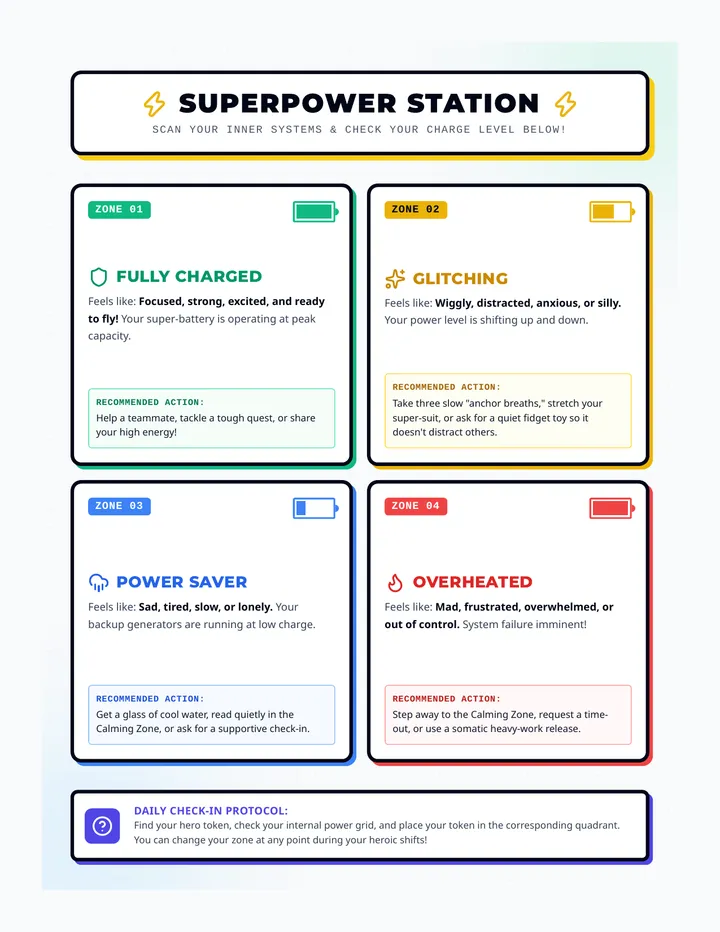
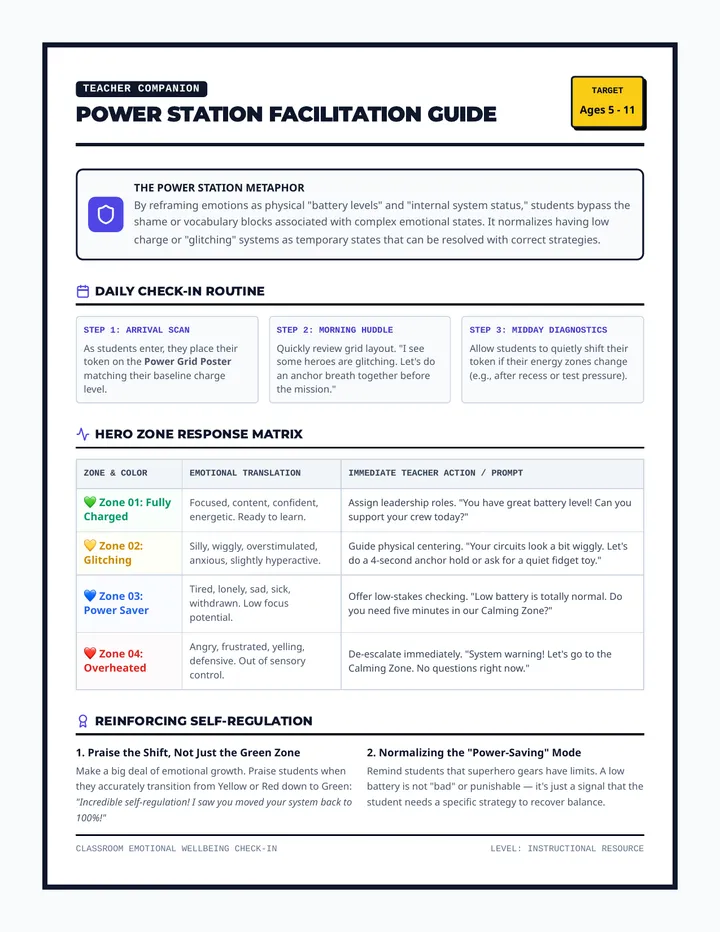
Walk through each zone: Blue (Low), Green (Ideal), Yellow (Warning), and Red (Intense).
Explain what each zone feels like and give examples of emotions.
Key Message: Emphasize that no zone is "bad"—they are all just ways of feeling.
10 min
Feelings & Zones Worksheet
Distribute the Feelings & Zones Worksheet .
Activity: Students read scenarios and identify the feeling, its size (big/small), and its zone.
Circulate and assist. Encourage small group discussion if time permits.
5 min
Wrap-up & Share
Bring the class back together.
Invite students to share one feeling they identified and its corresponding zone.
Closing: Reiterate that it's okay to be in any zone. Our goal is to find strategies to get back to Green.
Zones of Regulation Slide Deck What Are Feelings?
Happy Sad Mad Calm
We all have feelings, and every feeling is okay!
Start by welcoming everyone!
The Zones of Regulation
Blue Zone
Low Energy: Sad, Tired, Bored, Sick
Green Zone
Ready to Learn: Calm, Happy, Focused
Yellow Zone
Warning Sign: Frustrated, Silly, Wiggly
Red Zone
Out of Control: Angry, Scared, Panicked
The Blue Zone
When you feel low energy...
• Sad
• Tired
• Bored
• Sick
What does the Blue Zone feel like in your body?
The Green Zone
When you feel "Just Right!"
• Happy
• Calm
• Focused
• Content
What helps you stay in the Green Zone?
The Yellow Zone
When your energy is high or wobbly...
• Frustrated
• Worried
• Excited
• Silly
What makes you feel in the Yellow Zone?
The Red Zone
When feelings are BIG & out of control!
• Angry
• Terrified
• Panicked
• Yelling
What does the Red Zone feel like?
All Zones Are OK!
The Zones help us understand our feelings.
Knowing your zone helps you decide what you need.
Which zone helps you learn best?
Time to Practice!
Grab your Feelings & Zones Worksheet
We're going to read some scenarios and decide which zone fits best!
Zones Regulation Script Facilitation Guide
Zones of Regulation Script
Identifying Big and Small Feelings
PART 1
Introduction: What are Feelings?
5 Minutes
"Good morning/afternoon everyone! I'm so glad to see you all today. We're going to talk about something super important that we all experience every single day: our feelings!"
"Can anyone tell me some feelings they know? What are some emotions you've felt before? Shout them out!"
Action: Write student responses on the board (happy, sad, mad, excited, calm, worried, frustrated, etc.).
"Wow, that's a great list! You're right, there are so many different feelings. And sometimes, these feelings can feel really big, like when you're super excited for a field trip or really angry about something unfair. Other times, they might feel a little smaller, like being a little tired or a little annoyed."
"Today, we're going to learn a tool that can help us understand and talk about these feelings, whether they're big or small."
PART 2
Introducing the Zones
10 Minutes
[ Slide 2: The Zones of Regulation ]
"This tool is called the Zones of Regulation . Think of it like a traffic light, or different colored houses where our feelings live. Each color represents a different zone, or a different way our body and mind might be feeling and how much energy we have."
[ Slide 3: The Blue Zone ]
"First, we have the Blue Zone . When you're in the Blue Zone, you might feel a bit down. Your energy is usually low. You might be sad, tired, bored, or even sick. Imagine how your body feels when you're dragging your feet or wishing you could just take a nap."
"Can anyone think of a time they felt in the Blue Zone? What does it feel like in your body?"
Note: Guide responses towards physical sensations like heavy eyelids or slow movements.
[ Slide 4: The Green Zone ]
"Next up is the Green Zone . This is often where we want to be! When you're in the Green Zone, you feel calm, happy, focused, and ready to learn. Your body feels just right, and you're able to think clearly and work with others."
"What helps you feel like you're in the Green Zone? What does it feel like to be ready to learn and happy?"
[ Slide 5: The Yellow Zone ]
"Then we have the Yellow Zone . This is like a warning light. When you're in the Yellow Zone, your energy might be a little high or wobbly. You could feel frustrated, worried, silly, excited, nervous, or a bit wiggly. You're still in control, but you might feel a little out of sync. These can be 'big feelings' that are starting to bubble up."
Feelings and Zones Worksheet Feelings & Zones
What Zone Am I In?
Name:
Date:
We all experience different feelings throughout the day. Sometimes our feelings are small, and sometimes they feel really BIG! The Zones of Regulation help us understand our energy levels.
Blue Zone
Green Zone
Yellow Zone
Red Zone
Scenario 1
Liam just found out that his family is going to Disney World next summer! He's jumping up and down and can't stop smiling.
Feeling
Feeling Size
Small
Big
Which Zone?
BLUE
GREEN
YELLOW
RED
Scenario 2
Maria worked really hard on her science project, and when she got it back, she saw that she got a C- minus. She feels like she wants to cry.
Feeling
Feeling Size
Small
Big
Which Zone?
BLUE
GREEN
YELLOW
RED
Scenario 3
During recess, someone accidentally bumped into Sam and he fell down. Now he is yelling at them and wants to push them back.
Feeling
Feeling Size
Small
Big
Which Zone?
BLUE
GREEN
YELLOW
RED
Scenario 4
Maya is sitting in class listening to her teacher. She feels calm and her body is still. She is ready to learn.
Feeling
Feeling Size
Small
Big
Which Zone?
BLUE
GREEN
YELLOW
RED
Feelings and Zones Answer Key Teacher Resource
Feelings & Zones
Answer Key & Discussion Guide
Counseling Lesson 1
Scenario 1: Liam (Disney World)
Feeling
Excited, Thrilled, Overjoyed
Size
Big Feeling
Zone
Yellow Zone
Note: High energy excitement is usually Yellow. If he is so excited he's losing control of his body, it could be Red.
Scenario 2: Maria (C- Grade)
Feeling
Sad, Disappointed, Upset
Size
Big Feeling
Zone
Blue Zone
Note: Low energy feelings like sadness and disappointment live in the Blue Zone.
Scenario 3: Sam (Recess Fall)
Feeling
Angry, Furious, Mad
Size
Big Feeling
Zone
Red Zone
Note: Wanting to push back and yelling are signs of being out of control (Red Zone).
Scenario 4: Maya (Listening in Class)
Feeling
Calm, Focused, Ready
Size
Small Feeling
Zone
Green Zone
Note: This is the "just right" zone for learning.
Discussion Points
Zone Fluidity: Remind students that they can move between zones many times in one day.
Individual Differences: One person might feel "Yellow" about a scenario while another feels "Green." That's okay!
No Bad Zones: Reiterate that zones are descriptive, not judgmental. We just want to learn to manage them.