Thought Tides Script Session 4: Thought Tides
Facilitator Instructional Script
30 Minute Session
Materials Needed
Thought Tides Slides
Thought Flip Worksheet
Pens
Key Objectives
1. Understand the Thought-Feeling-Behavior loop
2. Identify common "Thought Traps" (Cognitive Distortions)
3. Practice the "Thought Flip" technique
1. Collective Check-In
0:00 - 0:05
[Action: Display Slide 1]
Say: "Welcome back everyone. Last time we talked about physical tools—cold water, breathing, sensory items. Today we're moving into the mind. But first, check-in: If you could 'delete' one stressor from your life right now, what would it be?"
[Allow for brief sharing. Listen for academic or social themes.]
2. The CBT Loop
0:05 - 0:12
[Action: Display Slides 2 & 3]
Say: "We often think our feelings just 'happen' to us. But there's a loop. It starts with a Thought ('I'm going to fail'), which creates a Feeling (Anxiety), which leads to a Behavior (Procrastinating). This behavior then reinforces the thought."
Say: "To change how we feel, we have to interrupt the loop at the Thought level. We have to look at the 'Tides' of our mind—the waves of thoughts that come in and out."
3. Thought Traps
0:12 - 0:20
[Action: Display Slide 4]
Say: "Our brains are masters at playing tricks on us. We call these 'Thought Traps.' Does anyone recognize these? 'Catastrophizing' (making a mountain out of a molehill), 'Black-and-White Thinking' (if it's not perfect, it's a failure), or 'Mind Reading' (assuming everyone is judging you)."
[Ask the group: "Which one of these do you hear in your head the most?"]
4. Flipping the Script
0:20 - 0:28
[Action: Display Slide 5. Distribute 'Thought Flip' Worksheet.]
Say: "Just because you have a thought doesn't mean it's true. We're going to practice the 'Thought Flip.' Look at your worksheet. Write down an anxious thought you've had this week. Now, let's put it on trial. What is the actual evidence that it's true? What is the evidence that it's false? Now, flip it to a more balanced thought."
[Example to give: Flip "Everyone hates me because I didn't get invited" to "I wasn't invited to this one thing, but I have three friends who texted me today."]
5. Check-Out
0:28 - 0:30
Say: "Next time you catch yourself in a Thought Trap, try to 'Flip' it. Next week, we're going to talk about social pressure and how to draw boundaries that protect your peace. See you then!"
Thought Tides Slides Thought Tides
Navigating the connection between thoughts, feelings, and behaviors.
Session 4
The Anxiety Loop
Thought
"Everyone is judging me."
Feeling
Panic, Fear, Dread
Behavior
Avoiding groups
Common Thought Traps
Fortune Telling
"I just know it won't work out."
Catastrophizing
"This is literally the end of the world."
Sea-Change Reflection
Thoughts are not always facts. Challenge them with evidence.
"Is this thought 100% true, or is it just a wave passing by?"
Thought Flip Worksheet The Thought Flip
The Calm Collective | Session 4
Name: ________________________
Date: _________________________
The Anxious Thought
The Balanced Reality
The Anxious Thought
The Balanced Reality
The Evidence Check
Choose one thought from above. Is it 100% true? Put it on trial.
Facts that SUPPORT this thought:
Facts that CONTRADICT this thought:
Collective Facilitator Guide The Calm Collective
Facilitator Comprehensive Guide
Teacher Resource
Group Objectives
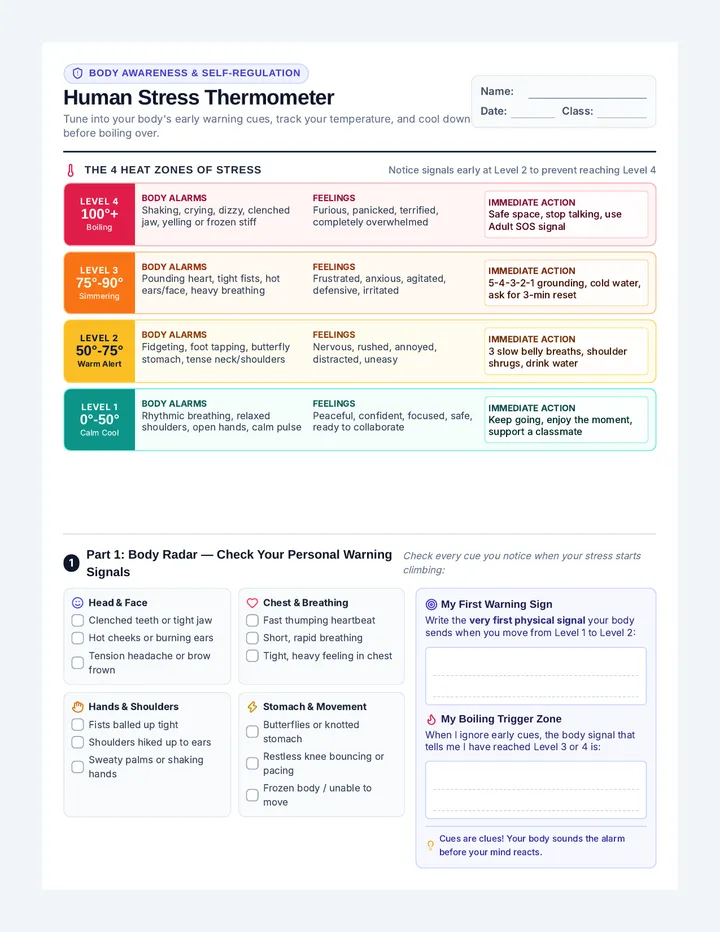
Identify physical "red flags" and cognitive "thought traps" that trigger anxiety.
Demonstrate mastery of 3+ regulation techniques (Mindfulness, CBT, Reframing).
Create a personalized Social & Academic wellness plan for maintenance.
Missouri Standards
AD.4.B: Identify and manage feelings and perspectives.
SE.2.A: Identify and manage personal stress and coping skills.
SE.3.C: Demonstrate the ability to set and achieve goals.
Session Key Activity Primary Goal 1: Anchor Point Body Map & Grounding Safety & physical symptoms. 2: Mindful Rhythm 4-7-8 Breathing Practice staying present. 3: Tactical Calm Coping Menu Sorting Sensory & rapid relief tools. 4: Thought Tides Thought Flip Chart CBT & cognitive reframing. 5: Social Safety Boundary Mapping Managing social anxiety. 6: Heart Space Self-Compassion Kit Overcoming perfectionism. 7: Power Play Routine Blueprint Academic & future planning. 8: Steady Sails Survival Kit Creation Maintenance & Celebration.
Facilitation Framework
Developmental Considerations
Social Identity
Peer validation often outweighs adult authority. The group must feel like a "Collective" rather than a clinical intervention to ensure engagement.
Executive Functioning
High-level stress makes staying organized biologically difficult. Logistical tools (Session 7) are essential scaffolds for this age group.
Cultural Considerations
Secular Mindfulness
Frame mindfulness as "brain training." This removes religious barriers and aligns with the analytical mindset of modern students.
Systemic Stress
Validate that anxiety is often a rational response to systemic pressures (racism, sexism, etc.) before teaching internal coping skills.
Body Signals Worksheet Body Signals
Decoding the language of your nervous system
Name: ___________________________
Date: ___________________________
The Internal Map
Anxiety often speaks through the body before our brain even knows what's happening. Use the space below to mark where you feel tension, heat, or "butterflies."
Draw or write your sensations on the map
Common Red Flags
Check off any that feel familiar to you:
Tightness in chest or throat
Racing or pounding heart
Clenched jaw or teeth grinding
Sweaty palms or feeling "flushed"
"Butterflies" or stomach knots
Fidgeting or restless legs
The Catalyst
What situations usually trigger these signals? (e.g., tests, lunchroom, presentations)
My "Early Warning"
If you could name one signal that always happens first, what would it be?
"Knowing your body is the first step to staying in the driver's seat."
Collective Consent Form The Calm Collective
School Counseling Small Group Program
Date: ________________________
Dear Parent or Guardian,
Your student has been invited to participate in The Calm Collective , a small group counseling program designed specifically for high school girls to address school-related stress and anxiety.
This group will meet for eight 30-minute sessions during the school day. Our goal is to provide a supportive environment where students can share experiences and build a practical toolkit for managing stress.
Program Focus Areas:
Physical stress signals
Mindfulness & breathing
Cognitive reframing (CBT)
Boundaries & Social anxiety
Self-compassion skills
Academic goal setting
Future stress planning
Maintenance & Graduation
Confidentiality: Trust is the foundation of our group. What is shared in the group stays in the group, with the exception of any information regarding a student being hurt, hurting themselves, or planning to hurt someone else.
____________________________________
School Counselor Signature
Contact: ________________
Parent/Guardian Permission
Student Name:
I give permission for my student to participate in The Calm Collective.
Signature
Date
Collective Pre Assessment Group Pre-Assessment
The Calm Collective | Session 1
Student Name
Date
Baseline Check
Rate your level of agreement (1 = Strongly Disagree, 5 = Strongly Agree)
I can identify specific physical signs of anxiety in my body.
1
2
3
4
5
I have tools I can use to calm down when I am stressed.
1
2
3
4
5
I understand how my thoughts impact my emotions.
1
2
3
4
5
My Goal
What is one thing you hope to gain from this group?
Your responses are confidential and help us tailor the group to your needs.
Anchor Point Slides The Calm Collective
Session 1: The Anchor Point
Our Foundation
Confidentiality
"What's said in the collective stays in the collective."
Exceptions
If someone is hurting you, you are hurting yourself, or you plan to hurt someone else.
Group Goals:
Respect every voice
No judgment, only support
Phones away, presence in
What is Anxiety?
Anxiety is the brain's alarm system . It's trying to protect you, but sometimes it gets stuck in the "ON" position.
"It's like an smoke alarm going off because you burned toast—not because the house is on fire."
Body Signals
Before we "feel" anxious in our heads, our bodies send signals:
Fast Heartbeat
Tense Shoulders
Stomach Knots
Sweaty Palms
Grab your "Body Signals" worksheet to map yours!
The Anchor: 5-4-3-2-1
5
See
4
Feel
3
Hear
2
Smell
1
Taste
Grounding your brain back to the present moment.
Anchor Point Script Session 1: The Anchor Point
Facilitator Instructional Script
30 Minute Session
Materials Needed
Anchor Point Slides
Body Signals Worksheets
Pens/Colored Pencils
Key Objectives
1. Establish trust & confidentiality
2. Identify physical anxiety markers
3. Practice 5-4-3-2-1 grounding
1. Welcome & The Collective Concept
0:00 - 0:05
[Action: Display Slide 1]
Say: "Welcome everyone. I’m so glad you’re here. We’re calling this group 'The Calm Collective.' In high school, it often feels like we have to navigate the 'storm' of stress and anxiety alone. A collective is a group that works together for a common purpose—ours is to build a toolkit to help us stay steady when things get choppy."
Say: "Before we dive in, let’s do a quick 'Icebreaker Check-In.' If your current mood today was a type of weather, what would it be? I’ll start—I’m feeling a bit like a 'Morning Fog,' a little slow to start but clearing up."
2. Safety & The Rules
0:05 - 0:10
[Action: Display Slide 2]
Say: "For this to be a place where we can be honest, we need safety. That starts with Confidentiality. My rule is the 'Kitchen Table Rule': What we talk about here stays at this table. However, as a counselor, I have three exceptions: if you tell me someone is hurting you, you are hurting yourself, or you plan to hurt someone else. In those cases, I have to get extra help to keep you safe."
Say: "Can I get a verbal 'Yes' or a 'Thumbs Up' from everyone that you agree to keep each other's stories private?"
3. The Body Alarm
0:10 - 0:22
[Action: Display Slides 3 & 4. Distribute 'Body Signals' Worksheet.]
Guide the girls through the Smoke Alarm analogy. Explain that anxiety is a physical response first.
Say: "Anxiety isn't just 'in your head.' It's a physical alarm system. Your brain thinks there's a bear in the room, even if it's actually just a Chemistry test. I want you to look at the 'Body Signals' worksheet. Use the markers to color or circle where you feel tension first. Do your palms get sweaty? Does your heart race? Is there a knot in your stomach?"
[Allow 3-4 minutes for them to work on the map, then invite them to share one signal with the person next to them.]
4. Dropping the Anchor
0:22 - 0:28
[Action: Display Slide 5]
Say: "When the alarm is going off, we need an anchor to pull us back to the present. We're going to practice the 5-4-3-2-1 technique. Everyone, find your feet on the floor. Take a breath."
Social Safety Slides Social Safety
Navigating social anxiety, peer pressure, and the power of boundaries.
Session 5
The Boundary Map
Not everyone gets the same access to your energy.
Public (Acquaintances)
Social (Friends/Peers)
Private
The Power of the Pivot
The Request
"Can you just do my homework?"
The Pivot
"I'd love to help, but I'm only doing my own."
Social Safety Script Session 5: Social Safety
Facilitator Instructional Script
30 Minute Session
Materials Needed
Social Safety Slides
Boundary Map Activity
Colored Pencils/Markers
Key Objectives
1. Normalize social anxiety and peer pressure
2. Identify the three layers of social boundaries
3. Practice assertive "I" statements
1. Collective Check-In
0:00 - 0:05
[Action: Display Slide 1]
Say: "Welcome back, everyone. Last week we talked about 'Thought Tides' and flipping the script. Today we're applying that to our social lives. But first, our check-in: On a scale of 'Introvert Island' to 'Social Butterfly,' where are you feeling today?"
[Allow for sharing. Many high schoolers might lean towards 'Island' if they are feeling drained.]
2. The Social Battery
0:05 - 0:12
[Action: Display Slides 2 & 3]
Say: "Social anxiety is often the fear that we are being judged or that we'll say the wrong thing. One way we protect ourselves is through Boundaries. Boundaries aren't walls to keep people out; they are gates that let the right people in and keep our peace protected."
Say: "Think of your energy like a phone battery. If you say 'yes' to everyone else, your battery dies. Boundaries help you decide who gets your 'charge.'"
3. Mapping Your Circle
0:12 - 0:22
[Action: Display Slide 4. Distribute 'Boundary Map' Activity.]
Say: "Look at your Boundary Map. You have three circles. The Inner Circle is for people you trust completely. The Middle Circle is for friends and acquaintances. The Outer Circle is for everyone else."
Say: "Take a few minutes to write names or initials in each circle. Think about: Who gets to know your 'deep' stories? Who just gets the 'school version' of you? Setting these boundaries mentally helps you know when to say 'no'."
4. Assertive Power
0:22 - 0:28
[Action: Display Slide 5]
Say: "Once you know your boundary, you have to communicate it. We use 'Assertive' communication—it’s not being mean (aggressive) and it’s not being a doormat (passive). It’s being clear."
Say: "Try using an 'I' Statement: 'I feel [feeling] when [event], so I need [need].' For example: 'I feel overwhelmed when you ask for my homework at the last minute, so I need you to ask earlier or I can't help.'"
5. Check-Out
0:28 - 0:30
Say: "This week, try to set one small boundary—maybe it’s saying 'no' to a late-night FaceTime so you can sleep. Next week, we’re talking about the 'Inner Critic' and how to be kinder to ourselves."
Boundary Map Activity Social Boundary Map
The Calm Collective | Session 5
Name: ________________________
Date: _________________________
Map out who has access to your time, energy, and private thoughts. Boundaries help you maintain your Social Safety .
Private
Trust & Support
Social Circle
Public / Classmates
Guarded Topics
What topics are only for your Private Circle?
Energy Boundaries
What social behaviors need a firm "No"?
"No is a complete sentence." — Anne Lamott
Mindful Rhythm Slides Mindful Rhythm
Session 2: Finding Your Center
Group Check-In
How is your "inner weather" today?
Drizzly / Low
Bright / High
Cloudy / Calm
Stormy / Anxious
Review:
"Did anyone notice a physical signal this week that we talked about in Session 1?"
What is Mindfulness?
It's simple, but not easy.
Being present in the here and now, on purpose, without judgment.
It's NOT about "clearing your mind."
It IS about noticing where your mind goes.
BE HERE.
The 4-7-8 Rhythm
This acts like a "brake pedal" for your nervous system.
4
Inhale
Through the nose
7
Hold
Keep the air in
8
Exhale
Swoosh out the mouth
Let's try 3 rounds together...
Micro-Mindfulness
Where can you hide a "Mindful Minute" during the school day?
Thresholds
Take one deep breath every time you walk into a new classroom.
The First Bite
Focus 100% on the taste and texture of just the first bite of lunch.
The Transition
Notice the feeling of your feet on the floor while walking between classes.
Screen Pause
Take a breath before you unlock your phone to check a notification.
Mindful Rhythm Script Session 2: Mindful Rhythm
Facilitator Instructional Script
30 Minute Session
Materials Needed
Mindful Rhythm Slides
Mindful Rhythm Tracker
Pens
Key Objectives
1. Define mindfulness for high school life
2. Master the 4-7-8 breathing technique
3. Identify "Micro-Mindfulness" windows
1. Collective Check-In
0:00 - 0:05
[Action: Display Slide 1]
Say: "Welcome back to the Collective. Last week we talked about 'Body Signals'—those physical alarms that go off when we're stressed. Did anyone notice their heart racing or stomach tight this week?"
[Allow for brief sharing. If they are quiet, share a personal example of a body signal you felt.]
Say: "Today's 'Icebreaker Check-In': If you could have any superpower to use during a stressful school day, what would it be? I'd choose the ability to pause time for 10 minutes."
2. Finding Your Rhythm
0:05 - 0:10
[Action: Display Slide 2 & 3]
Say: "When the body alarm goes off, we're usually either dwelling on the past (like a social mistake) or worrying about the future (like a grade). Mindfulness is just the practice of bringing your focus back to the 'Right Now.' It’s not about clearing your mind—it’s about noticing where your mind went and gently bringing it back."
Say: "Think of it like a radio dial. Anxiety is static. Mindfulness helps us tune back into the clear signal of the present moment."
3. The 4-7-8 Breath
0:10 - 0:20
[Action: Display Slide 4]
Say: "One of the fastest ways to hack your nervous system is through your breath. We're going to try the '4-7-8 technique.' It’s like a natural tranquilizer for the nervous system."
The Rhythm:
Inhale through your nose for 4 seconds.
Hold that breath for 7 seconds.
Exhale forcefully through your mouth for 8 seconds.
[Action: Lead the group through 3 cycles. Monitor for lightheadedness. Remind them it takes practice.]
4. Micro-Mindfulness Moments
0:20 - 0:27
[Action: Display Slide 5. Distribute 'Mindful Rhythm Tracker'.]
Say: "You don't need 30 minutes to meditate to be mindful. You can do it in 'Micro-Moments.' On your tracker, look at the school day examples: The first sip of water, the walk between periods, or even just sitting down at your desk. Let's circle three times today where you could take just one 4-7-8 breath."
5. Check-Out
0:27 - 0:30
Mindful Rhythm Tracker Mindful Rhythm Tracker
Finding pause in the chaos
Name: ___________________________
Date: ___________________________
4-7-8 Check-In
Practice 3 rounds of the 4-7-8 breath. How does your body feel before and after?
Before
After
Mindful Listening
Close your eyes for 30 seconds. What are the layers of sound you hear?
1
Closest sound...
2
Farthest sound...
3
Quiet sound...
The "Micro-Mindful" Challenge
Mark a box every time you use a "Mindful Minute" this week!
MON
TUE
WED
THU
FRI
SAT
SUN
My Favorite "Secret" Time to Practice:
Coping Menu Worksheet Coping Menu
Customizing your tactical calm response
Name: ___________________________
Date: ___________________________
Instructions: Not every strategy works for every situation. Read through the "Menu Items" below. Circle the ones that resonate with you, then select your "Top 5" to create your personal daily special at the bottom.
Sensory Starters
5-4-3-2-1 Grounding
Naming things you see, feel, hear, smell, and taste.
The Cold Shock
Splashing cold water on your face or holding an ice cube.
Heavy Work
Pushing against a wall or doing chair push-ups.
Cognitive Entrees
Reality Testing
Asking: "Is this a fact or just a feeling?"
The 24-Hour Rule
"Will this matter in 24 hours? 24 days?"
Self-Compassion Script
"I'm having a hard time, and that's okay."
Creative Sides
Safe Space Visualization
Imagine a place where you feel 100% secure.
The "Hype" Playlist
Curating songs that change your energy immediately.
Doodling/Journaling
Getting the "noise" out of your head and onto paper.
Rapid Relievers
Square Breathing
4 counts in, 4 hold, 4 out, 4 hold.
Shoulder Roll-Down
Actively dropping your shoulders away from your ears.
The "Safe Word"
A single word (e.g., "Peace") you repeat with your breath.
My Personal Daily Special
List your top 5 "must-have" tools below:
Tactical Calm Script Session 3: Tactical Calm
Facilitator Instructional Script
30 Minute Session
Materials Needed
Tactical Calm Slides
Coping Menu Worksheets
Pens/Highlighters
Key Objectives
1. Differentiate between Sensory & Cognitive tools
2. Identify "Rapid Relief" vs "Long-Term" strategies
3. Curate a personalized "Coping Menu"
1. Collective Check-In
0:00 - 0:05
[Action: Display Slide 1]
Say: "Welcome back, Collective! Last week was all about finding your rhythm with the 4-7-8 breath. How did it go? Did anyone use it before a test or a hard conversation?"
[Allow for sharing. Validate that some might have forgotten or found it difficult.]
Say: "Check-in question: On a scale of 1-10 (1 being a calm lake, 10 being a hurricane), how has your stress level been since we last met?"
2. Tools for the Storm
0:05 - 0:12
[Action: Display Slides 2, 3, & 4]
Say: "Grounding and breathing are great, but they aren't the only tools. Today we're talking about Tactical Calm. Coping strategies usually fall into two buckets: Sensory and Cognitive."
Say: "Sensory tools are for the body—like cold water on your face or a heavy blanket. Cognitive tools are for the mind—like listening to music or journaling. We need both because sometimes the 'alarm' is in our heart, and sometimes it's in our head."
3. Building Your Menu
0:12 - 0:25
[Action: Display Slide 5. Distribute 'Coping Menu' Worksheet.]
Say: "Every person's 'Tactical Calm' looks different. What works for your best friend might not work for you. I want you to look at this 'Coping Menu.' It has four categories: Appetizers (Rapid Relief), Main Course (Body/Sensory), Side Dishes (Mind/Cognitive), and Dessert (Creative)."
Say: "Spend some time circling the things that already work for you, and star two things you'd be willing to try this week. If you have a secret weapon that's not on the list, write it in!"
[Allow 5-7 minutes for individual work. Encourage them to talk to each other about what they chose.]
4. The Rapid Relief Hack
0:25 - 0:28
Say: "One 'Rapid Relief' tool that works for almost everyone is the 'Cold Shock.' If you're feeling a panic attack coming on or high anxiety, splash ice-cold water on your face or hold an ice cube. It triggers the 'Dive Reflex' and instantly slows your heart rate. It’s a total system reboot."
5. Check-Out
0:28 - 0:30
Say: "Keep your Coping Menu in your folder. This week, try that 'Cold Shock' hack or one of your starred Main Courses. Next week, we're diving into the 'Thought Tides'—how our internal voice can change our whole mood."
Tactical Calm Slides Tactical Calm
Session 3: Building Your Toolkit
Matching Tools to Tasks
The strategy you use during a major test might be different than the one you use when you're stuck in traffic.
"We need a variety of tools for a variety of problems."
High Intensity = Sensory Tools
Worry Loops = Cognitive Tools
Low Energy = Creative Tools
Sensory Starters
These help when your brain is in "Overdrive." They pull you back into your body.
The Cold Shock: Cold water or ice cubes.Texture: A fidget, a soft sweater, or a stone.Wall Pushes: Use your muscles.
Try It Now:
Clench your fists as tight as you can for 5 seconds... and release.
Cognitive Entrees
"Don't believe everything you think."
Fact vs. Feeling
Feelings are real, but they aren't always facts .
Ex: "I feel like a failure" vs. "I failed one math quiz."
The 24-Hour Test
Will this matter in 24 hours? 24 days? 24 weeks?
Helps put small stressors into perspective.
Time to Order
Grab your Coping Menu Worksheet . Review the options and select the "Daily Specials" that work best for YOU.
Discard
Keep
Heart Space Slides Heart Space
Softening the inner critic and practicing radical self-compassion.
Session 6
Heart Scan Check-In
Where are you holding stress in your body right now?
Energy Level
Stress Level
The Inner Critic
The "Inner Critic" is that voice that tells you you're not doing enough or smart enough.
"I should have studied more. I'm so lazy."
The Goal:
Protection through shame.
The Best Friend Test
If your best friend came to you with this struggle, what would you say to them?
"Now, say that to yourself."
Heart Space Script Session 6: Heart Space
Facilitator Instructional Script
30 Minute Session
Materials Needed
Heart Space Slides
Compassion Kit Worksheet
Sticky Notes
Key Objectives
1. Identify the "Inner Critic" and its impact
2. Understand the 3 pillars of self-compassion
3. Develop a personal self-compassion mantra
1. Collective Check-In
0:00 - 0:05
[Action: Display Slide 1]
Say: "Welcome back, everyone. Last week was all about boundaries and 'Social Safety.' This week, we're going internal. We're talking about how we treat ourselves. Check-in question: What is one thing you did this week that you're proud of—no matter how small it is?"
[Encourage them to share even 'boring' things like 'I got to class on time' or 'I drank enough water.']
2. The Meanest Person You Know
0:05 - 0:12
[Action: Display Slides 2 & 3]
Say: "Most of us have an 'Inner Critic.' It’s that voice that tells you you’re not doing enough, or that everyone else is better than you. Often, we say things to ourselves that we would never say to a friend."
Say: "Why are we so hard on ourselves? Usually, it's because we think being mean will motivate us to do better. But research shows that self-criticism actually triggers the 'threat' part of our brain, making it harder to learn and grow."
3. The 3 Pillars
0:12 - 0:22
[Action: Display Slides 4 & 5]
Say: "The antidote to the inner critic is Self-Compassion. It has three parts: 1. Mindfulness (noticing you're hurting), 2. Common Humanity (remembering you aren't the only one struggling), and 3. Self-Kindness (treating yourself like a friend)."
Say: "When you mess up, try saying: 'This is a moment of suffering. Everyone feels this way sometimes. May I be kind to myself in this moment.'"
4. Your Compassion Mantra
0:22 - 0:28
[Action: Distribute 'Compassion Kit' Worksheet.]
Say: "Look at your worksheet. I want you to write down one common thing your inner critic says. Now, use the pillars we just talked about to write a 'counter-statement.' This is your mantra for when things get tough."
[Allow for quiet work. Invite them to write their mantra on a sticky note to put on their phone or mirror.]
5. Check-Out
0:28 - 0:30
Say: "This week, catch yourself when you're being your own worst enemy and try out your mantra. Next week, we're getting 'Power Play'—talking about academic stress and how to manage the 'giant' projects without panicking."
Compassion Kit Worksheet The Compassion Kit
The Calm Collective | Session 6
Name: ________________________
Date: _________________________
Critic Voice:
What does your critic say when you struggle?
Friend Voice:
What would a kind friend say instead?
Build Your Mantra
1
Mindfulness
"This is really hard right now..."
2
Humanity
"...and I'm not the only one who feels this way."
3
Kindness
"May I be patient with myself today."
My Personal Mantra: Power Play Script Session 7: Power Play
Facilitator Instructional Script
30 Minute Session
Materials Needed
Power Play Slides
Routine Blueprint Worksheet
Highlighters
Key Objectives
1. Address procrastination as an emotional response
2. Practice "Micro-Tasking" large projects
3. Create a balanced Routine Blueprint
1. Collective Check-In
0:00 - 0:05
[Action: Display Slide 1]
Say: "Welcome back, Collective. Last week was heavy—talking about the inner critic. Today we're getting tactical again. We're talking about the 'School Stress' giant. Check-in question: What is one thing on your to-do list right now that is making your stomach do flips?"
[Validate their stress. High school is a lot to juggle.]
2. Procrastination is Not Laziness
0:05 - 0:12
[Action: Display Slides 2 & 3]
Say: "We often think we procrastinate because we're 'lazy.' But usually, procrastination is just emotion management. We avoid the task because the task makes us feel anxious or overwhelmed. So we scroll on TikTok to feel better for a minute, but the stress just grows."
Say: "The secret to beating procrastination isn't better willpower; it's making the task feel smaller so it's less scary."
3. The Power of Micro-Tasks
0:12 - 0:20
[Action: Display Slide 4]
Say: "Instead of 'Study for Biology Final,' which is a giant scary monster, we create Micro-Tasks. A micro-task is something so small it feels almost silly. For example: 'Open my Biology notebook' or 'Read the first five terms on the vocab list.' Once you start, it’s much easier to keep going."
4. Building the Blueprint
0:20 - 0:28
[Action: Distribute 'Routine Blueprint' Worksheet.]
Say: "Look at your Blueprint. I want you to pick a 'typical' stressful school day. We're going to time-block it. But we aren't just blocking out study time. We're blocking out rest time and joy time. If you don't schedule your rest, your anxiety will take it anyway."
[Help them find windows for 'Micro-Mindfulness' and 'Tactical Calm' tools within their schedule.]
5. Check-Out
0:28 - 0:30
Say: "This week, try to break that one scary to-do into three micro-tasks. Next week is our final session! We're going to build your 'Survival Kits' and celebrate how far you've come."
Power Play Slides Power Play
Taking control of your schedule and turning academic stress into action.
Session 7
The Procrastination Loop
Big Task
Anxiety
Avoidance
Temporary Relief
Productivity Power Moves
Micro-Sizing
Break a 2-hour task into four 15-minute sprints.
Pomodoro
25 mins focus + 5 mins breathing.
Time Blocks
Assign specific tasks to specific hours.
Energy Audit
Do the hardest tasks when energy is high.
The 5-Minute Rule
"I'll do this for just 5 minutes. If I want to stop then, I can. But I must start."
STARTING IS THE HARDEST PART
Routine Blueprint Worksheet Routine Blueprint
The Calm Collective | Session 7
Name: ________________________
Date: _________________________
The Ideal School Day
Morning Flow
Wake Up Block
Mid-Day Reset
Lunch / Break
After School
Homework Peak
Wind Down
The "Micro-Sizer"
Break a big project into four 15-minute tiny tasks.
The Big Scary Project:
1
2
3
4
My Action Reward
What is one non-screen reward you'll give yourself?
Steady Sails Script Session 8: Steady Sails
Facilitator Instructional Script
30 Minute Session
Materials Needed
Steady Sails Slides
Survival Kit Plan Worksheet
Post-Assessments
Small treats/certificates (optional)
Key Objectives
1. Consolidate 8 weeks of coping tools
2. Create a "Survival Kit" for future stressors
3. Reflect on personal growth & group connection
1. Collective Check-In
0:00 - 0:05
[Action: Display Slide 1]
Say: "Welcome to our final session of the Calm Collective. Over the last 8 weeks, we’ve talked about body signals, breath, coping menus, thought traps, boundaries, self-compassion, and academic routines. Check-in question: What is the most useful tool you’re taking away from this group?"
[Allow everyone to share. This reinforces the learning for the whole group.]
2. Building the Kit
0:05 - 0:15
[Action: Display Slide 2 & 3. Distribute 'Survival Kit Plan'.]
Say: "Anxiety isn't going to disappear forever—life is always going to have waves. But now you have a boat. The 'Survival Kit' is your quick-reference guide for when you're in the middle of a storm. It lists your favorite grounding techniques, your 'Thought Flip' examples, and your emergency contacts."
Say: "Take a few minutes to fill this out. This is yours to keep in your binder, your car, or even take a photo of it on your phone."
3. Staying Steady
0:15 - 0:20
[Action: Display Slide 4]
Say: "Remember: Failing to use a tool doesn't mean you've failed the group. Progress isn't a straight line. If you have a bad day, use your 'Heart Space' self-compassion tools and try again tomorrow. You know what your 'Body Signals' are now—trust them."
4. Final Reflection
0:20 - 0:28
[Action: Distribute Post-Assessments.]
Say: "To help me see how the group helped you (and how I can make it better for the next group), please fill out this final assessment. Be honest—your feedback is part of the Collective too."
5. Closing
0:28 - 0:30
Say: "I am so incredibly proud of the work you’ve done. You’ve supported each other and built a real community here. Even though we aren't meeting weekly anymore, remember that you carry these tools with you. Stay steady, Collective!"
[Action: Distribute certificates or small treats if provided.]
Steady Sails Slides Steady Sails
Celebrating our journey and charting the course for long-term wellness.
Session 8
Reflecting on the Collective
Biggest Win
A moment you felt proud of how you handled stress.
Favorite Tool
The strategy that felt most natural to you.
Peer Power
"You are not alone. Your collective strength is your anchor."
Staying Steady
Prevention
Spotting "Red Flags" early.
Practice
Daily mindful rhythms.
Connection
Call your Inner Circle.
You've Got This
Anxiety is a wave, but you've learned to surf.
Collective
Calm
Future
Collective Post Assessment Group Post-Assessment
The Calm Collective | Session 8
Student Name
Date
Growth Check
Rate your current level (1 = Disagree, 5 = Agree)
I can identify physical anxiety signals early.
1
2
3
4
5
I have multiple tools to use during high stress.
1
2
3
4
5
I understand how to flip a negative script.
1
2
3
4
5
Top 2 Coping Strategies:
One Boundary you practiced:
The Collective Reflection
What was your favorite part of this group?
One thing you will take with you:
Congratulations on completing the collective! Keep sailing.
Survival Kit Plan Survival Kit Plan
The Calm Collective | 8-Session Toolkit
Student Name
Main "Anchor" Goal
1. Body Signals
2. Breathing Rhythms
3. Rapid Coping Tools
4. Thought Reframes
5. Social Boundaries
6. Self-Compassion
7 & 8. Future Power Plan
My proactive plan for academic and future stressors:
(e.g., Micro-sizing, Pomodoro, 5-Minute Rule)
"Anxiety is a wave, but you've learned to surf. Keep sailing, Collective."