Foundations of Safety Slides Foundations of Safety
The Six Principles of Trauma-Informed Care
Case File: TIC-001
Why a Trauma-Informed Approach?
"What's wrong with you?"
The traditional medical model.
"What happened to you?"
The Trauma-Informed perspective.
The Goal
To create an environment where clients feel safe enough to share, valued enough to speak, and empowered enough to change.
The SAMHSA Core Principles
1. Safety
Physical and psychological safety is paramount.
2. Trust
Transparency and consistency in operations.
3. Peer Support
Mutual self-help and healing through shared experience.
4. Collaboration
Leveling power differentials between staff and clients.
5. Empowerment
Focusing on strengths and fostering choice.
6. Cultural
Moving past stereotypes and honoring history/tradition.
1 Safety
Physical layout of the space (lighting, exits, seating).
Psychological climate: Predictability and privacy.
2 Trust
Principle 5: Empowerment & Choice
Giving Voice to the Voiceless
Trauma is inherently a loss of control. In TIC, we hand that control back whenever possible.
Avoid
"You need to do this worksheet now."
Try
"Would you prefer to talk today, or would you like to work through this activity together?"
Active Learning
The Policy Audit
We are going to look at three common school or clinic policies. Using your Policy Audit Worksheet, evaluate them against the 6 principles.
Zero-Tolerance
"Any physical altercation results in automatic 5-day suspension, no exceptions."
Intake Lockdown
"Wait in the high-walled reception until your number is called; no cell phones allowed."
The 'Must Report'
"Clinicians will not discuss treatment goals with minors without parental presence."
Policy Audit Worksheet Policy Audit Worksheet
Foundations of Safety | Case File: TIC-PA-001
Investigator Name
Date
Instructions
Review the following institutional policies. For each policy, identify which of the 6 SAMHSA Principles are being violated or ignored. Then, propose a Trauma-Informed Revision that maintains institutional needs while prioritizing client safety and empowerment.
Policy 01: Physical Space
"Clients must wait in the central reception area. To ensure security, seating is bolted to the floor in a single row facing the security desk. Cell phone use is prohibited to maintain a 'clinical atmosphere'."
Principles Violated/Ignored (Check all that apply)
Safety
Trust
Peer Support
Collaboration
Empowerment
Cultural
Trauma-Informed Revision (How would you fix this?)
Policy 02: Discipline
"Zero Tolerance: Any student involved in a verbal or physical altercation is immediately suspended for 3 days. This policy is applied uniformly regardless of individual history or 'context' to ensure fairness."
Principles Violated/Ignored
Safety
Trust
Peer Support
Collaboration
Empowerment
Cultural
Trauma-Informed Revision
Policy 03: Communication
"To maximize clinical efficiency, intake specialists follow a rigid 45-item script. If a client becomes emotional or pauses for more than 30 seconds, the specialist is instructed to move to the next question to stay on schedule."
Principles Violated/Ignored
Safety
Trust
Peer Support
Collaboration
Empowerment
Cultural
Trauma-Informed Revision
Intake Critique Teacher Guide Teacher Guide: The Bad Intake Session
Lesson 1 Hook: Identifying TIC Violations
Duration 20 Min
Setup
Since we cannot watch a live session, you will read this transcript aloud with a student volunteer. One person plays the Clinician (C) and the other plays the Client (J) .
Goal for Students:
"List every moment where the clinician violates safety, trust, or empowerment."
Key Violations to Highlight
Safety: Sitting between the client and the door; harsh lighting; interrupting.Trust: Looking at a computer screen instead of the client; dismissive tone.Empowerment: Forcing questions out of order; using jargon.Collaboration: Making decisions for the client without asking.
--- Transcript: Session 004 ---
C: (Not looking up from screen) Name?
J: Jordan...
C: Last name, Jordan. I need the full file name. I have five Jordans today. (Type type type) Right. Age?
J: I'm 17.
C: 17. Okay. The intake form says you're here for 'general anxiety.' That's a bit vague. We need to get specific if you want the insurance to cover this. Did something happen? A trauma?
J: (Shifting in chair) Um, I don't really want to talk about that right now. I just haven't been sleeping...
C: (Interrupting) Jordan, look, I have 30 minutes for this intake. If we don't get the trauma history now, we have to push the actual therapy back three weeks. Just give me the bullet points. Was it physical? Family stuff?
J: I... I don't know. It’s just loud noises and—
C: (Phone pings) Hang on. (Checks phone) Right. Loud noises. Got it. I’m going to put you down for PTSD-Lite. We'll start you on a CBT track. It's the most efficient. I’ll print the schedule, don't lose it, we charge for reprints.
J: Do I have a choice in the—
C: Trust the process, Jordan. I’ve been doing this for ten years. Now, let's talk about your living situation. Is it stable or 'messy'?
Use for class discussion after reading
Discussion Prompt A
How did the clinician's focus on "efficiency" and "insurance" directly compromise Jordan's psychological safety?
Discussion Prompt B
The Art of Intake Slides The Art of Intake
Trauma-Sensitive Interviewing
The Primary Objective
The goal of a trauma history assessment is NOT information gathering.
It is the cultivation of a Therapeutic Alliance.
If you get the info but lose the client...
YOU FAILED.
Re-traumatization during intake is the #1 reason clients never return for a second session.
Phrasing: From Interrogation to Invitation
Avoid: Closed/Directive
"Tell me exactly what happened."
"Was there any sexual abuse?"
"Why didn't you leave?"
"Describe your worst memory."
Try: Open/Invitational
"What do you feel comfortable sharing?"
"I want to ask about your history; is that okay?"
"We can stop at any time. You're in control."
"What does safety feel like to you?"
The Clinical 'Brake'
Pacing is the speed at which you move through a client's story. If you see signs of dysregulation , you MUST hit the brake.
Watch For:
• Rapid breathing / Sweating
• Sudden "shutting down" / Silence
• Hyper-vigilance (checking the door)
• Emotional flooding (sobbing)
How to Brake:
• "Let's take a breath together."
• "We don't need to go further today."
• "I can see this is heavy. Let's pause."
• Grounding (5-4-3-2-1 technique)
Slow is Smooth.
Smooth is Safe.
Workshop: The Revision Lab
You have a standard, sterile intake form. It is efficient, cold, and potentially dangerous. Your job is to rewrite it using trauma-sensitive language.
Open your Intake Question Revision Worksheet now.
Intake Question Revision Lab Worksheet Skill-Builder
Intake Question Revision Lab
Transforming Clinical Interrogation into Therapeutic Alliance
Practitioner:
Date:
The Challenge: Below are standard, direct intake questions used in high-volume clinics. These questions are often perceived as invasive, threatening, or cold by survivors of trauma. Rewrite each question to be open-ended, invitational, and supportive of client autonomy.
01
Medical Model Question:
"List all instances of physical or emotional abuse in your household growing up."
Trauma-Sensitive Revision:
Tip: Focus on comfort and choice (e.g., "If you feel comfortable...")
02
Medical Model Question:
"What is your current relationship with your primary abuser?"
Trauma-Sensitive Revision:
Tip: Avoid clinical labels like 'abuser' unless the client uses them first.
03
Medical Model Question:
"Why did it take you so long to seek treatment for these symptoms?"
Trauma-Sensitive Revision:
Tip: Reframe to validate their strength and current readiness.
Practitioner Reflection
Which of these revisions was the hardest to write? Why is it difficult to balance "getting the facts" with "keeping the client safe"?
Intake Role Play Scenarios Teacher Guide Teacher Guide: Intake Role-Play Scenarios
Lesson 2 Simulation: Practicing Pacing & Phrasing
Simulation Setup
Pair students up. Assign one as Practitioner and one as Client .
Hand out Scenario A. Let them role-play for 5 minutes.
Pause and debrief as a class. "Practitioners: What did it feel like when the client 'shut down'? Clients: Did your partner notice?"
Switch roles and use Scenario B.
Case-A
Scenario A: The "Freeze" Response
Client Profile: Sam (18)
Sam is here after a recent car accident. Whenever the Practitioner asks about the "details of the crash," Sam should start looking at the floor, stop talking, and begin tapping their foot rapidly.
Practitioner Goal:
"Notice the freeze response. Stop questioning immediately. Use a grounding technique or change the subject to something safe (e.g., pets, hobbies) to bring Sam back."
Case-B
Scenario B: The Boundary Test
Client Profile: Alex (17)
Alex has a history of inconsistent adults in their life. During the intake, Alex should ask the Practitioner personal questions like, "What's your home life like? Are you married? Do you actually care about this or is it just a job?"
Practitioner Goal:
"Maintain professional boundaries with warmth. Validate the client's desire for connection without over-sharing personal details. Bring the focus back to Alex's goals."
Observation Checklist for Peer Evaluators
Notice the Body?
Did they see the foot tapping or the gaze shift?
Permission Granted?
Did they ask "Is it okay if we talk about...?"
The Pause?
Did they allow silence, or did they rush to fill it?
Mapping Safety Slides Mapping Safety
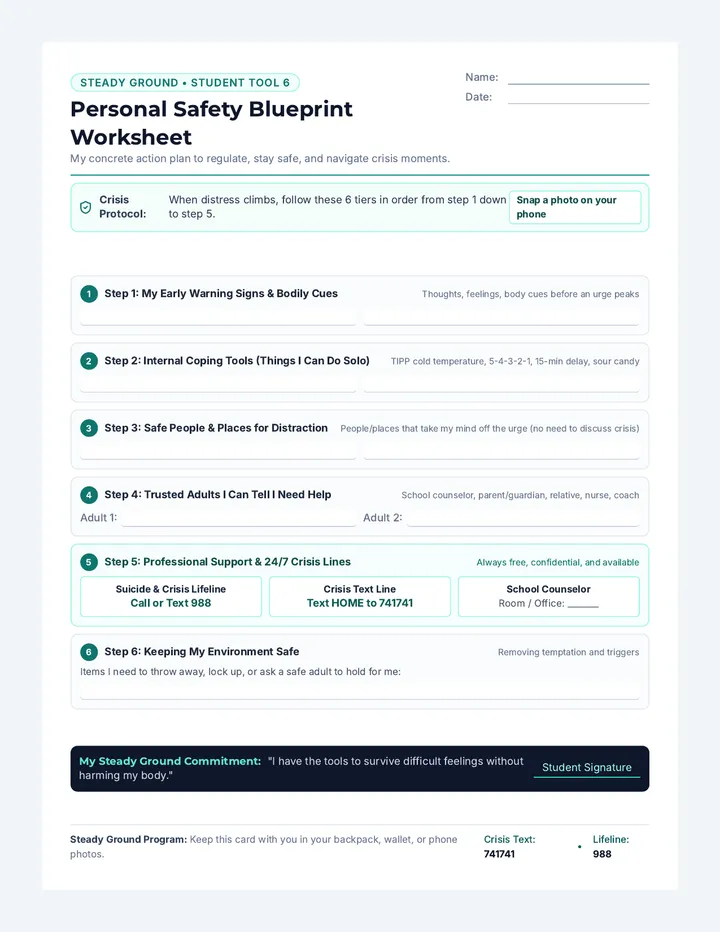
Developing Personal Safety Plans
Triggers
Warning Signs
Coping
The "Crisis Map"
A safety plan is a living document that helps a client navigate high-stress moments before they become full crises.
Proactive
Written during "calm" times.
Collaborative
The client owns the strategies.
"It's like a fire drill. You don't want to figure out where the exits are while the building is on fire."
— Clinical Proverb
Anatomy of the Plan
1. Triggers
External events that spark distress (e.g., loud bangs, specific smells, news stories).
2. Signs
Internal signals (e.g., racing heart, clenching jaw, isolating, negative self-talk).
3. Coping
Things I can do myself (e.g., 4-7-8 breathing, listening to music, walking).
4. Support
People I can contact (Friends, hotlines, clinical team, family).
Clinical Post-Mortem
Why did Alex's plan fail?
Alex had a safety plan. On Tuesday night, they experienced a panic attack after a confrontation at school. They didn't use any of their coping skills and ended up in the ER.
The Gaps:
1. "Coping skill: Meditation" — (Too hard to do during high panic)
2. "Contact: Mom" — (Mom was the trigger that night)
3. "Warning sign: Anger" — (Too vague; didn't notice the physical sign)
Project Time
You will be assigned a Client Bio. Your task is to build a safety plan that is specific, actionable, and fail-safe.
Phase 1: Identifying the Red Flags
Personal Safety Map Template Personal Safety Map
Clinical Tool TIC-SM-09
Client ID / Code
Effective Date
1. Known Triggers
Identify specific people, places, sounds, or smells that increase your distress.
2. Internal Warning Signs
Internal feelings or physical sensations that indicate a crisis might be coming.
3. Internal Coping Strategies
Physical Activity
Mental Distraction
Sensory/Grounding
4. My Support Network
People I can contact in a crisis:
Professional/Emergency Resources:
Crisis Text Line: Text HOME to 741741
988 Suicide & Crisis Lifeline
Safety Plan Case Study Teacher Guide Teacher Guide: Safety Plan Post-Mortem
Lesson 3 Project: Case Bio & Analysis
Phase Project Prep
The Case of Alex (17)
The Background
Alex lives in a high-stress household where shouting is common. Alex suffers from hyper-vigilance and sensory processing issues. Their safety plan was developed quickly during a 15-minute intake.
The Incident:
Alex got into an argument with their mother at 9:00 PM. By 9:30 PM, Alex was having a panic attack, feeling dizzy, and shouting. They did not use the plan and eventually threw a chair, leading to an ER visit.
Alex's Original Plan (The Gaps)
Warning Sign: "Feeling bad"
Issue: Too vague. Alex didn't realize they were in crisis until the shouting started.
Coping Skill: "Go for a run"
Issue: Impractical at 9:30 PM in their neighborhood; mother wouldn't let them leave.
Support: "Text Best Friend"
Issue: Friend has phone taken away at 9:00 PM every night.
Student Activity: Building for Leo (18)
Distribute this bio to students. They must use the Personal Safety Map Template to build a plan that avoids the mistakes made in Alex's case.
Leo's Bio: Leo is a senior preparing for college. He has history of childhood medical trauma (frequent surgeries).
Triggers: Smell of antiseptic/hospitals, being told "you're fine" when he is in pain, sudden loud voices, feeling 'trapped' in small rooms.Signs: His palms get sweaty, he starts picking at his cuticles until they bleed, he loses his appetite, and he becomes very quiet/compliant (the "fawn" response).Environment: Lives with supportive grandparents. Has a part-time job at a library. Is very tech-savvy and likes gaming.
Mastery Checklist for Teachers
Specificity
Are signs physical (sweaty palms) or vague (sad)?
Feasibility
Can they actually do these skills at 10 PM?
Accessibility
Are support people available 24/7?
Autonomy
Does it rely on the client or others?
Frameworks for Healing Slides PHASE-04
Frameworks
for Healing
Designing the Intervention Strategy
Multimodal
Phased Approach
The Two Pillars of Intervention
Top-Down (Cognitive)
Focuses on thoughts, beliefs, and narratives. Using the logical brain to manage emotions.
Example: CBT (Cognitive Behavioral Therapy)
Identifying "thinking traps" or distorted beliefs about safety.
Bottom-Up (Somatic)
Focuses on the body and nervous system. Calming the physical response before the brain can think.
Example: Somatic Experiencing / Yoga
Breathwork, grounding, and physical movement to release tension.
The Healing Trajectory
1
Stabilization
"Am I safe right now?"
Focus: Coping & Safety Plans
2
Processing
"What happened to me?"
Focus: Narrative & Memory
3
Integration
"Who am I now?"
Focus: Meaning & Future
Case Alert: Complex PTSD
Where
do you
The file on your desk describes a client with multiple childhood traumas, housing instability, and intense panic. They don't trust the system.
The First 6 Weeks
Your team must design a trajectory that prioritizes Safety First.
What modalities will you use?
How will you build trust?
Plan Your Path
Open your 6-Week Intervention Planner. It's time to build a framework for healing.
Mission: Clinical Stabilization
6-Week Intervention Planner Worksheet 6-Week Intervention Planner
Case Trajectory Framework: Stabilization Phase
Clinical Team
Client Code
Clinical Tool Selection
Top-Down Approaches (Cognitive)
CBT (Cognitive Behavioral)
Narrative Therapy
Psychoeducation
Justify your cognitive choices here...
Bottom-Up Approaches (Somatic)
Breathwork/Grounding
Mindfulness/Yoga
Sensory Integration
Justify your somatic choices here...
Weekly Trajectory (Phase 1: Stabilization)
Weeks 1 - 2
Primary Goal: Relationship & Safety
Weeks 3 - 4
Primary Goal: Building the Toolkit
Weeks 5 - 6
Primary Goal: Mastery & Resilience
Clinical Readiness Check
How will your team know the client is ready to move from Stabilization (Phase 1) to Processing (Phase 2)? List three behavioral markers.
Client Echo Case Dossier Teacher Resource Case Dossier: Complex PTSD
Lesson 4 Team Project: Detailed Scenario
Strictly Confidential
Client Profile
Code Name: CLIENT-ECHO
Age: 17 Years
Status: Unstable
Core Symptoms
Severe hyper-vigilance (cannot sit with back to door)
Frequent "Flash-Bulb" memories of domestic violence
Intense mistrust of male authority figures
RESTRICTED
Detailed Narrative History
"Echo" grew up in a household with chronic domestic instability. Between ages 4 and 12, "Echo" witnessed multiple physical altercations. At age 13, the family entered the shelter system, resulting in two years of housing instability and school-hopping.
"The client presents as 'too cooperative.' They agree with everything the clinician says but offer no personal insight. This is likely a 'fawn' response used to avoid conflict."
Current living situation: Reunited with biological mother in a stable apartment, but mother works two jobs and is rarely home. "Echo" is struggling in high school; they have 4 absences a week and are failing three subjects.
Current Triggers identified in intake:
Keys rattling in a lock (reminds them of father coming home angry)
Raised male voices in school hallways
The smell of "old spice" or similar colognes
Forms or paperwork that ask for "Father's Name"
The Clinical Directive
"As a team of social workers, your directive is to build the 6-week stabilization plan for 'Echo.' You must choose one Top-Down and one Bottom-Up strategy. How will you get 'Echo' to move past the 'Fawn' response and actually engage?"
Grand Rounds Slides Mastery Level
Grand
Rounds
Clinical Case Conference Presentation
The Professional Standard
In clinics and hospitals, a Case Conference is where professionals present their strategy to colleagues for critique and refinement.
Today, you are the experts.
You are no longer "students." You are the clinical team justifying why your plan will save a life.
Safety
Everything rooted in TIC principles.
Evidence
Justified by neurobiology.
Trajectory
Clear path for the next 6 weeks.
Q & A
Ready to defend your choices.
Conference Checklist
01
Case Summary
Briefly introduce Client Echo. What are the critical risk factors? What is the 'fawn' or 'freeze' baseline?
02
Intervention
Explain your chosen Top-Down and Bottom-Up strategies. Why these specifically for Echo?
03
Safety Map
Present the Safety Plan. How will you handle a sudden trigger during the school day?
The Panel's Role
While your peers present, you are the Clinical Supervisors. You must provide critical, constructive feedback.
Use your Peer Consultation Form.
Ask:
"How does this plan honor the client's cultural background?"
Ask:
"What is the backup if the somatic strategy causes a trigger?"
Experts on Deck
Clinical integrity starts now. Prepare your justifications.
Peer Consultation Feedback Form Peer Consultation Form
Grand Rounds | Clinical Review Panel
Reviewer:
Presenting Team ID: _________
Session Ref: GR-2026
1. Evidence-Based Justification
Did they explain WHY their chosen modality works for Echo's specific symptoms?
2. Safety Plan Integrity
Is the safety plan realistic for a high school setting? Are the triggers specific?
3. Trauma-Informed Language
Did the team use person-first, non-judgmental language? Did they respect the client's story?
4. Ethical Considerations
Did they mention collaboration, empowerment, or cultural sensitivity?
Clinical Supervision Question
As a supervisor, what is one "blind spot" or potential risk you see in their 6-week strategy?
Mastery Level:
Novice
Practitioner
Specialist
Clinically Approved
Grand Rounds Presentation Rubric Grand Rounds Mastery Rubric
Clinical Evaluation: Trauma-Informed Intervention Plans
Max Score 100 pts
Criteria Exemplary (Practitioner) Developing (Novice) Score TIC Alignment (25 pts) Plan demonstrates deep integration of all 6 SAMHSA principles. Choice and safety are non-negotiable pillars of the presentation. Principles are mentioned but not applied. Focus remains on 'fixing' the client rather than empowering them. /25 Clinical Reasoning (25 pts) Evidence-based justification for Top-Down and Bottom-Up modalities. Connection between neurobiology and intervention is clear. Modalities are chosen randomly with little justification. No mention of how the brain/nervous system is affected. /25 Safety Map (20 pts) Safety plan is hyper-specific to 'Echo.' Skills are feasible and account for external barriers (time, environment, family). Safety plan is generic. Coping skills are impractical (e.g., "be happy") or lack specific triggers. /20 Professionalism (20 pts) Team uses person-first clinical language. Defense of plan during Q&A is professional and evidence-based. Language is stigmatizing or informal. Unable to justify choices when questioned by the panel. /20 Peer Review (10 pts) Student provided high-quality, clinical feedback to at least two other teams using the Consultation Form. Student was disengaged during other presentations or provided superficial feedback. /10
Supervisor's Summative Comments
Final Mastery Level:
Practitioner Specialist