Lines I Won’t Cross Facilitator Guide Lines I Won’t Cross
Facilitator Guide
Audience
4th Grade
Duration
45 Minutes
Why This Matters
Building boundary awareness and help-seeking skills empowers students to stay safe, respectful, and confident both face-to-face and online while fostering empathy and digital courtesy.
Our Objective
Students will distinguish between conflict, rudeness, and bullying, craft a clear personal boundary statement, and identify two trusted adults and one peer for support.
Prep (10 mins)
Print one copy of My Boundary and Help Map per student.
Print and cut Sort-It Scenarios cards into sets for pairs.
Queue the Boundary and Bullying Visual Guide slide deck.
Review the When to Involve Adults Protocol for reference.
Materials Checklist
Boundary & Bullying Slides
Sort-It Scenarios Cards
My Boundary and Help Map
Involve Adults Protocol
Lesson Flow
5
Mins
The Hook: Spot the Spark
Show the brief cartoon slide depicting a playground disagreement.
Ask: "Is this conflict, rudeness, or bullying?" and collect quick responses.
Goal: Introduce the idea that interactions aren't always what they seem.
10
Mins
Direct Instruction: Definitions in Action
Present definitions with Visual Guide : conflict, rudeness, bullying, and boundaries.
Contrast examples of these behaviors happening in-person vs. online.
Model: State a strong, respectful boundary: "Please stop pushing me; I need space."
10
Mins
Guided Practice: Scenario Sorting
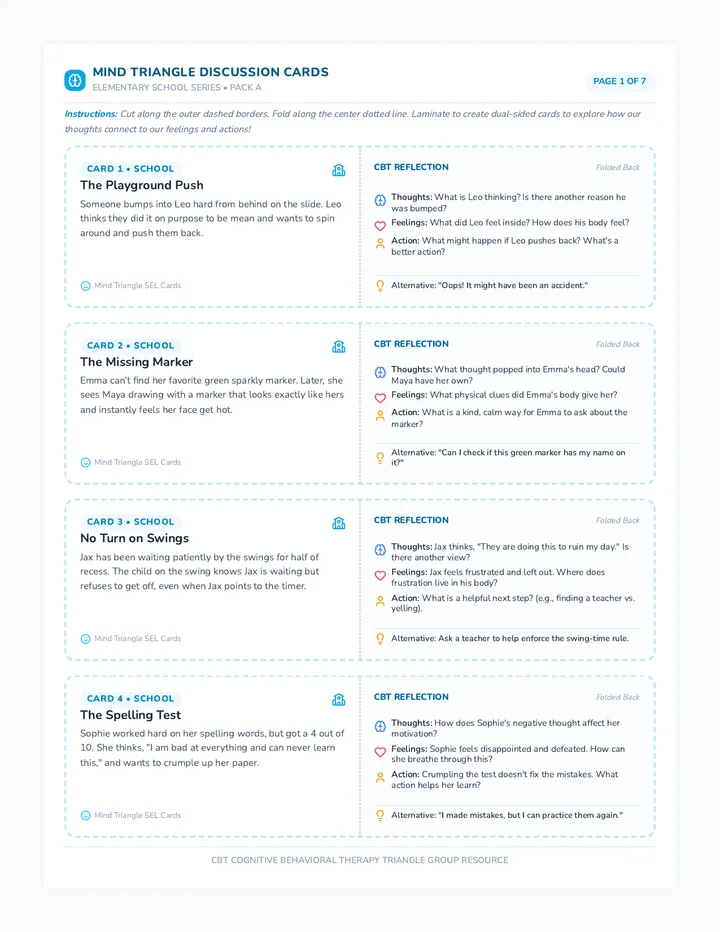
Pairs distribute Sort-It Scenarios cards.
Students sort into three piles: conflict, rudeness, or bullying.
Pairs craft a boundary statement for one of the bullying scenarios.
Share out 2–3 pairs' sorting results and their statements.
15
Mins
Independent Practice: Personal Mapping
Hand out My Boundary and Help Map .
Students write one personal boundary statement and list their support network (2 adults, 1 peer).
Encourage using phrasing from the When to Involve Adults Protocol .
5
Mins
Wrap-Up & Check-In
Volunteers share boundary statements and help maps.
Key Digital Tip: Emphasize "Think before you click or type."
Accommodations & Support
Provide sentence stems for boundary statements.
Offer scenario visuals or read-aloud support.
Pair English learners with supportive peers.
Allow extra time for Help Map completion.
Boundary and Bullying Visual Guide Slides Social Emotional Learning
Drawing
the Line
Building skills to recognize conflict, rudeness, and bullying—and setting boundaries face-to-face and online.
Teacher Note: Use this deck during the Direct Instruction portion of the lesson.
Learning Objectives
Distinguish between conflict, rudeness, and bullying
Define and respect personal boundaries
Identify examples in person vs. online
Learn when and how to ask for help
Playground Disagreement
Video Placeholder
(Insert your cartoon clip depicting a disagreement here. After watching, ask the class: "Is this conflict, rudeness, or bullying?")
Conflict
What is Conflict?
A natural disagreement or argument where both people have equal power and no one is trying to hurt repeatedly.
"We both want the same thing, and we're figuring it out."
Rudeness
What is Rudeness?
Disrespectful or impolite behavior—like rolling eyes or name-calling—but not part of a repeated pattern.
"That was mean, but it's not a regular thing."
Bullying
What is Bullying?
Repeated, intentional harm or teasing where the bully has more power (physical, social, or online).
Repeated + Power Imbalance
Personal Boundaries
A boundary is what you are comfortable with—your personal space, your feelings, and your privacy.
Boundaries help you feel safe and respected.
In-Person Examples
Conflict
Two friends argue over whose turn on the swing it is.
Rudeness
One child shoves in line without saying "excuse me."
Bullying
A group repeatedly pushes someone and laughs when they cry.
Online Examples
Conflict
Honest disagreement in a group chat about a game rule.
Rudeness
A mean comment posted once on someone's photo.
Bullying
Repeated, harassing messages or exclusion in a game.
Sort-It Scenarios Activity Sort-It Scenarios
Pair Activity
Instructions for Pairs
Cut out the 9 scenario cards below.
Sort them into three piles: Conflict , Rudeness , or Bullying .
Pick one bullying card and talk about a boundary statement you could use.
Two friends both want the same book and start arguing over whose turn it is.
Two classmates debate what game to play at recess and can’t agree.
Students disagree over rules in a board game and raise their voices but take turns speaking.
Someone rolls their eyes and says “whatever” when a classmate asks a question.
A student calls another a silly name once when feeling annoyed.
Someone cuts in line without saying “excuse me” and ignores the person behind them.
A group of students repeatedly calls a classmate a mean name every day at recess.
One student keeps pushing another in the hallway and laughs when they fall.
A classmate spreads a mean rumor about someone on a group chat and sends it multiple times.
Practice Your Boundary Statement
Choose one of the Bullying cards. What could someone say to set a boundary?
Write your statement here...
Conflict
Pile Label
Rudeness
Pile Label
Bullying
Pile Label
My Boundary and Help Map Worksheet My Boundary and Help Map
Independent Practice Worksheet
Name:
Date:
1
Personal Boundary Statement
Think of a situation where someone is making you feel uncomfortable or not respecting your space. Write one clear, respectful boundary statement you could use in that situation.
My boundary statement:
2
My Help Map
If you ever feel unsafe, upset, or unsure, it’s important to know who you can ask for help. List two trusted adults and one peer (friend or classmate).
Trusted Adult #1 (Teacher, Coach, etc.)
Who they are:
How I would ask for help:
Trusted Adult #2 (Family Member, Counselor, etc.)
Who they are:
How I would ask for help:
Trusted Peer (Friend or Classmate)
Who they are:
How I would ask for help:
Quick Tip: You can choose to talk in person, send a message, or ask for a check-in—whatever feels safest. It's okay to ask more than once if you need extra support!
When to Involve Adults Protocol Discussion When to Involve Adults
The Help-Seeking Protocol
Use this guide to decide when and how to ask an adult for help—whether you’re at school, at home, or online.
1
Assess the Situation
What happened?
Do you feel unsafe, upset, or overwhelmed?
Is the problem happening again?
Tip:
If someone's safety is at risk, get help immediately.
2
Identify a Trusted Adult
Who can help right now? (Teacher, coach, parent)
Who knows you well and takes you seriously?
Who is nearby or easy to reach?
3
Choose How to Ask
In Person:
"Mrs. Lee, can I talk to you for a minute?"
Note or Message:
"I need help with something making me upset."
4
Reflect and Follow-Up
Did the adult listen and make a plan?
Do you need more help? (Ask again or try someone else)
Discussion Questions
What makes a person “trusted”? What qualities do you look for?
How might you feel nervous and still decide to ask for help?
Why is it important to be clear about what you need when asking for help?
How could you help a friend use this protocol if they were struggling?
Application: Scenario Practice
Scenario A
A classmate keeps sending mean messages in the group chat.
Scenario B
Someone shoves you in line at lunch and calls you a name.
Scenario C
You see a friend looking upset after reading something online.
For your scenario: Decide if you need help, pick a trusted adult, and script what you would say.