Impulse Heroes Teacher Guide Impulse Heroes
6-Week Curriculum Overview
Target Grade 1st Grade
Unit Philosophy
First grade is a pivotal year for executive function development. "Impulse Heroes" reframes self-control from a "don't do that" mindset to a "superpower" mindset. Students learn that their brain has a "Pause Button" and "Focus Flash" powers to help them make better choices.
The 6-Week Journey
1
Pause Power
The Stoplight Method: Stop, Think, Act. Introducing the "Pause Button" concept.
2
Focus Flashers
Developing attention and concentration. Identifying "Distraction Villains" and using "Focus Flash" eyes.
3
Talk and Track
Conversational turn-taking. Using a "Talking Stick" and practicing active listening.
4
Fair Play Friends
Waiting for turns in games. Dealing with the impulse to go first or win every time.
5
Body and Wait Bosses
Personal space and patience. Combining "Body Bubbles" with waiting strategies for transitions.
6
Hero Graduation
Review, role-play challenges, and awarding Hero Certificates.
Lesson 2: Focus Flashers
Goal: Master Concentration & Resist Distractions
Key Vocabulary
Focus: Putting all your brain-power on one thing.
Distraction: A villain that pulls your brain away.
Focus Flash: Quick refocusing power!
Materials Needed
Lesson 2 Slides, "Distraction Villain" Worksheet, Magnifying glass (optional).
Activity: The Distraction Duel
Task: Have students try to draw a simple shape while you make silly (but not too loud) noises or walk around.The Flash: If they feel distracted, they must tap their temple and whisper "Focus Flash!" to bring their brain back.Check-in: Ask: "Was it hard to keep your eyes on the paper? How did you bring your brain back?"
Discussion Prompts
Pause Power Slides Impulse
Heroes
Training Mission 1: Pause Power
What is an Impulse?
An Impulse is a "RIGHT NOW" feeling to do something.
Examples:
Shouting out an answer
Grabbing a toy
Running in the hall
My Stoplight Brain
STOP
Don't do it yet! Take a breath.
THINK
What will happen if I do this?
ACT
Make the best choice.
Hero Challenge!
Can you use your Pause Button when I say a silly word?
Wait for the signal...
Pause Power Worksheet Pause Power!
Training Mission #1
Hero Name:
Date:
Hero Mission: Color the stoplight. Then, draw a picture of a time you need to use your Pause Button !
1
STOP
Take a deep breath.
2
THINK
What is a good choice?
3
ACT
Be an Impulse Hero!
I can use my Pause Button when...
Draw your picture above!
How many breaths should you take when you STOP?
1 breath
3 breaths
100 breaths!
Talk and Track Slides Talk and
Track
Training Mission 2: Conversation Turns
The Hero's Talking Stick
How it works:
1 Only the Hero holding the stick may speak.
2 Everyone else uses their "Listening Ears."
Pass the stick gently.
Watch out for... BLURT ALERTS!
The Shouter
"I know! Pick me! Me me me!"
The Interrupter
Starts talking while someone else is speaking.
The Space Raider
Gets too close while waiting to speak.
Hero Tracker
A Hero uses their eyes to track who is speaking.
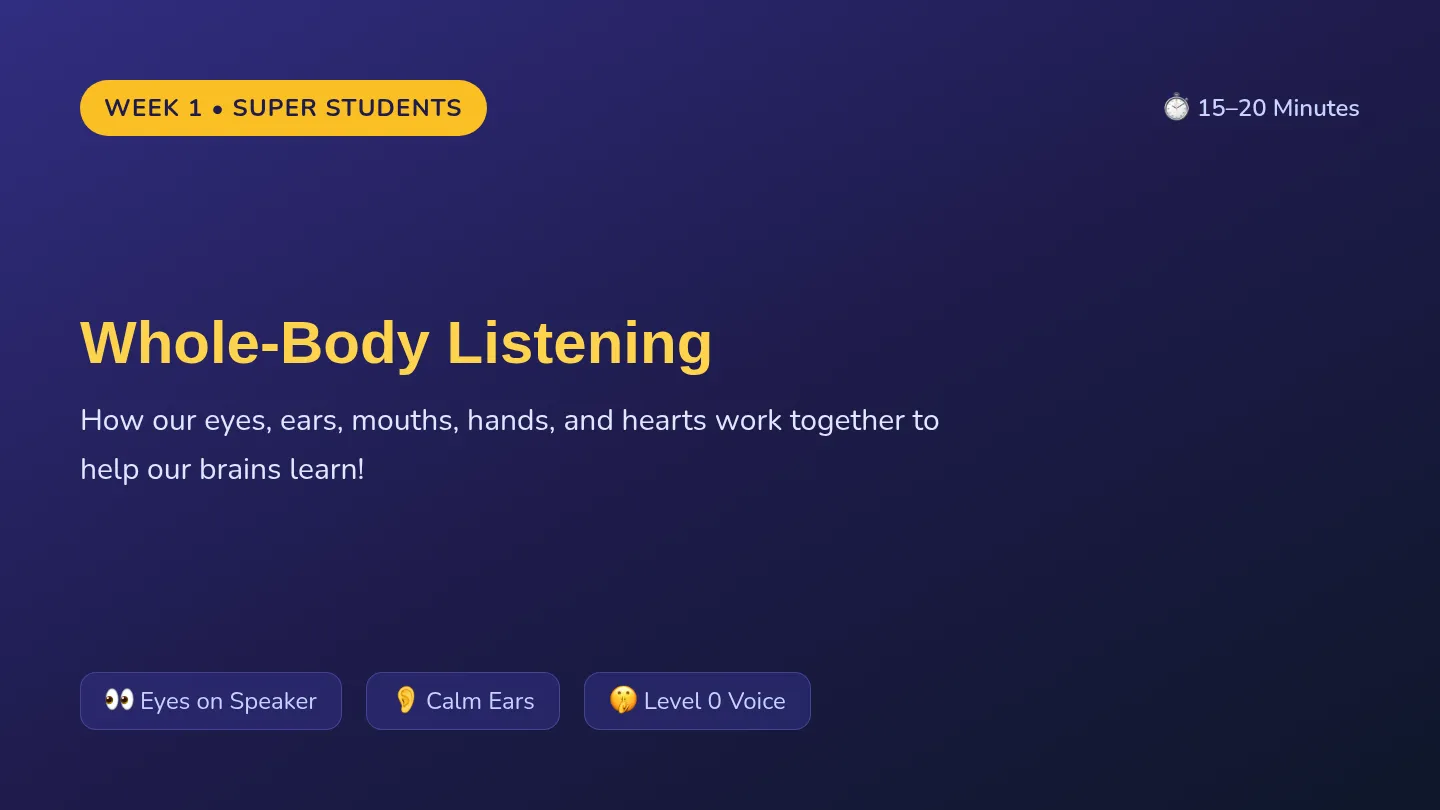
Eyes on Speaker
Ears Open
Quiet Mouth
Hero Discussion Cards Activity Hero Discussion Cards
Turn-Taking Practice
MISSION #2
Teacher Note: Cut these cards out. Give one Hero the "Talking Stick" (a ruler or marker). Use these cards to prompt short discussions. When the stick is passed, the speaker changes. Everyone else "Tracks" the speaker!
Topic 1:
If you could have any flavor of ice cream right now, what would it be?
Wait for the stick
Topic 2:
What is your favorite animal? Why do you like it?
Wait for the stick
Topic 3:
What is the coolest thing you have ever drawn or painted?
Wait for the stick
Topic 4:
If you could fly a rocket ship anywhere, where would you go?
Wait for the stick
Self-Check:
I Waited
I Tracked
I Listened
Fair Play Friends Slides Fair Play
Friends
Training Mission 3: Game Time Turns
The "Me First" Monster
Sometimes an impulse tells us:
"I HAVE TO GO FIRST!"
"I HAVE TO WIN!"
"MY TURN IS NOT OVER!"
Hero Strategy:
"I can wait. My friends' turns are important too!"
1
2
3
Hero Game Rules
Wait the Rotation
Wait for everyone else to go before it's your turn again.
Cheer for Friends
Being a Hero means being happy for others when they do well!
Time to Switch
When the timer dings, we pass the toy or the controller.
Good Game
Always say "Good Game" whether you win or lose.
What should a Hero do?
"Your friend is playing with the toy you want. They have been playing for a long time."
Choice A
Grab it from them!
Choice B
Use words: "Can I have a turn next?"
Fair Play Friends Journal My Fair Play Journal
Training Mission #3
Impulse Hero:
A time I shared a turn...
Draw a picture of you and a friend sharing a toy or game.
I shared my turn with _________________________.
It made me feel _________________________________.
Hero Game Check
I waited my turn.
I used kind words.
I said "Good Game."
I was happy for my friend.
Body Bosses Slides Body
Bosses
Training Mission 4: Personal Space
My Hero Body Bubble
Every Hero has a Body Bubble.
It is the space around you that belongs to YOU!
The Golden Rule:
"Hands to myself!"
Stop the Poke!
Wait... don't do it!
The impulse to poke or touch a friend while waiting in line.
The impulse to fidget or kick your feet while sitting on the carpet.
Hero Power:
"I am the Boss of my hands and my feet!"
Hero Space Check
How far away should we stand in line?
Too Close
One Hero Arm Length
Patience Pros Slides Patience
Pros
Training Mission 5: Waiting Strategies
When is waiting hard?
In the Hallway
"I want to run and be first in the cafeteria!"
For a Snack
"My tummy is growling and I want it NOW!"
Waiting for Teacher
"I have a question and I can't wait to ask!"
For a Toy
"I've been waiting for 100 years!"
Patience Power-Ups
The Cool Down
Take 3 deep, slow breaths. Blow out the "Rush."
The Count Up
Count slowly to 10 in your head. 1... 2... 3...
Pocket Hands
Put your hands in your pockets or clasp them together.
Hero Mantras
Repeat after me to get your Patience Power!
"I can wait, I'm doing great!"
"I'm the boss of my rush!"
"My turn will come soon!"
Patience Pros Toolbox Worksheet The Wait-Time Toolbox
Training Mission #5
Hero:
Match the Hero Strategy!
Draw a line from the Problem to the best Hero Tool .
My tummy is growling and I want lunch!
I have to wait in a long line for the slide.
I am so excited to tell my story to the class!
Take 3 Slow Breaths
Count slowly to 10
Say: "I can wait, I'm doing great!"
What do YOU do when you wait?
Draw your own patience tool here!
Hero Graduation Slides Hero
Graduation
Final Mission: Review & Celebrate
Our Superhero Skills
Pause Power
Stop, Think, Act.
Focus Flash
Brain Flashlight.
Talk & Track
Listening turns.
Fair Play
Game turns.
Wait Boss
Body & Patience.
The Ultimate Hero Test!
"Someone is tapping their pencil loudly during work time. Your brain wants to look at them!"
Which power do you use?
Focus Flash!
Hero Status: ACHIEVED
You are now official Impulse Heroes!
"I use my Focus and Pause Power every day!"
Impulse Hero Graduation Certificate Impulse Hero
Certified Superpower
Presented to the Hero known as:
For mastering the powers of Pause, Focus, and Fair Play!
Pause
Focus
Talk
Play
Boss
Hero Mentor
Mission Date
Focus Flash Slides Focus
Flashers
Training Mission 2: Attention Power
What is Focus?
Focus is like a flashlight in your brain.
You point your light at one thing and keep it there!
Beware: The Distraction Villains!
Noisy Ned
Makes noises that pull your ears away.
Moving Mary
Walks past and pulls your eyes away.
Daydream Dan
Pulls your thoughts into a dream world.
Hero Power: Focus Flash!
When a villain tries to steal your focus, do this:
1
Notice
2
Breathe
3
Flash Back!
Focus Flash Worksheet Focus Flashers!
Training Mission #2
Hero Name:
Hero Mission: Color the Distraction Villains that pull your brain away. Then, draw your Focus Flash light shining on your work!
Color the Villains:
Noisy Ned
Window Bird
Daydreamer
My Focus Flash is shining on...
Draw yourself working with your "brain flashlight" on!
When I lose my focus, I can say:
"FOCUS FLASH!"
Body and Wait Bosses Slides Wait &
Body Bosses
Training Mission 5: Body Control & Patience
Hero Body Bubbles
A Body Boss keeps their hands and feet in their own bubble.
"Hands to myself!"
Waiting is a Superpower!
The Cool Down
3 slow breaths.
The Count
1 to 10 in your head.
Pocket Hands
Keep 'em safe!
Wait Boss Challenge
"You are in line for the water fountain. Someone is taking a LONG drink."
"I can wait, I'm doing great!"
Friendship Architects Teacher Guide Friendship Architects
6-Week Social-Emotional Curriculum
Target Grade 5TH GRADE
Project Mission
As 5th graders prepare for middle school, social dynamics become increasingly complex. Friendship Architects uses the metaphor of construction to help students understand that healthy relationships aren't accidental—they are built with intention, maintained with care, and repaired with skill.
Core Goals
Sustain long-term connections
Resolve conflicts independently
Evaluate peer influences
Navigate digital social spaces
Phase Breakdown
Week 01
Building Foundations
Identifying "Structural Values" (loyalty, trust, humor) and practicing "Outreach Blueprints" for new friendships.
Week 02
Structural Support
Maintenance tasks: active listening, being reliable, and the "Social Check-in" technique.
Week 03
The Choice Blueprint
Analyzing social pressure. Using the "Structural Strength Test" to evaluate choices before acting.
Week 04
Renovation & Repair
Conflict resolution framework. Sincere apologies and rebuilding "Safety Walls" after a misunderstanding.
Week 05
Digital Design
Applying architectural principles to texting, gaming, and social media. The "Delete" button vs. the "Send" button.
Week 06
Grand Opening Ceremony
Final project showcase, graduation, and creating a personal "Future Blueprint" for Middle School social life.
Architect's Guide: Facilitation
Core strategies for the 5th Grade developmental stage.
Group Dynamics
5th graders are often highly attuned to status and cliques. Use heterogeneous grouping to break down existing barriers. Emphasize that "Architects" collaborate with everyone on the site.
Common Pitfalls
• Over-Correction: Avoid lecturing. Use the "Scenario Lab" to let them analyze choices first.
• Exclusivity: Address the "Best Friend" trap. Focus on building a broad "Friendship Portfolio."
Weekly Anchor Routine
1
The Inspection Self-reflection on the previous week's "social construction."
2
The Blueprint Direct instruction on the new skill/concept.
3
Scenario Lab Collaborative role-play or problem-solving.
Building Foundations Slides Building
Foundations
Friendship Architects: Mission 01
Structural Integrity
A skyscraper can only go as high as its foundation is deep.
The Question:
"What are the 'materials' we need to build a strong friendship?"
Trust
Loyalty
Honesty
The Outreach Blueprint
01
Site Survey
Observe! Find someone with a common interest (a book, a shirt, a game).
02
First Contact
The "Structural Question." Ask about their day or what they are doing.
03
Load Test
Follow up! Use their name and remember something they said earlier.
Scenario Lab
Construction Conflict
"You see someone in your class playing a card game you love, but you don't know them very well. Your brain says 'they probably won't want to talk to me.'"
How do you use your Outreach Blueprint here?
Foundation Survey Worksheet Foundation Survey
Project Phase 01: Core Values
Lead Architect:
Project Date:
1
Structural Materials
In the construction of a friendship, Core Values are the materials you use. If you use weak materials, the friendship might fall apart during a storm.
Top 3 Materials
Write down the 3 qualities you think are MOST important in a friend.
Quality Inspector's Tip
Think about "Hidden Structural Values." Someone might be funny (which is great!), but are they also reliable? High-quality friends are consistent.
2
Site Survey (Action Plan)
Mission: The New Connection
Think of someone in your grade you don't know very well yet. Plan your "Outreach Blueprint" below.
Architect's Observation (Site Survey)
What is one thing you've noticed you have in common? (e.g., "They read the same book series as me.")
The Structural Question (First Contact)
What is a specific question you could ask them to start a conversation?
Structural Support Slides Structural
Support
Friendship Architects: Mission 02
Maintenance
Construction
Making the friend. Starting the project. The "New Friend" feeling.
Maintenance
Keeping the friend. Showing up. Doing the small things over and over.
The Social Check-In
Ask
"How was your practice?"
Listen
No phone. Eyes on them.
Follow Up
"Wait, what happened next?"
Structural Warning
Which of these causes a friendship to collapse?
Being a "Fair Weather" Friend
Ignoring texts for days
Only talking about yourself
Breaking small promises
Structural Support Log Worksheet Maintenance Log
Project Phase 02: Structural Support
Lead Architect:
1
The Reliability Test
Structural support in a friendship is built on Reliability. Reliability means doing what you said you would do, even if you don't feel like it anymore.
Architect's Self-Inspection
I respond to messages within a reasonable time.
Always
Sometimes
Rarely
I keep secrets that friends tell me in private.
Always
Sometimes
Rarely
I show up when I say I will (meetings/calls/play).
Always
Sometimes
Rarely
I defend my friends if others are being mean.
Always
Sometimes
Rarely
2
Social Check-In Practice
The Follow-Up Challenge
Maintaining a friendship means remembering the small things. Choose a friend you want to "check in" with this week.
What is one thing they told you recently?
(e.g., A big game, a family trip, a project they were nervous about)
What is your follow-up script?
Write exactly how you would ask them about it.
The Choice Blueprint Slides The Choice
Blueprint
Friendship Architects: Mission 03
Social Pressure
In architecture, Pressure is a force that pushes on a building.
Peer Pressure:
When your friends push you to make a choice you aren't sure about.
Pressure
The Structural Strength Test
Ask these 3 questions before you build the choice:
Safe?
Could someone get hurt (physically or emotionally)?
Values?
Does this match who I want to be?
Truth?
Would I be okay if my teacher or family saw me do this?
Choice Lab
"A group of friends is teasing a new student behind their back. They look at you and say, 'Don't you think their shoes are weird too?'"
How do you resist the pressure?
The Choice Blueprint Worksheet Strength Test
Project Phase 03: Positive Choices
Lead Architect:
1
My Structural Values
Before you can make a good choice, you need to know your Foundation Values. These are the rules you live by, no matter what others are doing.
Kindness
Integrity
Inclusion
Honesty
Respect
Courage
Check the 3 values that are MOST important to you.
2
Structural Strength Lab
Pressure Scenario Analysis
"Your group of friends wants to exclude a classmate from a game at recess because they aren't 'cool' enough. They look at you and say, 'You're on our side, right?'"
Which of your values does this push against?
Your Structural Response (Resistance Script):
What exactly would you say to stay true to your values?
Renovation and Repair Slides Renovation
& Repair
Friendship Architects: Mission 04
Social Damage
In a building, cracks happen when the structure is under too much stress.
In Friendships:
"Cracks are misunderstandings, hurt feelings, or broken trust."
STRESS
The Architect's Repair Toolkit
Direct Talk
"I felt [feeling] when [action] happened." No guessing games.
Sincere Apology
Own it. No "I'm sorry IF you felt..." Say "I'm sorry FOR my [action]."
Time to Set
Like concrete, trust takes time to harden again. Be patient.
Restoration Project
"You accidentally told a secret your friend asked you to keep. Now they aren't talking to you."
What is your first repair move?
Renovation and Repair Worksheet Repair Log
Project Phase 04: Renovation & Repair
Lead Architect:
1
Damage Assessment
Case Study: The Broken Beam
"Riley and Sam are working on a project. Sam makes a joke about Riley's drawing in front of others. Riley feels embarrassed and stops talking to Sam for the rest of the day."
Identify the Damage:
Sam's Repair Strategy:
2
The Sincere Apology Blueprint
A strong repair needs high-quality ingredients. Fill in the blueprint below for a time you might need to apologize.
I
Ingredient 01: Admit the action
"I am sorry for..." (Write exactly what you did)
II
Ingredient 02: Validate the feeling
"I know that made you feel..."
III
Ingredient 03: The Fix
"In the future, I will..."
Digital Design Slides Digital
Design
Friendship Architects: Mission 05
Virtual Space
Digital spaces (texts, games, social media) are like remotely built structures.
The Challenge:
"It is harder to see the 'damage' we cause when we aren't face-to-face."
The Digital Load Test
Before you press 'Send', run this check:
Public Park?
Would I say this in a public park with everyone watching?
Tone Survey
Is it easy to misunderstand? (Sarcasm is hard to 'build' online).
Permanent?
Is this a structure I want to exist forever? (Screen caps are real!)
The Group Chat Lab
"A friend posts a funny photo of another classmate in your group chat. Everyone is replying with 'LOL' and laughing emojis. You know that person would be upset if they saw it."
How do you show Integrity in this chat?
Digital Design Worksheet Digital Design Log
Project Phase 05: Virtual Spaces
Lead Architect:
1
The Emoji Tone Check
In digital design, Tone is hard to build. Without hearing your voice or seeing your face, your "social structure" can easily lean the wrong way.
Scenario: The Text Message
"Thanks for the invite."
Tone A: They are genuinely happy to be invited.
Tone B: They are being sarcastic because the invite was late.
How could you use your Digital Design skills to make the tone clear?
Design Rule:
"If a message could be taken two ways, always assume the KIND way—or ask for a face-to-face inspection!"
2
Permanent Structures
Site Safety Plan
List 3 things you will never build in a digital space (e.g., gossip about Sam).
Grand Opening Ceremony Slides Grand
Opening
Friendship Architects: Finale
Portfolio Review
Foundations
Values & Maintenance
Choices
Resisting Pressure
Repairs
Apologies & Trust
Digital
Virtual Integrity
Future Blueprint: Middle School
Expansion Phase
Middle school is a bigger "site." You will meet hundreds of new people.
"Keep your foundations strong, but build new rooms!"
The Architect's Motto
"I am the architect of my social life. I choose who I build with."
Final Challenge
"Go out and tell one classmate something you appreciate about their 'friendship foundation'."
Architect Status Achieved
Architect License Certificate Certificate of Completion
Licensed Architect
Social Foundations & Choice Design
This license is officially granted to:
Architect of Healthy Connections
For demonstrating expert skill in Building Foundations, maintaining structural support, making positive Social Choices, and performing high-quality relationship repairs.
Senior Project Mentor
Approved FRIENDSHIP DEPT
Certification Date
Identity Lab Teacher Guide True North: Identity Lab
5th Grade SEL Curriculum Guide
The Mission
As students approach adolescence, the question "Who am I?" moves to the forefront. The Identity Lab provides a safe, structured environment to deconstruct identity into manageable components: values, strengths, mindset, and self-talk. By the end of Week 6, students will have a "True North Map" to guide their choices in middle school.
Weekly Lab Schedule
01 Point Zero: What makes up an identity? Internal vs. External.
02 Strength Analysis: Character traits and talent identification.
03 Mindset Mechanics: The science of growth mindset.
04 04 Signal Decoding: Catching and reframing the "Inner Critic."
05 Authenticity Test: Real self vs. Social filters.
06 The Reveal: Final portfolio and graduation ceremony.
Lab Standards
Identify 5 personal core strengths.
Differentiate between internal and external identity.
Practice 3 positive self-talk reframes.
Teacher Tip
5th graders are sensitive to peer perception. Model vulnerability by sharing your own 'Lab Reports' during group time.
Week 01
Lesson 1: Point Zero
Key Concept
Students often define themselves by what they do (sports, grades) rather than who they are . "Point Zero" focuses on the "Inner Identity"—the values and traits that stay the same regardless of what activity they are doing.
Activity: The Identity Map
Discuss the difference between "What I do" and "Who I am."
Use the Identity Map Worksheet to categorize traits.
Small Group Share: One internal trait I'm proud of.
Facilitator Questions
"If all your hobbies were taken away tomorrow, what parts of you would still be there?"
"Do people see the same 'version' of you that you see inside?"
Point Zero Slides True North
Identity Lab: Project Point Zero
The Two Layers of Identity
Outer Layer
"The things I DO and HAVE."
• Sports / Hobbies
• Grades / School
• My Clothes
• My Friends
Inner Layer
"The person I AM inside."
• My Values
• My Feelings
• My Kindness
• My Courage
Lab Inspection: Who Are You?
"If you were a book, what would your chapters be titled?"
Mission: Point Zero
We are going to map out the "ingredients" that make you Unique.
Start the Scan...
Point Zero Identity Worksheet Identity Map
Lab Report 01: Point Zero
Subject Name:
1
Identity Breakdown
Think of yourself like a planet. You have a surface (what people see easily) and a core (the deep parts of your personality).
Surface Layer
Things I DO / What I Look Like
The Core
Who I AM / My Values
2
The Unchanging Part
"If you couldn't do any of your favorite activities for a whole month, what is one thing you would still love about yourself?"
THIS IS YOUR POINT ZERO.
Strength Analysis Slides Strength
Analysis
Identity Lab: Project 02
Skills vs. Strengths
Skills
"Things I have learned to do well."
(Playing piano, coding, soccer, drawing)
Strengths
"Who I AM while I'm doing them."
(Persistence, Curiosity, Bravery, Kindness)
Common Lab Strengths
Kindness
Helping others succeed.
Integrity
Doing the right thing.
Curiosity
Always asking 'Why?'.
Grit
Never giving up.
Leadership
Helping the team.
Humor
Lightening the mood.
Strength In Action
"You are working on a difficult math problem. You don't know the answer yet."
Skill Needed:
Division
Strength Needed:
Persistence (Grit)
Strength Catalog Worksheet Strength Catalog
Lab Report 02: Strength Analysis
Lead Investigator:
1
Strength Scan
Brave
Patient
Creative
Honest
Helpful
Curious
Funny
Fair
My Top 3 Results:
2
The Evidence Lab
Proof
Choose one of your strengths. When did you show it this week?
Evidence doesn't have to be a big win—it can be a small choice.
S
My Strength:
E
The Evidence:
Mindset Mechanics Slides Mindset
Mechanics
Identity Lab: Project 03
The Mindset Shift
Fixed Mindset
"I'm either good at it or I'm not."
Mistakes = I'm not smart.
Growth Mindset
"My brain is a muscle that gets stronger."
Mistakes = I'm learning.
The "Yet" Engine
YET.
This tiny word is the most powerful Identity Upgrade you can ever install.
Upgrade Lab
"I'm not good at math."
"I'm not good at math yet."
Mindset Upgrade Worksheet Mindset Upgrade
Lab Report 03: Mindset Mechanics
Subject:
1
Brain Muscle Scan
Growth mindset means believing that your ability can be increased through effort. It's like lifting weights for your brain.
Fixed to Growth: Upgrade Challenge
Rewrite the Fixed Mindset statements into Growth Mindset statements using "YET" or effort-based words.
"This is too hard. I'll never get it."
Upgrade:
"I'm just not a natural at sports."
Upgrade:
"I made a mistake. I'm so embarrassed."
Upgrade:
2
The Struggle Lab
What is one thing you are currently struggling with?
Describe the "muscle burn" your brain is feeling right now.
Growth Plan: One thing I can try next is...
Signal Decoding Slides Signal
Decoding
Identity Lab: Project 04
The Inner Radio
Your brain is constantly broadcasting a Self-Talk Signal.
The Question:
"Is your radio playing a song that helps you, or static that hurts you?"
Decoding the Signal...
Identify the Broadcaster
The Inner Critic
"You're going to fail."
The Inner Champion
"You've handled this before."
Signal Re-Routing
"I'm so stupid for making that mistake."
"I'm learning. Mistakes are just data."
Master your broadcast!
Signal Tracker Worksheet Signal Tracker
Lab Report 04: Signal Decoding
Technician:
1
Intercepting Static
We all have an Inner Critic that plays static in our minds. To fix the signal, we have to catch it first!
Static Intercept Log
What is one "mean" thing your Inner Critic said to you today?
When does the Critic usually broadcast? (e.g. Test days, social time)
2
Inner Champion Frequency
Reframe the Signal! Pick a common negative thought and rewrite it in the "Champion Voice."
"I'll never be as good as [Name] at [Activity]."
My Personal Power Phrase:
What is one sentence you can tell yourself whenever you feel self-doubt?
The Authenticity Test Slides The Authenticity
Test
Identity Lab: Project 05
Social Filters
The "Filtered" Me
Showing only the highlights. Hiding mistakes. Acting like everyone else.
(Social Media, Fitting In)
The "Authentic" Me
Showing my real interests. Being honest about my feelings. My True North.
(Authenticity)
The Distortion Effect
Sometimes, the pressure to Fit In distorts our True North.
"Are you choosing because YOU like it, or because THEY like it?"
Unmasked
Authenticity isn't about being perfect.
Lab Challenge:
One interest I have that I don't always share is...
Authenticity Scan Worksheet Authenticity Scan
Lab Report 05: The Authenticity Test
Lead Architect:
1
Spotting the Filters
Distortion Alert: The Chameleon
"A Chameleon is someone who changes their personality depending on who they are with just to fit in."
Have you ever felt like a Chameleon?
Yes
No
Sometimes
Authenticity Check: The Compass
"A Compass is someone who stays the same, even when the group is heading in a different direction."
What helps you be a Compass?
2
Unfiltered Interests
What is something you truly love doing or learning about, even if it's not "cool" or popular?
Drawing this in your Identity Portfolio shows you aren't afraid to be Authentic.
(Sketch or write about your authentic interest here)
The Reveal Final Slides The Reveal
Identity Lab: Final Exhibition
Identity Portfolio Review
Core Values
My unchanging Point Zero.
Strengths
Character traits in action.
Growth Mindset
The Power of Yet.
Self-Talk
Mastering the inner champion.
"Be yourself; everyone else is already taken."
Authenticity Achieved
Mission Complete
You have the data. You have the mindset.
Certified Identity Scientist
Identity Scientist Certificate Laboratory Certification
True North
Expert in Identity Science
This certification is awarded to:
Verified Authenticity Investigator
For completing 6 weeks of deep analysis into Core Strengths, mastering the Power of Yet, and successfully reframing the signal of the Inner Champion.
Lead Lab Instructor
Certified ID LAB DEPT
Discovery Date