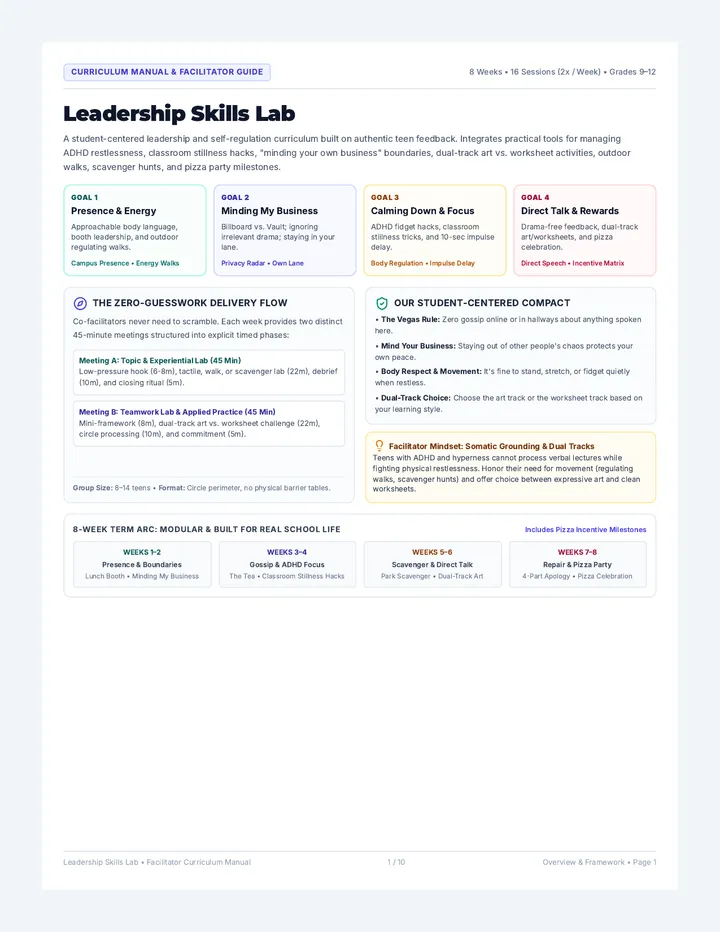
An 8-week transition and career curriculum designed for 11th-12th grade students entitled Life After Logos. Includes a comprehensive Facilitator Guide emphasizing motivational interviewing and two volumes of structured student workbooks covering assessments, pathways, and adult responsibilities.
Immediate financial income, real-world experience, no academic stress.
Potentially lower initial wages, fewer pathways for rapid promotion.
Your Personal Pathway Evaluation
Select the two pathways you are most curious about and evaluate them below:
PATHWAY A:
_______________________________
What excites me about this?
My biggest concern/question:
PATHWAY B:
_______________________________
What excites me about this?
My biggest concern/question:
LIFE AFTER LOGOS STUDENT WORKBOOK • VOL. 1 PAGE 2
STUDENT WORKBOOK • VOL. 1
WEEK 3: MY STORY ON PAPER
NAME: ____________________________
DATE: ____________________________
You don't need a formal 10-year career history to build an impressive resume. Your hobbies, household responsibilities, team sports, and volunteering show critical transferable skills.
1. Transferable Skill Inventory
Check the boxes that represent skills you use in daily life, chores, or hobbies:
Coordination / Scheduling
Managing family routines or club schedules.
Active Problem-Solving
Fixing software, cars, or resolving team conflicts.
Punctuality & Stamina
Showing up early for demanding athletic sessions.
Client/Customer Care
Helping neighbors, pet-sitting, or tutoring peers.
2. My First Resume Draft Scaffold
RESUME OUTLINE WRITE DIRECTLY BELOW
Professional Objective Statement
Briefly outline your core strengths and your immediate post-secondary target:
Key Experience (Work, Volunteering, Sports, Family Responsibilities)
Role & Organization:
Bullet Action Point (What you did):
Role & Organization:
Bullet Action Point (What you did):
LIFE AFTER LOGOS STUDENT WORKBOOK • VOL. 1 PAGE 3
STUDENT WORKBOOK • VOL. 1
WEEK 4: HIGHER ED BLUEPRINT
NAME: ____________________________
DATE: ____________________________
Let's pull back the curtain on collegiate terminology and deadlines. Understanding how application pipelines work will protect you from unexpected surprises.
1. Navigating Collegiate Jargon
Connect the concepts with their practical real-world meaning below:
CONCEPT A
FAFSA Application
The federal form used to determine your eligibility for financial aid, grants, and work-study.
CONCEPT B
Associate Degree
A 2-year higher education program typically offered at community or junior colleges.
CONCEPT C
Grants vs. Student Loans
Grants represent gift money you do not pay back; loans represent money you must pay back with interest.
CONCEPT D
Academic Credits
Units of value assigned to college courses. You accumulate these to earn your formal diploma.
2. My Pathway Milestones & Dates
Outline the physical steps and timeline requirements for your plan:
STEP 01
Submission Deadlines
When must your application be officially filed?
STEP 02
Financial Planning
Key dates for FAFSA or private scholarships:
STEP 03
Required Documents
Identify letters of support & school transcripts:
3. My Next Immediate Action
What is the single most important document you need to track down this week?
LIFE AFTER LOGOS STUDENT WORKBOOK • VOL. 1 PAGE 4
Your work supervisor schedules you for hours that directly conflict with your trade school classes, even though you provided your availability weeks ago.
Your Action Plan (How do you handle this professionally?):
LIFE AFTER LOGOS STUDENT WORKBOOK • VOL. 2 PAGE 2
STUDENT WORKBOOK • VOL. 2
WEEK 7: INTERVIEW SIMULATOR
NAME: ____________________________
DATE: ____________________________
Let's practice the art of presenting your narrative. Work in pairs to run the mock interview below. Use the feedback matrix to document positive attributes.
1. The 60-Second Professional Pitch Blueprint
Draft your short, powerful introduction below using our structural prompts:
PRESENT STATE
Who are you and what are you doing?
PAST RELEVANCE
What skills or classes did you master?
FUTURE PATHWAY
What role/study are you targeting?
2. Peer Mock Interview Feedback Matrix
Let your mock partner interview you, then have them complete your evaluation below:
My Partner's Bright Spot Rating
Which area was my biggest strength during the simulation?
Clear and confident eye contact
Structured answers (Beginning, Middle, End)
Highlighting authentic transferable skills
Constructive Reflection Box
What is one specific trick or tip we discussed for future growth?
LIFE AFTER LOGOS STUDENT WORKBOOK • VOL. 2 PAGE 3
STUDENT WORKBOOK • VOL. 2
WEEK 8: MY LAUNCH PLAN
NAME: ____________________________
DATE: ____________________________
Congratulations! You have completed the 8-week Life After Logos journey. Below, construct your official personal post-secondary blueprint with concrete milestones.
Write down three micro-goals you can actually complete in the near future:
IMMEDIATE (NEXT WEEK)
Micro-Goal 1
MEDIUM RANGE (NEXT MONTH)
Micro-Goal 2
LONG RANGE (3-6 MONTHS)
Micro-Goal 3
3. My Support Circles & Accountability Partnership
Who is a trusted adult/friend to share this plan with?
What is my plan if I hit an unexpected obstacle or fear?
LIFE AFTER LOGOS STUDENT WORKBOOK • VOL. 2 PAGE 4
FACILITATOR SCORING MATRIX
Sum Likert points (Pre vs. Post) to measure the raw transition-readiness delta.
PRE: _____ / 30
POST: _____ / 30
DELTA: _____ pts
LIFE AFTER LOGOS TRANSITION PROTOCOL PAGE 2
Session 8: Concrete Milestones & Launch Map
SLIDE 05
ADA DISABILITY LAW
High School IEP vs. Adult ADA
High school IEP accommodations are legally mandated and monitored by the school. In adult workplaces and colleges, the student is responsible for requesting support from accommodations officers or HR.
2. Practical Independence Milestone Checklist
Support your student as they check off these fundamental real-world benchmarks:
Primary Documents
Locate and store their Social Security Card, Birth Certificate, and State ID.
Financial Starter Pack
Open a checking account and demonstrate how a debit card operates.
Communication Practice
Have them schedule their own dental/medical visits and draft emails.
Digital Footprint
Ensure their professional email addresses and voice mail greetings are mature.
3. Low-Pressure Conversational Openers
"What feels like the most exciting part of graduating?"
"What is one thing we could practice to make you feel more ready?"