Week 1 Educator Guide WEEK 1
The Drama System
Core Focus: Mapping triggers, roles, and escalation patterns
Drama Detox Guide
Target Group: Middle & High School
Duration
45 Minutes
Skills Used
System Mapping
CBT Concept
Situation Analysis
DBT Concept
Objective Reality
Session Objective
Students will understand that school drama is a system with identifiable inputs (triggers, communication styles, and roles) rather than an uncontrollable force, laying the groundwork for clinical and behavioral interventions.
Facilitation Breakdown
01
Icebreaker: The Drama Thermometer
10 Mins
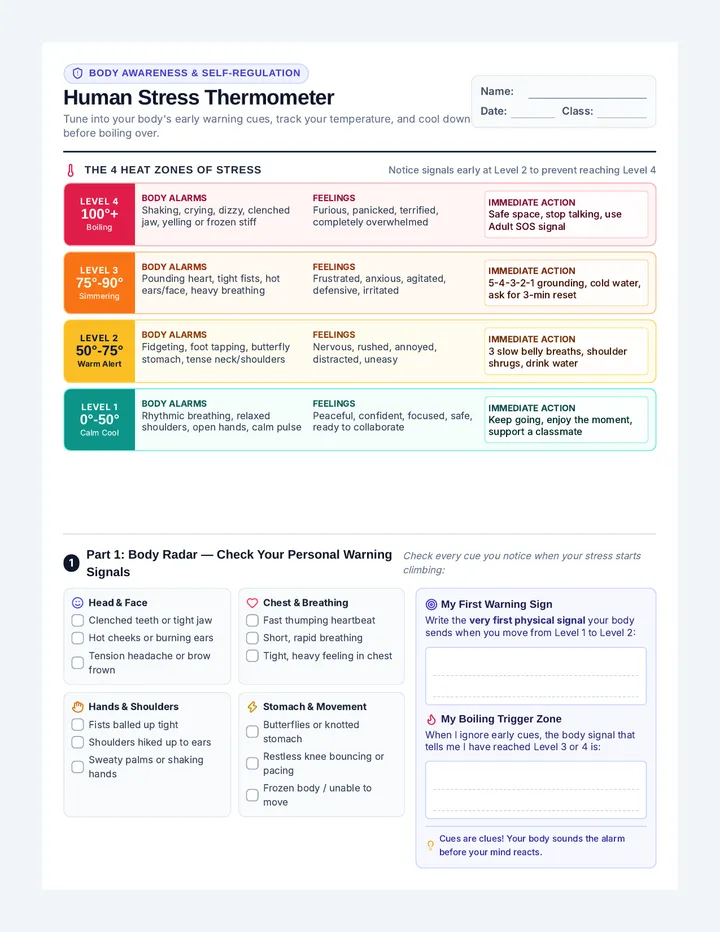
Ask students to gauge the "school-wide drama temperature" from 1 (completely calm) to 10 (extremely toxic). Discuss what behaviors cause the temperature to rise (gossip, texting, exclusion).
02
Direct Instruction: Defining the Drama Loop
15 Mins
Explain that drama is a structured system. Detail the roles: the Trigger (the spark), Communicators (who sends the message), Audience (the spectators who keep it alive), and the Escalation Patterns (unregulated reactions).
03
Group Mapping Activity: "Deconstructing the Fire"
15 Mins
Have students work in pairs to analyze a common school scenario: "A hears that B said they were copying their outfit, post a vague-book text, and C screenshots it for B." Guide them to identify the players, audience, and the moment it went out of control.
04
Clinical Reflection & Wrap-Up
5 Mins
Synthesize learning: "We can only change the system if we recognize which role we are playing in it." Hand out Student Workbook Page 1.
Suggested Facilitator Script
"When we think of drama, we often think of it as a storm that just randomly hits us. In this group, we're going to think like social scientists. Drama isn't magic; it's a machine. It requires fuel (triggers), wires (communication), and a cheering squad (the audience). If we pull just one piece out of that machine, the whole thing stops running. Today, we map the machine. Next week, we start taking it apart."
© Drama Detox Student Curriculum System Navigation • Session 1 Facilitator Material Page 1
Week 1 Student Workbook WEEK 1
The Drama Map
Deconstructing the school-ground social machinery
My Social Lab
Student Journal
Student Name
__________________________________________________
Date
__________________________________________________
System Formula: School drama is not a mysterious fog. It is a machine made of specific parts: a Trigger , Communication , and the Audience . When we identify these parts, we can stop the cycle.
Part 1: Spotting My Default Role
When drama breaks out in my friend group, what do I usually find myself doing? (Circle one)
The Broadcaster
I share updates, forward screenshots, or pass messages.
The Spectator
I watch silently, read chat threads, but stay quiet.
The Defender
I jump in to protect others, even if it adds tension.
The Escape Artist
I leave group chats, ignore messages, and hide.
Part 2: Mapping a Real Drama Machine
Think of a typical school drama scenario. Map its structure below in the writing boxes.
1. The Trigger
What started it?
Write here...
2. Transmission
How did it travel?
Write here...
3. Audience
Who kept it alive?
Write here...
4. The Peak
How did it explode?
Write here...
Reflection Prompt
If you wanted to dismantle this machine, which of the 4 stages above is the easiest to break? Explain why:
Write your explanation here...
© Drama Detox Student Curriculum Classroom System Map • Student Worksheet Page 1
Week 2 Educator Guide WEEK 2
Unmasking Mind Reading
Core Focus: CBT cognitive distortions and threat bias in text messaging
Drama Detox Guide
Target Group: Middle & High School
Duration
45 Minutes
Skills Used
Thought Catching
CBT Concept
Mind Reading Trap
DBT Concept
What is vs. What if
Session Objective
Students will learn to recognize the cognitive distortion of "Mind Reading" (assuming we know what others think without evidence) and "Personalization" (interpreting neutral events as direct attacks).
Facilitation Breakdown
01
Check-in: The Late Text Tension
10 Mins
Introduce a scenario: "You text a close friend about plans and they read it but don't reply for 4 hours." Ask students: "What is your immediate brain-story?" (e.g., They hate me, I did something wrong).
02
Direct Instruction: Mind Reading & Personalization
15 Mins
Define Mind Reading : Assuming you know someone's negative opinion of you without asking. Define Personalization : Believing neutral situations are about you. Explain how these fuel digital drama.
03
Group Activity: Translating "K."
15 Mins
Analyze neutral text messages ("K.", "Sure", "Oh cool") in group chats. Show students how the lack of tone in text makes it easy to project "threats." Work through Workbook Page 2 exercises.
04
Debrief: Asking vs. Assuming
5 Mins
Wrap up by framing the core CBT defense: "We cannot read minds. If we don't ask, we are making up movies in our heads and reacting to them."
Suggested Facilitator Script
"How many of you are licensed psychics? None of us? Then why do we spend half our school day acting like we know exactly what someone meant by their text emoji, or why they glanced at us in the hallway? Our brains have a default 'threat detector' that assumes the worst to protect us. But in school, this threat detector makes us jump to conclusions, get defensive, and ignite huge conflicts over absolutely nothing."
© Drama Detox Student Curriculum CBT Reframing • Session 2 Facilitator Material Page 2
Week 2 Student Workbook WEEK 2
Mind Reading Trap
Deactivating hallway hallucinations and text tension
My Social Lab
Student Journal
Student Name
__________________________________________________
Date
__________________________________________________
The Thought Trap: Mind Reading happens when we assume someone thinks poorly of us without any real proof. We take a neutral action (like an short text or a quick glance) and personalize it, writing a negative story in our head.
Part 1: Decoding Neutral Texts
Read the actual text received, write the Mind Reading Trap , then write 2 Alternative Explanations that are neutral.
TEXT: "K." Delivered 3:15 PM
Mind Reading (What my brain says):
They're mad at me...
Alternative Reality (2 other options):
1. They are busy driving. 2...
TEXT: "Oh. Okay." (After you cancel plans) Delivered 8:12 PM
Mind Reading (What my brain says):
They hate me now...
Alternative Reality (2 other options):
1. They are disappointed but fine...
Part 2: Classroom & Hallway Assumptions
Think of a face-to-face interaction at school that felt tense. Map it below to check for mind reading.
What Actually Happened
(E.g., They sat far away)
My Mind Reading Story
(What I assumed they thought)
How I Can Check Facts
(What can I ask them directly?)
Weekly Skill Mission
This week, if you catch your brain mind reading or personalizing, stop and ask yourself: "Do I have absolute proof, or am I writing a horror story in my head?" Check this box if you committed to try this: [ ]
© Drama Detox Student Curriculum CBT Reframing • Student Worksheet Page 2
Week 3 Educator Guide WEEK 3
Cooling the Heat
Core Focus: DBT Distress Tolerance (STOP and TIPP) during social emergencies
Drama Detox Guide
Target Group: Middle & High School
Duration
45 Minutes
Skills Used
Emotional Regulation
CBT Concept
De-escalation
DBT Concept
STOP / TIPP Skills
Session Objective
Provide students with immediate physical and cognitive emergency strategies (STOP & TIPP) to block fight-or-flight reactions when rumors, call-outs, or digital threats occur.
Facilitation Breakdown
01
Opening: Emotional Hijacking
10 Mins
Introduce the idea of "high emotional heat" (e.g., getting a direct threat text or seeing a bad post). Ask: "What happens in your body?" (Racing heart, hot face). Explain that high heat blocks logical thinking.
02
The Emergency Shield: STOP Skill
15 Mins
Teach the acronym: S top, T ake a step back (physically/digitally), O bserve (what are the facts, what am I feeling?), and P roceed mindfully. Emphasize taking a step back before hitting "send."
03
Physical Reset: TIPP Introduction
15 Mins
Explain how to hack the nervous system using TIPP : Temperature (cold water on face), Intense exercise (burst of movement), Paced breathing (box breathing), and Paired muscle relaxation. Practice Paced Breathing together.
04
Practice & Distribute Workbooks
5 Mins
Distribute Week 3 Worksheets. Instruct students to complete the personal STOP & TIPP emergency cards to carry in their wallets or save in their phones.
Suggested Facilitator Script
"When you are in a state of high emotional arousal, your prefrontal cortex—the part of your brain that makes smart decisions—literally goes offline. It's like trying to navigate school hallways with a bag over your head. If you react while your brain is offline, you will feed the drama loop. Today, we're building physical brakes for your brain. We will learn how to chill out before we blow up."
© Drama Detox Student Curriculum Distress Tolerance • Session 3 Facilitator Material Page 3
Week 3 Student Workbook WEEK 3
Cooling the Heat
Your emergency nervous-system reset button
My Social Lab
Student Journal
Student Name
__________________________________________________
Date
__________________________________________________
Part 1: My Emergency STOP Protocol
When rumors or text notifications start "heating up" your nervous system, apply the STOP formula. Personalize your emergency checklist below.
S
STOP
Freeze! Do not type, talk, or post.
My stop cue (e.g., locked lips):
T
TAKE BACK
Step away from phone/situation.
My digital exit tactic:
O
OBSERVE
What are the facts? Emotion level?
What I will ask my body:
P
PROCEED
Act calmly, stick to facts.
What is my calmest move?
Part 2: My Physical TIPP Toolkit
If your brain is too hot for thoughts, hack your body to calm down instantly. Fill out your physical strategies below.
T
Temperature Reset
Splash ice water on face, or hold an ice cube.
Where can I find ice or cold water at school?
I
Intense Exercise
Do 20 jumping jacks, or run up the stairs.
What physical burst can I do in the hall?
P
Paced Breathing
Inhale 4s, hold 4s, exhale 4s, hold 4s.
Where can I go to breathe privately?
P
Paired Relaxation
Squeeze fist tight for 5s, then release.
What muscle groups will I practice releasing?
Distress Tolerance Tracker
This week, practice using STOP or TIPP at least twice when you feel stressed (even minor academic stress count!). Log dates and times:
Practice 1: Date: _______ | Skill: ________ | Heat Level: (1-10) ____
Practice 2: Date: _______ | Skill: ________ | Heat Level: (1-10) ____
© Drama Detox Student Curriculum Distress Tolerance • Student Worksheet Page 3
Week 4 Educator Guide WEEK 4
Fact vs Friction
Core Focus: CBT Thought Challenging and evidence testing in social circles
Drama Detox Guide
Target Group: Middle & High School
Duration
45 Minutes
Skills Used
Thought Challenging
CBT Concept
Evidence Testing
DBT Concept
Wise Mind Facts
Session Objective
Students will learn to act as "defense attorneys" for their own thoughts, systematically separating concrete observable facts from social opinions, emotional assumptions, and rumors (friction).
Facilitation Breakdown
01
Icebreaker: The Classroom Courtroom
10 Mins
Read out a dramatic sentence: "Everybody saw Alex ignore Sarah on purpose because she's jealous." Ask: "In a real court of law, what parts of that sentence would a judge throw out because there is no proof?" (Everybody, ignore on purpose, jealous).
02
Direct Instruction: What is a Fact?
10 Mins
A Fact is 100% objective, observable, and indisputable (e.g., "Sarah walked past Alex"). Friction is opinions, motives, assumptions, and feelings (e.g., "She walked past because she's stuck-up").
03
Activity: The Thought Trial
20 Mins
Have students use Workbook Page 4. Present a mock social rumor. Have them identify: "What is the evidence supporting the rumor?" vs. "What is the evidence against the rumor?" Emphasize that gossip is based on zero hard evidence.
04
Session Closing & Reflection
5 Mins
Conclude: "When we separate facts from rumors, the drama dissolves because it loses its foundation. Don't believe everything you hear—or think."
Suggested Facilitator Script
"A rumor is like a house of cards. It looks big and scary, but it's held up by absolutely nothing. When someone tells you some dramatic news, or when your brain starts telling you that a friend is plotting against you, I want you to become a detective. Ask: Where is the physical evidence? If you wouldn't say it in front of a judge, it's not a fact—it's just friction."
© Drama Detox Student Curriculum CBT Reframing • Session 4 Facilitator Material Page 4
Week 4 Student Workbook WEEK 4
Fact vs Friction
Filtering social rumors with the evidence-based lens
My Social Lab
Student Journal
Student Name
__________________________________________________
Date
__________________________________________________
Part 1: The Truth Filter
Check the box to label each statement as either a Fact (observable, indisputable) or Friction (assumption, opinion, rumor).
"Sam didn't invite me to the party because they are trying to exclude me."
Fact Friction
"Taylor sent a screenshot of our conversation to three other people in a group chat."
Fact Friction
"Everybody at this school is talking about what happened at lunch yesterday."
Fact Friction
Part 2: Putting My Rumor on Trial
Think of a rumor, dramatic text, or scary social assumption you recently encountered. Write it down and put it on trial using facts.
The Social Accusation / Rumor / Assumption:
Write the rumor or assumption here...
Evidence FOR (Indisputable Facts Only):
What concrete, observable facts prove this accusation is true?
Evidence AGAINST (Facts & Alternatives):
What facts show it might NOT be true, or what are other possibilities?
The Final Balanced Verdict (The Real Truth):
Synthesize the facts into a calm, balanced thought...
CBT Thought Weapon of the Week: Before you let a rumor ruin your day or start a group chat fight, ask the person directly using neutral language, or look for 3 facts that contradict the gossip.
© Drama Detox Student Curriculum CBT Reframing • Student Worksheet Page 4
Week 5 Educator Guide WEEK 5
Speaking Up Clearly
Core Focus: DBT DEAR MAN for assertiveness and boundary setting
Drama Detox Guide
Target Group: Middle & High School
Duration
45 Minutes
Skills Used
Assertive Request
CBT Concept
Objective Style
DBT Concept
DEAR MAN Skill
Session Objective
Students will master DEAR MAN, a structured step-by-step formula to make direct requests, set clear interpersonal boundaries, and resolve peer friction without initiating defensive escalation.
Facilitation Breakdown
01
Icebreaker: The "Slam" vs. "Squeak" Communication
10 Mins
Contrast two styles of responding when someone takes your seat: "Slamming" (aggressive/shouting) vs. "Squeaking" (passive/mumbling). Explain that assertiveness is the calm "Wise Mind" middle ground.
02
Direct Instruction: Introducing DEAR MAN
15 Mins
Break down the formula: D escribe facts, E xpress feelings ("I-statements"), A ssert the boundary/request, R einforce positive outcomes, stay M indful, A ppear confident, and N egotiate.
03
Role-play & Workbook Activity
15 Mins
Pass out Workbook Page 5. Have students pick a common issue: "My friend Borrowed my sweatshirt without asking and has kept it for two weeks." Help them write their own customized DEAR MAN scripts.
04
Debrief: The Confidence Hack
5 Mins
Stress the importance of "Appear Confident": "Keep eye contact, stand tall, and keep your voice steady. People respect structured boundaries."
Suggested Facilitator Script
"When we have a problem with a classmate, we usually make one of two mistakes: either we bottle it up until we explode (passive), or we go in guns blazing, screaming accusations (aggressive). DEAR MAN is your blueprint for getting what you actually want without starting a war. It's calm, it's logical, and it's incredibly effective because it's impossible to argue with facts."
© Drama Detox Student Curriculum Interpersonal Skills • Session 5 Facilitator Material Page 5
Week 5 Student Workbook WEEK 5
Speaking Up Clearly
Drafting your custom DBT boundary-setting blueprint
My Social Lab
Student Journal
Student Name
__________________________________________________
Date
__________________________________________________
DEAR MAN Blueprint: Assertiveness is a script. Rather than shouting or staying silent, use this step-by-step clinical strategy to state your boundaries clearly and maintain peace.
Part 1: Select Your Conflict Scenario
Check one common school conflict to write your script for:
Friend borrows clothes and hasn't returned them.
Someone took a screenshot of your DM and sent it around.
A group partner isn't doing any of the research work.
Part 2: Build Your Script
Complete each box below to construct your powerful, non-confrontational message.
1. DESCRIBE (Facts Only):
"You borrowed my shirt 2 weeks ago..."
Write objective facts...
2. EXPRESS (I Feel...):
"I feel stressed because I wanted to wear it..."
Write your feelings...
3. ASSERT (Direct Request):
"Please bring it back to locker tomorrow..."
Ask directly...
4. REINFORCE (Benefit):
"Then we can move on and wear our own gear..."
Explain the mutual benefit...
Mindful
Stick to your point. Ignore baiting or sarcasm.
Appear Confident
Keep eye contact, stand tall, speak clearly.
Negotiate
Be willing to meet halfway if needed.
© Drama Detox Student Curriculum Interpersonal Skills • Student Worksheet Page 5
Week 6 Educator Guide WEEK 6
Keeping Friends Intact
Core Focus: DBT GIVE skill for empathy, active listening, and social repair
Drama Detox Guide
Target Group: Middle & High School
Duration
45 Minutes
Skills Used
Relationship Repair
CBT Concept
Perspective Taking
DBT Concept
GIVE Skill
Session Objective
Students will practice the DBT GIVE skill (Gentle, Interested, Validate, Easy manner) to keep friendships healthy, lower high social tension, and defuse gossip through active validation and non-defensive empathy.
Facilitation Breakdown
01
Opening Discussion: Friend Group Splitting
10 Mins
Ask students: "What happens when two people in a friend group fight?" (People pick sides, rumors start, the group splits). Explain that keeping individual connections healthy is the best defense against group drama.
02
Direct Instruction: The GIVE Formula
15 Mins
Explain that GIVE preserves relationships: G entle (no threats/attacks), I nterested (listen without looking at phone), V alidate ("I get why you are upset"), and E asy manner (smile, keep it light).
03
The Empathy Reset: Practice in Validation
15 Mins
Practice validation. Read out: "A friend says, 'You forgot my birthday and I'm super hurt.'" Show validation: "I can understand why you feel left out since I missed it." Contrast this with defensiveness. Use Workbook Page 6.
04
Review & Wrap Up
5 Mins
Consolidate: "Validation doesn't mean you agree you did something wrong; it means you respect their feelings. When you validate, the fight running out of fuel."
Suggested Facilitator Script
"When a friend tells us we hurt their feelings, our brain immediately screams: 'DEFEND! ATTACK!' We start yelling about what they did last month, and a tiny spark turns into an explosion. The GIVE skill is like spraying water on that spark. Instead of getting defensive, you say: 'I understand why that hurt.' Suddenly, there is nothing left to fight about. You have validated them, and the drama has completely lost its steam."
© Drama Detox Student Curriculum Interpersonal Skills • Session 6 Facilitator Material Page 6
Week 6 Student Workbook WEEK 6
Keeping Friends
Applying the DBT GIVE formula to repair and protect relationships
My Social Lab
Student Journal
Student Name
__________________________________________________
Date
__________________________________________________
The GIVE Formula: When resolving conflicts, how you treat the other person is just as important as setting your boundary. Use the GIVE skill to show respect, maintain closeness, and keep peer circles from dividing.
Part 1: Understanding GIVE
G GENTLE
No attacks, no threats, no rolling eyes, and no sarcasm.
I INTERESTED
Listen active-ly. Face them, don't look at your screen.
V VALIDATE
Acknowledge their side. "I see how that hurt you."
E EASY MANNER
Keep voice calm. Use a bit of humor. Stay cool.
Part 2: The Validation Bridge
Convert a defensive "clash" statement into a supportive "validation" statement. Note: Validating does not mean you agree, just that you understand their feelings.
Clash Statement (Defensive): Classmate: "You totally ignored me in the hall!"
"I didn't ignore you! I was busy reading a text. You are way too sensitive anyway."
Validation Statement (GIVE style):
Write how to acknowledge their hurt feeling first...
Clash Statement (Defensive): Friend: "You went to lunch with Sarah and left me alone!"
"You were literally on the other side of the cafeteria! I can eat with whoever I want!"
Validation Statement (GIVE style):
Write how to validate their exclusion feeling...
© Drama Detox Student Curriculum Interpersonal Skills • Student Worksheet Page 6
Week 7 Educator Guide WEEK 7
Standing Tall with FAST
Core Focus: DBT FAST skill for self-respect, honesty, and resisting peer pressure
Drama Detox Guide
Target Group: Middle & High School
Duration
45 Minutes
Skills Used
Self-Respect
CBT Concept
Value Clarification
DBT Concept
FAST Skill
Session Objective
Students will master the DBT FAST skill to stand firm in their personal values, reduce the habit of "over-apologizing" for basic rights, and speak truthfully to maintain absolute self-respect during peer pressure.
Facilitation Breakdown
01
Icebreaker: The "Sorry" Jar
10 Mins
Ask: "How many times a day do you say 'Sorry' when you didn't do anything wrong?" (e.g., when bumping into a desk, when starting to speak). Discuss how over-apologizing silently tells our brain we are always in the wrong.
02
Direct Instruction: Defining FAST
15 Mins
Break down FAST: F air (be fair to your feelings and theirs), A pologies (no over-apologizing for boundaries), S tick to values (integrity, honesty, respect), T ruthful (no rumors, exaggerations, or fake stories).
03
Group Activity: Values Anchoring
15 Mins
Hand out Student Workbook Page 7. Help students identify their top three core relationship values (e.g., loyalty, honesty, safety, humor). Practice responding to peer pressure to spread a rumor using these core values.
04
Session Review
5 Mins
Consolidate: "To stop drama, you must stand for yourself. When you apologize for having boundaries, you lose self-respect. Use the FAST formula to stay sturdy."
Suggested Facilitator Script
"Sometimes we participate in drama just to stay popular, fit in, or make others like us. We apologize for speaking up, we pass along rumors we know are fake, and we sacrifice our integrity. FAST is about keeping your self-respect intact. You are learning to stand straight, speak with absolute truth, and make sure that when you look in the mirror at the end of the day, you are proud of who is looking back."
© Drama Detox Student Curriculum Interpersonal Skills • Session 7 Facilitator Material Page 7
Week 7 Student Workbook WEEK 7
Standing Tall
Using the DBT FAST formula to hold self-respect under peer pressure
My Social Lab
Student Journal
Student Name
__________________________________________________
Date
__________________________________________________
Self-Respect First: To step out of drama loops, we must value our own integrity. The FAST skill prevents us from over-apologizing, lying, or ignoring our personal boundaries just to make classmates happy.
Part 1: My FAST Anchor Sheet
F FAIR
Fair to my feelings and theirs.
How I'll show fairness:
A NO APOLOGIES
No saying sorry for basic boundaries.
Apology trap I'll avoid:
S VALUES
Stick to my top core social standards.
Core value I'll protect:
T TRUTHFUL
No rumors, gossip, or exaggerations.
My pledge for absolute truth:
Part 2: Standing Firm Against Pressure
Draft your direct response to stay truthful and values-based during high-pressure social setups.
Pressure setup: Classmate: "Hey, screenshot your chat with Logan and forward it here!"
Value Challenge: Loyalty, trust, and digital privacy.
My values-based FAST response (Firm & No apologies):
"I don't share private messages. That's between Logan and me." (Draft your own...)
Pressure setup: Classmate: "Did you hear that Alex got kicked off the cheer team because they were crying?"
Value Challenge: Truthfulness, safety, and resisting gossip.
My values-based FAST response (Firm & No apologies):
"I don't know if that's true and I'm not going to pass it along." (Draft your own...)
© Drama Detox Student Curriculum Interpersonal Skills • Student Worksheet Page 7
Week 8 Educator Guide WEEK 8
The Drama Detox Pledge
Core Focus: Synthesis, personal escape plans, and graduation commitment
Drama Detox Guide
Target Group: Middle & High School
Duration
45 Minutes
Skills Used
Coping Synthesis
CBT Concept
Coping Blueprint
DBT Concept
Commitment Pledge
Session Objective
Students will synthesize CBT thought-challenging and DBT emotional/interpersonal skills into a structured personal "Drama Escape Plan" and commit to healthy peer relationships by signing the group pledge.
Facilitation Breakdown
01
Reflection: Group Journey Review
10 Mins
Begin by summarizing the past 8 weeks: identifying the drama machine, catching mind-reading traps, using physical brakes (STOP & TIPP), testing facts, and using scripts (DEAR MAN, GIVE, FAST). Ask: "Which skill was your ultimate favorite?"
02
Action: Drafting the Drama Escape Plan
15 Mins
Guide students to complete Workbook Page 8 Part 1. They will write out their custom sequence of coping steps for when high-heat conflict breaks out next semester.
03
The Drama Detox Graduation Ceremony
15 Mins
Introduce the "Drama Detox Pledge." This is a solemn clinical and behavioral agreement to maintain integrity, protect peers, check facts, and respect boundaries. Have each student read their pledge line, sign it, and have a peer sign as a witness.
04
Facilitator Closing Remarks
5 Mins
Conclude the 8-week series: "Group is ending, but your skills stay with you. You now have the power to break the machine. Stay clear, stay calm, and stand firm."
Suggested Facilitator Script
"We have officially made it to the end of our 8 weeks. You've graduated from being part of the drama system to being a master technician who can disarm it. This pledge is not a contract with the school; it is a contract with yourself. It's a statement that says: 'I respect myself and my classmates too much to play in the rumor mud.' Sign it with pride today."
© Drama Detox Student Curriculum Pledge & Graduation • Session 8 Facilitator Material Page 8
Week 8 Student Workbook WEEK 8
Personal Pledge
Synthesizing CBT/DBT skills and committing to a drama-free lifestyle
My Social Lab
Student Journal
Student Name
__________________________________________________
Date
__________________________________________________
Part 1: My Personal Drama Escape Plan
When high-heat social stress or rumors arise, what are your personalized steps? Fill out your escape blueprint:
STEP 1: REGULATE
My physical calming skill to get my prefrontal cortex back online:
My STOP or TIPP strategy...
STEP 2: THINK
My cognitive check to separate rumors and mind reading from fact:
My Fact-check question...
STEP 3: SPEAK UP
My interpersonal script style to set respectful, sturdy boundaries:
My DEAR MAN or FAST phrase...
Part 2: The Drama Detox Pledge
Official Commitment Agreement
Having completed the 8-week Drama Detox curriculum, I proudly commit to using my social skills to build a safe, respectful, and calm environment for myself and my peers.
I will check facts first: I will not spread gossip, forward unverified screenshots, or assume I can read classmates' minds.
I will pause my reactions: If my emotions heat up, I will use STOP & TIPP to regulate my body before I type or speak.
I will speak with self-respect: I will set direct, non-confrontational boundaries with DEAR MAN, and I will maintain FAST integrity.
My Personal Signature
Peer / Facilitator Witness
© Drama Detox Student Curriculum Pledge & Graduation • Student Worksheet Page 8