Game On Facilitator Guide
GAME ON
Facilitator Guide
Session Type
Interactive Game
Duration
45 Minutes
Audience
3rd Grade
Objective
Mastering Accountability
Why This Lesson?
Accountability is more than just "owning up" to mistakes; it's about understanding the ripple effect our choices have on our community. By gamifying these moments, students learn to navigate responsibility with empathy rather than fear.
Equipment List
Power Move Scenario Cards
The Big Debrief Guide
Level Up Reflection Journals
Pens & Writing Paper
Mission Briefing
1
Introduction
5 MINS
- Define Accountability: The choice to own your actions and their results.
- Ask: "What's an example of a time you did something you were supposed to do, even when it was hard?"
2
Role-Playing Scenarios
20 MINS
- Divide students into squads of 3-4.
- Hand out one Scenario Card per group.
- The Task: Act out two endings. End 1: No accountability (The "Oops" moment). End 2: The "Power Move" (Taking responsibility).
3
Group Discussion
10 MINS
Reconvene the class in a circle.
- Use the Big Debrief Guide to process the scenes.
- Focus on how the characters felt in both endings.
4
Reflection Journal
5 MINS
- Distribute the Level Up Reflection Journals.
- Students write silently about a personal connection to the lesson.
5
Closure
5 MINS
Summarize the "Accountability Armor": Taking responsibility protects your friendships and helps you grow stronger.
Power Move Scenario Cards
CARD #1
THE HOMEWORK HURDLE
"You forgot to do your homework. Your teacher is asking everyone to pass it to the front."
The Challenge
How do you show accountability without making excuses?
CARD #2
THE PENCIL PROBLEM
"You accidentally snapped a classmate's favorite pencil while borrowing it."
The Challenge
What is the kindest way to handle this mistake?
CARD #3
THE FORGOTTEN PROMISE
"You promised to help a friend study for a test at recess, but you went to play soccer instead."
The Challenge
How can you make things right with your friend?
CARD #4
THE SPLASH SCENE
"You accidentally spilled your water bottle on a library book that belongs to the class."
The Challenge
What's the very first thing you should do?
CARD #5
THE REESS RIFT
"You said something mean about a classmate in a group chat or at lunch, and they heard about it."
The Challenge
How do you own up to your words?
CARD #6
THE MESSY MYSTERY
"You left a big mess in the art corner, but the teacher thinks someone else did it."
The Challenge
Do you speak up or stay quiet?
Teacher Note
Cut along the dashed lines to create individual scenario cards. Laminate for reuse! Encourage students to play out the "bad choice" and the "power move" for each one.
The Big Debrief Guide
The Big Debrief
Post-Game Discussion Guide
01
What does accountability mean to you?
Teacher Facilitation Tip:
Encourage students to think beyond just "getting in trouble." Guide them to words like trust, honesty, and growing up. Ask: "Is it a sign of weakness or strength to admit a mistake?"
02
How did the scenarios make you feel?
Focus on Empathy:
Discuss the feelings of both people in the scene. "How did it feel to hide the truth?" vs. "How did it feel to finally say it?" Contrast the feeling of a "secret weight" with the "relief of truth."
03
Why is it important to be accountable?
The Big Picture:
Connect accountability to relationships. If someone always makes excuses, do we trust them as much? How does accountability build a better classroom for everyone?
The Power Move Formula:
Admit It + Fix It + Learn From It
Level Up Reflection Journal
Character Quest
Level Up!
Accountability Reflection Journal
Player Name:
Mission Date:
1
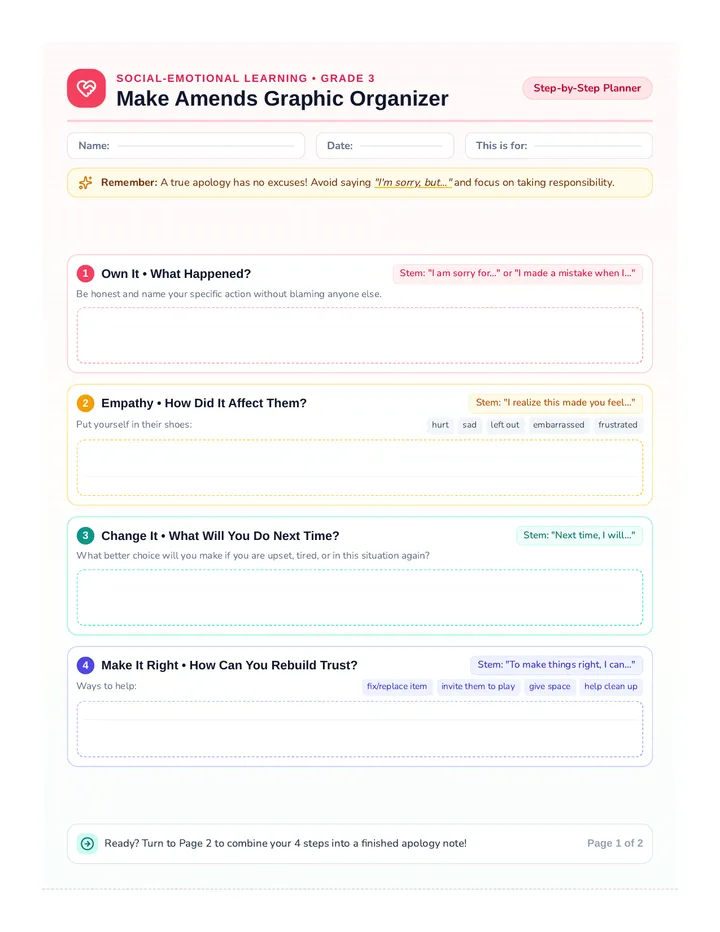
Write about a time you were accountable for your actions.
Think about a situation at home or school where you admitted to a mistake.
2
How can you be more accountable in the future?
Consider your daily activities and how you talk to others when things go wrong.
Accountability Checklist
Tell the Truth
Own the Choice
Fix the Problem