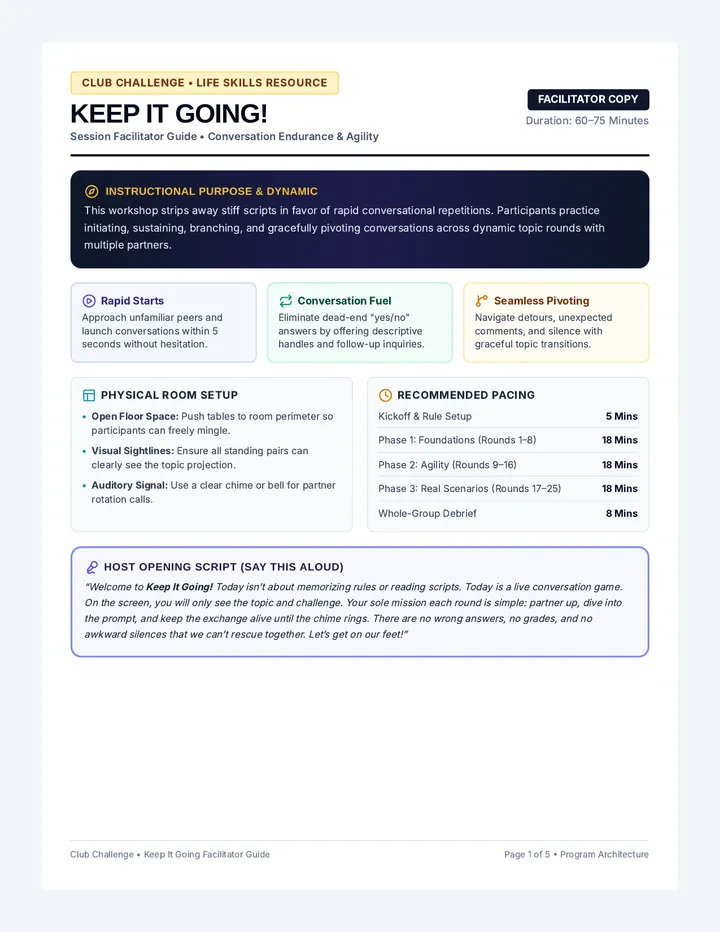
| Prompt immediate eye contact and a warm greeting. Eliminate lingering hesitation. |
| R02 | Find Common Ground | “Food, music, movies, sports—hunt for ONE shared passion. Once found, explore why you both enjoy it!” | Stop participants from just listing items; coach them to unpack details. |
| R03 | The Follow-Up Challenge | “Your partner shares a fact. Do not pivot away! Ask at least TWO follow-up questions before switching.” | Enforce deep listening rather than just waiting for one’s turn to talk. |
| R04 | “Tell Me More!” | “Speaker picks any hobby. Listener uses the magic phrase: ‘Tell me more!’ Keep them talking!” | Practice verbal encouragers and affirming nodding that shows full attention. |
| R05 | Would You Rather? | “Beach or mountains? Pizza or tacos? Free travel or free food? Pick your side and defend it!” | Encourage participants to give vivid reasons and anecdotes, not single words. |
| R06 | The “Why?” Game | “Ask what they love. Then ask ‘Why?’ and build an inquiry chain at least three layers deep.” | Coach a curious, warm tone of voice so it feels inquisitive rather than critical. |
| R07 | Two-Minute Talk | “Full partner switch! One speaker shares a passion for 60 seconds, then reverse roles on the chime.” | Timing stamina; call out the 60-second midpoint so airtime is shared equally. |
| R08 | The Pivot: Food & Beyond | “Start on Food. Notice how natural associations take you to family, travel, holidays, and memories!” | Demonstrate that conversations are living streams that can branch organically. |
Do not allow extended dead time between rounds. Ring the chime, click the next slide, and call: “Switch partners in 3... 2... 1... Go!” Keeping high momentum removes awkward pauses and keeps everyone engaged.
Club Challenge • Keep It Going Facilitator Guide Page 2 of 5 • Rounds 01–08
Phase 2: Agility & Listening
Slide Display: Topics Only • 60–90s Each
| Round | Screen Topic | Host Spoken Cue | Coaching Focus |
|---|---|---|---|
| R09 | Storytime & Reaction | “Tell a funny or unexpected mishap. Listeners: react aloud! Laugh, nod, and ask what happened next!” | Look for expressive nonverbal cues and enthusiastic responses from listeners. |
| R10 | The “Me Too!” Spark | “Hunt for a common link. The moment you find one, celebrate with ‘Me too!’ and dive in.” | Builds social warmth and rapport. Encourages high positive energy. |
| R11 | “I’ve Never...” | “Share: ‘I’ve never...’ Partner probes: ‘Would you want to? What holds you back?’” | Uncovers aspirational experiences and funny personal preferences. |
| R12 | Highlight Reel | “Pick: Best birthday, greatest concert, or memorable trip. Bring the sensory details to life!” | Guide speakers to describe sights, sounds, and emotions rather than dry facts. |
| R13 | The Opinion Exchange | “Pick: Pizza, music, or sports. State your take. Disagree with a smile and ask: ‘What do you think?’” | Teach polite disagreement: “Interesting! What made you prefer that?” |
| R14 | One-Word Association | “Give partner one word (e.g., ‘Dog’). Partner must immediately turn it into a full narrative!” | Eliminates freezing when handed unexpected conversational triggers. |
| R15 | The Smooth Pivot | “Partner calls ‘NEW TOPIC!’ Bridge smoothly: ‘That reminds me of...’ or ‘Speaking of that...’” | Practice conversational connectors without abrupt topic changes. |
| R16 | The Active Recall Test | “After your partner shares, mirror back ONE specific fact you heard before asking your question!” | Verifies true listening and memory retention over passive waiting. |
During Round 16, circulate and listen for exact detail playback (e.g., “You mentioned you visited your sister in Chicago...”). Praise listeners who repeat proper nouns or emotions back to their partner.
Club Challenge • Keep It Going Facilitator Guide Page 3 of 5 • Rounds 09–16
Phase 3 & Phase 4
Slide Display: Topics Only • 90–120s Each
| Round | Screen Topic | Host Spoken Cue | Coaching Focus |
|---|---|---|---|
| R17 | No “Yes / No” Rule | “‘Yes’, ‘No’, and ‘I don’t know’ are BANNED. Every response must provide context!” | Forces speakers to offer descriptive hooks for the other person to grasp. |
| R18 | The 4-Way Chain (Group) | “Form circles of 3–4! Person 1 asks, Person 2 answers, Person 3 probes, Person 4 expands!” | Group awareness; tracking one cohesive thread across multiple speakers. |
| R19 | Community Event Scenario | “Roleplay: Seated next to a stranger at a local event. Come up with 3 openers, try one right now!” | Translates classroom games directly to authentic public social settings. |
| R20 | Everyday Situations | “Pick: Bus stop, waiting room, or break room. Practice low-key everyday small talk!” | Situational tone matching; keeping small talk casual and pressure-free. |
| R21 | The Emergency Rescue | “Silence hit? Don’t freeze! Say: ‘Anyway, how has your week been going?’” | De-stigmatizes silences as normal moments that are easy to restart. |
| R22 | The Detour Twist | “Say something unexpected. Partner must lean in, validate, and follow the new path!” | Teaches conversational flexibility and staying open to unexpected topics. |
| R23 | The 5-Minute Marathon | “Endurance challenge: Five unbroken minutes with one partner. No scripts. Just talk!” | Assess self-sustaining stamina. Only intervene if a pair completely stalls out. |
| R24 | Speed Mixer | “30 seconds each! Introduce, share one fun fact, switch immediately! Meet as many as you can!” | High-energy celebration; rapid low-friction social interaction. |
| R25 | The Final Deep Question | “‘What is something you want people to know about you?’ Listen with full respect and warmth.” | Meaningful personal sharing and thoughtful closure for the workshop. |
Five minutes can feel long for nervous participants. Circulate constantly. If you notice a pair run dry around minute 3, gently toss in a quick prompt: “Ask them about the coolest place they’ve ever visited!” and step away so they retain conversational control.
Club Challenge • Keep It Going Facilitator Guide Page 4 of 5 • Rounds 17–25
Field Toolkit
Classroom Management & Reflection
Do not let silence turn into shame. Walk by and drop a quick prompt: “Ask them what show they are streaming right now!”
Step in warmly: “Great story! Now let’s turn the mic over: Sarah, what’s your take on that?” Encourage balanced turns.
If someone hesitates to find a new partner, become their partner for one round, then smoothly introduce them to a friendly peer.
For Reluctant / Anxious Speakers: Allow them to remain seated during early rounds and pair them with an encouraging peer or co-facilitator. Acknowledge any two-turn exchange as a win.
For High-Confidence Participants: Add subtle challenges: “Ask only open-ended questions starting with ‘How’ or ‘What’” or “Aim to have your partner talk 70% of the time.”
Gather the group into a single circle. Ask 2 or 3 of these reflection questions to anchor long-term takeaways:
1. The Breakthrough: “What was the easiest way you found to restart a conversation when words ran out?”
2. The Magic Phrase: “How did it feel when someone asked you to ‘Tell me more!’ versus changing the topic?”
3. Active Listening: “What follow-up question unlocked the most surprising story today?”
4. Real-World Use: “Where is one place outside this room you will use this conversation stamina this week?”
Core Facilitator Takeaway
“Connection is not about performing or being clever; it is about curiosity and generous attention.”
Club Challenge • Keep It Going Facilitator Guide Page 5 of 5 • Toolkit & Reflection