Conflict Resolution Slides
Workplace SPARK Skills
Professional Communication Series
Resolving Team Tension with SPARK Skills
De-escalating workplace conflict, aligning project goals, and composing Level 3+ professional responses.
7 Core Terms
Workplace Competencies
Sentence Frame
Structured Response
Share & Justify
Collaborative Dialogue
Soft Skills & SPARK Competencies
Foundational Definition
What Are SPARK / Soft Skills?
Personal traits and communication abilities that help individuals interact smoothly, work well with others, and succeed in the workplace.
Workplace Example: Using patience and clear, respectful speech when de-escalating an upset coworker or resolving a customer dispute.
5 Core SPARK Skill Pillars
Communication
Teamwork
Collaboration
Problem Solving
Professionalism
Key Vocabulary • Demeanor & Connection
Part 1 of 2
Active Listening
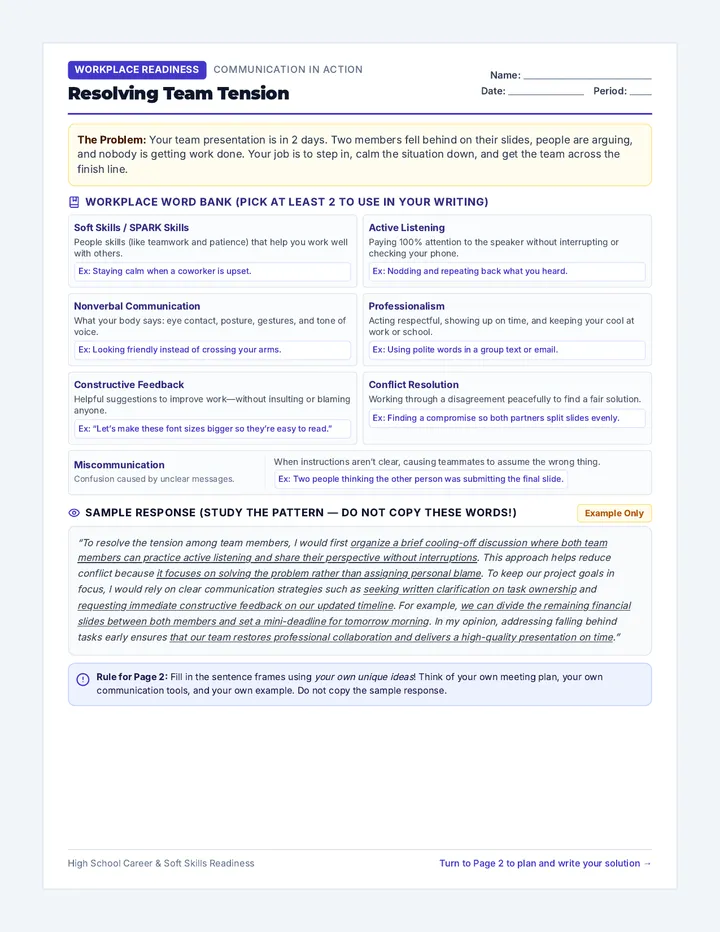
Fully focusing on, understanding, responding to, and remembering what a speaker is saying during dialogue.
Example: Making steady eye contact and nodding thoughtfully while a teammate explains project issues.
Nonverbal Cues
Transfer of information through body language, facial expressions, posture, gestures, and vocal tone rather than spoken words.
Example: Keeping open posture and an approachable expression during a heated team discussion.
Professionalism
The conduct, behavior, and respectful attitude expected of an individual working in any workplace environment.
Example: Arriving on schedule and consistently using courteous, solutions-focused language.
💡 Pro Tip: In high-tension meetings, nonverbal signals communicate credibility before words are spoken.
Key Vocabulary • Conflict & Resolution
Part 2 of 2
Constructive Feedback
Helpful, specific advice given to an individual to help them improve work performance, deliverables, or soft skills.
Example: Advising a peer to clarify slide bullet points to improve audience engagement.
Miscommunication
A breakdown in communication resulting in errors, confusion, friction, or misunderstandings between coworkers.
Example: Missing a key milestone because two partners both assumed the other had finalized the data.
Conflict Resolution
The process of identifying, managing, and achieving a peaceful, fair, and professional solution to a dispute.
Example: Facilitating an equitable compromise when dividing complex task responsibilities.
⚖️ Goal: Move conversations from blame ("You failed to...") to collaborative solutions ("How do we solve this?").
The Scenario • Team Breakdown
Case Study Dilemma
Deadline: 24 Hours Away
Your project team is scheduled to deliver a major client presentation tomorrow morning. However, interpersonal tension has spiked:
- • Two members disagree sharply over who owns the financial analysis slides.
- • Unfinished tasks are falling behind because communication has stalled.
- • Blame is being assigned rather than actions being executed.
Your Leadership Challenge
How will you intervene to defuse emotional friction, re-establish shared accountability, and protect the project deadline?
Target Objective:
Construct a cohesive, Level 3+ professional paragraph utilizing the sentence frame assist.
Next: Let's inspect the sentence frame that will structure our response.
Sentence Frame Assist • Breakdown
Paragraph Scaffold
1. Immediate Action: "To resolve the tension among team members, I would first [ cooling-off step ]."
Sets tone
2. Psychological Rationale: "This approach helps reduce conflict because [ reason / de-escalation ]."
Explains "Why"
3. Communication Strategy: "To keep our project goals in focus, I would rely on clear strategies like [ strategy 1 ] & [ strategy 2 ]."
Applies skills
4. Actionable Example: "For example, [ delegation or mini-deadline ]."
Tangible proof
5. Strategic Impact: "In my opinion, addressing falling behind tasks early ensures [ ultimate project outcome ]."
Final result
🎯 Logical Progression: Action → Rationale → Strategic Tools → Concrete Application → Impact.
Model Level 3+ Response Exemplar
Gold Standard
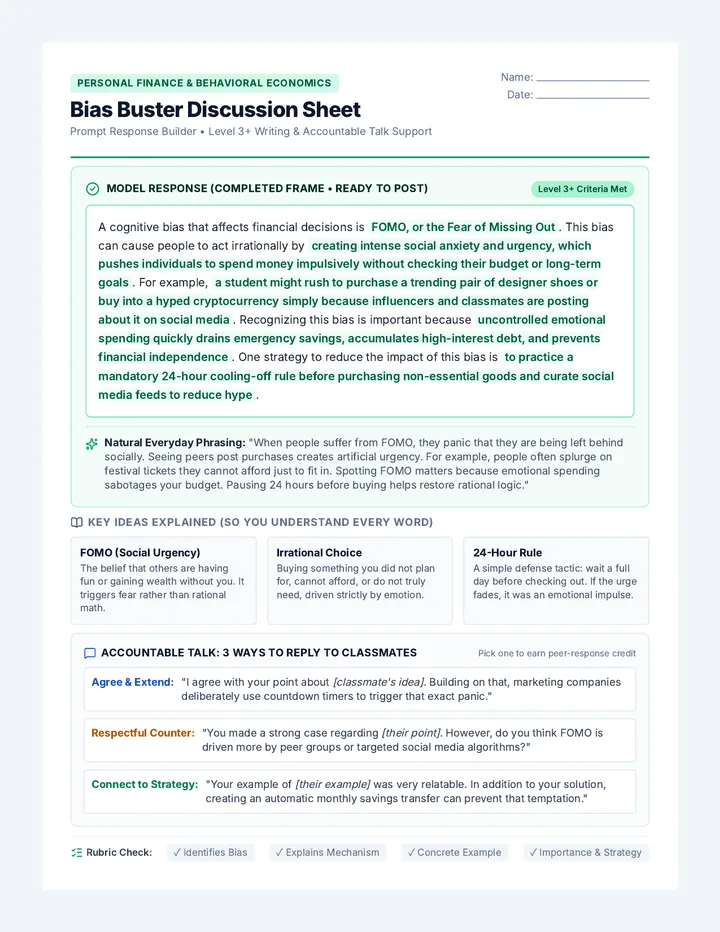
"To resolve the tension among team members, I would first organize a brief cooling-off discussion where both team members can practice active listening and share their perspective without interruptions. This approach helps reduce conflict because it focuses on solving the problem rather than assigning personal blame. To keep our project goals in focus, I would rely on clear communication strategies such as seeking written clarification on task ownership and requesting immediate constructive feedback on our updated timeline. For example, we can divide the remaining financial slides between both members and set a mini-deadline for tomorrow morning. In my opinion, addressing falling behind tasks early ensures that our team restores professional collaboration and delivers a high-quality presentation on time."
Specific Actions: No generic responses
SPARK Vocab: Embedded seamlessly
Measurable: Concrete deadlines included
Independent Writing Mission
Individual Practice
Your Assignment
Draft your own complete, original paragraph using the Sentence Frame Assist. Address the team tension dilemma with your unique leadership strategy.
Focus Standard:
Write a complete, fluent paragraph that moves naturally from problem de-escalation to project completion.
Level 3+ Criteria Checklist
- ✓ All 5 sentence frame prompts are thoroughly completed.
- ✓ Integrates at least 2 key vocabulary terms accurately.
- ✓ Includes a realistic, actionable workplace example.
- ✓ Maintains formal, professional business tone throughout.
✍️ Take 8-10 minutes to write your response before transitioning to partner discussion.
Share, Justify & Respond Protocol
Collaborative Dialogue
1
Share
Read your completed response aloud clearly to your partner. Use open posture and confident vocal tone.
"My strategy begins by..."
2
Justify
Defend your reasoning. Explain why your chosen communication strategy is the most effective way to eliminate conflict.
"I chose this approach because..."
3
Respond
Listener practices active listening and provides constructive feedback or builds upon their classmate's perspective.
"I agree with... but consider..."
Remember Your SPARK Norms: Maintain eye contact, avoid interruptions, and evaluate ideas respectfully.