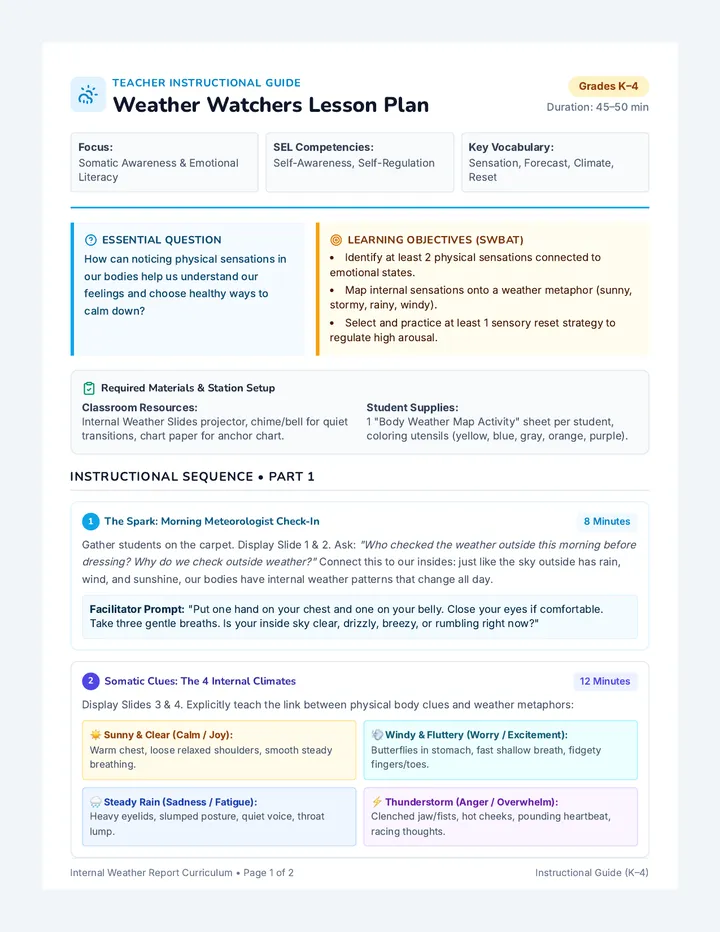
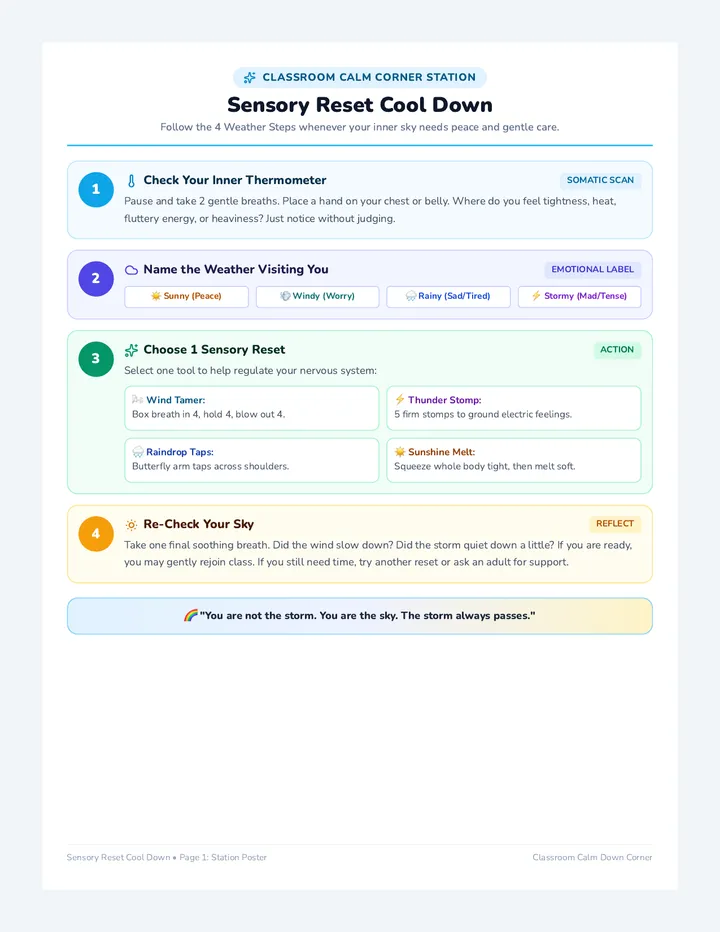
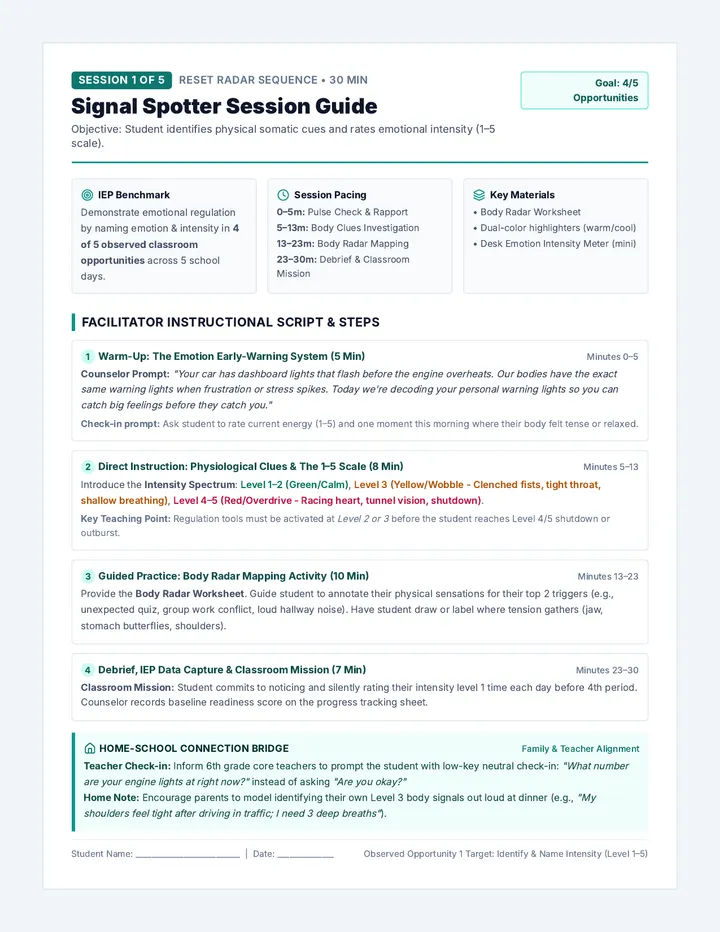
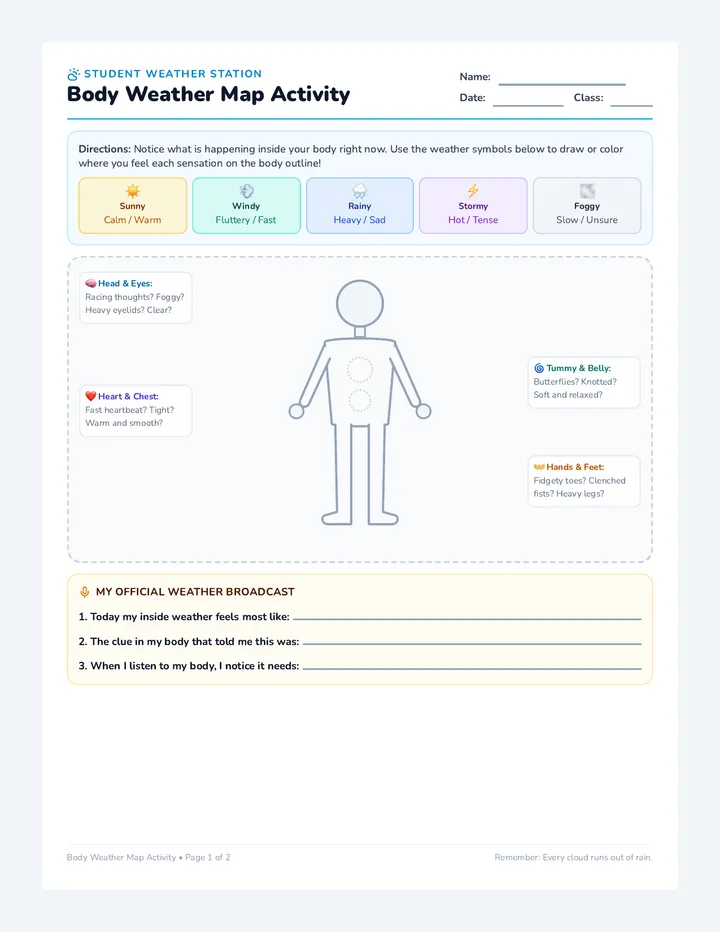
Error Audit Lesson Plan Teacher Facilitation Guide Grades 7–12 • All Subjects
Pacing: 55–60 Minutes
The Post-Exam Audit: Lesson Blueprint
A structured metacognitive intervention transforming graded assessments into diagnostic data points. Students classify root causes, eliminate superficial re-writes, and engineer concrete prevention strategies.
Core Learning Objectives
• Categorize Errors: Classify every incorrect item into one of four distinct cognitive breakdown types.
• Explicate Misconceptions: Articulate the flawed premise or missing schema that caused the response.
• Formulate Action Rules: Craft conditional "If-Then" operational rules to prevent recurrence on future exams.
Required Prep & Materials
• Graded student assessments with marked errors (numerical scores can be withheld initially).
• Accompanying Error Audit Slides projected at room front.
• Printed copies of the 2-page Error Audit Worksheet per student.
• Color highlighters (Green: Slip, Yellow: Misread, Orange: Strategy, Red: Concept).
Diagnostic Error Taxonomy (Teach Explicitly)
Type 1: Precision Slip
Understood the concept completely, but made an inadvertent arithmetic, spelling, sign, or clerical mistake.
Fix: Deliberate re-check routine.
Type 2: Prompt Misread
Rushed or overlooked negative stems ("NOT", "EXCEPT"), missed multi-part prompts, or answered wrong variable.
Fix: Underlining keywords & constraints.
Type 3: Strategy Flaw
Knew the general topic but chose an inefficient formula, mismanaged pacing, or failed to evaluate plausibility.
Fix: Pre-planning step before solving.
Type 4: Concept Gap
Fundamental absence of understanding, faulty theory, completely misapplied formula, or guessing without schema.
Fix: Re-instruction, notes reteach.
Instructional Delivery: Phases 1 & 2
Phase 1: The Metacognitive Reframe (10 Minutes) Mindset Calibration
Teacher Action: Frame the audit not as punishment for poor performance, but as clinical autopsy data. Contrast two mindsets: Defensive Student ("The teacher graded too hard; let me just write down option B to get credit") vs. Forensic Auditor ("Where did my thinking derail? How do I make sure this error never repeats?").
Pro-Tip: Withhold final letter grades until the audit is completed to lower affective filters and maintain diagnostic focus.
Phase 2: Modeling the 3-Step Audit Protocol (15 Minutes) I Do / We Do
Teacher Action: Project a real anonymized student error on Slide 4. Demonstrate why a lazy fix ("Correct answer is 42 because I solved it") earns zero credit. Model the required 3-part forensic entry:
Step 1: Diagnose Root Cause "I classified this as Misread Prompt because I solved for x instead of 2x + 1."
Step 2: Correct & Justify Full scratchwork plus sentence explaining why the new method satisfies conditions.
Step 3: Prevention Rule "Rule: Double-check what the question asks before boxing my answer."
Error Audit Protocol • Teacher Lesson Blueprint Page 1 of 2
Instructional Execution & Differentiation
Error Audit Protocol • Teacher Guide
Phase 3: Active Forensic Lab Time (20–25 Minutes) You Do / Guided Practice
Students distribute their assessments and begin independent completion of their Error Audit Worksheet . The teacher conducts targeted circulation using the "2-Minute Diagnostic Check":
• Intervention 1: Halt students who default to labeling every mistake as "careless slip." Challenge: "If you understood the rule, what exact step failed?"
• Intervention 2: When a Concept Gap is detected, point students to specific textbook sections, anchor charts, or peer mentors before allowing them to rewrite.
• Collaboration Norm: Students may consult a designated "Lab Partner" for concept clarification, but each student must write their own rationale in their own words.
Phase 4: Synthesis, Trend Analysis & Journal Logging (10 Minutes) Metacognitive Closure
Students total their Error Taxonomy tallies at the top of their worksheet and transfer the aggregate data to their ongoing Error Pattern Journal . Facilitate a 3-minute room debrief: "Which error type occurred most frequently across the class, and what environmental or study factor caused it?"
Differentiation & Responsive Scaffolding
Tier 1: High Needs / ELL
• Provide pre-printed sentence starters for explanations (e.g., "I previously chose this because I thought... Now I know...").
• Limit corrections to the 3 highest point-value errors rather than the entire exam to reduce cognitive overload.
Tier 2: On-Level Standard
• Require full taxonomy tallying across all missed items.
• Require one generalized "Rule of Prevention" per error block.
• Spot-check for depth: reject passive descriptions like "I forgot the formula."
Tier 3: Advanced Metacognition
• Students author an alternative "Trap Distractor" question that exploits the same misconception.
• Act as peer audit consultants to review and validate Tier 1/2 peer corrections before teacher submission.
Audit Quality Evaluation Rubric (For Partial Credit Recovery)
Component Proficient (Full Credit) Emerging (Half Credit) Incomplete (No Credit) 1. Root Diagnosis Identifies exact flaw in logic or execution with specific cognitive evidence. Correct taxonomy chosen, but vague rationale ("I just made a mistake"). Incorrect categorization or blank diagnosis line. 2. Solution & Rationale Complete step-by-step correct solution with clear academic justification. Correct answer shown with partial or unclear intermediate reasoning. Only the final letter/number copied with zero supporting work. 3. Prevention Rule Actionable, memorable behavioral trigger (e.g., "Check units on both axes"). Generic advice that is hard to verify (e.g., "Study more," "Read carefully"). Missing prevention rule entirely.
Warning - The "Passive Copy" Pitfall: Never allow students to write down an answer provided by a peer without requiring them to articulate why their original answer was mathematically or conceptually unviable. If they cannot explain why the old answer is false, they do not understand why the new answer is true.
Error Audit Protocol • Teacher Lesson Blueprint Page 2 of 2
Error Audit Slides Metacognitive Protocol Secondary Assessment Lab
Clinical Error Analysis
The Post-Exam Autopsy
Turning Missed Points
Into Bulletproof Mastery
Writing the right answer isn't enough. Today we diagnose the exact cognitive failure that caused each error—so it never happens again.
Objective: Diagnose root causes & build personal prevention rules Step 1: Mindset Reframe
The Reality Check Why Traditional Corrections Fail
The "Copycat" Trap
Looking at the answer key, copying down "Option C" or the formula, and convincing yourself: "Oh yeah, I knew that."
Result: Zero retention. You make the exact same mistake on the semester final.
The Forensic Audit
Treating the error like a crime scene. Asking: What specific line of thinking led me into this trap?
Result: Schema rewiring. You build an internal alarm system that triggers before the trap.
"You don't learn from mistakes. You learn from analyzing mistakes."
The Diagnostic Taxonomy Classify Every Mistake
1. Precision Slip Execution Flaw
You fully understood the concept, but made an inadvertent mental glitch: sign drop, arithmetic slip, or copying error.
2. Misread Prompt Attention Breakdown
You answered the wrong question! Missed a negative word ("NOT"), overlooked a unit constraint, or solved for x instead of y.
3. Strategy Flaw Method Error
You knew the general topic, but picked the wrong formula, rushed without planning, or took an inefficient path that timed out.
4. Concept Gap Schema Absence
You genuinely did not understand the underlying theory or mechanism. You guessed or applied an invalid rule from memory.
Rule of thumb: If you can't re-solve it cold in 60 seconds, it is NOT a slip.
Model Case Study Question 14: Prompt Asked for Perimeter, Found Area
Superficial (Rejected: 0 Pts)
Category: Careless mistake
Correction: The answer is 28 cm.
Why: Because I multiplied instead of added.
✖ Identifies what happened, but offers zero cognitive autopsy or future behavioral trigger.
Master Audit (Full Credit)
Category: Misread Prompt
Diagnosis: Saw dimensions 6 and 8 and instinctively solved for Area (48) rather than reading "perimeter" (28).
Prevention Rule: Underline the exact measurement target before writing work.
✔ Isolates the sensory cue and creates a concrete physical habit to block the impulse.
Error Audit Worksheet Diagnostic Protocol Forensic Assessment Autopsy
Form EA-101
Assessment Error Audit
Student Name
Date / Period
Assessment Title
Error Taxonomy Classification & Summary Tally
Tally every missed problem on your exam
1. Precision Slip Understood method; minor calculation, sign, or clerical error.
Tally Count:
2. Misread Prompt Overlooked key constraint, negative stem, or answered wrong part.
Tally Count:
3. Strategy Flaw Inefficient method, formula misapplication, or time trouble.
Tally Count:
4. Concept Gap Did not grasp core principle; guessed or used invalid rule.
Tally Count:
CASE 01
Question #:
Points Missed:
Category: Slip Misread Strategy Concept
Part A: Cognitive Breakdown What specific assumption was flawed?
Part B: Verified Re-solve & Proof Show complete work and reasoning
Part C: Actionable Prevention Rule "If / When I encounter... I will immediately..."
CASE 02
Question #:
Points Missed:
Category: Slip Misread Strategy Concept
Part A: Cognitive Breakdown What specific assumption was flawed?
Part B: Verified Re-solve & Proof Show complete work and reasoning
Part C: Actionable Prevention Rule "If / When I encounter... I will immediately..."
Secondary Metacognitive Protocol • Error Audit Worksheet Page 1 of 2
CONTINUED
Case Autopsies (3 & 4) & Diagnostic Synthesis
Student:
CASE 03
Question #:
Points Missed:
Category: Slip Misread Strategy Concept
Part A: Cognitive Breakdown What specific assumption was flawed?
Part B: Verified Re-solve & Proof Show complete work and reasoning
Part C: Actionable Prevention Rule "If / When I encounter... I will immediately..."
CASE 04
Question #:
Points Missed:
Category: Slip Misread Strategy Concept
Part A: Cognitive Breakdown What specific assumption was flawed?
Part B: Verified Re-solve & Proof Show complete work and reasoning
Part C: Actionable Prevention Rule "If / When I encounter... I will immediately..."
Audit Synthesis & Retest Mastery Readiness
Action Commitment
Primary Vulnerability Pattern (My #1 Error Type):
Targeted Pre-Exam Preparation Action:
Error Pattern Journal Metacognitive Log Longitudinal Growth Tracker
Student Personal Edition
Error Pattern Journal
Student Name
Academic Year / Course
The Goal of Pattern Tracking: An isolated mistake is a fluke. A recurring mistake is a system flaw. Use this log across every unit test this semester to uncover which cognitive category is silently draining your score.
Semester Assessment Audit Log
Record data after completing each Error Audit Worksheet
Assessment Date Score Slips Misreads Strategy Concepts Primary Culprit & Action Taken Unit 1 Exam Unit 2 Exam Midterm Exam Unit 3 Exam Unit 4 Exam Final Exam
Cognitive Shift Visualizer (Shade Count per Exam)
Ideal shift: Concept Gaps shrink into minor Precision Slips
Precision Slips
Goal: 0–1 per test
Prompt Misreads
Goal: 0 (Eliminate)
Strategy Flaws
Goal: ≤ 1 per test
Concept Gaps
Goal: 0 on retake
Mid-Semester Pattern Reflection Prompts
1. Which category has caused the largest loss of total raw score points so far?
2. When an error recurs across multiple exams, what environment or study habit is triggering it?
Secondary Metacognitive Protocol • Error Pattern Journal Page 1 of 2
PLAYBOOK
Personal Avoidance Rules & Pre-Exam Audit
Error Pattern Journal • Page 2
Your Personal Prevention Rules: When you complete an autopsy worksheet, transfer your highest-value "If-Then" prevention rules here. Review this custom playbook 10 minutes prior to every upcoming exam.
Master Prevention Rules Registry
Defense Rule #1
Target Error Type: Date Added:
Trigger (When I notice...):