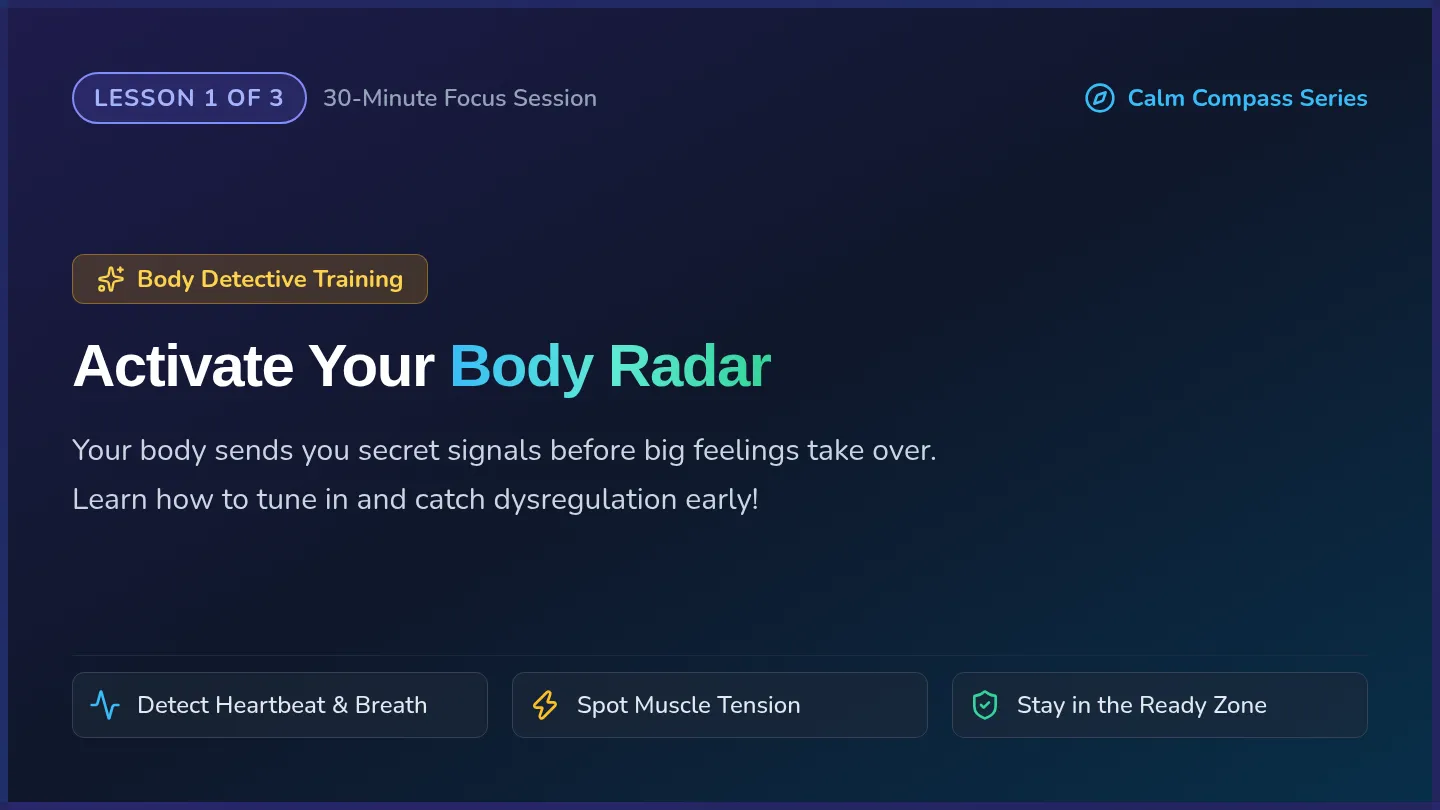
Signal Spotter Session Guide Session 1 of 5 Reset Radar Sequence • 30 Min
Signal Spotter Session Guide
Objective: Student identifies physical somatic cues and rates emotional intensity (1–5 scale).
Goal: 4/5 Opportunities
IEP Benchmark
Demonstrate emotional regulation by naming emotion & intensity in 4 of 5 observed classroom opportunities across 5 school days.
Session Pacing
0–5m: Pulse Check & Rapport5–13m: Body Clues Investigation13–23m: Body Radar Mapping23–30m: Debrief & Classroom Mission
Key Materials
• Body Radar Worksheet
• Dual-color highlighters (warm/cool)
• Desk Emotion Intensity Meter (mini)
Facilitator Instructional Script & Steps
1 Warm-Up: The Emotion Early-Warning System (5 Min) Minutes 0–5
Counselor Prompt: "Your car has dashboard lights that flash before the engine overheats. Our bodies have the exact same warning lights when frustration or stress spikes. Today we're decoding your personal warning lights so you can catch big feelings before they catch you."
Check-in prompt: Ask student to rate current energy (1–5) and one moment this morning where their body felt tense or relaxed.
2 Direct Instruction: Physiological Clues & The 1–5 Scale (8 Min) Minutes 5–13
Introduce the Intensity Spectrum : Level 1–2 (Green/Calm), Level 3 (Yellow/Wobble - Clenched fists, tight throat, shallow breathing), Level 4–5 (Red/Overdrive - Racing heart, tunnel vision, shutdown).
Key Teaching Point: Regulation tools must be activated at Level 2 or 3 before the student reaches Level 4/5 shutdown or outburst.
3 Guided Practice: Body Radar Mapping Activity (10 Min) Minutes 13–23
Provide the Body Radar Worksheet . Guide student to annotate their physical sensations for their top 2 triggers (e.g., unexpected quiz, group work conflict, loud hallway noise). Have student draw or label where tension gathers (jaw, stomach butterflies, shoulders).
4 Debrief, IEP Data Capture & Classroom Mission (7 Min) Minutes 23–30
Classroom Mission: Student commits to noticing and silently rating their intensity level 1 time each day before 4th period. Counselor records baseline readiness score on the progress tracking sheet.
Home-School Connection Bridge Family & Teacher Alignment
Teacher Check-in: Inform 6th grade core teachers to prompt the student with low-key neutral check-in: "What number are your engine lights at right now?" instead of asking "Are you okay?" Home Note: Encourage parents to model identifying their own Level 3 body signals out loud at dinner (e.g., "My shoulders feel tight after driving in traffic; I need 3 deep breaths" ).
Student Name: __________________________ | Date: ______________
Observed Opportunity 1 Target: Identify & Name Intensity (Level 1–5)
Body Radar Worksheet Reset Radar • Student Activity
Body Radar Worksheet
Spot your body's early-warning clues before emotional intensity spikes.
Name:
Date:
Part 1: Emotional Intensity Meter
1
Chill
Relaxed, focused, breathing slowly
2
Alert
Noticing a small annoyance; calm body
3
Wobble
Tension rising! Use tools NOW
4
Heated
Racing heart, clenching, hard to think
5
Overdrive
Explosive or shut down; urgent reset
Part 2: Body Clues Map
Radar Hotspots
Head & Face
Clenched jaw / teeth Hot cheeks / flushing Headache / throbbing
Chest & Breath
Rapid pounding heartbeat Shallow, quick breathing Tight chest or throat
Stomach & Center
Fluttering butterflies Hard knot / stomach ache Nausea / jittery feeling
Hands & Muscles
Tight balled fists Tense, hunched shoulders Shaky fingers / fidgeting
Part 3: Trigger Detective Log
Classroom Situation What My Body Feels First Intensity (1–5) My Reset Plan Example: Called on unexpectedly Hot face, heart beats fast 3 1 slow belly breath 1. Unexpected test / quiz 2. Disagreement in group work 3. _________________________
My Level 3 Signal Alert
When my intensity reaches Level 3 , my top physical signal is:
I will notice this clue and begin a self-regulation tool before reaching Level 4 or 5.
Reset Radar • 6th Grade Self-Regulation Recognize • Rate • Regulate
Breath Anchors Session Guide Session 2 of 5 Reset Radar Sequence • 30 Min
Breath Anchors Session Guide
Objective: Student independently initiates 2 somatic calming tools (Box Breath, 5-4-3-2-1 Grounding) at Level 2/3.
Goal: 4/5 Opportunities
IEP Focus Area
Use deep breathing or sensory grounding tools to de-escalate intensity from Level 3 to Level 2/1 in 4 of 5 monitored school situations.
30-Min Pacing
0–5m: Week 1 Review & Intensity Check5–14m: Somatic Biology & Box Breath14–23m: 5-4-3-2-1 Sensory Grounding & Stealth Drill23–30m: Desk Tool Customization & Exit Slip
Middle School Nuance
6th graders fear looking "weird" in front of peers. Frame tools as "Stealth Resets" that no one sitting next to them will ever notice.
Facilitator Scripting & Activity Breakdown
1 Welcome & Baseline Review (5 Min) Minutes 0–5
Review the Body Radar Worksheet from Week 1. Ask: "Did your engine lights flash this week? What did you notice in your body before you felt overwhelmed?"
Reinforce that noticing is 50% of the battle. Today we give the student two immediate brake pedals.
2 Direct Instruction: The Vagus Brake & 4x4 Box Breath (9 Min) Minutes 5–14
Counselor Script: "When stress kicks in, your nervous system pumps adrenaline. Deep breathing isn't just fluffy advice; an extended exhale physically stimulates the vagus nerve, forcing your heart rate to drop within 60 seconds."
Box Breathing Cadence: Inhale through nose (4s) → Hold gently (4s) → Slow exhale out mouth (4s) → Hold empty (4s). Practice 3 full cycles together.
3 Guided Practice: 5-4-3-2-1 Sensory Grounding & Desk Stealth Drill (9 Min) Minutes 14–23
Teach sensory anchoring to stop spiraling thoughts: 5 things to see, 4 to touch (desk wood, hoodie, pen grip), 3 to hear (clock, footsteps, hum), 2 to smell, 1 deep grounding breath.
Stealth Simulation: Have student sit as if at a middle school desk during a hard math test. Practice running a 5-second palm press against thighs or box breath without drawing peer eyes.
4 Somatic Anchor Poster & Opportunity 2 Commitment (7 Min) Minutes 23–30
Provide the Somatic Reset Poster (to keep in locker or folder). Student selects their #1 stealth anchor to use this week whenever intensity touches Level 3.
Teacher & Parent Support Note Classroom Prompt Cue
Somatic Reset Poster Reset Radar • Somatic Toolkit
Somatic Reset Poster
Portable somatic tools to drop physical tension in 60 seconds or less.
Stealth Edition
Tool 1: 4x4 Tactical Box Breathing
Heart Rate Drop
Step 1
INHALE
4s
Through nose; feel belly expand like a balloon
Step 2
HOLD
4s
Soft still pause; keep shoulders relaxed
Step 3
EXHALE
4s
Slow steady release through parted lips
Step 4
REST
4s
Empty lungs; feel muscles unhook
Tool 2: 5-4-3-2-1 Sensory Grounding Radar
Mind Spiral Stopper
5
SEE
5 things in the room (e.g., clock, blue folder, pen tip)
4
FEEL
4 textures (smooth desk, hoodie sleeve, shoe sole)
3
HEAR
3 distinct sounds (pencil lead, clock tick, air vent)
2
SMELL
2 scents (paper aroma, lotion, fresh hallway air)
1
GROUND
1 deep grounding sigh out through your lips
Tool 3: Three Invisible Stealth Resets
1. The Desk Palm Press
Place both palms flat under the desk or on your lap. Press down firmly for 5 seconds, then let go completely. Releases hidden arm tension instantly.
2. The Shoulder Drop
Silently inhale while rolling shoulders gently up toward your ears; exhale and let them drop a full 2 inches away from your neck.
3. Sole Floor Anchors
Plant both sneakers flat on the classroom floor. Feel the floor holding your entire weight. Unclench your jaw and soften your forehead.
My Personal Stealth Anchor
The tool that feels most natural and comfortable for me to use during class is:
Reset Radar • Somatic Regulation Anchor Keep in binder, folder pocket, or desk locker
Break Blueprint Session Guide Session 3 of 5 Reset Radar Sequence • 30 Min
Break Blueprint Session Guide
Objective: Student initiates a proactive break request at Level 3 using a pass or verbal script, then returns in ≤5 min.
Goal: 4/5 Opportunities
IEP Focus Area
Request a scheduled or self-identified regulation break appropriately in 4 of 5 observed opportunities without work refusal or disruption.
30-Min Pacing
0–5m: Somatic Check-In & Wins5–13m: Proactive vs Avoidance Breaks13–22m: Script Rehearsal & Pass System22–30m: Teacher Pact & Return Plan
Critical Distinction
A break is a recharge tool to get back into the game , not an escape hatch to dodge academic work. Clear boundaries maintain student dignity.
Facilitator Scripting & Activity Breakdown
1 Warm-Up: Reframing the Break as Athletic Reset (5 Min) Minutes 0–5
Counselor Script: "NBA players take timeouts when the opposing team goes on a run. They don't walk off the court and quit; they take 60 seconds on the bench, drink water, get their breath back, and return to score. That's exactly what a proactive break is."
2 Direct Instruction: The 3-Step Break Protocol (8 Min) Minutes 5–13
1. Signal at Level 3: Don't wait until Level 4/5. Use the nonverbal break pass or low-whisper script.
2. Regulate (3–5 Min): Water cooler walk, cold water splash, 3 box breaths, or quiet sensory focus.
3. Re-engage: Walk back into class calmly, give teacher the silent thumbs-up, start the next problem.
3 Role-Play & Script Rehearsal (9 Min) Minutes 13–22
Provide the Pass Power Printable . Roleplay two scenarios:
Option A (Nonverbal): Student quietly slides the Reset Pass to the teacher's podium or desk edge during silent reading or work time.Option B (Verbal Script): "Excuse me, Mr./Ms. [Name], my engine is at a Level 3. May I have a 3-minute water reset?"
4 Classroom Implementation Pact (8 Min) Minutes 22–30
Student identifies their top class where break requests are most likely needed (e.g., Math or ELA). Complete the teacher communication agreement note so the student feels safe knowing the teacher will grant the pass without questions.
Teacher & Parent Collaboration Fidelity & Boundaries
Pass Power Printable Reset Radar • Self-Advocacy Tools
Pass Power Printable
Discreet break request tools, verbal scripts, and return-to-task habits.
Name:
Date:
Part 1: Pocket Break Passes (Cut along dashed lines)
Laminate or keep in pencil case
Quick Reset Pass 3–5 Min
I am taking a proactive Level 3 reset to breathe, recalibrate, and return ready to learn.
Time Out: _______ Time Back: _______
Hydrate & Move Pass 3 Min
Quick water station walk and shoulder drop to release physical tension.
Time Out: _______ Time Back: _______
Sensory Ground Pass 4 Min
5-4-3-2-1 sensory grounding and fresh air check to stop cognitive overload.
Time Out: _______ Time Back: _______
Counselor Check-In Brief
Pre-arranged brief check-in with counseling support to recalibrate safely.
Teacher Initial: _____ Location: Room ___
Part 2: Middle School Self-Advocacy Scripts
The Silent Slide (Nonverbal)
Place the pass quietly on the corner of your desk or slide it onto the teacher's podium during transition. Make eye contact and give a brief nod. No speech needed!
The 10-Second Low Whisper
"Excuse me, I'm noticing my tension at Level 3. I'm going to take a 3-minute water break and return to finish problem #4."
Part 3: The 5-Minute Reset Routine (What to do on a break)
Minute 1
Physical Step-Away & cool water sip
Minute 2
3 cycles of 4x4 Box Breathing
Minute 3
Cold water splash on wrists / jaw drop
Minute 4–5
Smooth walk back to desk & begin next step
Classroom Regulation Compact
Class Subject / Teacher:
Agreed Pass Location / Signal:
"I agree to request my break before Level 4, spend 3–5 minutes doing active calming, and return quietly to my seat."
Reset Radar • Proactive Break Blueprint Self-Advocacy with Purpose
Strategy Showdown Session Guide Session 4 of 5 Reset Radar Sequence • 30 Min
Strategy Showdown Session Guide
Objective: Student plays the Coping Quest simulation game, correctly matching tools to 5 realistic scenarios.
Goal: 4/5 Opportunities
IEP Focus Area
Select and apply an appropriate coping strategy (somatic, break, cognitive) across 4 of 5 observed or simulated problem scenarios .
30-Min Pacing
0–5m: Coping Deck Assembly5–20m: Coping Quest Board Game20–25m: Strategy Analysis & Pairing25–30m: Ring-Binder Deck Prep & Data
Game Purpose
Gamification lowers defensiveness. Simulating high-friction middle school moments builds automatic reflex retrieval under low-stakes play.
Facilitator Scripting & Activity Breakdown
1 Assemble the Personal Coping Deck (5 Min) Minutes 0–5
Provide the Coping Quest Game printable. Cut or separate the 6 Coping Cards. Explain that these cards are her "hand" in today's game and her real-life pocket deck moving forward.
2 Gameplay: Coping Quest Board Game (15 Min) Minutes 5–20
Counselor Prompt: "Every tile on this board represents a typical middle school obstacle. When you land on a challenge, you have 10 seconds to play a Coping Card that matches the intensity level and explain how you'd execute it."
Counselor Role: Act as the referee and counter-player. Award +1 "Regulation Point" for every strategy that accurately de-escalates the scenario. Goal is to earn at least 4 out of 5 scenario points.
3 Post-Game Debrief: The "Mismatched Tool" Trap (5 Min) Minutes 20–25
Discuss: "Did any strategy feel too weak for a high-intensity moment?" (e.g., trying to do a quiet breath when intensity is at Level 5 — when a structured break pass is actually needed). Help student understand tool hierarchy.
4 Pocket Deck Packaging & Opportunity Data (5 Min) Minutes 25–30
Hole-punch and place the cards on a binder ring or inside student ID lanyard. Record game performance (e.g., 5/5 or 4/5 scenarios successfully resolved) toward IEP benchmark tracking.
Family & Teacher Connection Lanyard / Binder Integration
Teacher Collaboration: Allow student to keep her laminated coping cards visible on the corner of her desk during independent work or assessments.Home Extension: Play 3 scenario rounds at home with a sibling or parent to celebrate her growing toolkit.
Coping Quest Game Reset Radar • Counseling Game
Coping Quest Board Game
Navigate middle school hurdles by playing the matching coping tool at Level 3!
Win Target: 4/5 Regulations
Rules: Roll a die (or flip a coin: heads=2, tails=1). Move token along track.
Match a Coping Card to solve each scenario and earn +1 Point!
START 1
Locker Hallway
Take 1 baseline calm breath. Head to class.
Challenge 2
Pop Quiz Announced!
Heart races at Level 3. Play a Somatic Card.
Challenge 3
Lost Your Pencil Lead
Frustration rises. Use Stealth Palm Press.
Power Zone 4
Water Break Recharge
Hydration reset! Auto +1 Regulation Point.
Challenge 5
Loud Cafeteria Noise
Sensory overload. Play 5-4-3-2-1 Grounding Card.
Challenge 6
Peer Snickers at Desk
Flushed cheeks. Use Self-Talk Reframe.
Challenge 7
Group Partner Inactive
Level 4 warning! Show nonverbal break pass.
Safe Anchor 8
Teacher Silent Nod
Teacher supports your break. Roll again!
Challenge 9
Hard Math Problem
Feeling stuck. Do 3 Box Breaths before trying.
Challenge 10
Forgot Homework
Drop shoulders. Rate intensity 1-5 aloud.
Challenge 11
Tech Glitch on Laptop
Unsaved work! Play Wildcard Coping Card.
FINISH 12
Mastery Circle
Final bell rings! You stayed in control!
Game Opportunity Tracker (Goal: 4 of 5 Scenarios Regulated)
Opp 1
□
Tool Match
Opp 2
□
Tool Match
Opp 3
□
Tool Match
Opp 4
□
Tool Match
Opp 5
□
Tool Match
Coping Quest Game Board • Page 1 of 2 See Page 2 for Cut-Out Coping Cards
Reset Radar • Pocket Deck
Personal Coping Cards Deck
Cut along the dotted borders. Laminate or keep on a binder ring for daily use.
6 Printable Cards
Somatic Card #1
4x4 Box Breath
• Inhale 4s through nose
Regulation Mastery Session Guide Session 5 of 5 Reset Radar Sequence • 30 Min
Regulation Mastery Session Guide
Objective: Student evaluates 4-out-of-5 opportunity data, celebrates mastery, and builds a sustainable self-monitoring routine.
Goal: 4/5 Opportunities
IEP Benchmark Goal
Student independently uses regulation tools (deep breath, break request, coping cards) in 4 of 5 observed opportunities with 80% fidelity.
30-Min Pacing
0–6m: 5-Week Data Review & Wins6–15m: Pulse Check Self-Assessment15–24m: Maintenance Plan & High-Stakes Prep24–30m: Celebration & Home Connection
Data Synthesis
Compare Week 1 baseline against Week 5 performance data collected by classroom teachers and counselor observations.
Facilitator Scripting & Activity Breakdown
1 Reviewing the 5-Week Journey & Data Reveal (6 Min) Minutes 0–6
Counselor Prompt: "Five weeks ago, stress felt like a lightning storm that struck without warning. Look at what you’ve built: you know your body's early signals, you have 4x4 breathing, you can advocate for breaks with zero drama, and you carry your coping cards. Let’s look at your real classroom data."
Present the observation counts: highlight specific moments where the student chose a strategy at Level 3 instead of exploding or shutting down.
2 Pulse Check Tracker & Self-Reflection Rubric (9 Min) Minutes 6–15
Provide the Pulse Check Tracker . Guide the student to complete the self-reflection: "When I feel overwhelmed now, what is my first move?" Have the student self-rate her confidence (1–5) in using her tools without adult prompting.
3 The Relapse Safety Net: What if I reach Level 5? (9 Min) Minutes 15–24
Normalize that nobody regulates 100% of the time (hence the 4 out of 5 goal, leaving room for being human).
Key Teaching Point: If a Level 5 outburst or shutdown happens, the recovery protocol is: 1) Safe physical space, 2) Complete silence for 5 minutes, 3) Debrief with counselor or trusted adult with no shame.
4 Graduation Badge & Home Celebration Slip (6 Min) Minutes 24–30
Sign the Reset Radar Champion Certificate . Give the student the tear-off Home Celebration Slip to share her accomplishment with parents.
Ongoing Maintenance System Post-Sequence Pacing
Bi-Weekly Check-in: Transition the student from weekly 30-minute sessions to a 10-minute bi-weekly check-in to review her ongoing 4/5 tracker.
Pulse Check Tracker Reset Radar • Progress Monitoring
Pulse Check Tracker
Weekly 4-out-of-5 opportunity regulation log and self-reflection rubric.
Student:
Week:
Target Benchmark: Successfully identify emotion and use a coping tool in 4 out of 5 observed opportunities .
80% Target
Part 1: Weekly Opportunity Log (Track 5 Moments)
Opp # Class / Setting Trigger / Situation Intensity Tool Used (Breath / Pass / Card) Regulated? #1 1 2 3 4 5 YES / NO #2 1 2 3 4 5 YES / NO #3 1 2 3 4 5 YES / NO #4 1 2 3 4 5 YES / NO #5 1 2 3 4 5 YES / NO
Part 2: Growth Reflection Rubric
1. Signal Detection
I can feel my body signals (jaw, chest, hands) before reaching Level 4.
Growing Mastered
2. Tool Selection
I choose an effective tool (Box breath, stealth reset, or break pass) quickly.
Growing Mastered
3. Fast Recovery
I return to my classwork or conversation within 5 minutes calmly.
Growing Mastered
Milestone Achievement
Reset Radar Regulation Champion
Awarded for mastering emotion awareness and achieving the 4 out of 5 opportunities regulation goal!
4/5
Student Signature: _______________________
Counselor Signature: _______________________
Date: _________
Family Celebration Slip (Tear off & send home) Keep on family fridge!
Great news! Your student successfully completed the 5-week Reset Radar sequence, meeting her benchmark goal of applying self-regulation tools in 4 of 5 observed classroom situations. Ask her to show you her favorite 4x4 Box Breath or Stealth Palm Press !
Reset Radar • Cumulative Mastery Tracker Recognize • Rate • Regulate