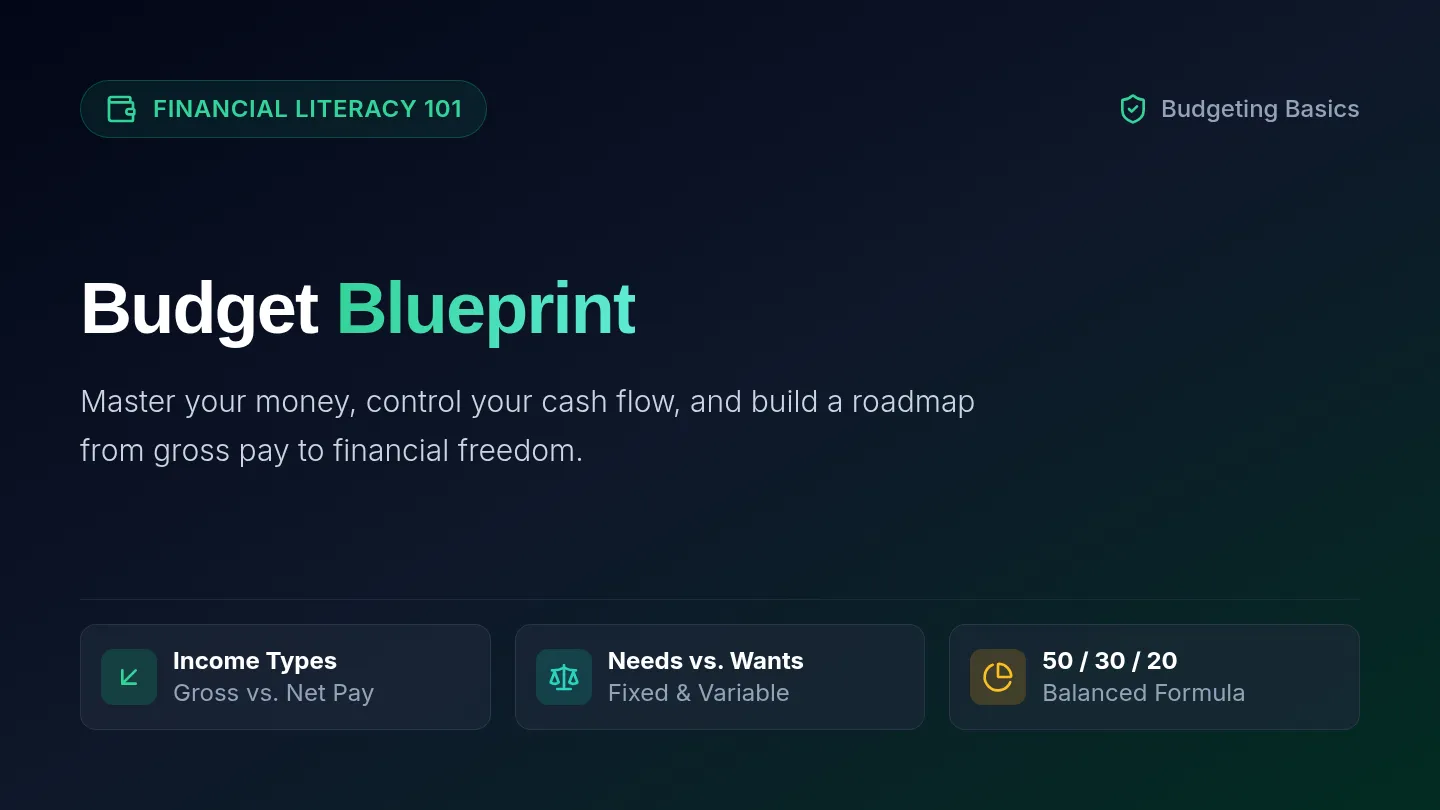
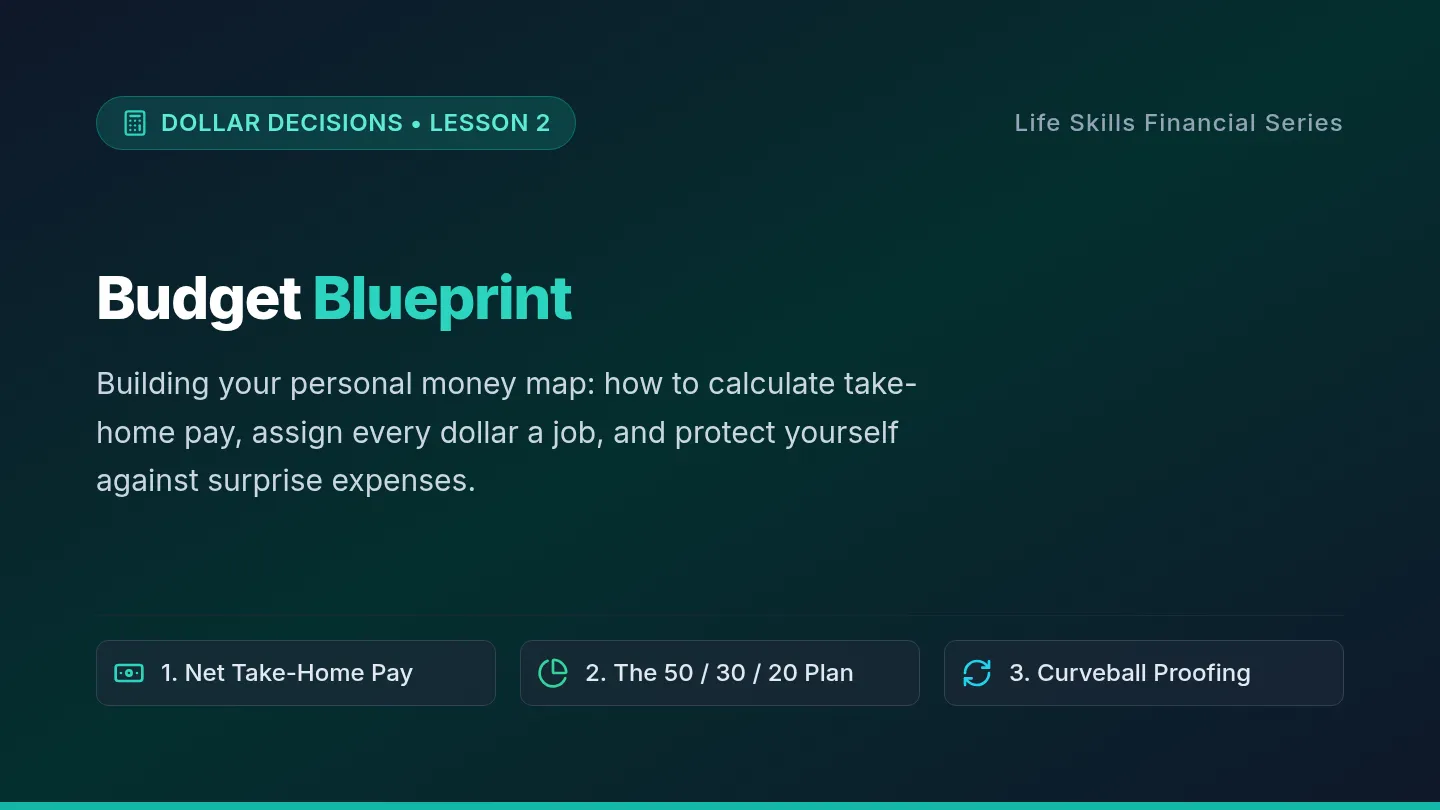
A practical financial literacy sequence designed for life skills learners to master personal money management. Across structured lessons, students learn to differentiate needs from wants, categorize recurring expenses, and build a balanced monthly budget.
1. Calculate the total cost if Jordan pays both needs and the concert: Math: $140 + $90 + $160 = $___________ (Is this under or over Jordan's $320 account balance?)
2. If Jordan chooses to go to the concert, what negative life consequences might occur?
3. What is the most financially responsible decision Jordan should make, and how can Jordan communicate that politely?
Part 5 My Personal Money Rule
Identify one "sneaky want" you regularly buy that you could pause or reduce when you need extra cash:
Dollar Decisions • Needs vs Wants Priority Playbook Page 2 of 2
Item
Correct Category
Teacher Notes / Grading Criteria
1. Apartment Rent ($650)
Need
Essential shelter; failure to pay risks late fees, credit damage, and eviction.
2. Video Game Pass ($15)
Want
Pure entertainment; zero impact on health or ability to function safely.
3. Asthma Inhaler ($35)
Need
Directly safeguards life/breathing; medical necessities are non-negotiable.
4. City Bus Pass ($50)
Need / Context
Need if required to reach employment; earning income sustains all other needs.
5. Fast Food Delivery ($28)
Want
Eating is a need, but delivery markups and restaurant meals are lifestyle wants.
6. Winter Snow Boots ($65)
Need
Physical safety against frostbite; replacing failed footwear is a basic need.
7. Music Streaming ($12)
Want
Free radio or ad-supported audio exists; paying for premium is discretionary.
Priority Ladder Consensus
Apartment Rent: Shelter protection is foundational.
Electricity Bill: Necessary for heat, refrigeration, light.
Math: $140 + $90 + $160 = $390. Over budget by $70.
Consequences: If Jordan attends the concert, car insurance lapses (illegal/suspended license) or food money is wiped out.
Responsible Action: Politely decline concert: "Can't make this trip due to my budget, but catch you next time!"
Differentiation Supports for Diverse Learners
Scaffolding / ELL
Provide a two-column physical cut-and-paste card deck with icons before filling in the written justification table.
Neurodiverse Learners
Use tactile tokens or play cash to physically allocate money to each bill so scarcity and trade-offs are concrete.
Extension / Advanced
Have students research actual utility bills and rent averages in their local zip code to ground figures in local economic realities.
Dollar Decisions • Priority Playbook Teacher Guide End of Lesson 1 Materials Page 2 of 2
$1,600
The Curveball Challenge
Life Happens
Emergency: $150 Sudden Urgent Dental Repair
Alex wakes up with a fractured tooth. The clinic requires $150 cash copay today. Rent ($550) is due Friday and cannot be touched.
Wrong Instinct:
Skip part of rent or pay with a high-interest credit card that can't be repaid.
Budget Master Solution:
Slash $150 from flexible Wants (dining out and shopping) or draw from the emergency buffer!
Key Takeaway: Wants are the shock absorbers of your life. When a curveball hits, shrink your wants to protect your shelter.
Ready to balance your own budget? Activity: Monthly Budget Simulation Worksheet →
Dining + Media + Fun:
$___________ / $1,600
Calculated %: %
Savings Buffer (Goal: ~20%)
Emergency Account:
$___________ / $1,600
Calculated %: %
Part 4 The Curveball Challenge: Urgent Dental Copay ($150)
CRISIS: Mid-month, Alex experiences severe tooth pain. The dentist requires an immediate $150 cash copay. Rent and bills cannot be delayed. Alex refuses to go into credit card debt.
Complete the Rebalancing Plan: Which flexible categories will you reduce to find exactly $150?
Category Being Cut / Reduced
Original Amount
Reduction Amount ($)
$_______
- $___________
$_______
- $___________
Total Money Freed to Pay Dental Bill (Must Equal $150.00):
$150.00
Part 5 Budget Mastery Reflection
1. Why is it vital to cut from "Wants" rather than shortchanging Rent or Utilities during a crisis?
2. If Alex had not set aside any money in Savings, what dangerous options might Alex have been forced into?
Dollar Decisions • Monthly Budget Simulation End of Student Worksheet Page 2 of 2
Dollar Decisions • Budget Mastery Answer Key Page 1 of 2 • Flip for Curveball Solutions & Rubric → Lesson 2
Educator Evaluation Matrix & Curveball Solutions Dollar Decisions Series • Lesson 2
Part 4 Solutions Curveball Challenge: $150 Dental Emergency Rebalancing Models
Model Solution A: Wants Reductions
• Reduce Dining Out: -$80 (new balance: $80)
• Reduce Personal Care/Fun: -$70 (new balance: $170)
• Total freed: $80 + $70 = $150.00
Shelter and savings remain 100% intact.
Model Solution B: Emergency Fund Tap
• Allocate $150 from Alex's $320 savings line item.
• New monthly savings contribution: $170.
• Total freed:$150.00
Demonstrates exact purpose of an emergency fund.
Unacceptable Student Strategy: Reducing rent, skipping the bus pass, or cutting groceries to near zero. Point out that skipping fixed bills results in late fees or eviction.
Part 5 Criteria Exemplary Student Reflection Responses
Q1: Why cut Wants rather than shortchanging Rent or Utilities?
Exemplary Answer: "Rent and utilities are legally binding survival contracts. If Alex cuts rent, Alex risks late penalty fees, bad credit, and eviction. Wants like takeout or shopping can be paused for a month with zero lasting harm to Alex's future."
Q2: If Alex had no savings, what dangerous options might occur?
Exemplary Answer: "Alex might turn to high-interest payday loans or credit cards with 25%+ interest, creating a spiral of debt. Or Alex might postpone treating the tooth, causing severe infection and far higher hospital emergency bills later."
Rubric Life Skills Financial Literacy Scoring Guide (4 Points Total)
4 - Advanced
Budget balances exactly to $1,600. Percentages hit targets. Curveball rebalances solely from wants or savings with thoughtful rationale.
3 - Proficient
Budget balances within $20 of $1,600. Needs are fully protected. Curveball cuts identify $150 from discretionary categories.
2 - Developing
Math errors in subtotaling. Some fixed needs underfunded. Curveball rebalancing cuts into basic groceries or transit.
1 - Beginning
Incomplete budget. Does not understand distinction between net income and gross expenses. Needs significant 1-on-1 coaching.
Dollar Decisions • Budget Mastery Answer Key End of Sequence Materials Page 2 of 2