Money Moves Presentation Slides
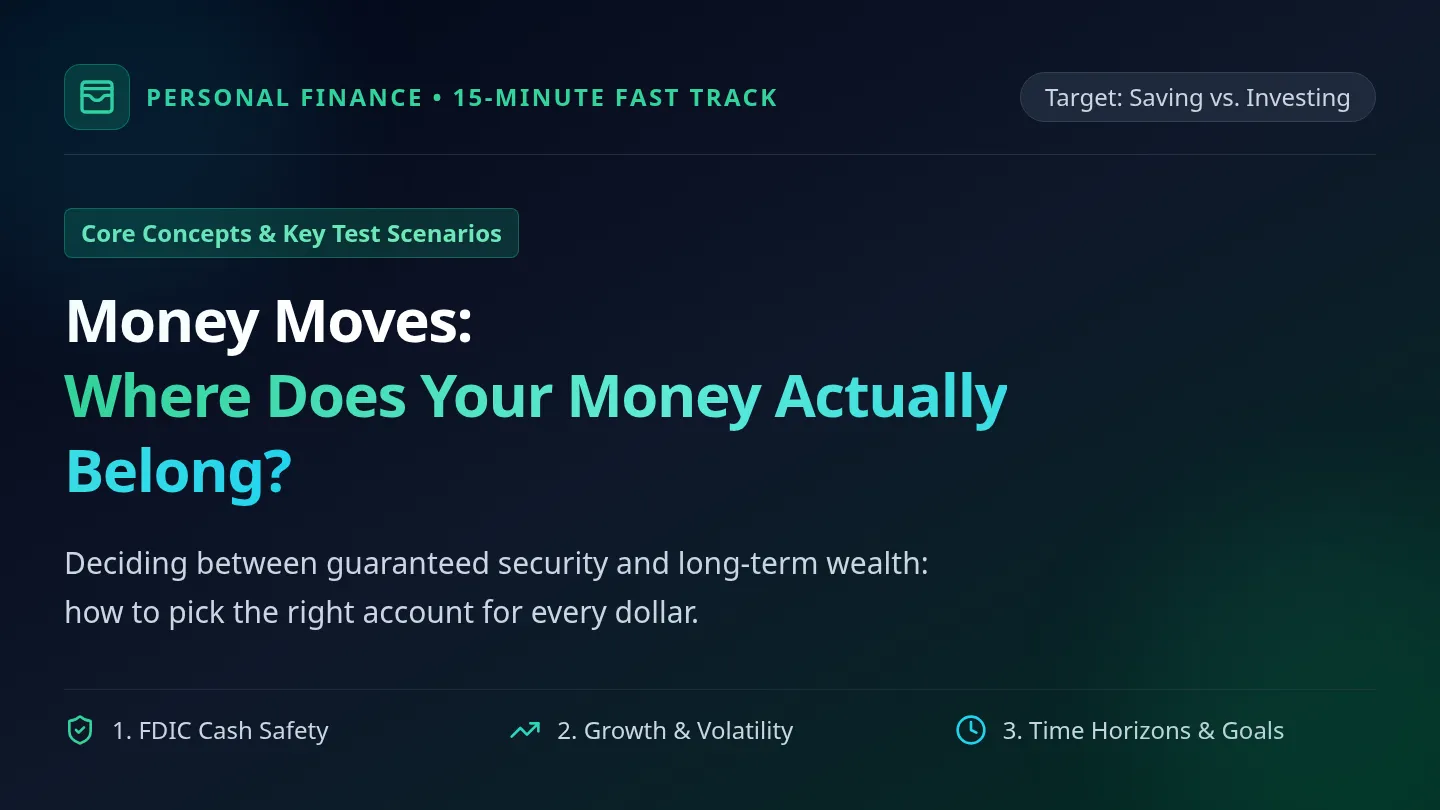
Personal Finance • 15-Minute Fast Track
Target: Saving vs. Investing
Core Concepts & Key Test Scenarios
Money Moves:
Where Does Your Money Actually Belong?
Deciding between guaranteed security and long-term wealth: how to pick the right account for every dollar.
1. FDIC Cash Safety
2. Growth & Volatility
3. Time Horizons & Goals
Part 1: The Safety Zone
Cash Accounts: Insured & Protected
FDIC / NCUSIF: Up to $250k Safe
Traditional Savings
Low interest (0.4%), maximum liquidity. FDIC insured.
Rule:
No restrictions on withdrawals, but low return.
High-Yield (HYSA)
Significantly higher APY (3.5%–4.5%+), FDIC insured.
Key Feature:
Zero market risk + beats standard bank rates.
Certificate of Deposit
Guaranteed fixed rate for a fixed time term.
The Catch:
Steep penalties for early withdrawal!
Money Market (MMA)
Hybrid savings + check writing / debit card.
The Catch:
Higher min. balance & limits on monthly withdrawals.
Test Insight: All 4 options protect your principal ($0 loss), but differ in yield and liquidity restrictions.
Part 2: The Growth Engine
Investing: Stocks, Bonds & Diversification
No FDIC Insurance • Risk of Loss
Ownership
Stocks
You buy a share of a company.
• Highest growth potential
• Value fluctuates significantly
• Can lose principal (no guarantee)
Best for: Long-term horizons
Lending
Bonds
A loan where you lend to gov/corp.
• More security than stocks
• Predictable fixed interest payments
• Historically lower return rates
Best for: Stability & income
Diversification
Mutual Funds
A pooled basket of stocks & bonds.
• Spreads risk across assets
• Avoids "all eggs in one basket"
• Does NOT eliminate all risk
Core Tool: Roth IRA / 401(k)
Key Distinction: Stocks carry volatility risk; diversification spreads it; bonds provide stability.
Part 3: Time Horizon & Purpose
Match the Goal to the Investment
When do you need the money?
Case A: Emergency Fund ($2,000)
Rainy Day Savings
Goal: Instant access when car breaks or medical bill arrives.
Right Choice: Savings Account or HYSA
No lockup, zero loss risk, highly liquid.
Wrong Choice: 401(k) / CD (penalties) or Stocks (market drop risk).
Case B: 40-Year Horizon
Young Person Saving for Retirement
Goal: Maximize growth over 30–40 years to beat inflation.
Right Choice: Roth IRA / Aggressive Stocks
Decades to ride out volatility & earn compound returns.
Wrong Choice: Cash under mattress or checking (eaten by inflation).
Rule of Thumb: Short time horizon (< 3 yrs) = Safety/Cash. Long time horizon (> 5-10 yrs) = Growth/Stocks.
Check Your Understanding
Quick-Fire Test Scenarios
Getting a Baseline
Question 1
Which account is FDIC insured and pays higher interest than a traditional savings account?
Answer: High-Yield Savings Account (HYSA)
Question 2
What is the defining feature and drawback of a Certificate of Deposit (CD)?
Answer: Fixed time commitment with early withdrawal penalty
Question 3
What is the primary benefit of diversification in an investment portfolio?
Answer: Spreading risk across different assets
Question 4
Who would MOST likely choose an aggressive stock portfolio?
Answer: A younger person saving for retirement
Review Tip: Look for keywords like insured, penalties, diversify, and time horizon!
15-Minute Takeaway
The 4 Golden Rules of Money Moves
Mastery Checklist
1. Emergency Cash Stays Liquid
Keep 3–6 months in a Savings or HYSA ($0 loss risk, no lockup, immediate withdrawal).
2. Higher Interest Has Trade-Offs
CDs lock money for a set term; MMAs require high minimums and have withdrawal caps.
3. Volatility Pays Over Decades
Stocks fluctuate significantly in the short run, but generate the highest retirement growth.
4. Diversify to Manage Risk
Mutual funds & Roth IRAs pool investments across hundreds of companies to protect you.
Ready for the assessment: Match each dollar to its timeframe, liquidity need, and risk tolerance!
Money Moves Lecture Guide
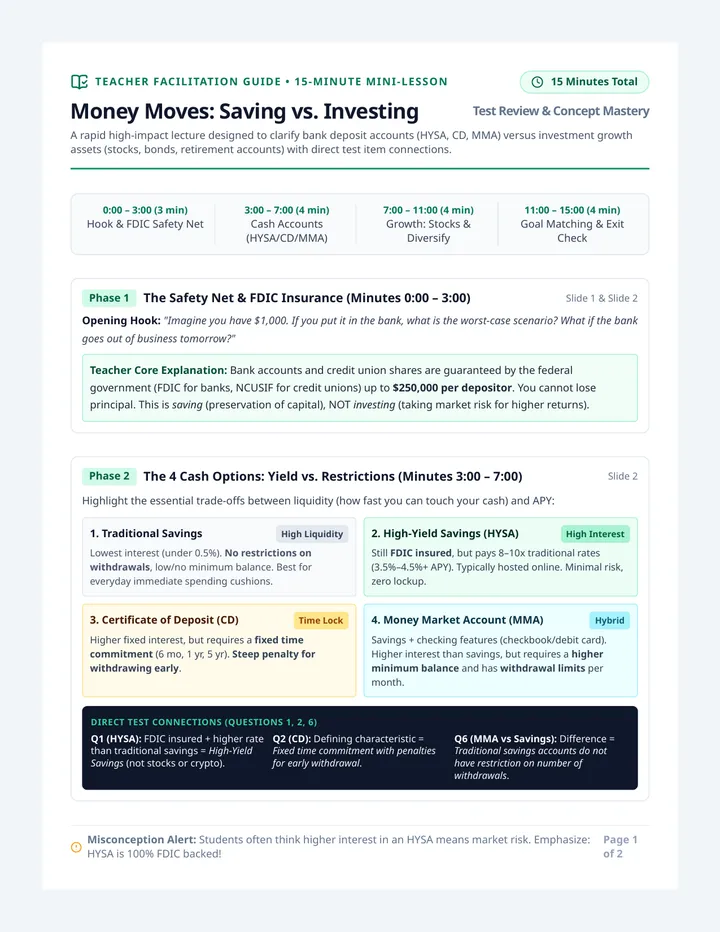
Teacher Facilitation Guide • 15-Minute Mini-Lesson
15 Minutes Total
Money Moves: Saving vs. Investing Test Review & Concept Mastery
A rapid high-impact lecture designed to clarify bank deposit accounts (HYSA, CD, MMA) versus investment growth assets (stocks, bonds, retirement accounts) with direct test item connections.
0:00 – 3:00 (3 min) Hook & FDIC Safety Net
3:00 – 7:00 (4 min) Cash Accounts (HYSA/CD/MMA)
7:00 – 11:00 (4 min) Growth: Stocks & Diversify
11:00 – 15:00 (4 min) Goal Matching & Exit Check
Phase 1
The Safety Net & FDIC Insurance (Minutes 0:00 – 3:00)
Slide 1 & Slide 2
Opening Hook: "Imagine you have $1,000. If you put it in the bank, what is the worst-case scenario? What if the bank goes out of business tomorrow?"
Teacher Core Explanation: Bank accounts and credit union shares are guaranteed by the federal government (FDIC for banks, NCUSIF for credit unions) up to $250,000 per depositor. You cannot lose principal. This is saving (preservation of capital), NOT investing (taking market risk for higher returns).
Phase 2
The 4 Cash Options: Yield vs. Restrictions (Minutes 3:00 – 7:00)
Slide 2
Highlight the essential trade-offs between liquidity (how fast you can touch your cash) and APY:
1. Traditional Savings High Liquidity
Lowest interest (under 0.5%). No restrictions on withdrawals, low/no minimum balance. Best for everyday immediate spending cushions.
2. High-Yield Savings (HYSA) High Interest
Still FDIC insured, but pays 8–10x traditional rates (3.5%–4.5%+ APY). Typically hosted online. Minimal risk, zero lockup.
3. Certificate of Deposit (CD) Time Lock
Higher fixed interest, but requires a fixed time commitment (6 mo, 1 yr, 5 yr). Steep penalty for withdrawing early.
4. Money Market Account (MMA) Hybrid
Savings + checking features (checkbook/debit card). Higher interest than savings, but requires a higher minimum balance and has withdrawal limits per month.
Direct Test Connections (Questions 1, 2, 6)
Q1 (HYSA): FDIC insured + higher rate than traditional savings = High-Yield Savings (not stocks or crypto).
Q2 (CD): Defining characteristic = Fixed time commitment with penalties for early withdrawal.