Different Views Lesson Plan Grade 5 • SEL & ELA 20 Minutes
Teacher Facilitation Guide
What Does It Mean to See From a Different View?
Exploring Perspective, Empathy, and Active Listening in Everyday Interactions
Learning Objective
Students will be able to define perspective and identify at least two different points of view in a given social scenario, explaining how individual feelings and needs shape reactions.
Key Vocabulary
• Perspective: Unique lens
• Point of View: Position/stance
• Empathy: Feeling with others
• Active Listening: Focus & reflect
Required Materials: Projector & Slide Deck • "Two Sides to a Story" Scenario Cards • Student Journals • Pencils
20-Minute Instructional Arc
3 Mins Welcome
1. Warm-Up: The Ambiguous Cylinder & Visual Lens
Display Slide 2 (cylinder casting a square shadow on one wall and a circle on another). Ask: "Who is right—the person who sees a square or a circle?" Reveal that both are telling the truth from their angle.
4 Mins Direct Teach
2. Introduce "Perspective" & The Eyeglasses Metaphor
Define Perspective as the personal lens shaped by experiences, feelings, and beliefs. Introduce Empathy (trying on someone else's glasses) and Active Listening (listening to understand, not to debate).
7 Mins Pair Practice
3. "Two Sides to a Story" Scenario Investigation
Distribute the Scenario Cards. Pairs choose one social scenario (e.g., The Kickball Call or The Group Project). Students identify: (A) Person 1's view & emotion, (B) Person 2's view & emotion, and (C) An active-listening bridge.
3 Mins Discussion
4. Whole-Class Dialogue & Debrief
Ask: "Why do people assume the other person is being mean when perspectives clash?" Emphasize that having a different perspective doesn't make someone an enemy; it reveals a missing piece of the puzzle.
3 Mins Reflection
5. My Point of View Journal Wrap-Up
Students open their reflection journal and complete the "Through Another's Eyes" prompt: recalling a recent disagreement and rewriting it from the other person's perspective.
Facilitation Tips & Common Pitfalls
• Watch for "Right vs. Wrong": Redirect students from deciding who is "correct" to discovering what each person is feeling and protecting.
• Sentence Stems: Encourage students to say "From your seat, you felt..." instead of "You made me..."
Differentiation & Support
• Support / Scaffolding: Use Scenario A (The Art Supply Swap) with pre-highlighted emotion clues and guided feeling word banks.
• Extension: Challenge early finishers to write a 3-sentence script where both characters resolve their conflict using active listening.
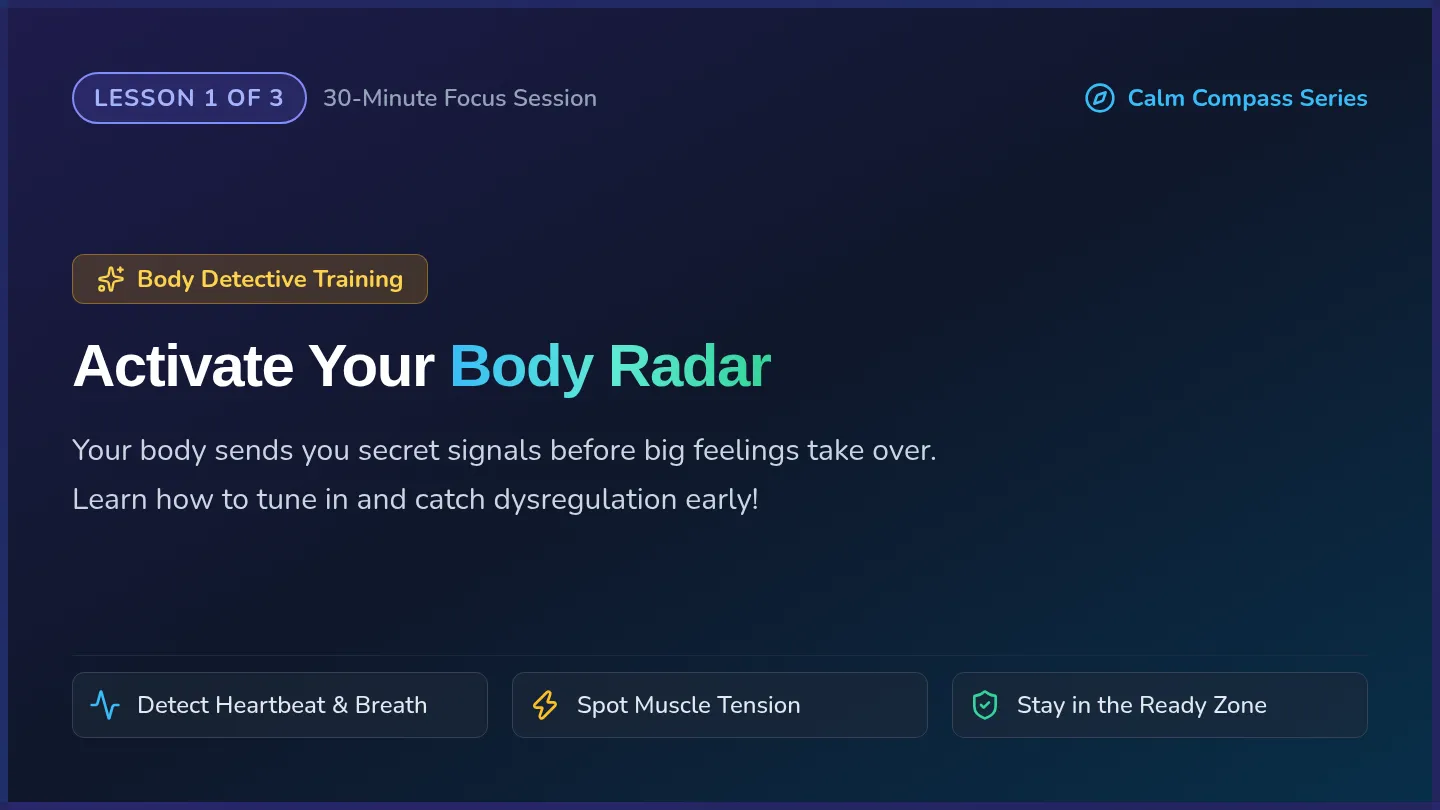
Different Views Slides Grade 5 • SEL Workshop
20-Minute Lesson
What Does It Mean to See From a Different View?
Discovering perspective, unlocking empathy, and learning how two people can experience the exact same moment in completely different ways.
Perspective Empathy Active Listening
Welcome & Warm-Up 3 Minutes
What Do You See?
◼
Person A's Angle
"I am 100% sure this object is a square!"
●
Person B's Angle
"No way! It is definitely a circle!"
The Truth: The 3D object is a cylinder! Both people are telling the exact truth from where they are standing.
Core Concepts 4 Minutes
What Is Perspective?
Perspective is the personal lens shaped by your past experiences, memories, feelings, and current needs.
Point of View
Where you stand and what you physically or emotionally notice first in a situation.
Empathy
Pausing to try on someone else’s glasses and feeling what they might be experiencing.
Active Listening
Listening to understand how someone feels, rather than just waiting for your turn to argue back.
"Two people can look at the same event and feel completely different emotions."
Pair Activity 7 Minutes
Two Sides to a Story
With your partner, choose a scenario and put on both pairs of glasses.
1
Side A's Lens
What did Person A see happen? What were they feeling, and what did they need?
2
Side B's Lens
What did Person B see happen? What were they feeling, and what did they need?
3
The Bridge
How can active listening help both sides realize neither person was trying to hurt the other?
Partner rule: No judging! Treat both points of view as real and understandable.
Group Discussion 3 Minutes
Let's Talk It Out
Consider these big questions with our whole class community:
When two people disagree, must one be the "bad guy"?
Why do our brains naturally assume someone meant to hurt our feelings?
What is the difference between hearing and active listening?
How does saying "What I hear you saying is..." change the conversation?
Key Takeaway: Understanding someone doesn't mean you must agree with everything they do.
Two Sides Scenario Cards Case Files Pair Investigation
Seeing Through Different Lenses
Two Sides to a Story: Scenario Cards
Read the three real-life school situations below. Notice how two people can experience the exact same event completely differently.
Case 01
The Recess Kickball Call
Setting: Playground
Lucas kicks a high ball right along the baseline. Lucas rounds first base celebrating, but Maya (the first-base referee) shouts, "Foul ball! You're out!"
Lucas's Lens:
Lucas waited all recess for his turn to kick. From where he was running, the ball looked like it grazed chalk. He feels frustrated and thinks Maya is picking on him.
Maya's Lens:
Maya took refereeing seriously and stood right over the chalk line. From her angle, the ball bounced two inches outside. She feels hurt that Lucas yelled at her for just doing her job.
Case 02
The Shared Pastel Dilemma
Setting: Art Room
The art teacher announces there are only five minutes left. Jordan quickly reaches across the table and grabs the only royal blue oil pastel. Sam gasps and throws their hands up in anger.
Jordan's Lens:
Jordan is panicked about getting a bad grade because their sky is completely uncolored. They saw the pastel sitting unused for two minutes and grabbed it in a rush.
Sam's Lens:
Sam had placed the pastel right next to their paper while blending clouds. They were about to use it for details. Sam feels Jordan was rude and had no respect for personal space.
Case 03
The Cafeteria Whisper
Setting: Lunch Table
Ava walks toward the lunch table with a new haircut. Chloe looks up, leans over, and whispers something into Mia’s ear. Both girls giggle. Ava abruptly turns around and sits alone.
Ava's Lens:
Ava felt self-conscious all morning about her short hair. Seeing her friends whisper and laugh right when she approached made her feel mocked, embarrassed, and excluded.
Chloe's Lens:
Chloe was actually whispering to Mia about a surprise birthday banner they were making for Ava after school. Chloe had no idea Ava noticed them or felt self-conscious.
Next Step: Pick one scenario with your partner and flip to the Investigation Sheet to decode both lenses! Page 1 of 2
Name:
Partner:
Date:
Perspective Detective Investigation Sheet
Selected Case: Case 01 Case 02 Case 03
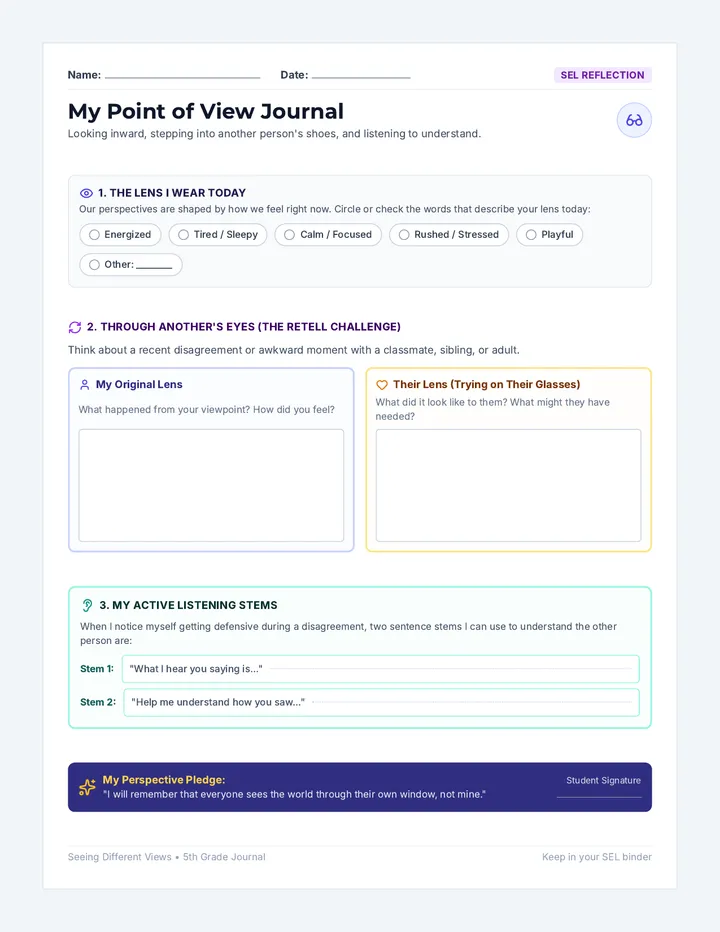
Point of View Journal Name:
Date:
SEL Reflection
My Point of View Journal
Looking inward, stepping into another person's shoes, and listening to understand.
1. The Lens I Wear Today
Our perspectives are shaped by how we feel right now. Circle or check the words that describe your lens today:
Energized Tired / Sleepy Calm / Focused Rushed / Stressed Playful Other: ________
2. Through Another's Eyes (The Retell Challenge)
Think about a recent disagreement or awkward moment with a classmate, sibling, or adult.
My Original Lens
What happened from your viewpoint? How did you feel?
Their Lens (Trying on Their Glasses)
What did it look like to them? What might they have needed?
3. My Active Listening Stems
When I notice myself getting defensive during a disagreement, two sentence stems I can use to understand the other person are:
Stem 1:
"What I hear you saying is..."
Stem 2:
"Help me understand how you saw..."
My Perspective Pledge: "I will remember that everyone sees the world through their own window, not mine."
Student Signature
Seeing Different Views • 5th Grade Journal Keep in your SEL binder