Feedback Shift Activity
10-Minute PD Sprint Teacher & Student Services Collaboration
10 Minutes Total
The Feedback Shift: Moving from Tell to Think
Navigating Judgmental, Constructive, and Facilitative (Mediative) Feedback in Schools
Partner 1 (Role):
Partner 2 (Role):
Date:
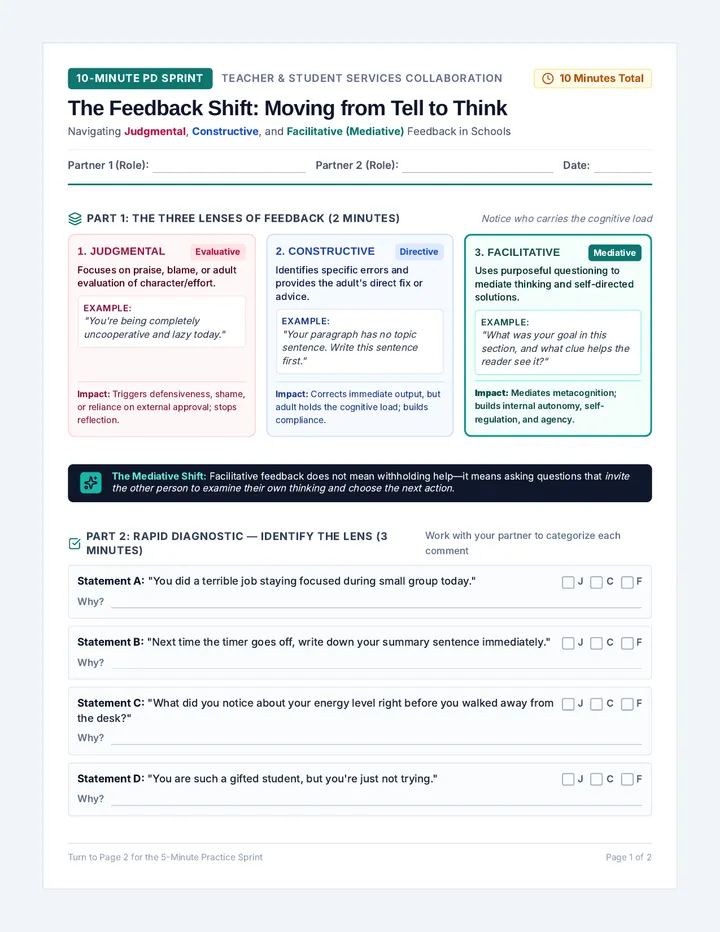
Part 1: The Three Lenses of Feedback (2 Minutes)
Notice who carries the cognitive load
1. Judgmental Evaluative
Focuses on praise, blame, or adult evaluation of character/effort.
Example:
"You're being completely uncooperative and lazy today."
Impact: Triggers defensiveness, shame, or reliance on external approval; stops reflection.
2. Constructive Directive
Identifies specific errors and provides the adult's direct fix or advice.
Example:
"Your paragraph has no topic sentence. Write this sentence first."
Impact: Corrects immediate output, but adult holds the cognitive load; builds compliance.
3. Facilitative Mediative
Uses purposeful questioning to mediate thinking and self-directed solutions.
Example:
"What was your goal in this section, and what clue helps the reader see it?"
Impact: Mediates metacognition; builds internal autonomy, self-regulation, and agency.
The Mediative Shift: Facilitative feedback does not mean withholding help—it means asking questions that invite the other person to examine their own thinking and choose the next action.
Part 2: Rapid Diagnostic — Identify the Lens (3 Minutes)
Work with your partner to categorize each comment
Statement A: "You did a terrible job staying focused during small group today."
J C F
Why?
Statement B: "Next time the timer goes off, write down your summary sentence immediately."
J C F
Why?
Statement C: "What did you notice about your energy level right before you walked away from the desk?"
J C F
Why?
Statement D: "You are such a gifted student, but you're just not trying."
J C F
Why?
Turn to Page 2 for the 5-Minute Practice Sprint Page 1 of 2
Part 3: The 5-Minute Reframe Relay (Practice Sprint)
Transform reactive judgmental or directive statements into facilitative coaching questions.
5 Minutes
Scenario 1 Classroom Engagement / Shutdown
Setting: Tier 1 Independent Practice
Typical Reactive Impulse (Judgmental / Directive):
"Stop putting your head down. You have no work done, and you're wasting time. Pick up your pencil and start problem one."
Your Facilitative / Mediative Rewrite: (Ask a question that invites the student to identify their hurdle or strategy)
Scenario 2 Support Team / Colleague Consultation
Setting: SST / IEP Check-in
Typical Reactive Impulse (Judgmental / Directive):
"That student just refuses to follow the behavior plan. You just need to send them out when they yell."
Your Facilitative / Mediative Rewrite: (Ask a question that prompts analyzing triggers or successful antecedent strategies)
Scenario 3 Academic Dependency
Setting: Co-Taught / Intervention Room
Typical Reactive Impulse (Judgmental / Directive):
"You're being overly needy. I just explained this; look at the board and do what it says."
Your Facilitative / Mediative Rewrite: (Ask a question that activates prior knowledge or self-checking criteria)
Facilitative / Mediative Stem Bank
• "What do you notice about how...?"
• "What criteria are you using to decide...?"
• "What was your intent when you tried...?"
• "What part feels clear, and where does it get murky?"
• "What tool or resource might help you test this?"
• "If you tried X, what might happen next?"
Part 5: 60-Second Micro-Commitment
Self-Selected Action
One student or colleague I will use a facilitative question with this week:
The question I plan to lead with:
Feedback Shift Protocol • Professional Development for Educators & Support Staff Page 2 of 2
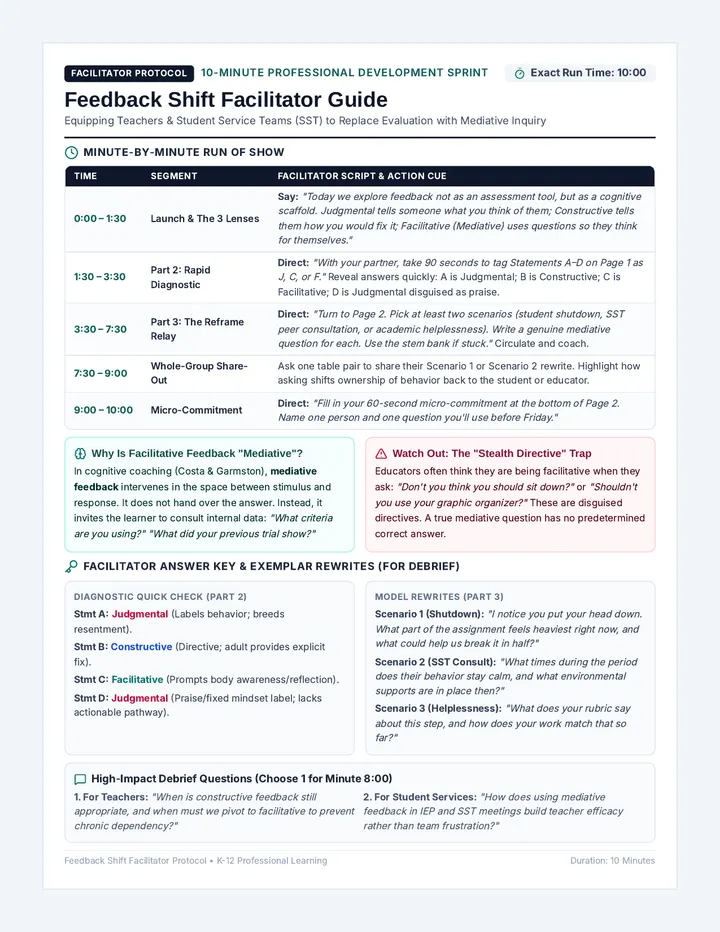
Feedback Shift Facilitator Guide
Facilitator Protocol 10-Minute Professional Development Sprint
Exact Run Time: 10:00
Feedback Shift Facilitator Guide
Equipping Teachers & Student Service Teams (SST) to Replace Evaluation with Mediative Inquiry
Minute-by-Minute Run of Show
| Time |
Segment |
Facilitator Script & Action Cue |
| 0:00 – 1:30 |
Launch & The 3 Lenses |
Say: "Today we explore feedback not as an assessment tool, but as a cognitive scaffold. Judgmental tells someone what you think of them; Constructive tells them how you would fix it; Facilitative (Mediative) uses questions so they think for themselves." |
| 1:30 – 3:30 |
Part 2: Rapid Diagnostic |
Direct: "With your partner, take 90 seconds to tag Statements A–D on Page 1 as J, C, or F." Reveal answers quickly: A is Judgmental; B is Constructive; C is Facilitative; D is Judgmental disguised as praise. |
| 3:30 – 7:30 |
Part 3: The Reframe Relay |
Direct: "Turn to Page 2. Pick at least two scenarios (student shutdown, SST peer consultation, or academic helplessness). Write a genuine mediative question for each. Use the stem bank if stuck." Circulate and coach. |
| 7:30 – 9:00 |
Whole-Group Share-Out |
Ask one table pair to share their Scenario 1 or Scenario 2 rewrite. Highlight how asking shifts ownership of behavior back to the student or educator. |
| 9:00 – 10:00 |
Micro-Commitment |
Direct: "Fill in your 60-second micro-commitment at the bottom of Page 2. Name one person and one question you'll use before Friday." |
Why Is Facilitative Feedback "Mediative"?
In cognitive coaching (Costa & Garmston), mediative feedback intervenes in the space between stimulus and response. It does not hand over the answer. Instead, it invites the learner to consult internal data: "What criteria are you using?" "What did your previous trial show?"
Watch Out: The "Stealth Directive" Trap
Educators often think they are being facilitative when they ask: "Don't you think you should sit down?" or "Shouldn't you use your graphic organizer?" These are disguised directives. A true mediative question has no predetermined correct answer.
Facilitator Answer Key & Exemplar Rewrites (For Debrief)
Diagnostic Quick Check (Part 2)
- Stmt A: Judgmental (Labels behavior; breeds resentment).
- Stmt B: Constructive (Directive; adult provides explicit fix).
- Stmt C: Facilitative (Prompts body awareness/reflection).
- Stmt D: Judgmental (Praise/fixed mindset label; lacks actionable pathway).
Model Rewrites (Part 3)
- Scenario 1 (Shutdown): "I notice you put your head down. What part of the assignment feels heaviest right now, and what could help us break it in half?"
- Scenario 2 (SST Consult): "What times during the period does their behavior stay calm, and what environmental supports are in place then?"
- Scenario 3 (Helplessness): "What does your rubric say about this step, and how does your work match that so far?"
High-Impact Debrief Questions (Choose 1 for Minute 8:00)
1. For Teachers: "When is constructive feedback still appropriate, and when must we pivot to facilitative to prevent chronic dependency?"
2. For Student Services: "How does using mediative feedback in IEP and SST meetings build teacher efficacy rather than team frustration?"
Feedback Shift Facilitator Protocol • K-12 Professional Learning Duration: 10 Minutes
Feedback Shift Slides
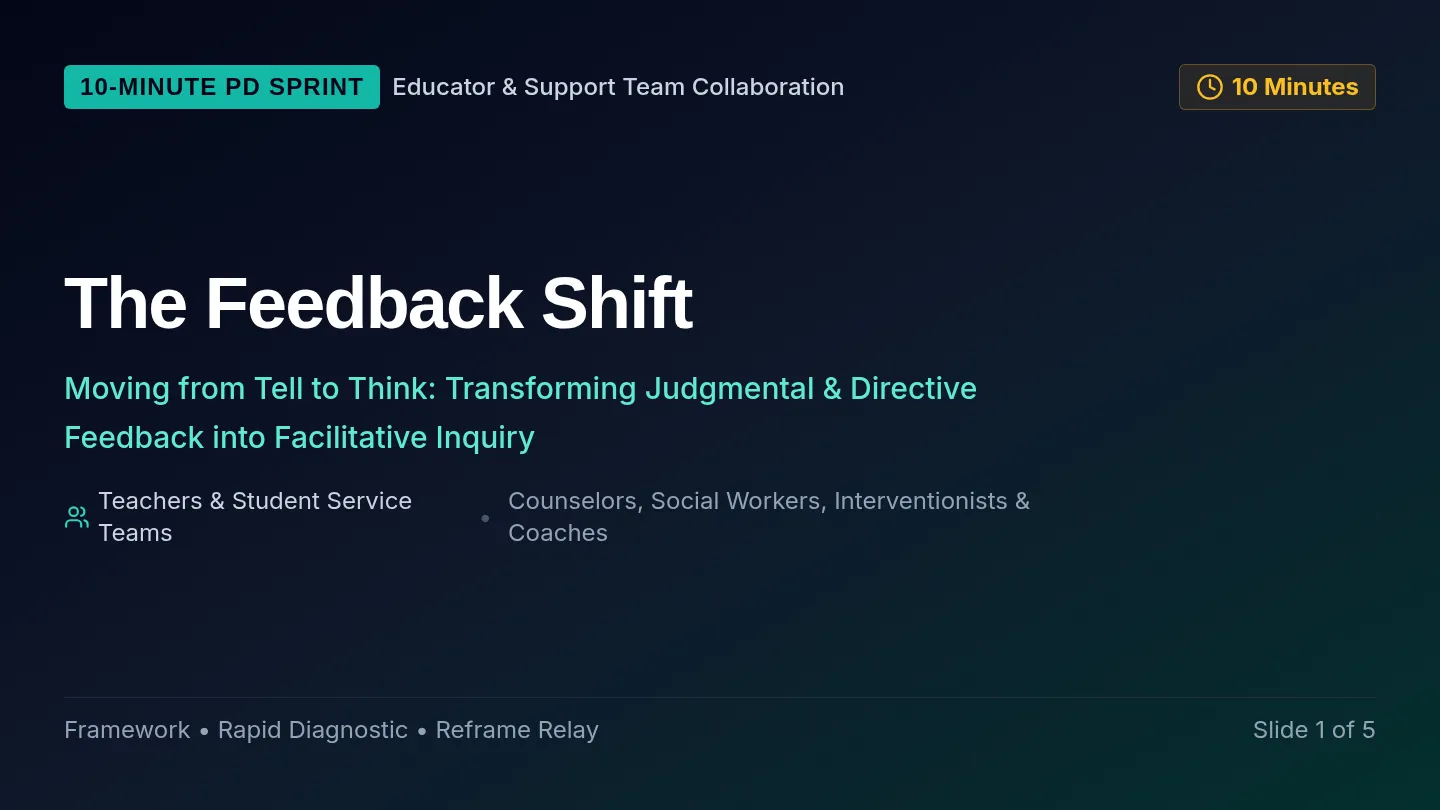
10-Minute PD Sprint Educator & Support Team Collaboration
10 Minutes
The Feedback Shift
Moving from Tell to Think: Transforming Judgmental & Directive Feedback into Facilitative Inquiry
Teachers & Student Service Teams • Counselors, Social Workers, Interventionists & Coaches
Framework • Rapid Diagnostic • Reframe Relay Slide 1 of 5
The Three Feedback Lenses
Who carries the cognitive load during the conversation?
Minutes 0:00 – 2:00
1. Judgmental Evaluative
Evaluates character or effort with praise or blame.
Example:
"You're completely off-task and unmotivated."
Outcome: Triggers defensiveness, shame, or reliance on praise.
2. Constructive Directive
Identifies errors and provides the adult's explicit fix.
Example:
"Write a topic sentence here before continuing."
Outcome: Solves immediate task, but adult retains the thinking.
3. Facilitative Mediative
Uses purposeful questions to mediate reflection and agency.
Example:
"What was your goal here, and what's in the way?"
Outcome: Builds metacognition, autonomy, and self-directed solutions.
Concept Framework Slide 2 of 5
The Reframing Arc
One authentic school moment transformed across all three levels
Classroom Reality
The Situation:
A middle school student pushes their workbook away and puts their head on their desk during independent work.
Judgmental Impulse
"Stop shutting down and being lazy. You're wasting class time."
Focus: Blame / Label
Constructive Directive
"Sit up, grab your pencil, and reread the directions for problem one."
Focus: Adult solves it
Facilitative / Mediative
"I notice your head is down. What part of the directions feels cloudy, and what tool could help us restart?"
Focus: Student reflects
The shift requires pausing the adult reflex to command. Slide 3 of 5
5-Minute Reframe Relay
Pair Up: 1 Teacher + 1 Student Services or Support Peer
5:00 on Clock
Partner Action Protocol
- 1 Open Page 2 of your printed activity sheet.
- 2 Select at least two scenarios (Shutdown, SST Consult, or Helplessness).
- 3 Write a genuine mediative question that triggers reflection.
Mediative Question Stems
• "What do you notice about...?"
• "What criteria are you using to decide...?"
• "What was your intent when you tried...?"
• "What tool or strategy could you test first?"
• "Where does the task get unclear?"
Rule: No "fake questions" (e.g., "Don't you think you should...?")
Collaborative Practice Sprint Slide 4 of 5
Debrief & Micro-Commitment
Translating 10 minutes into daily school practice
Final 2 Minutes
The Golden Acid Test:
"Could they give an answer that I didn't already have in my head?"
If the only acceptable answer to your question was your own secret plan, it wasn't mediative—it was a directive wearing a question mark.
Mediative feedback values the thinker over the quick fix.
Part 5 on Page 2:
Your 60-Second Micro-Commitment
- 1. Name one student or colleague you interact with this week.
- 2. Write the exact mediative question you will lead with.
- 3. Notice what happens to their body language and problem ownership.
"When we tell, we carry the load. When we ask, we build their capacity."
Feedback Shift Complete • Thank you for empowering our learners and teams! Slide 5 of 5