Regulation Navigators Teacher Guide REGULATION NAVIGATORS
10-Day SEL Curriculum: Tying Self-Control to the Zones of Regulation
Grades 1–5
Week 1 & Week 2 Scope
The Core Connection
The Zones identify emotional & physiological states (Blue, Green, Yellow, Red). Self-Control is the student's active steering wheel and brake pedal that chooses the right tool for each zone.
BLUE ZONE Tired, sad, slow Tool: Re-energize
GREEN ZONE Calm, focused, okay Tool: Maintain Focus
YELLOW ZONE Frustrated, silly, fast Tool: Impulse Brake
RED ZONE Angry, yelling, surge Tool: Full Stop / Reset
Week 1: Recognizing States & Self-Control Signals
15–20 Mins / Day
DAY 1
What is Self-Control? (Cerebrate Sheet 1 Connection)
Core Concept Intro
Objective: Define self-control as thinking before acting, controlling words/actions, and waiting. Read aloud a relatable scenario (waiting for recess line). Introduce the 4 koala self-control anchors. Students complete Packet Page 1: What is Self-Control? and draw themselves showing control.
DAY 2
The 4 Emotional Zones & Your Inner Engine
Zone Engine Slides
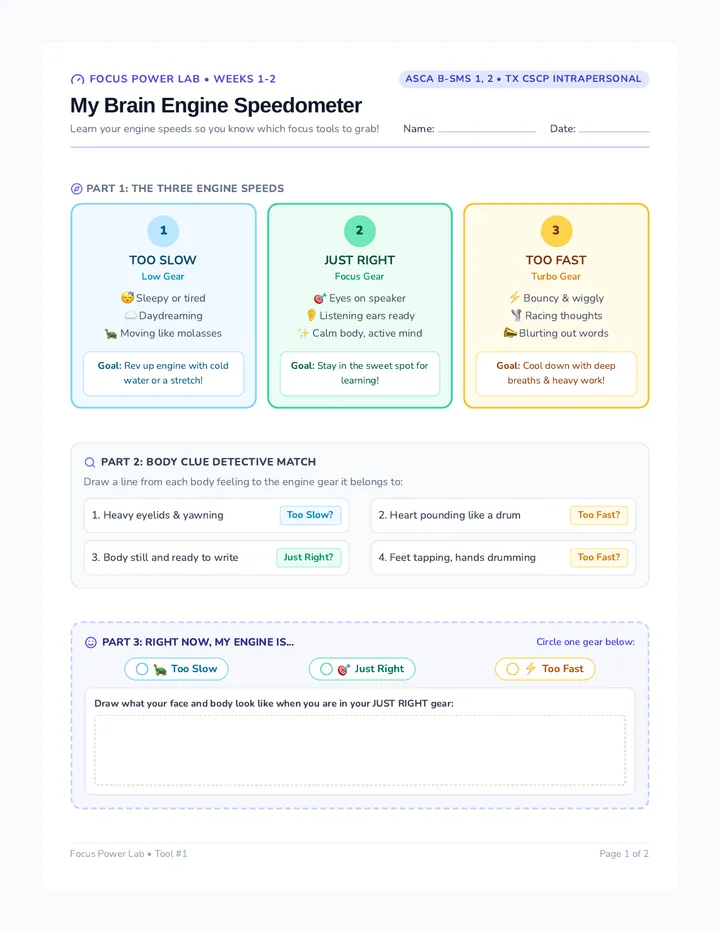
Objective: Introduce the 4 Zones using car engine metaphors (too slow, just right, revving up, overheating). Emphasize that all zones are normal and acceptable, but our behavior and words need our steering wheel. Present Slides 1–4 with group gestures for each zone.
DAY 3
Self-Control and Me: Classroom Audit (Cerebrate Sheet 2)
Self-Audit
Objective: Guide an honest self-assessment without shame. Students complete the 7-item audit (blurting, hands to self, seat wandering) marking Never, Sometimes, Always. Model annotating with ! (celebrate), * (goal to improve), and ? (clarify).
DAY 4
Why Self-Control? Cause & Effect (Cerebrate Sheet 3)
Positive Outcomes
Objective: Explore consequences of uncontrolled impulses vs. self-controlled choices. Discuss three scenarios: raising hand, staying calm when frustrated, respecting game rules. Students complete Packet Page 2 illustrating positive outcomes (trust, fun games, proud feelings).
DAY 5
Body Warning Signals: Catching the Yellow Zone Early
Body Mapping
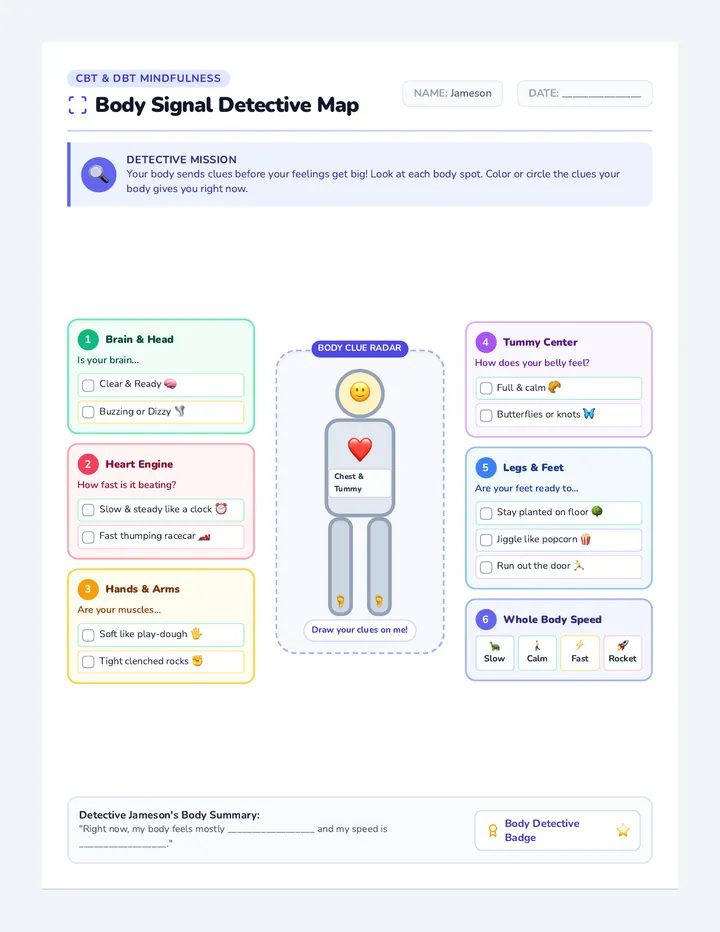
Objective: Help students identify early somatic warnings before reaching the Red Zone (clenched fists, rapid heartbeat, tight jaw, squirmy feet). Introduce the Body Alarm Check routine during morning circle.
Unit: Regulation Navigators • Lesson 1 of 2 Page 1 of 2 (Teacher Implementation Plan)
WEEK 2 ROADMAP & CLASSROOM STRATEGIES
Action Tools, Gamified Practice, & Daily Goal Tracking
Days 6–10
Week 2: Tools in Action, Game Practice & Habit Mastery
15–25 Mins / Day
DAY 6
The "Stop-Think-Choose" Impulse Brake Formula
Brake Protocol
Objective: Practice the 3-step impulse brake: 1. Stop (freeze physical movement, 1 deep belly breath), 2. Think (what zone am I in?), 3. Choose (pick a Green Zone returning tool). Role-play peer blurting and line-cutting scenarios.
DAY 7
Building the Zone Toolkits: Sensory & Cognitive Brakes
Tool Selection
Objective: Explore individualized calming tools for each zone (e.g., 5-finger breathing, sensory wall push, drink of water, chair push-up, positive self-talk). Introduce the Zones Quest Activity Sheet as vocabulary reinforcement and strategy decoding.
DAY 8
Impulse Brakes Classroom Board Game Day
Interactive Play
Objective: Students play the Impulse Brakes Board Game in pairs or small groups. They draw real-life school dilemma cards, identify the emotional zone, and demonstrate the appropriate self-control strategy to advance on the track.
DAY 9
Setting the Self-Control Goal (Cerebrate Sheet 4)
Goal Formulation
Objective: Using their Day 3 audit (* stars), each student crafts one concrete, measurable self-control goal (e.g., "Raise hand before speaking in math"). Introduce the Goal Navigator Weekly Tracker (1–4 rubric) for daily self-scoring.
DAY 10
Navigator Celebration & Routine Sustainability
Mastery & Wrap-Up
Objective: Celebrate self-control milestones! Students pair-share their goal progress, review their weekly 1–4 tracking cards, and sign their Navigator Self-Control Pledge. Teacher embeds the daily 1-minute morning zone check-in permanently into classroom culture.
Daily Morning Meeting Check-In
Zone Finger Scale: Show 1 (Blue), 2 (Green), 3 (Yellow), 4 (Red) upon morning arrival.Brake Practice: One collective class belly breath before transition to direct instruction.Goal Anchor: 30-second silent review of their personal Cerebrate goal card.
Accommodations & Scaffolds
Visual Cue Cards: Tape a mini stop-sign & 4-zone badge to desks for non-verbal reminders.Movement Breaks: Provide heavy work options (wall pushups) for Yellow Zone body restlessness.Dictation Option: Allow emerging writers to dictate reflection responses or draw comic panels.
Adapted from Cerebrate SEL Framework (Lively Minds Institute) Page 2 of 2 (Classroom Implementation Guide)
Zone Engine Slides Regulation Navigators
Lesson Series
Inner Engines &
Self-Control
How our internal steering wheel and brakes help us navigate the 4 emotional zones every single day.
Check Your Engine • Use Your Brakes • Reach Your Goals
What is Self-Control?
The 4 Superpowers
1. Thinking Before You Act
Pressing pause inside your brain before making your next move.
2. Controlling Words & Actions
Keeping hands to yourself and choosing kind, helpful words.
3. Staying Calm When Upset
Taking deep belly breaths instead of yelling or slamming things.
4. Waiting Your Turn to Speak
Holding your thoughts until it is your turn without blurting out.
Self-control is a muscle. The more you practice, the stronger your steering wheel becomes!
The 4 Emotional Zones
What speed is your engine running?
BLUE ZONE
Engine Running Slow
Tired • Sad • Bored • Sick
Need: Recharging
GREEN ZONE
Engine Just Right
Calm • Happy • Focused • Ready
Ready to Learn!
YELLOW ZONE
Engine Revving Up
Frustrated • Silly • Worried • Wiggly
Need: Impulse Brakes
RED ZONE
Engine Overheating
Mad • Yelling • Explosive • Out of Control
Need: Full Stop Reset
Remember: All zones are okay to feel! Self-control helps us choose what to do next.
Recognizing Common Impulses
Self-Control and Me
When our engine revs into the Yellow Zone, we feel impulses like:
Blurting Out
Shouting answers before the teacher calls on anyone.
Leaving Seat
Wandering around the room when it is quiet work time.
Busy Hands
Touching neighbors' supplies or pushing in line.
! = Things I do great ★ = Things I want to improve ? = Things I want to ask about
The 3-Step Impulse Brake
How to Steer Back to Green
Step 1
STOP
Freeze your body and mouth. Take 1 slow, deep belly breath through your nose.
"Hit the Brakes"
Step 2
THINK
Check your engine: What zone am I in? What will happen if I act right now?
Self Control Student Packet Regulation Navigators • Explorer Packet
What is Self-Control?
Name:
Date:
Self-control can be shown in many ways. When you understand what it is, it's easier to learn how to improve it.
Part 1: Four Ways We Use Self-Control
Draw a circle around the one you do best!
Thinking before you act
Pause your engine
Controlling what you do or say
Gentle hands & words
Staying calm when upset
Take a deep breath
Waiting your turn to speak
Raise hand patiently
Part 2: Self-Control and Me (My Honesty Audit)
Check Never, Sometimes, or Always for each challenge.
! = Never ★ = Goal ? = Ask
! ★ ? Self-Control Challenge Never Sometimes Always 1. I blurt out the answers in class
|
|
| | 2. It is hard to stop my actions |
|
|
|
| | 3. I interrupt others when they are talking |
|
|
|
| | 4. I don't think before I act |
|
|
|
| | 5. I don't keep my hands to myself |
|
|
|
| | 6. I get out of my seat a lot |
|
|
|
| | 7. I don't keep my thoughts to myself |
|
|
|
Take Action: 1. Draw ! next to actions marked "Never". 2. Draw ★ next to 1–2 actions you want to improve. 3. Draw ? next to anything confusing.
Regulation Navigators • Adapted from Cerebrate SEL Page 1 of 2
Regulation Navigators • Explorer Packet
Why Self-Control?
Name:
Date:
Self-control looks different for everyone. Thinking about how you have used self-control helps you see how important it is.
Part 3: Three Powerful Moments of Self-Control
1. Raising Hand
Waiting patiently for your turn to share your brilliant idea.
2. Staying Calm
Taking a reset breath when you feel frustrated or upset.
3. Following Rules
Deciding to make safe choices even when no one is watching.
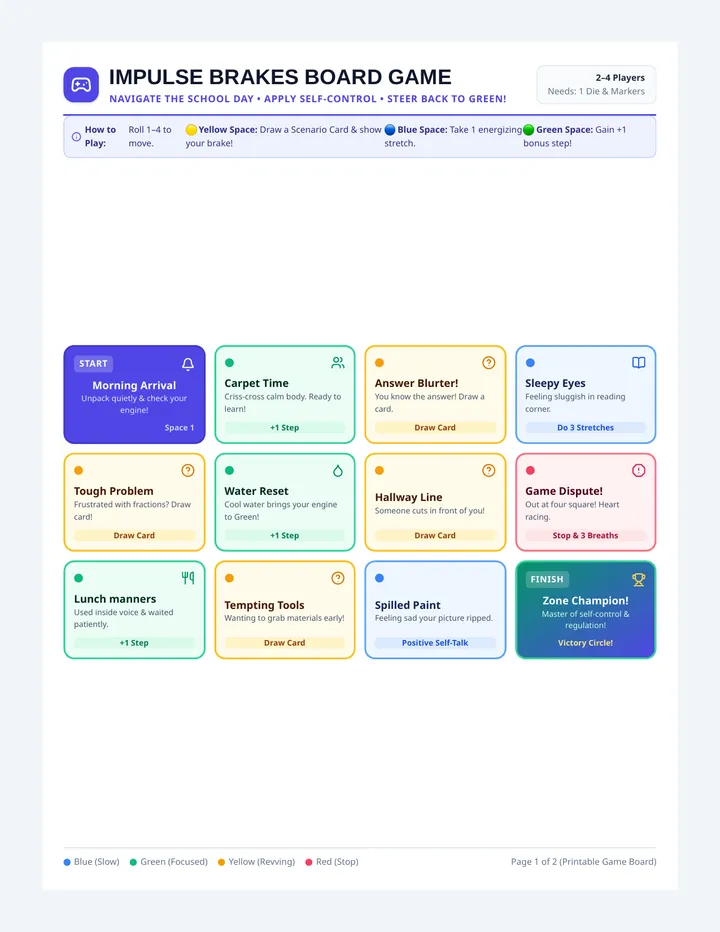
Impulse Brakes Board Game IMPULSE BRAKES BOARD GAME
Navigate the School Day • Apply Self-Control • Steer Back to Green!
2–4 Players
Needs: 1 Die & Markers
How to Play: Roll 1–4 to move. 🟡 Yellow Space: Draw a Scenario Card & show your brake! 🔵 Blue Space: Take 1 energizing stretch. 🟢 Green Space: Gain +1 bonus step!
START
Morning Arrival
Unpack quietly & check your engine!
Space 1
Carpet Time
Criss-cross calm body. Ready to learn!
+1 Step
Answer Blurter!
You know the answer! Draw a card.
Draw Card
Sleepy Eyes
Feeling sluggish in reading corner.
Do 3 Stretches
Tough Problem
Frustrated with fractions? Draw card!
Draw Card
Water Reset
Cool water brings your engine to Green!
+1 Step
Hallway Line
Someone cuts in front of you!
Draw Card
Game Dispute!
Out at four square! Heart racing.
Stop & 3 Breaths
Lunch manners
Used inside voice & waited patiently.
+1 Step
Tempting Tools
Wanting to grab materials early!
Draw Card
Spilled Paint
Feeling sad your picture ripped.
Positive Self-Talk
FINISH
Zone Champion!
Master of self-control & regulation!
Victory Circle!
Blue (Slow) Green (Focused) Yellow (Revving) Red (Stop)
Page 1 of 2 (Printable Game Board)
SCENARIO CARDS & GAME PIECES
Cut along dotted lines • Draw when landing on a Yellow dilemma space
8 Dilemma Cards
Dilemma #1
The Exciting Question
The teacher asks your favorite question. You want to scream the answer!
Self-Control Brake: Hold your bubble & raise hand quietly.
Dilemma #2
Losing at Recess
Your soccer team loses at the buzzer. You feel mad and want to kick the cone.
Self-Control Brake: 5-finger breathing & say "Good game!"
Dilemma #3
Accidental Bump
A classmate bumps into your desk and knocks down your pencil box.
Self-Control Brake: Pause, ask calmly: "Are you okay?"
Zones Quest Activity Sheet Regulation Navigators • Fun Challenge
Zones & Self-Control Quest
Name:
Date:
Hunt for the hidden self-control and Zones vocabulary words below! Words can be found forward across ➔ or down ⬇️.
C O N T R O L X B O X G I M P U L S E Y R E D R B R A K E S Z P E N S E P A U S E W Q A A E T E B L U E J K L U T R E N Y E L L O W O S H G E Z C A L M D F G E E Y R O B R E A T H E T A T S N F O C U S K L S D E T E S T E E R M N O P T E S T H I N K Q U I E T R Z Z O N E S C H O I C E S
Word Bank (12 Words)
CONTROL
IMPULSE
BRAKES
PAUSE
BLUE
GREEN
YELLOW
RED
CALM
FOCUS
BREATHE
STEER
Bonus Words: Can you find THINK and CHOICES ?
Part 2: Regulation Strategy Match
Blue Zone Tool
Stretch & drink cold water
Green Zone Tool
Keep listening & doing best
Yellow Zone Tool
3 deep breaths & pause
Red Zone Tool
Safe quiet corner & reset
Part 3: Secret Navigator Code
Fill in the missing vowels (A, E, I, O, U) to reveal our classroom self-control motto:
I AM THE D R _ V _ R OF MY OWN B _ D Y !
Regulation Navigators • Week 2 Activity Page 1 of 1
Goal Navigator Weekly Tracker Regulation Navigators • Weekly Progress
My Self-Control Goal
Name:
Week Of:
Setting goals for yourself helps you grow. To improve your self-control, set a specific goal and practice steering your engine every single day!
My Self-Control Goal for This Week: Write or draw your goal clearly below:
My Zone Tool Menu (Pick 2 tools to help you reach your goal):
Take 3 slow belly breaths
Count to 5 before answering
Hands in pockets or lap
Ask for a 2-min quiet reset
Daily Goal Progress Check (Monday – Friday)
Each day before dismissal, write your score (1, 2, 3, or 4) and your primary zone:
Use 1–4 Scale Below
Record Monday Tuesday Wednesday Thursday Friday Score (1–4) Zone Today
1 1 — I didn't do this goal at all
2 2 — I did this goal some of the time
3 3 — I did this goal most of the time
4 4 — I did this goal all the time
Friday Teacher Conference: Did you steer your engine toward Green this week?
Student Check:
Teacher Initials:
Regulation Navigators • Adapted from Cerebrate SEL (Lively Minds Institute) Page 1 of 1