Body Signal Detective Worksheet CBT & DBT Mindfulness
Body Signal Detective Map
NAME: Jameson
DATE: _______________
🔍
Detective Mission
Your body sends clues before your feelings get big! Look at each body spot. Color or circle the clues your body gives you right now.
1 Brain & Head
Is your brain...
Clear & Ready 🧠
Buzzing or Dizzy 🌪️
2 Heart Engine
How fast is it beating?
Slow & steady like a clock ⏰
Fast thumping racecar 🏎️
3 Hands & Arms
Are your muscles...
Soft like play-dough 🖐️
Tight clenched rocks ✊
Body Clue Radar
🙂
❤️
Chest & Tummy
🦶
🦶
Draw your clues on me!
4 Tummy Center
How does your belly feel?
Full & calm 🥐
Butterflies or knots 🦋
5 Legs & Feet
Are your feet ready to...
Stay planted on floor 🌳
Jiggle like popcorn 🍿
Run out the door 🏃
6 Whole Body Speed
🐢
🚶
⚡
🚀
Detective Jameson's Body Summary:
"Right now, my body feels mostly __________________ and my speed is __________________."
Body Detective Badge ⭐
Emotion Identification
The 4 Zones Clue Decoder
PHASE 1: BODY SIGNALS
CBT & DBT Mindfulness
Connect how your inside body feels to the Zone you are in. When Jameson knows his Zone, he knows what tool to pick!
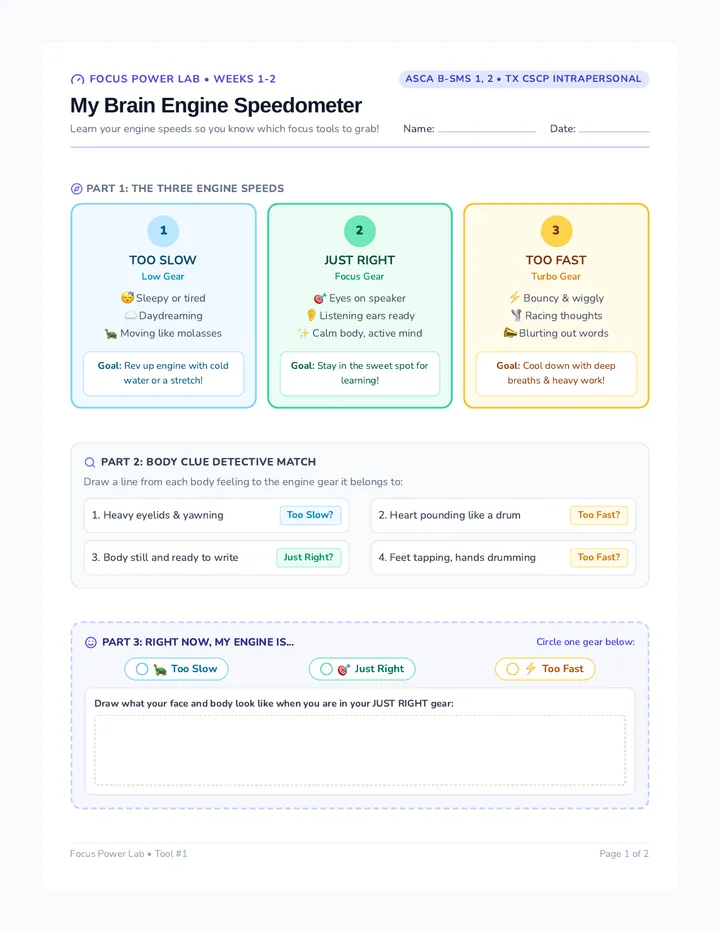
🥶
BLUE ZONE
Slow Body Engine
Low Energy
My Body Clues:
• Heavy eyes, yawning mouth
• Slouchy shoulders, slow movements
• Brain feels like it is moving in molasses
Feelings: Sad, Tired, Sick, Bored
😊
GREEN ZONE
Calm Body Engine
Just Right
My Body Clues:
• Steady breathing in and out
• Soft relaxed hands, feet on the floor
• Eyes looking at the teacher and work
Feelings: Calm, Happy, Focused, Ready
😬
YELLOW ZONE
Fast Body Engine
Caution Clue
My Body Clues:
• Popcorn jiggling legs in chair
• Butterflies in tummy, tight shoulders
• Voice getting louder or silly
Feelings: Frustrated, Worried, Wiggly, Silly
😡
RED ZONE
Exploding Body Engine
Flight Mode
My Body Clues:
• Racing thumping heart like a motor
• Clenched fists, tight jaw, hot cheeks
• Strong urge to run away or hide
Feelings: Out of Control, Terrified, Super Mad
Jameson's Zone Drawing Practice Pick one zone and draw your face or body clue!
When I am in Green Zone (Calm):
My body does: _______________________
When I am in Yellow Zone (Frustrated):
My body does: _______________________
🌟 "All zones are okay! When I notice my clues early, I can use my tools before I enter flight mode!"
Body Clue Counselor Guide Clinician & Staff Manual
Body Clue Counselor Guide
PHASE 1 (WEEKS 1-8)
Target Student: Jameson (Gr. 1)
Clinical Focus: Bridging physiological body awareness with CBT/DBT mindfulness. Jameson transitions from relying on adults to notice agitation toward independently detecting and naming physiological sensations (racing heart, tight muscles, jiggling legs) before behavioral escalation occurs.
8-Week Session Breakdown (Weekly 30-Min Sessions)
Weeks Module Topic Clinical Objective & Activity Prompt Level Goal Wk 1-2 The Body Engine Introduce "Car Engine" metaphor. Distinguish slow, just right, and fast speeds using gross motor games (Freeze Dance). Full Staff Co-Regulation Wk 3-4 Heart & Muscles Map "Rabbit Heart vs. Bear Heart." Practice clenching fists like lemons, then releasing to soft play-dough hands (Progressive Muscle Relaxation). High Staff Prompting Wk 5-6 Popcorn Legs & Tummy Identify the "Yellow Zone alert": jiggling legs and tummy butterflies. Introduce the tactile Body Signal Detective Map. Moderate Visual Cueing Wk 7-8 Independent Labeling Jameson independently completes the 4 Zones Clue Decoder at start/end of sessions and verbalizes: "My body is fast, I feel frustrated." Independent Labeling
Adult Dialogue: Moving from Co-Regulation to Independence
Staff-Driven Co-Regulation (Weeks 1-4)
"Jameson, I notice your feet are kicking the chair legs and your hands are tight into balls. That tells me your body is revving into fast gear. Let's place our hands on our belly together and take two slow balloon breaths."
Purpose: Staff acts as external nervous system, naming sensations for him.
Faded Inquiry Script (Weeks 5-8)
"Detective Jameson, run your radar! What clue are your hands giving you right now? What speed is your engine?"
Target Jameson Output: "My hands are tight. My heart is fast. I am frustrated."
Key Principle: Never demand emotional naming when heart rate is visibly elevated. Always validate the physical sensation first before asking for the cognitive emotion label. Phase 1 Guide
Counseling Protocols & Measurement
Body Scan Protocol & Data Tracker
DATA MONITORING
IEP & MTSS Aligned
Routine: 3-Minute Tactile Body Scan (Start of Every Session)
Flight Shield Busy Binder DBT Distress Tolerance
Flight Shield: My Reset Station
NAME: Jameson
DATE: _______________
🛡️
Stay In the Room Challenge
When your feet feel like running away, your brain is in Flight Mode . Pick 1 physical tool below to send heavy work into your muscles and turn your smart brain back on!
Tool A • Heavy Work 🚜
Bulldozer Wall Push-Ups
Put both hands flat on the strong wall. Push with all your muscle power! Push 5 times to calm the engine.
Touch each handprint as you push:
✋1
✋2
✋3
✋4
✋5
💪 "My muscles do the work so my feet can stay!"
Tool B • Deep Pressure 🛋️
Bean Bag Rest Island
Sink heavy into the big soft bean bag. Let your bones melt like warm butter. Take 3 deep ocean breaths.
Melt down and count 3 slow breaths:
🌊In... Out
🌊In... Out
🌊In... Out
🧘 "I am safe in my spot. The feeling will pass."
Jameson's Safe Choice Today:
🚜 5 Wall Push-Ups 🛋️ 3-Min Bean Bag Rest 📁 Busy Binder Cognitive Task
⭐ "Running away leaves my problem behind. Using my reset brings my calm back!" ⭐
Cognitive Distraction & Focus
Busy Binder: Brain Calming Station
DISTRESS TOLERANCE
Shift to Thinking Brain
Focus your eyes and fingers on these brain puzzles. When your brain is busy solving problems, your flight engine powers down!
1 The Calm Path Maze
Help the Turtle reach the Pond!
🐢 START
MAZE PATH
🪷 CALM POND
2 Color-By-Code: Engine Cooler
1 = Blue 💧 2 = Green 🍃 3 = Yellow ☀️ 4 = Purple 🍇
1
2
2
3
4
1
2
4
1
2
3
2
Slow Finger Wave Trace Trace the waves slowly without lifting your pencil!
In 🌬️
Hold ⚓
Out 🍃
Check-Out: How does your body feel now?
🟢 Calm & Ready 🟡 Need 1 More Minute
Distress Tolerance Station Guide Clinician & Classroom Protocol
Distress Tolerance Station Guide
PHASE 2 (WEEKS 9-16)
Anti-Elopement Focus
Clinical Mechanism: Elopement in early elementary is almost always an instinctual fight-or-flight response triggered by autonomic arousal and perceived lack of control. By supplying predetermined motor (heavy work) and sensory-cognitive replacement behaviors (Busy Binder), we provide Jameson an approved escape valve inside the learning environment.
The 3-Tier Anti-Elopement Intervention Protocol
Stage 1: Mild
Body Signs: Popcorn legs, pencil tapping, sighing, shifting in seat.Adult Action: Low-key visual prompt. Place the Reset Station Card silently on the corner of his desk. Avoid loud verbal demands. Prompt: "Jameson, check your radar. Pick your tool before your feet get light."
Stage 2: Surge
Body Signs: Standing abruptly, wide eyes, clenched fists, looking towards the classroom door.Adult Action: Intercept path to door with neutral body language. Redirect immediately to heavy work: "Jameson, bulldozer power to the wall with me. 5 big pushes right now!" Do not engage in academic debate.
Stage 3: Flight
Body Signs: Active attempt to exit room or hide behind furniture.Adult Action: Maintain safety boundary calmly. Keep verbal commands to 2-3 words: "Safe feet. Bean bag island." Guide directly to sensory decompression nook. Provide zero reprimands during active crisis.
Prompt Fading Hierarchy: Moving to Independent Coping
Weeks 9-10
Direct Co-Participation
Adult completes wall push-ups side-by-side with Jameson. Staff physically counts breaths on bean bag.
Weeks 11-13
Visual Tap & Point
Adult taps the Busy Binder icon on Jameson's desk without speaking. Jameson selects and walks to station independently.
Weeks 14-16
Student-Initiated Choice
Jameson detects Yellow Zone, places Reset Card on teacher desk, and completes 3-min reset independently.
Station Preparation: Keep wall push-up handprints at shoulder height. Store Busy Binder in a designated bin with sharpened colored pencils. Phase 2 Protocol
Behavior Data & Post-Crisis Counseling
Distress Tolerance Data & Debrief Log
DATA MONITORING
Target: Zero Unescorted Exits
The 4-Question Post-Reset Debrief (Once Calm in Green Zone)
Thought Switcher Roleplay Cards CBT Cognitive Reframing
Thought Switcher Role-Play Cards
NAME: Jameson
DATE: _______________
🔄
When surprise events happen in class, our brain can get Stuck or stay Flexible . Practice reading each card with your counselor and acting out the flexible brain switch!
Scenario 1 • Schedule Change 🌧️
"It is raining outside. Recess is inside the classroom today instead of the playground."
🔒 Stuck Thought: "Everything is ruined! I'm running out!"
💡 Flexible Switch: "Changes happen. I can build blocks or play games inside!"
Role-Play: Act out building blocks calmly!
Scenario 2 • Hard Task ✏️
"The teacher hands out a big math page with many numbers and words you don't know yet."
🔒 Stuck Thought: "I can't do this! I'm going to rip it up!"
💡 Flexible Switch: "This is tricky, but I can ask for help or do one problem at a time."
Role-Play: Raise hand and say: "Can you help me?"
Scenario 3 • Waiting Turn 🖍️
"Another student picks up the blue marker you wanted to use right now."
🔒 Stuck Thought: "That's mine! I'm going to grab it or yell!"
💡 Flexible Switch: "I can use the purple marker first and ask for a turn next."
Role-Play: Say: "Can I have that after you finish?"
Scenario 4 • Guest Teacher 👩🏫
"Your regular teacher is out sick today and a substitute teacher is standing at the door."
🔒 Stuck Thought: "They don't know the rules! I won't do anything!"
💡 Flexible Switch: "They are here to keep us safe. I can show them how our class shines."
Role-Play: Give guest teacher a friendly wave!
⭐ Practice Checklist: Jameson practiced role-playing 2 cards with flexible thinking! CBT Star ⭐
Perspective-Taking & Social Impact
The Social Impact Mirror
PHASE 3: ROLE-PLAY
How My Actions Affect Others
What Jameson does sends ripples across the whole classroom pond! See how different choices change how the people around you feel.
❌ Path A: When I Run Away or Knock Things Over Flight Reaction
😟
My Teacher:
Feels worried and has to stop teaching everyone to keep me safe.
🥺
My Classmates:
Feel confused, startled, and distracted from their learning.
😣
Jameson:
Still feels upset and the hard math problem is still waiting.
Social Impact Counselor Guide CBT Clinical Protocol
Social Impact Counselor Guide
PHASE 3 (WEEKS 17-24)
Behavioral Rehearsal
Clinical Focus: Cognitive Reframing & Perspective-Taking. First-grade students do not generalize new coping mechanisms under distress unless those reactions have been physically and verbally over-rehearsed in neutral states. This phase creates a "muscle memory of the mind" through structured role-play.
3-Step Behavioral Rehearsal Sequence
Step 1: Set the Stage & Micro-Simulation
Create a gentle, low-stakes simulation. E.g., during Uno, declare: "Oh no! A surprise rain shower just happened in our game, we have to swap cards!" Observe Jameson's immediate physical response. Call a "Time Out" to check body signals before any behavior occurs.
Step 2: Externalize the "Stuck Brain" vs. "Flexible Brain"
Ask: "What is the Stuck Brain monster whispering in your ear right now?" Validate his answer (e.g., "It says running away is better"). Then prompt: "What can our Flexible Champion Brain say to defeat that monster?"
Step 3: Triple Rehearsal (The "3x Rule")
Have Jameson act out the prosocial replacement script 3 consecutive times with varying facial expressions: once in a whisper, once in a normal speaking voice, and once with high-five celebration. Neurologically embeds the script.
Facilitation Scripts for Jameson's 2 Primary Classroom Triggers
Trigger 1: Schedule Changes
"Jameson, pretend the teacher just announced art is cancelled for an assembly."
Target Reframe: "My plan changed, but my day is not ruined. Assemblies can have surprises!"
Trigger 2: Academic Difficulty
"Jameson, pretend you get a worksheet with 10 hard math problems."
Target Reframe: "Hard work doesn't mean bad work. I will do number 1, then ask for a check."
Perspective Note: First graders are naturally egocentric. Role-playing how the teacher and classmates feel builds true social perspective without inducing shame. Phase 3 Guide
Generalization & Data Collection
Teacher Liaison & Role-Play Tracking
PHASE 3 LIAISON
Classroom Transfer
Pre-Correction Framework for General Education Teacher
Share this 30-second pre-correction sequence with Jameson's classroom teacher to use before known triggers occur:
1. Private Whisper
"Jameson, in 5 minutes our schedule will change for library. What Zone are you in right now?"
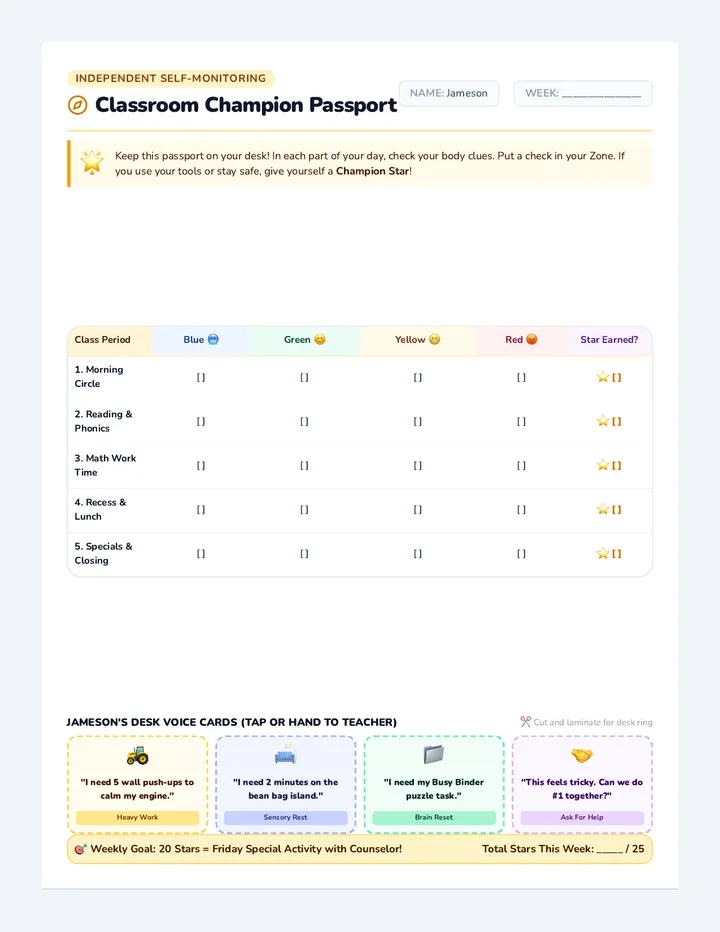
Classroom Passport Tracker Independent Self-Monitoring
Classroom Champion Passport
NAME: Jameson
WEEK: _______________
🌟
Keep this passport on your desk! In each part of your day, check your body clues. Put a check in your Zone. If you use your tools or stay safe, give yourself a Champion Star !
Class Period Blue 🥶 Green 😊 Yellow 😬 Red 😡 Star Earned? 1. Morning Circle [ ] [ ] [ ] [ ] ⭐ [ ] 2. Reading & Phonics [ ] [ ] [ ] [ ] ⭐ [ ] 3. Math Work Time [ ] [ ] [ ] [ ] ⭐ [ ] 4. Recess & Lunch [ ] [ ] [ ] [ ] ⭐ [ ] 5. Specials & Closing [ ] [ ] [ ] [ ] ⭐ [ ]
Jameson's Desk Voice Cards (Tap or Hand to Teacher) ✂️ Cut and laminate for desk ring
🚜
"I need 5 wall push-ups to calm my engine."
Heavy Work
🛋️
"I need 2 minutes on the bean bag island."
Sensory Rest
📁
"I need my Busy Binder puzzle task."
Brain Reset
🤝
"This feels tricky. Can we do #1 together?"
Ask For Help
🎯 Weekly Goal: 20 Stars = Friday Special Activity with Counselor! Total Stars This Week: _____ / 25
Celebration & Independence
4 Champion Badges & Regulation Pledge
PHASE 4 MASTERY
Full Generalization
Jameson has learned big skills all year long! Collect all 4 badges as you conquer each step of self-regulation.
🔍
Phase 1 Badge
Body Signal Detective
I can name when my heart beats fast and my muscles get tight!
EARNED ⭐
🛡️
Phase 2 Badge
Flight Shield Champion
I stay safe in my room and use wall push-ups and my Busy Binder!
EARNED ⭐
🔄
Phase 3 Badge
Brain Switch Master
Yearly Regulation Mastery Rubric IEP & Clinical Evaluation
Yearly Regulation Mastery Rubric
8-MONTH SUMMATIVE
Student: Jameson (Gr. 1)
Evaluation Purpose: Measures Jameson's full-year developmental trajectory from staff-driven co-regulation to independent emotional awareness, distress tolerance, and cognitive reframing across counseling and general education environments.
Core Objective Mastery Scale
| Objective Domain | Baseline (Month 1)
Independence Continuum Rating
Ratio of independent self-regulation vs. adult-dependent interventions:
Baseline: 15% Indep. ➔ Year-End: 88% Indep. ⭐
Jameson Comprehensive 8-Month Counseling Sequence Evaluation Period: Complete Academic Year
Generalization & Next-Grade Bridge
Generalization Matrix & Transition Plan
GRADE 2 BRIDGING
Multi-Tiered Support Plan
Setting-by-Setting Generalization Audit
1. Academic Core (Reading / Math)
Jameson utilizes desk voice cards to request task chunking or 2-minute reset without eloping from his chair.
Consistently Generalizing
2. Unstructured Spaces (Recess / Lunch)
Responds to peer game rule disputes with flexible reframe scripts rather than aggressive outbursts or running.
Consistently Generalizing
3. Specials (Art, PE, Music)
Portable visual passport travels with student; specials teachers trained to honor heavy-work wall push-up cards.
Consistently Generalizing