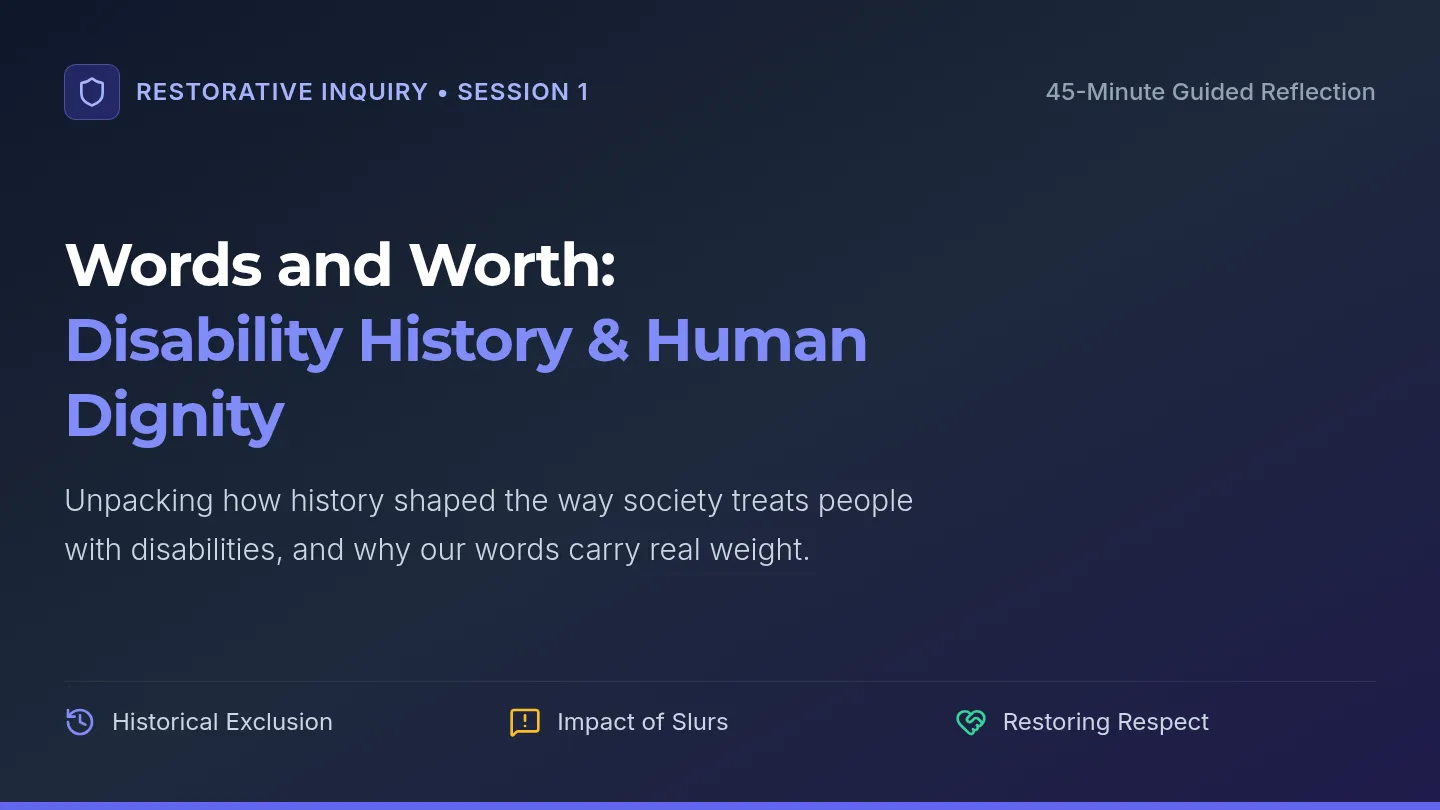
Words and Worth Slides Restorative Inquiry • Session 1
45-Minute Guided Reflection
Words and Worth:
Disability History & Human Dignity
Unpacking how history shaped the way society treats people with disabilities, and why our words carry real weight.
Historical Exclusion
Impact of Slurs
Restoring Respect
Framework
Our Agreement in this Space
Honest Accountability
We are here not just to lecture, but to honestly examine what happened, understand who was harmed, and look at the history behind the remarks.
Room to Grow
Making a mistake or using hurtful language does not mean you cannot change. Growth begins with curiosity and taking ownership of impact.
Reflection Question: When you hear someone use a word as an insult, where do you think that habit came from?
History Focus
From Hidden to Human: The Historical Fight
Part 1
Late 1800s - Mid 1900s
Isolation & Asylums
People with developmental and physical disabilities were locked away in institutions, hidden from public life, and labeled with clinical slurs.
1970s - 1980s
Demanding Rights
Activists like Judy Heumann led sit-ins for Section 504. Disabled citizens crawled up the Capitol steps to force laws protecting public access.
1990 - Present
The ADA & Dignity
The Americans with Disabilities Act banned discrimination in schools, jobs, and transit. Disability is recognized as human diversity, not a defect.
Key Takeaway: People with disabilities had to battle government and society simply to enter public schools and buildings.
Language Analysis
The Anatomy of an Ableist Insult
The Old Medical Label Trap
Words like the "R-word" were once medical classifications. Over time, bullies adopted them as slang to mean "stupid," "broken," or "worthless."
When people use those words casually, they revive an era where disabled human beings were stripped of rights and autonomy.
Intent vs. Impact
"I was just joking around with my friend!"
Even if your intent was playful, the impact is painful. It signals to peers and anyone with a disabled family member that their dignity is disposable.
Pause & Think: Have you ever felt judged or dismissed for something about your body or mind that you couldn't control?
Media Focus
Video Viewing & Guided Discussion
Prompts for Video Clip Analysis
1
What barrier or obstacle did the person in the video face that non-disabled people take for granted?
2
How did negative attitudes or language from others make their everyday life harder than the disability itself?
3
What was one moment where someone stood up or created an accessible solution?
Record your reflections on Section B of your Words and Worth Reflection Guide.
Action Step
Repairing the Harm: Three Real Steps
1
Name the Harm
State clearly what was said without making excuses or blaming friends. Acknowledge who felt targeted or uncomfortable.
2
Retire the Word
Make a deliberate decision to permanently remove derogatory language from your vocabulary, both in public and private.
3
Active Defense
When you hear other students use these insults in hallways or group chats, do not laugh or join in. Speak up or change the direction.
Session Goal: Complete your written repair commitment on page 2 of your reflection guide.
Disability Rights Reading Restorative Reading Series • 8th Grade History Lesson 1: Disability Rights
From Shadows to Full Citizens: The Disability Rights Movement
Reading Passage
Historical Focus: For much of American history, people with physical, sensory, and developmental disabilities were hidden away, denied schooling, and treated as burdens. This reading examines how disabled individuals fought back to demand equal rights and respect.
1. The Era of Exclusion and the "Ugly Laws"
Throughout the late nineteenth and early twentieth centuries, American cities passed ordinances known as "Ugly Laws." In Chicago, San Francisco, and Omaha, police were legally permitted to arrest anyone seen on public streets who was deemed "diseased, maimed, mutilated, or in any way deformed, so as to be an unsightly object." The underlying message was ruthless: people with visible differences had no right to occupy public space.
Families of children born with developmental delays or cognitive differences were routinely told by doctors that their children would never contribute to society and should be placed in state-run institutions. In places like Willowbrook State School in New York, thousands lived in overcrowded, neglected wards. When television journalist Geraldo Rivera exposed Willowbrook in 1972, the American public was shocked to discover citizens living without basic hygiene, education, or stimulation.
2. The Rise of the Independent Living Movement
Disabled leaders refused to accept pity or forced isolation. In the 1960s, Ed Roberts, a young man who contracted polio and used an iron lung and power wheelchair, was initially rejected by the University of California, Berkeley because campus dorms could not accommodate him. Roberts insisted on his constitutional right to higher education. He enrolled, founded the "Rolling Quads" activist group, and launched the Independent Living Movement.
Their philosophy was radical for its time: the central problem was not an individual’s wheelchair or blindness, but rather the stairs, narrow doors, and biased attitudes constructed by society. If the environment were made accessible, disabled people could work, learn, and live independently.
3. The 1977 Section 504 Sit-In
In 1973, Congress passed Section 504 of the Rehabilitation Act, declaring that no program receiving federal funds could discriminate against people with disabilities. Yet for four years, federal officials refused to sign the regulations enforcing the law. Frustrated by endless delays, activist Judy Heumann led more than one hundred disabled activists into the federal building in San Francisco in April 1977.
The occupation lasted 26 grueling days—the longest peaceful takeover of a federal building in U.S. history. Protesters in wheelchairs slept on desks; Deaf activists communicated secret messages via sign language through third-floor windows when phone lines were cut. Their courage forced the government to enforce Section 504, creating the legal blueprint for modern disability rights.
Words, History, and Repair • 8th Grade Restorative Curriculum Page 1 of 2
Restorative Reading Series • 8th Grade History Lesson 1: Disability Rights
The Americans with Disabilities Act & The Power of Words
Reading Passage
4. The Capitol Crawl of 1990
By 1990, activists wanted broad protections across the private sector, including jobs, restaurants, buses, and private schools. When the Americans with Disabilities Act (ADA) stalled in committee, over sixty activists abandoned their wheelchairs, crutches, and walkers at the base of the United States Capitol and began crawling up all 83 stone steps.
Eight-year-old Jennifer Keelan, who had cerebral palsy, pulled herself step-by-step to the top, declaring, "I'll take all night if I have to!" Images of her determination flashed across national newscasts, shaming lawmakers into action. On July 26, 1990, President George H.W. Bush signed the ADA into law, making accessibility ramps, braille signage, and equal employment rights the law of the land.
5. Why Ableist Words Carry History
Throughout history, the words used to describe people with disabilities were weaponized. Terms like the "R-word," "moron," "imbecile," or "spaz" were originally medical diagnostic terms created in the nineteenth and twentieth centuries. Over time, bullies adopted these labels as slang to mock someone who was perceived as slow, awkward, uncoordinated, or foolish.
When an 8th grader tosses out an ableist slur during a video game, in the school hallway, or in casual banter, that remark is not harmless slang. It reaches back into an era when people with disabilities were locked in institutions, denied legal rights, and treated as subhuman. To use someone's disability as a punchline or synonym for "stupid" sends a clear message: that their lives and dignity have less value.
Reading Checkpoint & Key Insights
1. The Core Shift
The disability rights movement proved that physical and mental differences are not personal flaws, but aspects of human diversity that society must accommodate.
2. Language as a Weapon
Slurs reinforce exclusion. Even when spoken without thinking, they uphold the false belief that having a disability makes someone inferior.
Discussion Bridge: In your counseling session, be prepared to discuss: Why do you think students often use disability-related insults when they are angry or trying to sound funny? What does that show about what school culture needs to change?
Words, History, and Repair • 8th Grade Restorative Curriculum Page 2 of 2
Words and Worth Reflection Guide Restorative Learning Guide • Individual Counseling Lesson 1: Disability Rights
Words and Worth: Reflection & Video Guide
Connecting history, language awareness, and personal accountability.
Session 1
Student:
Date:
Counselor:
Part A: Historical Reflection
1. In the reading, what surprised you about how people with disabilities were treated in American history (e.g., Ugly Laws or institutions)?
2. Activists like Judy Heumann and Jennifer Keelan had to fight for rights most people take for granted. What does their struggle tell you about what it feels like to be excluded?
Part B: Video Viewing Guide (Clip Selected by Facilitator)
Video Clip: _______________________
3. What physical, social, or emotional barrier did the person in the video encounter?
4. How did the attitudes or language of others affect their confidence or ability to participate?
5. What is one specific lesson from this video that applies to how we treat people at our school?
Words, History, and Repair • Restorative Counseling Protocol Page 1 of 2
Restorative Learning Guide • Accountability & Action Lesson 1: Disability Rights
Restorative Reflection: Impact, Ownership & Repair
Part C: Looking at What Happened
Restorative Principle: We separate the person from the action. You are not a bad person, but the words used caused real harm. Taking ownership means being honest without deflecting or making excuses.
1. Honest Reflection: What words or remarks were used, and what was going on in the moment (anger, trying to be funny, peer pressure)?
2. Impact Assessment: Even if you did not mean to hurt anyone, who was affected by these words (the person targeted, bystanders, classmates with family members who have disabilities)?
3. Connection to History: Why does using a disability-related slur carry a heavy history rather than just being "normal slang"?
Part D: Steps to Repair Harm & Moving Forward
4. Repair Commitment: What concrete step will you take to repair the relationship and the school environment (e.g., written restorative apology, meeting with the student, taking a leadership stance)?
5. Future Response: Next time you feel frustrated or someone around you uses derogatory remarks, what will you say or do instead?
Student Commitment Signature:
I acknowledge the impact of my words and commit to this repair plan.
Counselor / Facilitator Signature:
Reviewed and agreed upon in restorative conference.
Words, History, and Repair • Restorative Counseling Protocol Page 2 of 2
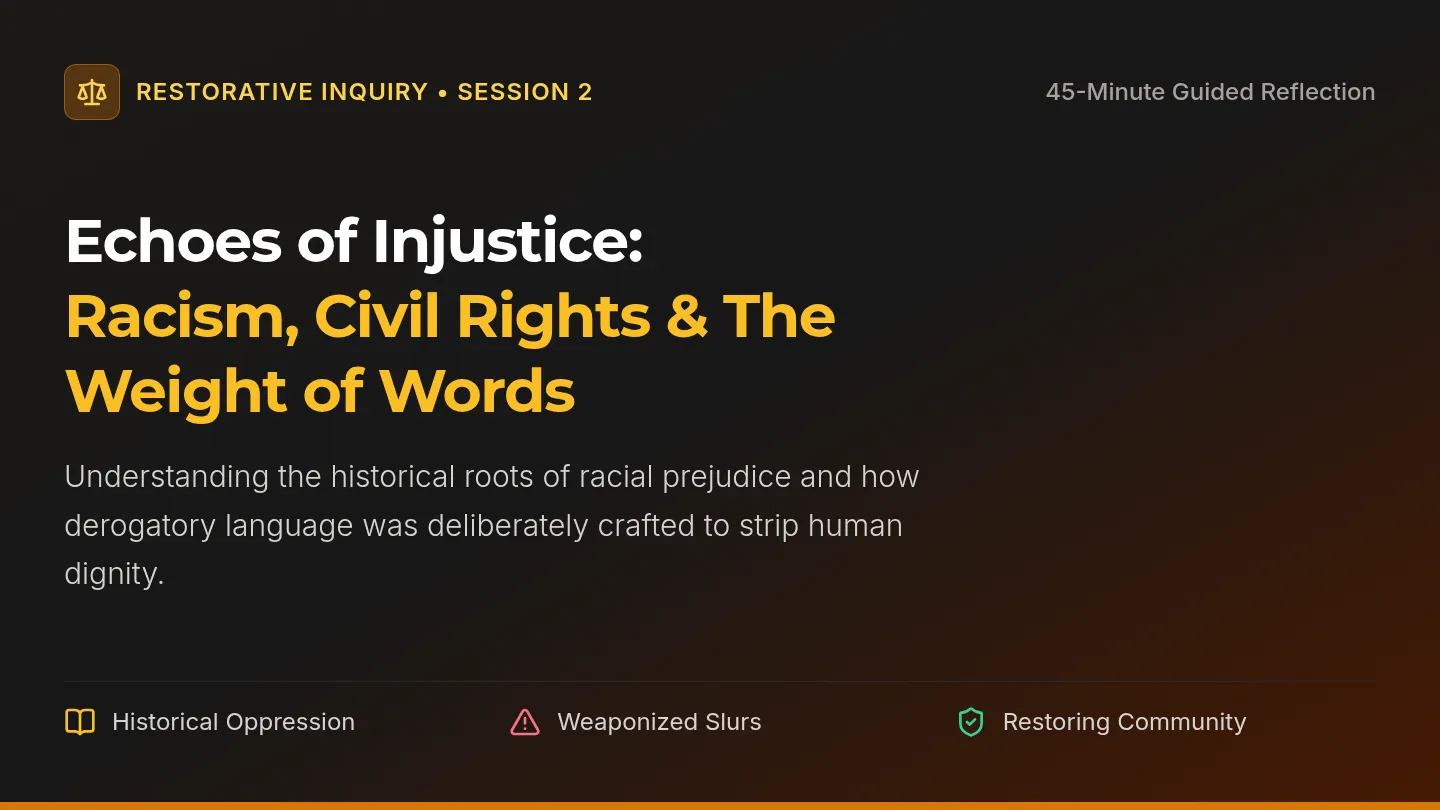
Echoes of Injustice Slides Restorative Inquiry • Session 2
45-Minute Guided Reflection
Echoes of Injustice:
Racism, Civil Rights & The Weight of Words
Understanding the historical roots of racial prejudice and how derogatory language was deliberately crafted to strip human dignity.
Historical Oppression
Weaponized Slurs
Restoring Community
Core Reality
Words Carry Centuries of History
Dehumanization in History
Before laws segregated schools or denied voting rights, language was used first. Enslavers and segregationists used slurs to convince society that Black, Brown, and Indigenous people were less than human.
The Modern Hallway Echo
When an 8th grader uses a racial slur today—even in a video game or as a "joke"—they are not creating new slang. They are repeating the exact vocabulary used during slavery and segregation.
Key Truth: You cannot separate a word from the blood, violence, and injustice that built it.
History Focus
The Ongoing Struggle for Equality
Part 1
1865 - 1950s
Jim Crow Terror
Systemic segregation, lynching, and voter suppression enforced second-class citizenship through law and vigilante violence.
1950s - 1960s
The Civil Rights Era
Young people led lunch counter sit-ins, Freedom Rides, and the Children's Crusade in Birmingham, facing fire hoses and dogs to demand dignity.
1964 - Present
Civil Rights Acts
Landmark laws outlawed racial discrimination, but creating true everyday respect and safety in schools remains a responsibility for every student.
Reflection: Students your exact age risked their lives and futures so that everyone could walk into school with equal rights.
Accountability
Examining the "Joke" Excuse
What People Say
"I was just repeating what I heard online."
"I didn't mean it in a racist way."
"Everybody says it in Discord or TikTok."
The Real Impact
For peers who hear it, it creates fear, anxiety, and a feeling that they are unsafe in their own school hallways.
It tells your classmates that you value cheap laughs or edgy shock value more than their basic human safety and dignity.
Question: Would you be willing to say those exact words to the parents or grandparents of your classmates? If not, why?
Video Inquiry
Historical & Documentary Clip Analysis
Critical Viewing Prompts
1
What courage did the speakers or activists display when faced with prejudice, taunts, or hostility?
2
How does learning about their sacrifice change how you look at "edgy" racial jokes or insults today?
3
What does true allyship look like when someone in your circle starts using discriminatory language?
Record your observations in Part B of your Echoes of Injustice Reflection Guide.
Repair Plan
Taking Restorative Responsibility
A
Full Acknowledgment
No minimizing ("it wasn't that deep"). Recognize that the words carry racial trauma and make school unwelcoming for others.
B
Clean Your Feed
Unfollow influencers, meme pages, or gaming servers that monetize casual racism or normalize slurs for shock value.
C
Active Rebuilding
Demonstrate through consistent daily actions, tone, and body language that you treat every classmate with dignity.
Next Step: Complete your personal accountability journal in your reflection guide.
Civil Rights Journey Reading Restorative Reading Series • 8th Grade History Lesson 2: Racism & Civil Rights
The Power of Words and the Fight for Dignity
Reading Passage
Historical Focus: In the United States, racism was not just about personal feelings; it was a legal and social system designed to keep certain groups in power. Derogatory language was crafted to make inequality seem acceptable. Understanding this history reveals why racial slurs can never be treated as "harmless jokes."
1. Dehumanization: The First Step of Oppression
Before laws could legally classify human beings as property during American chattel slavery, a cultural campaign of dehumanization had to take place. White plantation owners and politicians deliberately promoted false ideas that people of African descent, Indigenous peoples, and other non-white groups were less intelligent, less sensitive to pain, and naturally suited for servitude.
Racial slurs and degrading caricatures in newspapers, advertisements, and minstrel shows were repeated until white society viewed non-white individuals not as neighbors or equals, but as inferior objects. By reducing a human being to an ugly word, society made violence, family separation, and the denial of human rights feel normal to those in power.
2. Jim Crow and Everyday Terror
Following the Civil War and the end of slavery, Southern states enacted "Jim Crow" laws to enforce racial segregation. Black Americans were forced to use separate water fountains, sit in the back of buses, attend underfunded schools, and pay unfair poll taxes. Any violation of these unspoken racial rules was met with brutal violence, including public lynchings by white supremacist mobs that police often ignored.
During this period, racial slurs were constantly yelled on sidewalks, in courtrooms, and in workplaces to remind people of color that they were considered second-class citizens. To be called a slur was not simply an insult; it was an active threat of physical danger.
3. The 1963 Children's Crusade: Middle Schoolers on the Front Lines
When adults risked losing their jobs for protesting segregation, thousands of young students stepped forward. In May 1963, in Birmingham, Alabama, students ranging from high school down to 8th and 7th grade walked out of their classrooms and gathered at the 16th Street Baptist Church to march peacefully for civil rights.
City police commissioner Bull Connor ordered officers to turn high-pressure fire hoses and attack dogs on the children. The powerful water tore clothes and knocked middle schoolers down the street into parked cars. Over one thousand children were arrested and spent days in jail singing freedom songs. Their courage shamed the nation and forced President John F. Kennedy to introduce federal civil rights legislation.
Words, History, and Repair • 8th Grade Restorative Curriculum Page 1 of 2
Restorative Reading Series • 8th Grade History Lesson 2: Racism & Civil Rights
Why Racial Slurs Cannot Be Separated From History
Reading Passage
4. The Digital Hallway: Gaming and Meme Culture
Today, middle school students frequently encounter racial slurs in video game voice chats, Discord servers, and edgy social media videos. Often, creators and players repeat these words to get a shock reaction, to sound tough, or to gain laughs from peers. Some students begin repeating them thinking, "I'm not in the KKK, so it's just a funny word between friends."
This belief misunderstands how language works. Words do not lose their history because they are typed in a Discord chat or muttered by a locker. Racial slurs were invented for one specific purpose: to deny the humanity of a targeted racial group. When someone uses that word, they drag four hundred years of slavery, lynching, and segregation into the room.
5. The Real Psychological Impact on Classmates
When a student hears a peer use a racial slur or make derogatory comments about their race or ethnicity, the impact is immediate. It sends an unmistakable signal: "You do not belong here, and your dignity is not safe with me." Even if the targeted student stays quiet or acts like they do not care, research shows that experiencing racial slurs leads to chronic stress, difficulty concentrating in class, and feelings of isolation.
Taking restorative accountability means understanding that intention does not erase impact. An 8th grader who is mature enough to look at history honestly can recognize that true strength lies in protecting classmates, not in tearing them down with recycled hatred.
Reading Checkpoint & Key Insights
1. The Weapon of Slurs
Racial slurs were created to make violence and segregation seem acceptable by stripping targeted people of their dignity.
2. Youth Responsibility
Just as middle schoolers in 1963 stood up against fire hoses for equality, 8th graders today can refuse to normalize hateful language.
Discussion Bridge: In your counseling session, be prepared to discuss: Why do some students think saying racist words makes them seem "rebellious" or "cool"? What is the difference between genuine humor and tearing down someone's humanity?
Words, History, and Repair • 8th Grade Restorative Curriculum Page 2 of 2
Echoes of Injustice Reflection Guide Restorative Learning Guide • Individual Counseling Lesson 2: Racism & Civil Rights
Echoes of Injustice: Reflection & Video Guide
Examining racial history, the power of words, and personal accountability.
Session 2
Student:
Date:
Counselor:
Part A: Historical Reflection
1. The reading explains how slurs were used during slavery and Jim Crow to dehumanize people. Why is calling someone a slur fundamentally different from a regular insult like "jerk"?
2. Middle schoolers in the 1963 Children's Crusade faced dogs and fire hoses for dignity. What does their bravery teach us about standing up against disrespect today?
Part B: Video Viewing Guide (Clip Selected by Facilitator)
Video Clip: _______________________
3. What injustice or moment of courage was highlighted in the video clip?
4. How did the words, actions, or prejudice of others in the video cause harm or division?
5. What is one strong takeaway from this video that challenges the way teenagers talk to each other online or in school?
Words, History, and Repair • Restorative Counseling Protocol Page 1 of 2
Restorative Learning Guide • Accountability & Action Lesson 2: Racism & Civil Rights
Restorative Reflection: Impact, Ownership & Repair
Part C: Looking at What Happened
Restorative Principle: Real maturity means refusing to hide behind phrases like "I was just joking" or "everyone says it." Owning your impact requires acknowledging the pain words carry for students of color.
1. Honest Reflection: When you used or repeated racially derogatory remarks, where did you pick them up (games, online videos, peers), and what was your real motivation?
2. Impact Assessment: How does hearing racial remarks make students of color feel about their safety, belonging, and respect in our school?
3. Empathy Shift: If a member of your family were targeted by people who used slurs against them because of their identity, how would you expect others to respond?
Part D: Steps to Repair Harm & Moving Forward
4. Concrete Restorative Action: What will you do to repair trust with peers and demonstrate genuine respect (e.g., restorative apology, leaving toxic group chats, school community service)?
5. Peer Boundary: The next time someone makes an offensive racial joke in your presence, what specific boundary statement will you use to shut it down?
Student Commitment Signature:
I acknowledge the racial history behind these remarks and commit to positive change.
Counselor / Facilitator Signature:
Reviewed and agreed upon in restorative conference.
Words, History, and Repair • Restorative Counseling Protocol Page 2 of 2
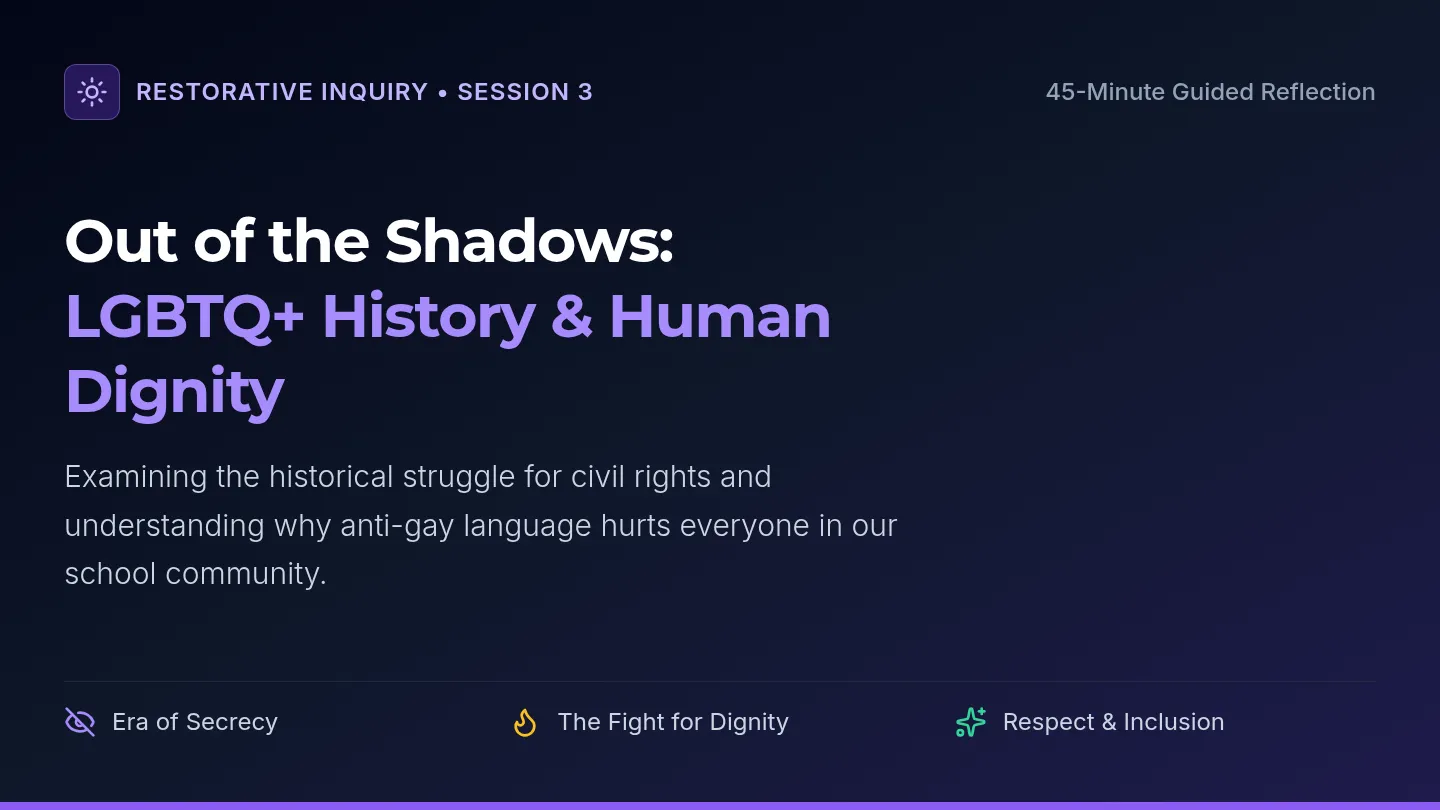
Out of the Shadows Slides Restorative Inquiry • Session 3
45-Minute Guided Reflection
Out of the Shadows:
LGBTQ+ History & Human Dignity
Examining the historical struggle for civil rights and understanding why anti-gay language hurts everyone in our school community.
Era of Secrecy
The Fight for Dignity
Respect & Inclusion
Historical Reality
The Cost of Being Forced to Hide
Targeted by Law
For most of the 20th century, being gay or lesbian was treated as a crime in all 50 states. Thousands lost their jobs, military careers, and families simply for who they loved.
False Medical Labels
Until 1973, psychiatry wrongly labeled homosexuality as a mental disorder. People were subjected to painful conversion treatments to force them to change their natural identities.
Imagine: What would it feel like if having honest feelings meant you could be expelled from school or disowned by family?
Key Moments
From Stonewall to Civil Rights
Timeline
June 1969
Stonewall Riots
Patrons at New York's Stonewall Inn fought back against constant police raids. This uprising sparked the modern Pride and civil rights movement.
1970s - 1980s
Speaking Out
Leaders like Harvey Milk insisted on visible representation. The AIDS crisis spurred massive community care and civil activism against government neglect.
2015 - 2020
Equal Protection
The Supreme Court affirmed nationwide marriage equality (Obergefell) and workplace protections (Bostock) under the Civil Rights Act.
The Takeaway: LGBTQ+ people didn't ask for special treatment—they asked for the exact same human rights and dignity as everyone else.
Language Impact
"That's So Gay" & Homophobic Slurs
The "Synonym" Trap
When students say "that test was so gay" or "those shoes are gay," they are using an identity as a synonym for "bad," "stupid," or "annoying."
Subconsciously, it teaches everyone within earshot that being gay is something undesirable or shameful.
The Safety Hazard
Middle school students who hear anti-LGBTQ+ remarks feel unsafe in classrooms, locker rooms, and hallways.
It isolates students who may be questioning their identity or who have LGBTQ+ parents, siblings, or friends.
Honest Question: Why do some middle school boys use anti-gay slurs to question each other's toughness or masculinity?
Video Inquiry
Guided Viewing: Stories of Courage
Video Reflection Questions
1
What was it like for the person in the video before they found acceptance or safe community?
2
How did hurtful remarks or feeling excluded affect their mental health, schooling, or relationships?
3
What kind of school environment does every student deserve regardless of sexual orientation or gender expression?
Record your thoughts in Part B of your Out of the Shadows Reflection Guide.
Action Step
Leading with Character & Respect
1
Clean Your Slang
Stop using "gay" or slurs to describe things you dislike. Use precise words: boring, unfair, frustrating, or difficult.
2
Own Your Space
Refuse to participate in jokes that mock people's identity or gender presentation. A simple "that's not funny" changes the vibe.
3
Complete Repair
Finish this 3-lesson series by drafting your personal restorative code of conduct in your guide.
Final Restorative Outcome: A safer school starts with individual decisions to respect everyone's humanity.
Pride and Dignity Reading Restorative Reading Series • 8th Grade History Lesson 3: Sexuality & LGBTQ+ Rights
Stepping Into the Light: The LGBTQ+ Civil Rights Movement
Reading Passage
Historical Focus: For decades, LGBTQ+ Americans lived under constant fear of being fired from jobs, arrested by police, or rejected by their own families. This reading traces how courageous everyday people organized to demand legal equality, human dignity, and the right to live openly.
1. The Era of Secrecy and the "Lavender Scare"
During the 1950s and 1960s, the United States government actively persecuted gay and lesbian citizens in what historians call the "Lavender Scare." Thousands of government workers, teachers, and military personnel were investigated, interrogated about their private lives, and fired simply because of their sexual orientation. In almost every state, loving someone of the same sex was classified as a criminal act.
Because being exposed meant losing your job, home, and community, most LGBTQ+ people were forced to lead double lives. They lived with constant anxiety, hiding letters, speaking in code, and using fake names in public spaces.
2. The Stonewall Uprising of 1969
In the late 1960s, one of the few places gay and transgender people could gather in New York City was a tavern called the Stonewall Inn in Greenwich Village. Police frequently raided the bar, arresting patrons, lining them up against walls, and subjecting them to humiliating body searches.
In the early morning hours of June 28, 1969, the crowd decided they had had enough. Led by transgender women of color, including Marsha P. Johnson and Sylvia Rivera, alongside gay and lesbian youths who were homeless after being rejected by their parents, the patrons fought back against police brutality. Several nights of protests followed. One year later, on June 28, 1970, thousands gathered in New York for the first Christopher Street Liberation Day March—the very first Pride parade in American history.
3. Removing the False Medical Label (1973)
For decades, mainstream psychiatry treated homosexuality as a mental illness in the Diagnostic and Statistical Manual (DSM). This diagnosis was used by courts to deny parents custody of their children and by doctors to justify forced electroshock "therapies." Activists disrupted medical conventions, demanding that scientists look at the evidence. In December 1973, the American Psychiatric Association voted to remove homosexuality from the list of mental disorders, confirming that sexual orientation is a natural human variation, not a disease.
Words, History, and Repair • 8th Grade Restorative Curriculum Page 1 of 2
Restorative Reading Series • 8th Grade History Lesson 3: Sexuality & LGBTQ+ Rights
Equal Protection and the Power of Middle School Culture
Reading Passage
4. Landmark Civil Rights Milestones
Over the past several decades, the struggle moved into classrooms and the nation's highest courts. In 2015, the Supreme Court ruled in Obergefell v. Hodges that the Fourteenth Amendment guarantees same-sex couples the fundamental right to marry. In 2020, the Court affirmed in Bostock v. Clayton County that federal civil rights laws protect LGBTQ+ individuals from workplace discrimination.
Yet legal equality on paper does not automatically guarantee safety in the school hallway. Every middle school student plays a direct role in determining whether their school is a place of belonging or fear.
5. Why "That's So Gay" and Anti-LGBTQ+ Slurs Hurt
In middle schools across the country, phrases like "that's so gay" or derogatory slurs are often thrown around casually. Students use them to describe a hard math quiz, an uncool pair of sneakers, or a friend who showed emotion or backed down from a challenge.
When you use someone's identity as a label for something inferior, weak, or undesirable, it has severe real-world consequences. National surveys by school climate organizations show that over 70% of LGBTQ+ students hear anti-gay remarks daily in school, leading to elevated rates of anxiety, depression, and skipping classes. Even when the speaker claims "I didn't mean anything by it," the listener hears: "Who you are is bad, and you are not welcome here."
Reading Checkpoint & Key Insights
1. The Right to Exist
LGBTQ+ history is a civil rights movement centered on the fundamental right to live safely, love freely, and be treated with dignity under the law.
2. Language and Safety
Casual homophobic remarks normalize bullying and make peers feel unsafe. Choosing respectful vocabulary directly protects fellow students.
Discussion Bridge: In your counseling session, be prepared to discuss: Why do people sometimes attack or tease others about their sexuality when trying to prove their own status? How can real strength be shown through respect?
Words, History, and Repair • 8th Grade Restorative Curriculum Page 2 of 2
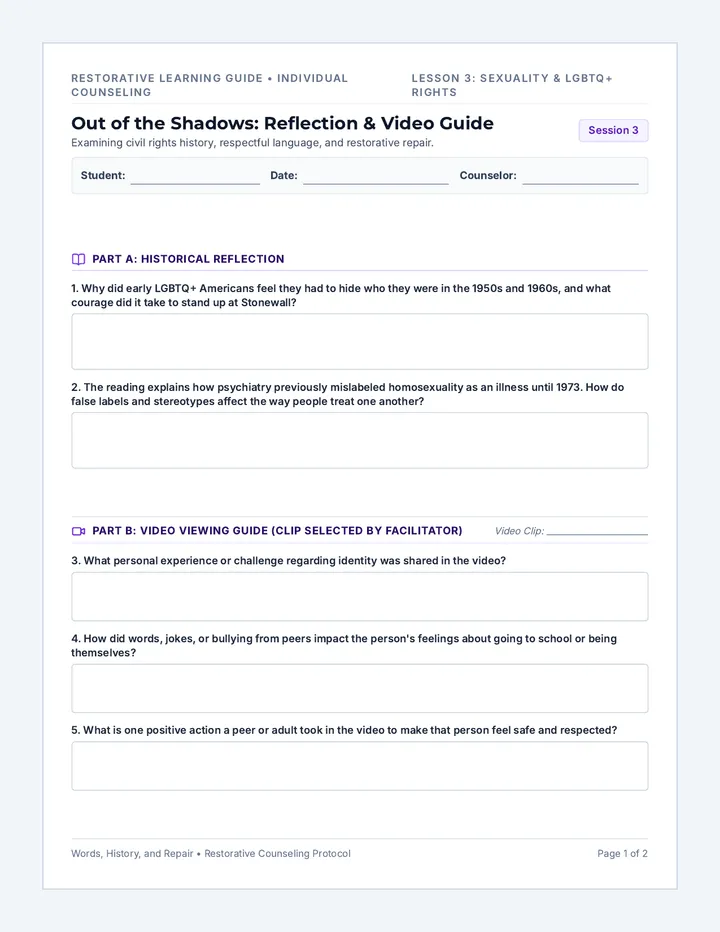
Out of the Shadows Reflection Guide Restorative Learning Guide • Individual Counseling Lesson 3: Sexuality & LGBTQ+ Rights
Out of the Shadows: Reflection & Video Guide
Examining civil rights history, respectful language, and restorative repair.
Session 3
Student:
Date:
Counselor:
Part A: Historical Reflection
1. Why did early LGBTQ+ Americans feel they had to hide who they were in the 1950s and 1960s, and what courage did it take to stand up at Stonewall?
2. The reading explains how psychiatry previously mislabeled homosexuality as an illness until 1973. How do false labels and stereotypes affect the way people treat one another?
Part B: Video Viewing Guide (Clip Selected by Facilitator)
Video Clip: _______________________
3. What personal experience or challenge regarding identity was shared in the video?
4. How did words, jokes, or bullying from peers impact the person's feelings about going to school or being themselves?
5. What is one positive action a peer or adult took in the video to make that person feel safe and respected?
Words, History, and Repair • Restorative Counseling Protocol Page 1 of 2
Restorative Learning Guide • Accountability & Action Lesson 3: Sexuality & LGBTQ+ Rights
Restorative Reflection: Impact, Ownership & Cumulative Repair
Part C: Looking at What Happened
Restorative Principle: When anti-gay slurs or phrases like "that's so gay" are used, they make the school unsafe for peers who may be questioning their identity or who have LGBTQ+ loved ones.
1. Honest Reflection: When you used phrases like "that's so gay" or anti-LGBTQ+ slurs, what message did you unintentionally send to everyone around you?
2. Empathy Shift: How does hearing those remarks affect a classmate who is already struggling with belonging, mental health, or fear of being judged?
Part D: Cumulative 3-Part Restorative Code of Conduct
3. Across all three topics (disability, race, and sexuality), what is your personal pledge for how you will use language moving forward?
4. What active step will you take during restorative meetings to demonstrate that you are committed to repairing relationships and building a safe school?
Student Commitment Signature:
I commit to respect and dignity for all students across race, disability, and sexuality.
Counselor / Facilitator Signature:
Three-session restorative inquiry and repair plan completed.
Words, History, and Repair • Restorative Counseling Protocol Page 2 of 2