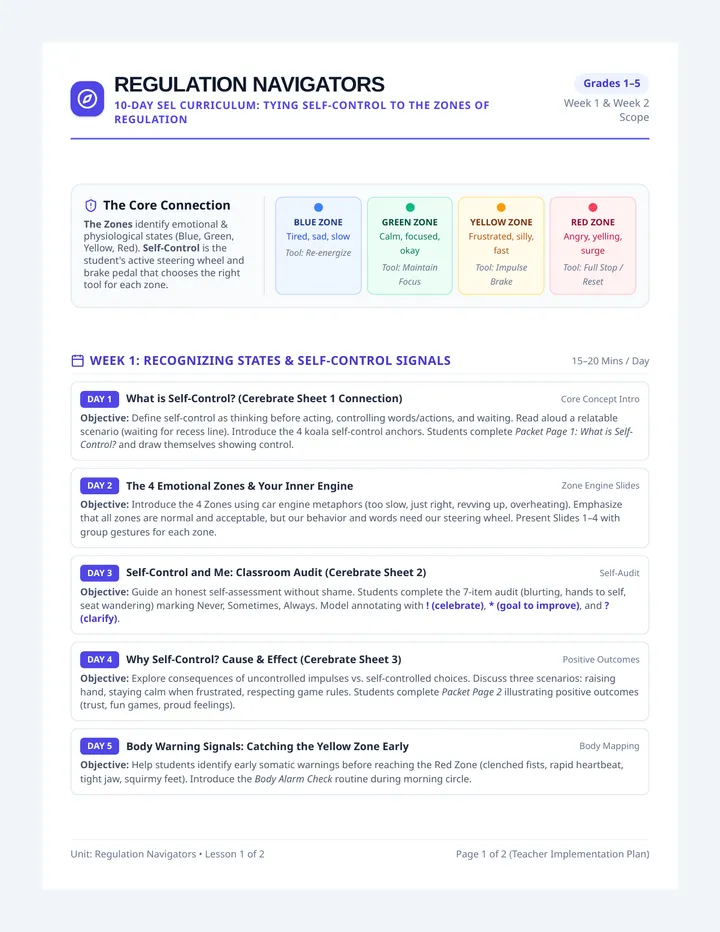
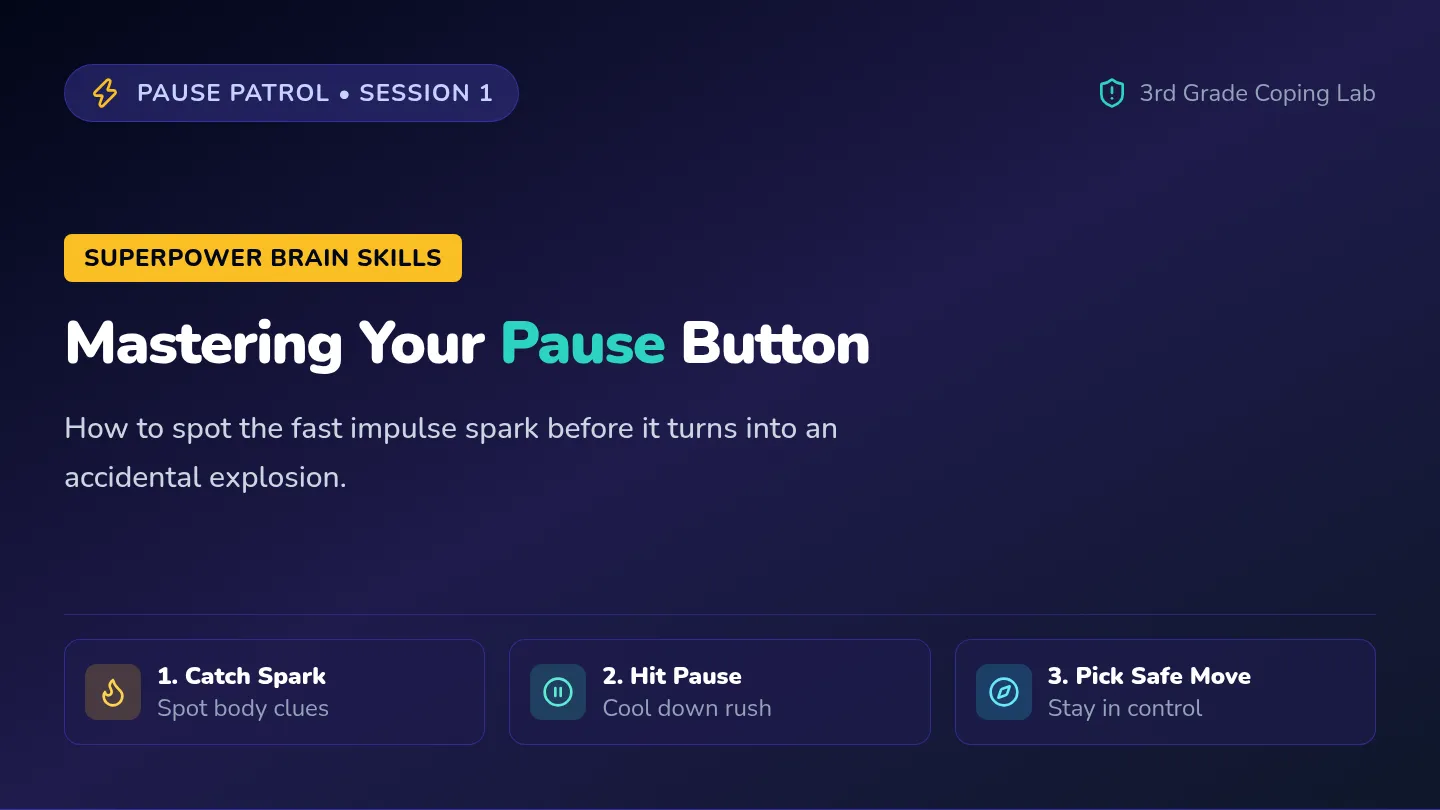
Pause Power Slides Pause Patrol • Session 1
3rd Grade Coping Lab
Superpower Brain Skills
Mastering Your Pause Button
How to spot the fast impulse spark before it turns into an accidental explosion.
1. Catch Spark
Spot body clues
2. Hit Pause
Cool down rush
3. Pick Safe Move
Stay in control
1
What is an Impulse Spark?
Brain Mechanics
The Fast Brain (Spark)
An impulse is when your brain sends a sudden urge to do or say something RIGHT NOW without asking your thinking brain first.
Common 3rd Grade Sparks:
• Blurting an answer before called on
• Grabbing a marker someone dropped
• Shoving back when someone bumps you
The Wise Brain (Pilot)
Your Wise Brain needs just 3 to 5 seconds to look ahead at what will happen next and make a safe, smart choice.
The Pause Secret:
Having an impulse spark is normal for everyone. What makes you strong is knowing how to press pause before your hands or mouth move!
Quick Discussion: When was a time an impulse spark jumped out before you could stop it?
2
Your Body Gives Early Warning Clues
Self-Detection
Before you react, your body sounds a silent siren. Notice which clue happens to you:
Face Gets Warm
Cheeks flush hot, teeth clench tight, or breath speeds up.
Tight Fist
Hands squeeze, shoulders rise up near your ears, muscles tense.
Thumping Heart
Heart races like an engine ready to rev into motion.
Fidget Buzz
Feet tap, stomach twists, or feeling like you might burst.
Catch the clue early: When your body whispers, you have time to hit the brake before it shouts!
3
Three Instant Brake Moves
Cool-Down Tactics
1. Volcano Breath
Inhale through nose for 3 counts while bringing hands up. Blow cool air slowly out of mouth for 5 counts while lowering hands.
Slows heart rate instantly
2. Pretzel Squeeze
Cross arms over chest, hug shoulders firmly, squeeze tight for 5 seconds, then let muscles melt like butter.
Drains body tension
3. Room Radar
Silently spot: 3 blue objects, 2 smooth things, and 1 quiet sound in the room. This moves your brain out of panic mode.
Refocuses Wise Brain
Try one right now together: Let's do 2 Volcano Breaths together before moving on!
4
The Fast-Forward Mind Movie
Future Check
If I react instantly...
💥 What might get broken, hurt, or yelled?
⏳ Will I lose recess or get a call home?
😞 How will I feel about myself 10 minutes later?
If I pause & use my brake...
🛡️ I keep myself and other people safe.
⭐ I stay in control instead of letting anger steer.
🎉 I feel proud of how I handled a tough spot.
Your Mission Today:
Grab your Pocket Pause Strategy Cards and choose your top 2 go-to moves!
Pocket Pause Strategy Cards Cut along dashed lines • Hole punch on circle for binder ring
Pocket Pause Strategy Cards
Pause Patrol Kit Keep on desk or in pocket
Breath Brake
Volcano Breath
When you feel hot, rushed, or about to explode:
1 Inhale deeply through your nose for 3 seconds while raising your hands like a mountain.
2 Blow out cool air slowly for 5 seconds as your hands float back down to your lap.
Repeat 3 times until muscles soften
Muscle Reset
Pretzel Squeeze
When your hands want to grab, shove, or fidget:
1 Cross both arms across your chest and grasp your opposite shoulders tightly.
2 Squeeze tight like a pretzel for 5 seconds . Inhale... then exhale and let all tension drop.
Gives your body heavy calming input
Brain Grounding
5-Finger Radar
When your mind is racing and you can't focus:
👀 Look around: Name 3 things in the room you can see that are blue or square.
✋ Touch: Feel 2 surfaces (your desk, your shirt texture).
👂 Listen: Catch 1 quiet room sound (fan, pencil).
Moves your brain out of panic mode
Thinking Check
Fast-Forward Movie
Before your mouth speaks or your hands touch:
⏩ Hit fast-forward in your mind 10 minutes into the future.
❓ Ask: "If I do this now, will I get in trouble or lose recess?"
💡 Ask: "What is one safe choice that keeps me proud?"
3 seconds of thinking saves your afternoon
Tension Drain
Ice Cube Melt
When your body feels stiff, clenched, or angry:
🧊 Freeze: Tense your whole body tight like an ice cube for 4 seconds.
☀️ Melt: Imagine warm sunshine. Slowly loosen your hands, shoulders, jaw, and feet.
Feel the tension turn into a calm puddle
Safe Self-Talk
Words That Protect Me
Say one of these silently in your mind:
💬 "I can pause right now. I am the boss of my hands."
💬 "It's okay to feel mad, but it's not okay to hurt things."
💬 "Teacher, I need a 2-minute water break reset."
Strong words help your wise brain stay in charge
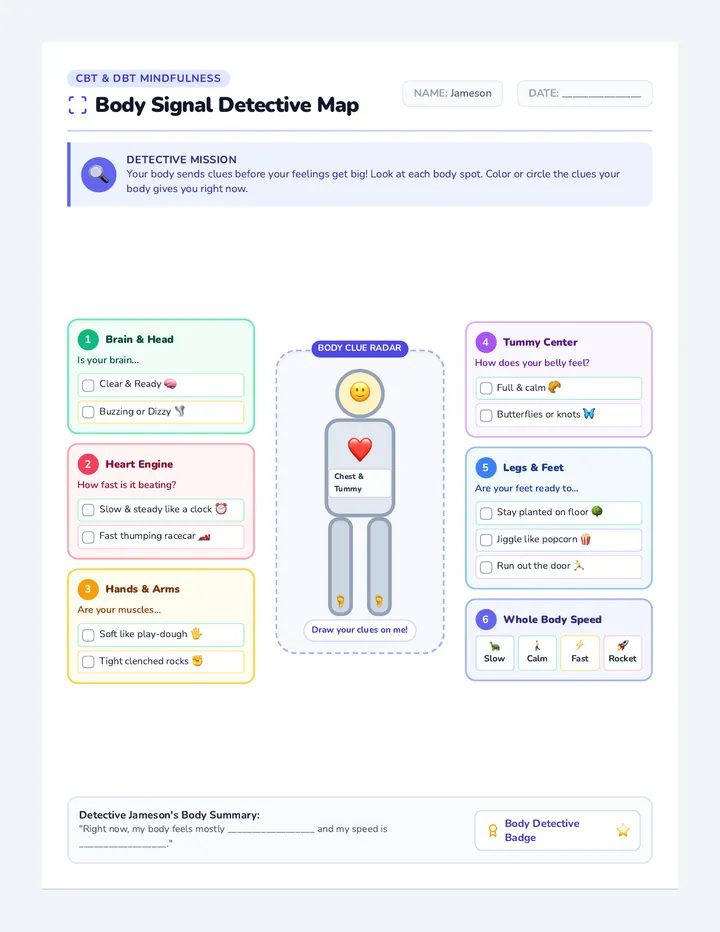
Spark Detective Worksheet Spark Detective Mission
Pause Patrol • Clue Investigation
Name:
Date:
Every impulse starts with a Spark (the trigger) and a Body Clue (your warning siren). Catch them early so your Wise Brain can hit the pause button!
1
Check Your Top Spark Triggers (Check 2 or 3 that feel familiar):
Someone cuts in front of me in line I know the answer and want to blurt it out Losing a game or getting called out at recess Someone bumps into my desk or chair Having to wait my turn when I feel excited Being told "no" or being corrected by an adult
Another spark for me:
2
Map Your Body Warning Clues: Where do you feel the spark first?
Face & Cheeks Gets hot or red
Chest & Heart Fast thump thump
Hands & Arms Tight fists or shaking
Belly & Legs Butterflies or fidgeting
3
My 2 Selected Brake Moves (From your Strategy Cards):
Brake Move #1 Name:
Why this move works for my body:
Brake Move #2 Name:
Why this move works for my body:
4
Detective Case File: Try the Wise Brain Fast-Forward
The Case: You are working quietly on math when a classmate accidentally knocks your colored markers off the table. They roll across the floor. You feel the spark flash in your chest!
What does your impulse brain want you to do?
If you hit pause and use a brake move, what safe choice will you make instead?
Pause Patrol • Level 1 Certification: I can spot my spark before it turns into an explosion!
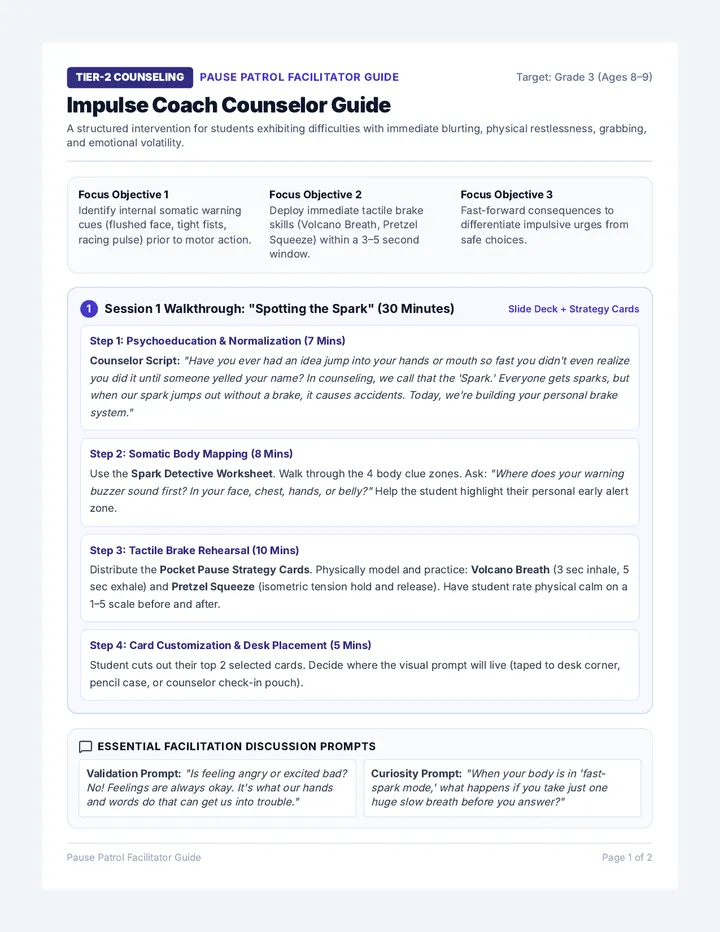
Impulse Coach Counselor Guide TIER-2 COUNSELING Pause Patrol Facilitator Guide
Target: Grade 3 (Ages 8–9)
Impulse Coach Counselor Guide
A structured intervention for students exhibiting difficulties with immediate blurting, physical restlessness, grabbing, and emotional volatility.
Focus Objective 1
Identify internal somatic warning cues (flushed face, tight fists, racing pulse) prior to motor action.
Focus Objective 2
Deploy immediate tactile brake skills (Volcano Breath, Pretzel Squeeze) within a 3–5 second window.
Focus Objective 3
Fast-forward consequences to differentiate impulsive urges from safe choices.
1
Session 1 Walkthrough: "Spotting the Spark" (30 Minutes)
Slide Deck + Strategy Cards
Step 1: Psychoeducation & Normalization (7 Mins)
Counselor Script: "Have you ever had an idea jump into your hands or mouth so fast you didn't even realize you did it until someone yelled your name? In counseling, we call that the 'Spark.' Everyone gets sparks, but when our spark jumps out without a brake, it causes accidents. Today, we're building your personal brake system."
Step 2: Somatic Body Mapping (8 Mins)
Use the Spark Detective Worksheet . Walk through the 4 body clue zones. Ask: "Where does your warning buzzer sound first? In your face, chest, hands, or belly?" Help the student highlight their personal early alert zone.
Step 3: Tactile Brake Rehearsal (10 Mins)
Distribute the Pocket Pause Strategy Cards . Physically model and practice: Volcano Breath (3 sec inhale, 5 sec exhale) and Pretzel Squeeze (isometric tension hold and release). Have student rate physical calm on a 1–5 scale before and after.
Step 4: Card Customization & Desk Placement (5 Mins)
Student cuts out their top 2 selected cards. Decide where the visual prompt will live (taped to desk corner, pencil case, or counselor check-in pouch).
Essential Facilitation Discussion Prompts
Validation Prompt: "Is feeling angry or excited bad? No! Feelings are always okay. It's what our hands and words do that can get us into trouble."
Curiosity Prompt: "When your body is in 'fast-spark mode,' what happens if you take just one huge slow breath before you answer?"
Pause Patrol Facilitator Guide Page 1 of 2
SESSION 2 Consequential Thinking & Practice
Session Duration: 30 Mins
Session 2 Walkthrough: "Choosing the Fix"
Safe Choice Mission Worksheet Safe Choice Movie Mission
Pause Patrol • Fast-Forward Thinking
Name:
Date:
Before your body reacts, hit fast-forward in your mind! Compare Movie A (reacting instantly) with Movie B (hitting the pause brake).
1
Mission Case 1: The Urgent Answer
The Spark: Your teacher asks a question during science. You know the exact answer and feel an overwhelming burst of energy to jump up and blurt it out before anyone else!
Movie A: Blurt it out loud
What happens 5 minutes later?
Movie B: Pretzel squeeze & raise hand
What happens 5 minutes later?
2
Mission Case 2: The Swiped Swing
The Spark: At recess, you run toward the open swing. Right before you sit down, another student darts in front of you and hops on. Your face feels hot and your hands clench!
Movie A: Shove swing or yell insults
What happens 5 minutes later?
Movie B: Volcano breath & talk calmly
What happens 5 minutes later?
Pause Patrol • Consequential Practice Page 1 of 2
My Remote Control Contract & Weekly Log
A personal agreement with myself to take charge of my Wise Brain!
Official Pause Patrol Brain Pledge
1. When my spark goes off, my body warning sign is usually:
2. My favorite brake move to freeze the spark is:
3. When I need a reset, my safe secret signal for my teacher is:
4. Helpful words I will whisper to myself:
Student Signature:
Counselor / Coach Signature:
My 5-Day Pause Tracker (Color a star each time you use a brake!)
5 Days of Power
Monday Brake used:
Tuesday Brake used:
Wednesday Brake used:
Thursday Brake used:
Friday Brake used:
Counseling Reflection: What makes you proud when you choose to pause?
Pause Patrol • Consequential Practice Page 2 of 2
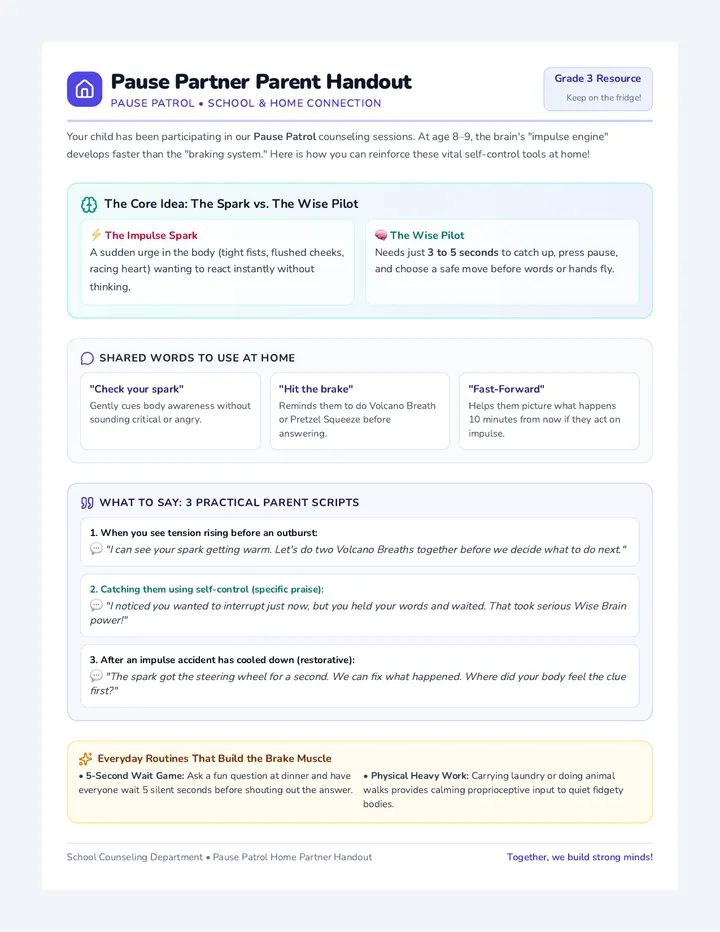
Pause Partner Parent Handout Pause Partner Parent Handout
Pause Patrol • School & Home Connection
Grade 3 Resource Keep on the fridge!
Your child has been participating in our Pause Patrol counseling sessions. At age 8–9, the brain's "impulse engine" develops faster than the "braking system." Here is how you can reinforce these vital self-control tools at home!
The Core Idea: The Spark vs. The Wise Pilot
⚡ The Impulse Spark
A sudden urge in the body (tight fists, flushed cheeks, racing heart) wanting to react instantly without thinking.
🧠 The Wise Pilot
Needs just 3 to 5 seconds to catch up, press pause, and choose a safe move before words or hands fly.
Shared Words to Use at Home
"Check your spark"
Gently cues body awareness without sounding critical or angry.
"Hit the brake"
Reminds them to do Volcano Breath or Pretzel Squeeze before answering.
"Fast-Forward"
Helps them picture what happens 10 minutes from now if they act on impulse.
What to Say: 3 Practical Parent Scripts
1. When you see tension rising before an outburst:
💬 "I can see your spark getting warm. Let's do two Volcano Breaths together before we decide what to do next."
2. Catching them using self-control (specific praise):
💬 "I noticed you wanted to interrupt just now, but you held your words and waited. That took serious Wise Brain power!"
3. After an impulse accident has cooled down (restorative):
💬 "The spark got the steering wheel for a second. We can fix what happened. Where did your body feel the clue first?"
Everyday Routines That Build the Brake Muscle
• 5-Second Wait Game: Ask a fun question at dinner and have everyone wait 5 silent seconds before shouting out the answer.
• Physical Heavy Work: Carrying laundry or doing animal walks provides calming proprioceptive input to quiet fidgety bodies.
School Counseling Department • Pause Patrol Home Partner Handout Together, we build strong minds!