Cluster Quest Slides Cluster Quest
Navigating the 16 National Career Clusters to find your future path.
What are Career Clusters?
A Framework for Success
Career clusters are groupings of occupations and industries used as an organizing tool for curriculum, instruction, and career counseling.
Helps students explore career options
Shows how school subjects apply to jobs
Identifies skills needed for specific paths
16
National Clusters
"Your career isn't a destination; it's a journey through a landscape of possibilities."
The Career Landscape (1-8)
Agriculture &
Architecture &
Arts, A/V Tech &
Business Management
Education &
Finance
Government &
Health Science
The Career Landscape (9-16)
Hospitality &
Human Services
Information Technology
Law, Public Safety
Manufacturing
Marketing
STEM Careers
Transportation &
Your Mission: The Brochure
1
Select
Choose one of the 16 Career Clusters that interests you.
2
Research
Find pathways, job titles, education, and market outlook.
3
Design
Use the tri-fold template to create a professional guide.
Where to Look?
Bureau of Labor Statistics
The OOH is your primary source for job descriptions and median pay.
O*NET OnLine
Detailed descriptions of skills, tasks, and work values for every role.
Must-Include Content:
3+ Career Pathways
Average Salaries
Degree Requirements
Soft & Hard Skills
Job Outlook %
Why Research Now?
1
Avoid Surprises
Know exactly what education you need before you commit.
2
Financial Planning
Understand the starting pay and growth potential.
3
Talent Match
See if your natural strengths align with real job tasks.
70% of Students
Change their major at least once. Research helps you get it right the first time!
Research is creating new knowledge about your future self.
Spotlight: High-Growth Markets
Information Tech
Cybersecurity and AI are seeing explosive global growth.
Health Science
Massive demand for nursing and specialized care roles.
STEM Careers
Engineering and renewable energy lead the technical market.
Soft vs. Hard Skills
Hard Skills
Teachable, quantifiable technical abilities.
Coding & Software
Foreign Languages
Machine Operation
Data Analysis
Soft Skills
Social and subjective interpersonal skills.
Communication
Critical Thinking
Collaboration
Emotional Intel
Design Tips
1. Hierarchy
Big titles for big ideas. Use font size to show what's important.
2. Consistency
Stick to one icon style and color scheme for a professional look.
3. Breathing Room
Don't crowd the panels. Leave white space so text is readable.
Think Like
Ready to Quest?
01
Pick Your Cluster
02
Gather The Data
03
Design The Guide
Career Brochure Template Brochure Template: Outside Panels
Name: ______________________ Date: __________
Why This Cluster?
Primary Goal & Purpose:
Key Core Skills:
Typical Work Environment:
Future Outlook
Predicted Job Growth (%):
Trends & Innovations:
Sources & References:
Career Cluster Exploration
[ Write Cluster Name Here ]
Draw an icon or image representing this cluster
Created By:
Brochure Template: Inside Spread
Inside View (All Panels)
The Big Picture
Research Summary:
Summarize the cluster definition and primary roles in your own words.
Key Industries Involved:
Pathways & Jobs
Top 3 Career Pathways:
Careers & Average Salary:
How to Get There
Required Training / Education:
HS Diploma
Cert.
Degree
HS Subjects to Focus On:
Professional Orgs:
Cluster Master List The 16 National Clusters
Master reference guide for selection.
Ag, Food & Natural Resources
Farming, environmental science, and food processing.
Architecture & Construction
Designing, planning, and building structures.
Arts, A/V Tech & Communication
Media, performing arts, and creative design.
Business Management & Admin
Directing business operations and planning.
Education & Training
Teaching and providing learner support services.
Finance
Banking, insurance, and investment planning.
Government & Public Admin
Public service and administrative functions.
Health Science
Therapeutic and diagnostic medical services.
Hospitality & Tourism
Lodging, travel services, and food operations.
Human Services
Family services, mental health, and social work.
Information Technology
Software development and hardware support.
Law, Public Safety & Security
Legal, safety, and protective services.
Manufacturing
Processing materials into final products.
Marketing
Consumer research and product promotion.
STEM
Scientific research and engineering.
Transportation & Logistics
Moving people and cargo by all modes.
Selection Guide
Choose a cluster that matches your interests.
Research data via BLS.gov or ONet.
Identify education paths for your top 3 jobs.
Check growth trends for the next 10 years.
Project Pilot Rubric Brochure Blueprint Rubric
Assessment criteria for the Career Cluster Research Project.
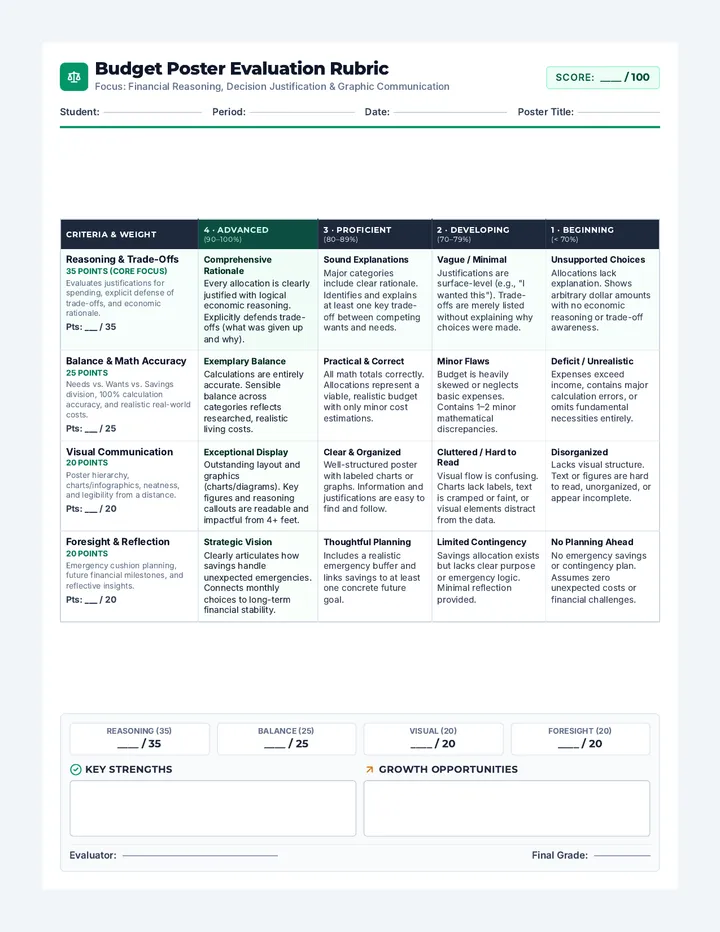
Criterion Exemplary (10) Proficient (8) Developing (5) Research Depth Includes precise data for 3+ pathways, accurate salaries, and specific job outlook percentages. Includes data for 2 pathways and general salary/outlook info. Information is missing or vague. Only one pathway covered. Educational Mapping Clear, step-by-step requirements from high school to professional certification/degree. Lists general degree requirements but lacks specific steps or certifications. Education requirements are unclear or incorrect. Visual Design Professional layout with meaningful icons/sketches. High readability and organization. Neat layout with basic organization. Most sections are easy to read. Disorganized or difficult to read. Lacks visual elements. Clarity & Mechanics No grammatical errors. Tone is professional and informative. Few errors that do not distract from content. Professional tone. Multiple errors that interfere with understanding. Tone is informal.
Teacher Feedback & Comments:
Final Project Score
/ 40
Signature: ______________________
Health Science Answer Key Teacher Answer Key: Health Science Cluster
Exemplary Sample Response
MASTER KEY
Why This Cluster?
Primary Goal & Purpose:
To provide therapeutic and diagnostic services, manage health informatics, and lead research to improve patient outcomes and wellness.
Key Core Skills:
Clinical Observation & Empathy
Medical Data Accuracy
Technical Proficiency
Typical Work Environment:
High-paced sterile environments (Hospitals, Labs), clinics, or data offices.
Future Outlook
Predicted Job Growth (%):
13% Growth (2022-2032)
Trends & Innovations:
Telemedicine and remote monitoring are expanding. AI aids faster radiology diagnostics. Personalized Genomics is tailoring treatments to DNA profiles.
Sources Used:
BLS Occupational Outlook Handbook
Career Cluster Exploration
Health Science
Created By:
Teacher Sample
Inside Spread: Health Science Key
Inside View
The Big Picture
Research Summary:
This cluster provides therapeutic and diagnostic services, health informatics, and biotechnology research. It is a stable, diverse field ranging from entry-level home health care to complex orthopedic surgery and genomics research.
Key Industries:
Hospital Systems / Public Health
Pharmaceutical & Biotech Labs
Pathways & Jobs
Top 3 Pathways:
1. Therapeutic Services
2. Health Informatics
3. Diagnostic Services
Careers & Salaries:
Nurse (RN)
$81k
Lab Tech
$57k
Physician Asst.
$126k
How to Get There
Education Path:
HS Diploma
College Degree
Licensure is mandatory for clinical roles (RN, MD). Technical paths often start with specialized certifications or Associate degrees.
Target HS Subjects:
AP Bio
Chemistry
Stats
Health Science
Pro Organizations:
HOSA, AMA, ANA.
Cluster Research Guide Cluster Quest: Research Guide
A step-by-step framework for your exploration.
Name: ______________________
Date: __________
1
Phase 1: Choose & Discover
Your Focus Cluster:
Visit bls.gov/ooh or onetonline.org. Search for your cluster and read the overview.
3 Interesting Facts Found:
Research Tip
Look for the "Cluster" or "Career Field" sections first. These provide the broad economic data you need for the "Big Picture" panel of your brochure.
2
Phase 2: The Numbers & Paths
Primary Pathways:
Major sub-groups.
Job Outlook:
Future Growth %.
%
Emerging Trend:
Specific Careers & Pay:
Job + Median Salary.
$
$
$
3
Phase 3: Skills & Education
Hard Skills (Quantifiable):
Soft Skills (Interpersonal):
Educational Requirements:
Cert.
Degree
License
Description of Training Path:
Professional Organization:
Personal Reflection:
After your research, is this cluster more or less interesting? Why?
Ready to Design?
3+ Pathways
Salary Stats
Outlook %
Skill List
Training Info
Pro Org
Research Roadmap Slides Research Roadmap
Breaking Down the Research Guide
The 3-Phase Strategy
1
Discovery
Finding your target cluster and the "Wow" facts.
2
Data Dive
The numbers, growth, and specific job paths.
3
Execution
Mapping the skills and education required.
Phase 1: Choose & Discover
Setting the Foundation
The Focus Cluster
Review the Cluster Master List. Pick the one that actually sparks your curiosity.
3 Interesting Facts
Look for the unusual! What surprised you about this industry? These grab the reader's attention.
The Primary Tools
bls.gov/ooh
onetonline.org
Industry Journals
Phase 2: The Numbers & Paths
Economic Realities
Pathways
Major sub-groups. Ex: "Horticulture" vs "Animal Science" in Ag.
Outlook %
The future growth rate. Is your cluster expanding?
Median Pay
What do professionals actually make annually?
Specific Trends
How is tech changing this specific cluster?
Return on Investment
"Researching the ROI of your effort means knowing the market before you join it."
Phase 3: Skills & Education
The Training Path
Hard Skills
Technical abilities specific to your cluster. Ex: "Blueprinting" for Architecture.
Soft Skills
Interpersonal traits. Ex: "Patient Communication" for Health Science.
Education Mapping
Map out the exact steps: HS Diploma, Industry Certifications, or College Degrees.
Pro Tip: Look for professional orgs (HOSA, SkillsUSA, DECA) related to your cluster!
ROI by Cluster
ROI (Return on Investment) varies by cluster. Think about Cost of Training vs. Future Pay:
Manufacturing
Low cost (Apprenticeship) → Solid stable pay.
Health Science
High cost (8-12 years) → Elite future pay.
ROI Question
"Does your chosen cluster require a 4-year degree, or can you start earning with a certification? Research this in Phase 3."
Finding Expert Data
Where to Sleuth
Fit Finder Worksheet Fit Finder
Career Cluster Self-Assessment
Name: ______________________
Date: __________
1. Interest Audit
Mark everything that sounds appealing to you:
Working Outdoors
Fixing Computers
Helping Others
Solving Math
Public Speaking
Designing Art
Law & Justice
Food & Service
Writing/Media
Building/Tools
Finance/Money
Science/Labs
2. Skill Spotlight
My "Top 3" Superpowers:
Preferred Work Style:
Independent: Working alone on tasks.
Leader: Organizing and directing others.
Collaborator: Working in a team.
3. Values Check
Rank 1 (Most) to 4 (Least):
High Income
Social Impact
Stability
Creativity
Your Match
Based on your audit, which Career Cluster matches you best?
Career Fit Finder Worksheet Project Fit Finder
Selecting the path that matches your profile.
Name:
Date:
1. My Superpowers
Low High
Solving Problems
Leading Others
Being Creative
Working with Data
Helping People
Working with Hands
2. Interest Categories
List subjects or hobbies you love within these categories:
Creating
Art, Design, Fashion, Food
Solving
Math, Coding, Robotics, Tech
Helping
Nursing, Tutoring, Coaching
3. Value Priority
Rank these 1-5 (1 is top priority) based on your future goals:
High Salary
Helping Others
Work/Life Balance
Job Security
Creativity
The Final Alignment
Top 3 Contenders
Which clusters stand out based on your profile?
Final Winner
Topic for your project
Why This Path?
Skill Alignment:
How does this career use your Part 1 superpowers?
Value Match:
Does this career provide your #1 priority from Part 3?
Mission Confirmed
Grab your Research Guide and start phase 1!
Phase 1 Target:
Research Launch
Career Fit Worksheet The Career Fit Factor
Discovering your path through interests, skills, and values.
Name: ______________________
Date: __________
Phase 1: Your Passion Profile
What topics or activities make you lose track of time?
Top 3 Hobbies or Personal Interests:
Preferred Subjects (Check all that apply):
Mathematics
Sciences
Literature/Arts
Social Studies
Technology/IT
Physical Ed.
Phase 2: The Skill Inventory
Hard Skills
Specific technical abilities you've learned (e.g., Coding, Playing Guitar, Math, Writing).
Soft Skills
Interpersonal traits and how you work (e.g., Public Speaking, Listening, Empathy).
Phase 3: Your Work Values
Rank these from 1 (Most Important) to 5 (Least Important) for your future job.
High Pay
Helping
Flexibility
Innovation
Security
Phase 4: The Cluster Match
The 16 Clusters
1. Agriculture
2. Architecture
3. Arts & Comm.
4. Business Mgmt.
5. Education
6. Finance
7. Gov & Admin
8. Health Science
9. Hospitality
10. Human Services
11. IT
12. Law & Safety
13. Manufacturing
14. Marketing
15. STEM
16. Transportation
Based on your reflection, pick your Top Match:
#1
Why this cluster fits you best:
Decision Made?
Take this choice to your Research Roadmap!
Career Interest Inventory Worksheet Interest Inventory
Part 1: The Activity Checklist
Name: ______________________
Discovery Tool
Check the activities that you enjoy or would like to learn. Use the Category Codes on the right to tally your score on page 2.
Caring for farm animals AGR
Drawing building plans ARC
Editing digital videos ART
Running a business BUS
Teaching sports skills EDU
Managing stock profiles FIN
Negotiating trade deals GOV
Giving first aid care HEA
Managing a restaurant HOS
Counseling a friend HUM
Removing viruses IT
Enforcing safety laws LAW
Operating a robot arm MAN
Designing an ad MAR
Researching chemistry STM
Planning logistics TRA
Analyzing soil quality AGR
Installing wiring ARC
Painting mural art ART
Directing employees BUS
Developing plans EDU
Preparing taxes FIN
City Government GOV
Analyzing DNA HEA
Travel planning HOS
Community support HUM
Cloud servers IT
Criminal cases LAW
Precision tools MAN
Brand marketing MAR
Physics formulas STM
Airplane repair TRA
Done? Turn to Part 2: The Tally.
Page 1 of 2
Part 2: The Tally
Mapping checks to Career Clusters
Scoring Guide
Count how many times each code appeared next to your checks. Write the totals below.
AGRAg & Natural Res.
ARCArchitecture & Const.
ARTArts, A/V & Comm.
BUSBusiness & Admin.
EDUEducation & Training
FINFinance
GOVGov & Public Admin.
HEAHealth Science
HOSHospitality & Tourism
HUMHuman Services
ITInfo. Technology
LAWLaw & Public Safety
MANManufacturing
MARMarketing
STMSTEM
TRATransport. & Logist.
Top Hits
My Top 3 Scoring Clusters
Self Discovery Slides The Fit Finder
Self Assessment & Interest Discovery
Today's Mission
1. Inventory
Check your interests to find which of the 16 Career Clusters match your personality.
2. Fit Finder
Audit your strengths and values to narrow your focus down to one specific path.
Project Goal
To select the perfect topic for your Career Brochure Project.
Why do this first?
Picking a career isn't a "one - and - done" decision. It's about alignment.
Saves time researching.
Matches your natural strengths.
Increases long - term satisfaction.
Know Yourself,
Activity Check
Interest Inventory: Part 1
On the first page, you'll see a list of 40 activities. Your job is simple:
The Golden Rule
"Don't think about the pay. Just ask: Would I actually enjoy doing this today?"
Pro - Tip
Be honest! Checking everything makes the data useless. Only mark things you genuinely like.
Category Codes
Each activity has a 3-letter code. These represent the clusters:
AGR Agri
HEA Health
IT Tech
+ 12 More!
The Tally
Count how many times each code appeared next to your checked items.
Check → Count → Tally
Part 2: The Tally
Turn your Inventory over to **Page 2**. This is where you see the patterns emerge.
Total Your Points
Which cluster got the highest score? These are your "Top Hits."
Strongest Fit
Circle Your Top 3
Interest Tiers
0 - 2
Casual
Likely a hobby, not a career path for you.
3 - 5
Contender
A field you would find engaging most days.
6 +
Prime Match
You belong here! Start your research guide.
Beyond
Interests.
Let's look at **WHO** you are using the **Career Fit Finder Worksheet**.
The 3 Pillars of Fit
Interests
"What I enjoy doing."
Strengths
"What I'm good at."
Values
"What matters to me."
Career Discovery Quiz Career Compass Quiz
Assessment of Interests, Skills, and Clusters
Name: ______________________
Date: __________
Part 1: Cluster Matching
Identify the National Career Cluster associated with the following activities.
1. Treat an injured animal: ___________
2. Design building plans: ___________
3. Edit digital videos: ___________
4. Manage stock profiles: ___________
5. Give first aid care: ___________
6. Write app code: ___________
7. Enforce safety laws: ___________
8. Plan travel tours: ___________
9. Direct employees: ___________
10. Conduct lab research: ___________
Part 2: Multiple Choice
11. What does the acronym ROI stand for in career planning?
[ ] Return on Interest
[ ] Revenue of Industry
[ ] Return on Investment
[ ] Risk of Income
12. Which government resource is used for median salary and job descriptions?
[ ] IRS.gov
[ ] BLS.gov (OOH)
[ ] USA.gov
[ ] Education.gov
13. A 'Soft Skill' is best defined as:
[ ] Ability to use a specific software
[ ] Interpersonal and behavioral traits
[ ] A degree from a university
[ ] Operating heavy machinery
14. Which cluster uses the category code "ARC"?
[ ] Arts and Communication
[ ] Archaeology
[ ] Architecture and Construction
[ ] Archive Management
15. If a student loves 'Logic Puzzles' and 'Strategy', they likely fall into which strength bucket?
[ ] Creating
[ ] Solving
[ ] Helping
[ ] Leading
Part 2: Multiple Choice (Continued)
16. The 'Lone Wolf' work style is characterized by:
[ ] Leading a large team of diverse people
[ ] Working deeply on individual technical projects
[ ] Constantly meeting with new clients
[ ] Working in group synergy with 5+ partners
17. Which of these is a 'Hard Skill'?
[ ] Empathy
[ ] Public Speaking
[ ] Python Programming
[ ] Time Management
18. The cluster 'Health Science' is characterized by which value priority?
[ ] Pure Creativity
[ ] High Social Impact
[ ] Minimal Education Need
Career Discovery Quiz Answer Key Answer Key
Career Discovery Quiz Master Guide
Teacher Resource
Project: Career Compass
Part 1: Cluster Matching
1. Treat animal: Agriculture (AGR)
6. Write app code: IT
2. Design plans: Architecture (ARC)
7. Enforce laws: Law & Safety
3. Edit videos: Arts/AV (ART)
8. Plan tours: Hospitality (HOS)
4. Manage stock: Finance (FIN)
9. Direct employees: Business (BUS)
5. First aid: Health (HEA)
10. Lab research: STEM (STM)
Part 2: Multiple Choice
11. Return on Investment
16. Working individual tech projects
12. BLS.gov (OOH)
17. Python Programming
13. Interpersonal/Behavioral
18. High Social Impact
14. Architecture & Construction
19. Skills & Education Path
15. Solving
20. Core belief for happiness
Part 3: True / False
21. T
22. F
23. F
24. T
25. F
26. T
27. F
28. T
29. F
30. F
Part 4/5 Scenarios & IDs
31. Hands/Engines: Transportation
41. Mural art: Arts/AV
32. Impact/Teach: Education
42. Real estate: Marketing
33. Salary/Data: Finance
43. Stars/Planets: STEM
34. Code for Art: ART
44. Chemistry: STEM
35. Code/Routers: IT
45. Airplanes: Transportation
36. Hotel: Hospitality
46. Taxes: Finance
37. Water samples: Agriculture
47. Hackers: IT
38. Wildlife: Agriculture
48. Physical rehab: Health Science
39. Wiring: Architecture
49. Crime scene: Law & Safety
40. Embassy: Government
50. Social media: Marketing
Peer Profile Audit Worksheet Peer Audit
Collaborative Career Discovery
Name: ______________________
Partner: ______________________
1. Ask Your Partner
Chosen Cluster
Top Superpower
Primary Value
2. Your Perspective
"I think this cluster (fits / doesn't fit) you because..."
"A specific job in this field I can see you doing is..."
3. Synergy Brainstorm
Create a "Startup" idea that combines BOTH of your clusters. (Ex: Agriculture + Tech = Smart Farm).
My Cluster
Partner's Cluster
Our Synergy Concept:
Audit Workshop • Career Compass Phase I
Pair up • Audit • Innovate
Peer Profile Audit Worksheet Project Peer Audit
Collaborative Feedback Workshop
My Name:
Partner:
1. The Interview
Chosen Cluster
Superpower
Primary Value
2. Peer Feedback
"I think this cluster fits you because..."
"I can see you working as a..." (Specific Job)
3. Synergy Challenge
Collaboration Lab
Brainstorm an innovation that combines BOTH of your clusters. (Ex: Health + IT = AI Doctor).
My Cluster
Partner's Cluster
Our Concept Idea:
Peer Audit Workshop • Phase I
Pair up • Audit • Innovate
Career Facilitation Guide Facilitation Guide
Career Compass Sequence • Instructional Strategy
Teacher Resource
Prompts and strategies to facilitate self-discovery, peer auditing, and digital research mastery.
1. Sparking Self-Discovery
The Reframing Prompt:
"Instead of asking 'What do you want to be?', ask 'What kind of problems in the world do you want to solve?' This makes the job a mission."
Fit Finder Discussion:
Why might your "Superpowers" change as you gain more life experience?
Is a high salary a value, or a tool to achieve a different goal (like travel or security)?
How does your work style (Soloist vs. Leader) impact your daily energy?
Inventory Debrief:
Which activities did you mark that you've never actually tried before?
Are there clusters that sound "boring" but have high scores? Let's explore why.
2. Peer Audit Strategy
Encourage students to act as "Career Consultants" for their partners.
The "Reality Check":
"If your partner says they value 'Independence' but picked 'Public Safety', ask how they will handle strict chain-of-command environments."
Critique Starters:
• "I see a match between your 'Solving' skill and 'IT'..."
• "How does this career path support your #1 value?"
• "What is one roadblock your partner might face?"
3. Research Navigation
Specific Site Strategies:
• CareerKey.com: Focus on the Holland Codes to explain "Environmental Fit."• PrincetonReview.com: Use for "A Day in the Life" narratives and major requirements.• CareerBuilder & Monster: Use to verify current hiring demand in specific zip codes.
Addressing the "Salary Gap":
Teach Cost of Living . Explain that $100k in San Francisco provides a different lifestyle than $70k in the Midwest.
The Credibility Test:
Ask: "Who funded this site? Is it a university, a gov agency, or a private school selling a degree?"
4. Closing Reflection
The Pivot
"What is your plan B if this industry changes in 10 years?"
The Skill
"Which technical skill are you most excited to learn?"
The Value
"Does this path still fit your #1 personal value?"
Future Blueprint Slides Future Blueprint
Project Phase II: Mapping Your Personal Path
Beyond the Brochure
Your brochure explored an entire industry . Now, it's time to build a personal strategy for just one specific job within that cluster.
Example:
From Health Science (Cluster) → to Nurse Practitioner (Blueprint).
The Core Goal
Create a 10-year advancement timeline that details exactly how you get from where you are today to your dream role.
Blueprint Requirements
01
The Education Arc
Specific degrees, certifications, or trade school programs required.
02
The Cost-Benefit Math
Tuition costs vs. projected starting salary (ROI).
03
The Skill Growth
Internships, entry-level roles, and networking goals.
Final Format
You will present your blueprint as a Digital Poster or Strategic Timeline .
Phase I: The Foundation
Entry Level (Years 0-2)
What is the very first job title someone has in this field? How much do they make while they are still learning?
Required Credentials
Research specific institutions. Does your state university offer this degree? Is there a local trade school with a better program?
Key Research Question:
"Is there a shortcut? Can I earn a certificate in 6 months to start working while I finish a 4-year degree?"
Your Action Plan
Step 1
Investigate
Gather specific costs for your chosen school or program.
Step 2
Calculate
Compare that cost to the "Median Salary" from your brochure.
Step 3
Visualize
Design your blueprint with clear nodes for each major milestone.
"A goal without a plan is just a wish."
Pathway Planning Organizer Strategic Path Blueprint
10-Year Career Advancement Plan
Target Career: ____________________
Primary Cluster: __________________
Master Timeline
Years 0-2: Foundation
TRAINING
School/Program & Learning Focus:
Years 3-5: Entry Level
EARNING
First Job Title & Tasks:
Years 6-10: Professional Pivot
ADVANCING
Advanced Role & Skills:
Hard Skills to Master
Professional Network
List mentors or organizations:
Architect's Tip: Use your 10-year timeline to identify "bottlenecks"—places where you might need extra support, like expensive tuition or a difficult certification exam.
ROI Calculator Worksheet Project The ROI Calculator
Financial Viability Assessment
Future Blueprint Project
1. The Investment
Annual Tuition/Program Cost:
$
Total Years of Training:
Total Educational Cost
$
Total = (Annual Cost x Years)
2. The Return
Expected Starting Salary:
$
Mid-Career Salary (Yr 10):
$
3. Theoretical Break-Even
Total Cost
$
÷
(Salary x 0.20)
$
=
Break-Even Years
*Calculation assumes 20% of your starting salary goes toward training costs/debt.*
Financial Strategy Verdict
Reflection Area
Is this path sustainable? Consider your break-even years and future salary growth.
Estimates only. real ROI will vary based on financial aid, regional cost-of-living, and individual spending habits.
Blueprint Presentation Rubric Blueprint Presentation Rubric
40 Points Max
Strategic Career Roadmap Assessment
Metric Elite (10) On-Path (8) Stalled (5) Strategic Timeline 3 clear phases with specific, measurable annual milestones. 3 phases included but some milestones are vague. Timeline is missing major steps or structure. Financial Accuracy Precise ROI calculation using real tuition and salary data. Includes cost and salary but ROI math is incomplete. Financial data is missing or highly inaccurate. Professionalism Creative blueprint theme. Exceptional clarity and flow. Organized and neat, but uses a basic design. Disorganized or difficult to navigate visually. Growth Mindset Explicitly identifies roadblocks and pivot strategies. Mentions skill mastery, but lacks roadblock planning. No mention of growth steps or future challenges.
Teacher Feedback & Comments:
Final Project Score
/ 40
Reviewer Signature: ______________________
Web Research Tools Slides Web Research Tools
Mastering the Art of the Search
Project Goals
Understand Search Logic
Navigate Databases
Verify Source Credibility
Organize Research Data
"Efficiency is doing things right; effectiveness is doing the right things."
The Detective Mindset
Quality over Speed
Don't settle for the first link. Web research is about digging for the most accurate answer, not the easiest one.
The Checklist
• Who wrote it?
• When was it updated?
• Why was it written?
Bureau of Labor Stats
The gold standard for career and economic data in the United States.
What you find here:
Verified Annual Salaries
Official Hub
BLS.GOV
The OOH Navigator
The OOH is the specific part of BLS.gov that contains thousands of career profiles.
How to Search:
"Use the search box in the top right of the handbook to type a specific job title."
Tabs to watch
• Summary (The snapshot)
• What They Do (Daily tasks)
• Pay (Specific numbers)
The Summary Tab
This is your first stop. It gives you the "Big Picture" for your brochure.
Median Pay $78,000+
Entry Level Bachelor's
Stat Tip:
Look for the "Job Outlook." This tells you if the career is growing or shrinking over the next 10 years.
"What They Do"
Don't guess. The OOH lists specific Daily Tasks . Use these for the "Description" section of your project.
Use Action Verbs!
Example Tasks
"Design and execute network security protocols for financial firms."
The Training Path
This tab is critical for your Strategic Path Blueprint .
Specific Degree Majors
Certifications Required
Residency or Internships
Mapping
"Note the difference between a Bachelor's Degree and a Professional Degree. It can mean 4 extra years of school!"
The Money Reality
BLS uses Median Annual Wage . This is the amount where exactly half the workers earned more and half earned less.
Web Research Tools Slides Mastery Search Mastery
A Guide to Career Web Research
The Mission
By the end of this deck, you will:
Navigate 6 Major Sites
Spot Source Red Flags
Map Data to Your Project
"Research is what I'm doing when I don't know what I'm doing." — Wernher von Braun
The Mindset
Be Skeptical
Every website has a motive. Some want to inform you, others want to SELL to you. Know the difference.
Rule #1
Always verify a salary or growth number with at least two different sources.
BLS.GOV
The Bureau of Labor Statistics.
This is the official database for the U.S. government.
BEST FOR:
Official Wages & Outlooks
The OOH
The Occupational Outlook Handbook is the heart of BLS.gov.
Search by Job Title.
Target Tabs:
• Summary
• Pay
• Outlook
Summary Tab
This is the "Cheat Sheet" for your brochure's front panels.
MEDIAN PAY
$70K+
EDUCATION
DEGREE
OUTLOOK
GROWING
"What They Do"
Stop guessing about daily tasks. Use this tab to find the Daily Reality of the job.
5 - 10 specific tasks
Pro - Tip
Turn these tasks into action - oriented bullet points for your project.
Pay & Outlook
The Bottom Line
This tab gives you the "Low," "Median," and "High" pay brackets. Use the Median for accuracy.
Stat Search:
"Is the job growing faster than average? (Over 5%)"
Becoming One
This is the blueprint for your 10-year plan.
Degrees + Training
"Look for licenses or certifications that are mandatory in your state."
O*NET OnLine
The Skills Bible.
While BLS focuses on the economy, O*NET focuses on the Skillsets .
URL:
onetonline.org
Quick Search
"One search term reveals thousands of data points."
Try it:
"CYBERSECURITY"