Budget Rescue Worksheet
CFM Lab Financial Literacy & Workplace Success
Cash Flow Rescue: Workplace Budgeting
NYC DOE / NOCTI Alignment
Standard 21: Financial Decision Making
Student Name:
Date:
Period:
Score: / 20
Workplace Scenario Retail Sales Associate Case Study
Weekly Net Pay: $400.00
You earn $400 per week at a retail job. You established a target goal to save $80 each week for a dependable car down payment. However, because you habitually swipe your debit card for convenience items—daily fast food lunches, iced coffees, and ride shares—you consistently lose track of your variable spending. At the end of the week, you discover you only have $15 left for savings ($65 short of your target).
Core Strategy Toolbox
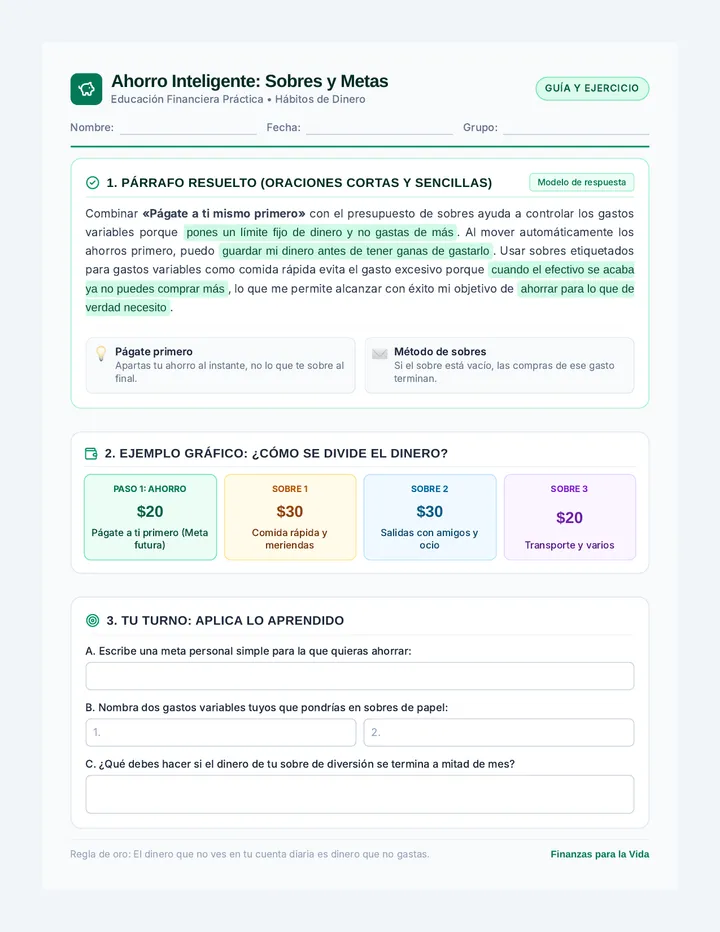
Pay Yourself First Priority
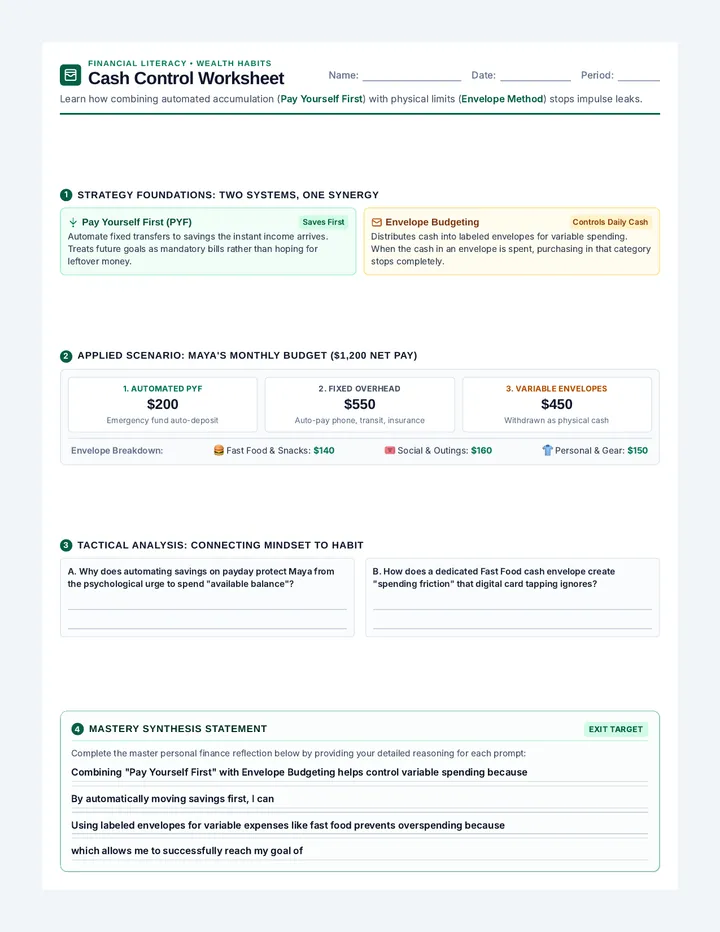
Automatically transfer savings goals ($80) into an account the moment net pay arrives, before paying discretionary bills.
Envelope Budgeting Variable Cap
Allocate cash into physical labeled envelopes (Food, Gas). When cash runs out, spending in that category ceases immediately.
Zero-Based Allocation Total Match
Every dollar has a pre-assigned assignment: Income – Total Allocations = $0, eliminating unmonitored checking cushions.
Quantitative Budget Audit: $400 Weekly Paycheck Breakdown
| Category & Expense Type |
Classification |
Current Status |
Zero-Based Plan |
Control Mechanism |
| Total Weekly Net Income |
Take-Home Pay |
$400.00 |
$400.00 |
Direct Deposit |
| Car Down Payment Fund |
Savings Goal |
$15.00 |
$80.00 |
Pay Yourself First (Auto-Transfer) |
| Work Transit & Subway / Gas |
Fixed / Need |
$65.00 |
$65.00 |
MetroCard / Fixed Budget |
| Dining, Fast Food & Coffee |
Variable Expense |
$210.00 |
$135.00 |
Envelope #1: Cash Only ($135) |
| Entertainment, Snacks & Misc. |
Discretionary Want |
$110.00 |
$120.00 |
Envelope #2: Cash Only ($120) |
| Net Unassigned Balance |
Checking Cushion |
-$0.00 (Leaked) |
$0.00 |
Zero-Based Balance Achieved |
1 Workplace Standards Knowledge Check Assigned Diagnostic Question
Which core budgeting strategy directly forces an individual to prioritize their long-term financial commitments by locking in personal savings allocations immediately upon receiving income, before any variable or discretionary living costs can occur?
A Envelope Budgeting
B Zero-Based Budgeting
C Pay Yourself First
D Variable Cost Budgeting
Part II • Written Analysis & Argumentation
Class Comment Drop: Strategy Synthesis
Level 3+ Protocol
Analytical Writing Prompt
How can combining the "Pay Yourself First" strategy with Envelope Budgeting help you reach a specific savings goal while keeping variable expenses under control?
Level 3+ Success Criteria Checklist Check off before writing
Clear Claim: Direct answer to prompt
Key Vocab: 3+ financial terms applied
Data Evidence: $400 & $80 figures used
Behavioral Cause: Debit vs. cash friction
✍️ Sentence Frame Assist (Scaffold) Use to structure or elevate your draft
“Combining 'Pay Yourself First' with Envelope Budgeting helps control variable spending because _____________________. By automatically moving savings first, I can _____________________. Using labeled envelopes for variable expenses like fast food prevents overspending because _____________________, which allows me to successfully reach my goal of _____________________.”
Your Structured Response (Level 3+ Writing) Synthesize both strategies with workplace justification
Accountable Talk & Peer Defense Protocol
Partner Name:
Discussion Prompt: Turn to your partner. Explain how relying on a debit card created the illusion of having unassigned cash. Record your peer's feedback and your justification below:
4 • Exemplary
Integrates PYF + envelopes with exact figures & behavioral defense
3 • Proficient
Accurately explains both methods and applies financial vocabulary
2 • Developing
Explains one method; partial math or vague justification provided
1 • Emerging
Incomplete sentence frames; missing connection to savings goal