Next Pitch AR Quiz
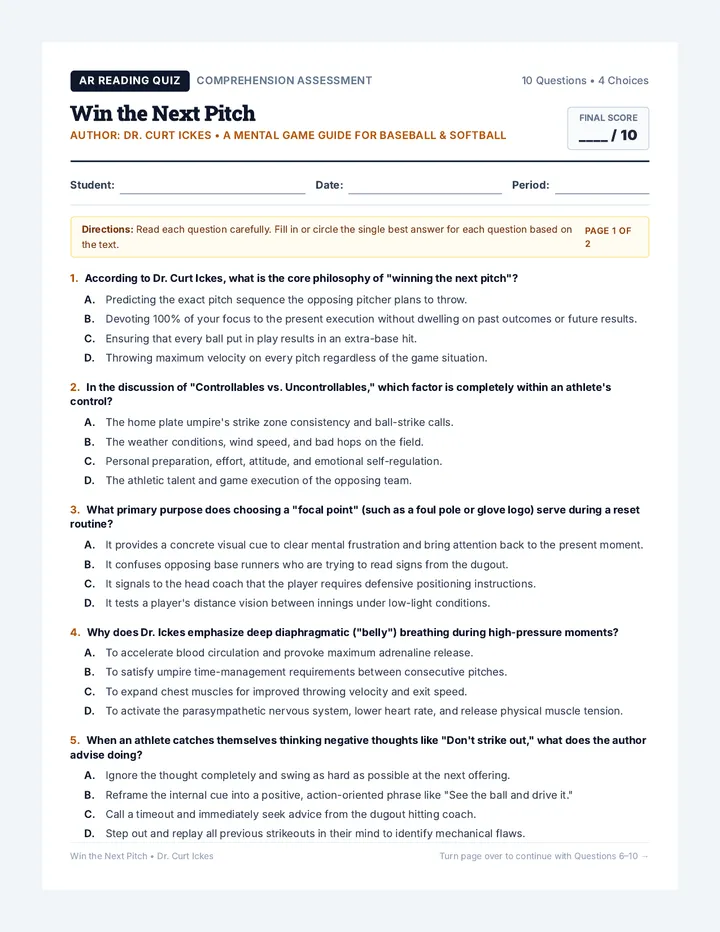
AR Reading Quiz Comprehension Assessment
10 Questions • 4 Choices
Win the Next Pitch
Author: Dr. Curt Ickes • A Mental Game Guide for Baseball & Softball
Final Score ____ / 10
Student:
Date:
Period:
Directions: Read each question carefully. Fill in or circle the single best answer for each question based on the text. Page 1 of 2
- According to Dr. Curt Ickes, what is the core philosophy of "winning the next pitch"?
A. Predicting the exact pitch sequence the opposing pitcher plans to throw.
B. Devoting 100% of your focus to the present execution without dwelling on past outcomes or future results.
C. Ensuring that every ball put in play results in an extra-base hit.
D. Throwing maximum velocity on every pitch regardless of the game situation.
- In the discussion of "Controllables vs. Uncontrollables," which factor is completely within an athlete's control?
A. The home plate umpire's strike zone consistency and ball-strike calls.
B. The weather conditions, wind speed, and bad hops on the field.
C. Personal preparation, effort, attitude, and emotional self-regulation.
D. The athletic talent and game execution of the opposing team.
- What primary purpose does choosing a "focal point" (such as a foul pole or glove logo) serve during a reset routine?
A. It provides a concrete visual cue to clear mental frustration and bring attention back to the present moment.
B. It confuses opposing base runners who are trying to read signs from the dugout.
C. It signals to the head coach that the player requires defensive positioning instructions.
D. It tests a player's distance vision between innings under low-light conditions.
- Why does Dr. Ickes emphasize deep diaphragmatic ("belly") breathing during high-pressure moments?
A. To accelerate blood circulation and provoke maximum adrenaline release.
B. To satisfy umpire time-management requirements between consecutive pitches.
C. To expand chest muscles for improved throwing velocity and exit speed.
D. To activate the parasympathetic nervous system, lower heart rate, and release physical muscle tension.
- When an athlete catches themselves thinking negative thoughts like "Don't strike out," what does the author advise doing?
A. Ignore the thought completely and swing as hard as possible at the next offering.
B. Reframe the internal cue into a positive, action-oriented phrase like "See the ball and drive it."
C. Call a timeout and immediately seek advice from the dugout hitting coach.
D. Step out and replay all previous strikeouts in their mind to identify mechanical flaws.
Win the Next Pitch • Dr. Curt Ickes Turn page over to continue with Questions 6–10 →
Win the Next Pitch — AR Reading Quiz
Dr. Curt Ickes • Mental Game Comprehension (Part 2)
Questions 6 – 10
- Why does Dr. Ickes recommend that hitters track "Quality At-Bats" (QABs) instead of relying solely on batting average?
A. Batting averages are only recorded by professional scouts and college recruiters.
B. QABs focus on controllable process factors (hard contact, seeing pitches) rather than defensive luck.
C. Tracking QABs allows hitters to avoid running hard on routine ground balls.
D. Quality At-Bats guarantee a base hit on at least every third plate appearance.
- According to the text, what commonly triggers prolonged hitting or pitching slumps?
A. Overthinking mechanics, obsessing over statistics, and compounding past failures.
B. Using the same bat or glove model for more than two consecutive months.
C. Eating high-carbohydrate meals before night games.
D. Practicing fundamental drills too frequently during weekly workouts.
- What is the primary benefit of maintaining upright, confident body language on the field?
A. It distracts opposing baserunners and forces umpires to favor your team.
B. It positively influences your internal emotional state while projecting poise and resilience.
C. It ensures that fielders will never commit physical fielding errors.
D. It reduces aerodynamic drag when sprinting between bases.
- Why does Dr. Ickes insist on using a repeatable pre-pitch routine on EVERY pitch?
A. To lengthen game times so relief pitchers have extra bullpen warm-up time.
B. To create mental consistency and trigger competitive readiness regardless of score or pressure.
C. To show spectators that the player has studied professional athletes' habits.
D. To prevent coaches from calling audibles or changing defensive shifts.
- When a player commits a fielding error or gets an unfair strike called against them, what is the "flush" technique designed to do?
A. Argue with the umpire to demonstrate intense competitive drive and fire.
B. Look immediately to the dugout for a substitute player to take their position.
C. Use a physical action (like wiping cleats or smoothing dirt) to release frustration and wipe the mental slate clean.
D. Pretend the mistake never happened by avoiding eye contact with any teammate.
Student Honor Pledge: Accelerated Reader Reading Practice Standard
"I completed this quiz independently based on my own reading and comprehension of the book."
Signature: Date Completed:
Win the Next Pitch • Dr. Curt Ickes End of AR Quiz • Page 2 of 2
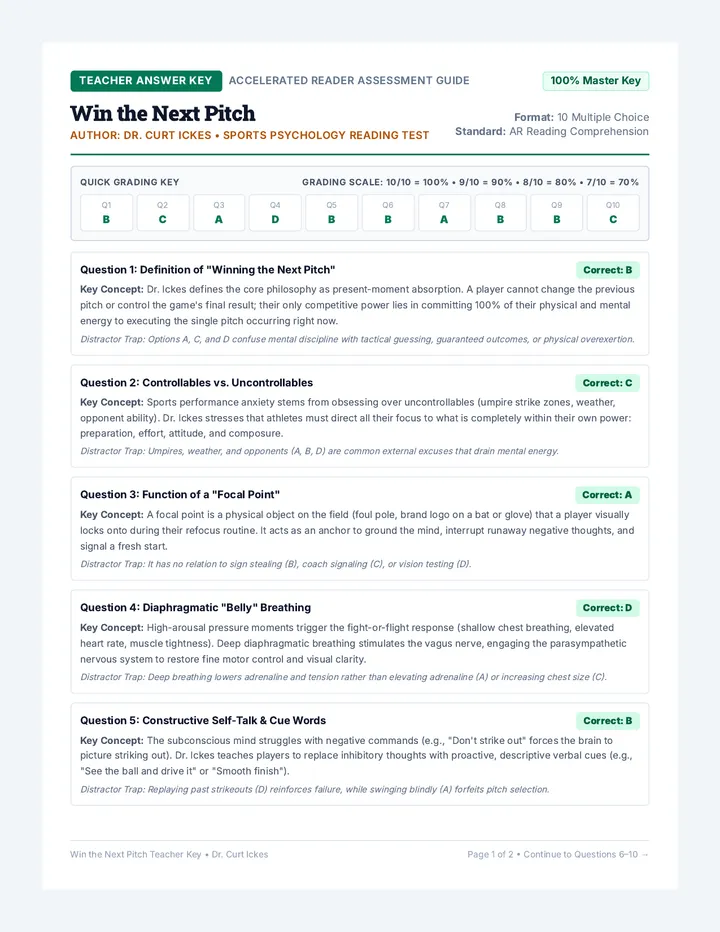
Next Pitch Answer Key
Teacher Answer Key Accelerated Reader Assessment Guide
100% Master Key
Win the Next Pitch
Author: Dr. Curt Ickes • Sports Psychology Reading Test
Format: 10 Multiple Choice
Standard: AR Reading Comprehension
Quick Grading Key Grading Scale: 10/10 = 100% • 9/10 = 90% • 8/10 = 80% • 7/10 = 70%
Q1
B
Q2
C
Q3
A
Q4
D
Q5
B
Q6
B
Q7
A
Q8
B
Q9
B
Q10
C
Question 1: Definition of "Winning the Next Pitch" Correct: B
Key Concept: Dr. Ickes defines the core philosophy as present-moment absorption. A player cannot change the previous pitch or control the game's final result; their only competitive power lies in committing 100% of their physical and mental energy to executing the single pitch occurring right now.
Distractor Trap: Options A, C, and D confuse mental discipline with tactical guessing, guaranteed outcomes, or physical overexertion.
Question 2: Controllables vs. Uncontrollables Correct: C
Key Concept: Sports performance anxiety stems from obsessing over uncontrollables (umpire strike zones, weather, opponent ability). Dr. Ickes stresses that athletes must direct all their focus to what is completely within their own power: preparation, effort, attitude, and composure.
Distractor Trap: Umpires, weather, and opponents (A, B, D) are common external excuses that drain mental energy.
Question 3: Function of a "Focal Point" Correct: A
Key Concept: A focal point is a physical object on the field (foul pole, brand logo on a bat or glove) that a player visually locks onto during their refocus routine. It acts as an anchor to ground the mind, interrupt runaway negative thoughts, and signal a fresh start.
Distractor Trap: It has no relation to sign stealing (B), coach signaling (C), or vision testing (D).
Question 4: Diaphragmatic "Belly" Breathing Correct: D
Key Concept: High-arousal pressure moments trigger the fight-or-flight response (shallow chest breathing, elevated heart rate, muscle tightness). Deep diaphragmatic breathing stimulates the vagus nerve, engaging the parasympathetic nervous system to restore fine motor control and visual clarity.
Distractor Trap: Deep breathing lowers adrenaline and tension rather than elevating adrenaline (A) or increasing chest size (C).
Question 5: Constructive Self-Talk & Cue Words Correct: B
Key Concept: The subconscious mind struggles with negative commands (e.g., "Don't strike out" forces the brain to picture striking out). Dr. Ickes teaches players to replace inhibitory thoughts with proactive, descriptive verbal cues (e.g., "See the ball and drive it" or "Smooth finish").
Distractor Trap: Replaying past strikeouts (D) reinforces failure, while swinging blindly (A) forfeits pitch selection.
Win the Next Pitch Teacher Key • Dr. Curt Ickes Page 1 of 2 • Continue to Questions 6–10 →
Win the Next Pitch — Teacher Answer Key (Part 2)
Dr. Curt Ickes • Questions 6–10 Concept Breakdown & Instructional Notes
Questions 6 – 10
Question 6: Quality At-Bats (QABs) vs. Batting Average Correct: B
Key Concept: In baseball/softball, a batter can hit a 105 mph line drive that is caught by a diving outfielder (an out on the stat sheet), or hit a weak blooper that drops for a hit. Quality At-Bats evaluate players based on execution and strike-zone discipline rather than luck or fielding alignment.
Distractor Trap: QABs do not guarantee hits (D) nor excuse lack of hustle (C); they measure competitive quality.
Question 7: The Psychology of Slumps Correct: A
Key Concept: Dr. Ickes explains that prolonged slumps are seldom mechanical; they are cognitive traps. When players enter an 0-for-10 stretch, they begin analyzing every micro-movement of their swing, obsessing over batting averages, and carrying past strikeouts into future at-bats.
Distractor Trap: Equipment changes (B), pre-game food (C), and fundamental practice (D) are irrelevant distractors.
Question 8: Body Language & Poise Correct: B
Key Concept: The mind and body operate in a reciprocal loop. Slumped shoulders, head down, and dragging feet reinforce feelings of defeat and signal vulnerability to opponents. An upright, active posture ("swagger with humility") triggers neurochemical composure and resilience.
Distractor Trap: Upright posture doesn't magically eliminate physical errors (C) or affect aerodynamics (D).
Question 9: Value of the Pre-Pitch Routine Correct: B
Key Concept: Whether it's the bottom of the 9th with bases loaded or an intrasquad scrimmage, performing the exact same pre-pitch sequence (step, breath, focus, lock-in) brings familiarity and predictability to unpredictable, high-pressure environments.
Distractor Trap: Routines are internal preparation tools, not delay tactics (A) or performances for spectators (C).
Question 10: The "Flush" Reset Technique Correct: C
Key Concept: Dr. Ickes advocates using an explicit physical metaphor or ritual—such as smoothing the dirt on the rubber, untying and retightening a batting glove strap, or wiping cleats—to "flush" the previous failure and mentally wipe the slate clean before the umpire puts the ball back in play.
Distractor Trap: Arguing with umpires (A) increases negative arousal, while asking for a substitute (B) reveals surrender.
Instructional Debrief & Discussion Prompts
1. Identify Your Anchor: Ask students to name their personal "focal point" and what physical flush ritual they will commit to using during their next game or exam.
2. Controllable Audit: Have students list 3 things outside their control in their daily sport or academics and write their controllable response for each.
3. Self-Talk Flip: Have students convert their most common negative thoughts ("I can't strike out") into actionable, positive cue phrases.
Win the Next Pitch Teacher Key • Dr. Curt Ickes AR Quiz Master Key • End of Document