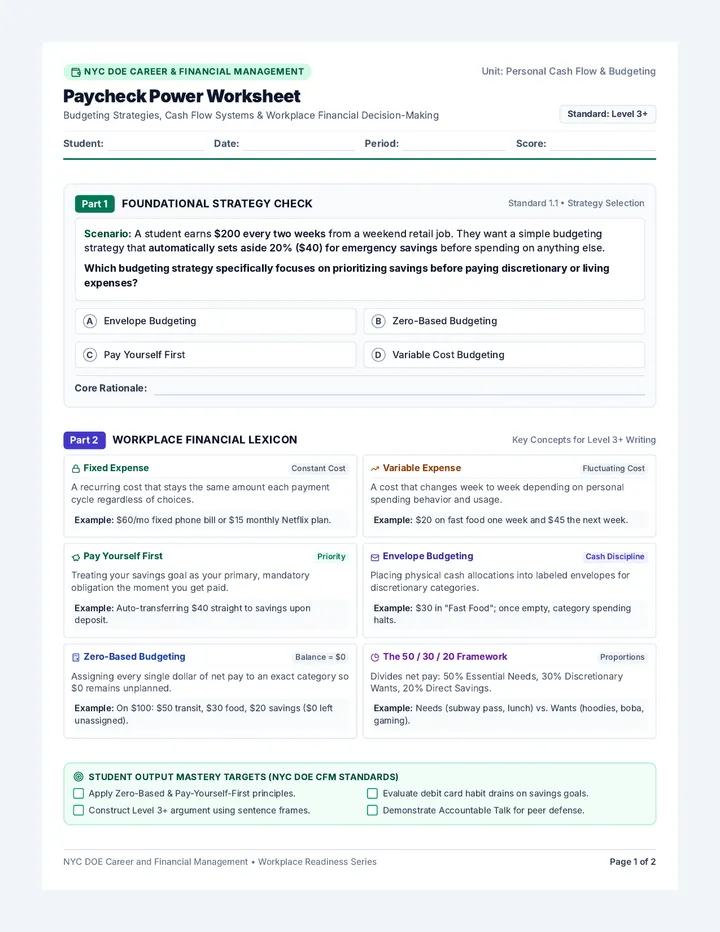
Cash Control Worksheet
Financial Literacy • Wealth Habits
Cash Control Worksheet
Name:
Date:
Period:
Learn how combining automated accumulation (Pay Yourself First) with physical limits (Envelope Method) stops impulse leaks.
1
Strategy Foundations: Two Systems, One Synergy
Pay Yourself First (PYF)
Saves First
Automate fixed transfers to savings the instant income arrives. Treats future goals as mandatory bills rather than hoping for leftover money.
Envelope Budgeting
Controls Daily Cash
Distributes cash into labeled envelopes for variable spending. When the cash in an envelope is spent, purchasing in that category stops completely.
2
Applied Scenario: Maya's Monthly Budget ($1,200 Net Pay)
1. Automated PYF $200
Emergency fund auto-deposit
2. Fixed Overhead $550
Auto-pay phone, transit, insurance
3. Variable Envelopes $450
Withdrawn as physical cash
Envelope Breakdown: 🍔 Fast Food & Snacks: $140 🎟️ Social & Outings: $160 👕 Personal & Gear: $150
3
Tactical Analysis: Connecting Mindset to Habit
A. Why does automating savings on payday protect Maya from the psychological urge to spend "available balance"?
B. How does a dedicated Fast Food cash envelope create "spending friction" that digital card tapping ignores?
4
Mastery Synthesis Statement
Exit Target
Complete the master personal finance reflection below by providing your detailed reasoning for each prompt:
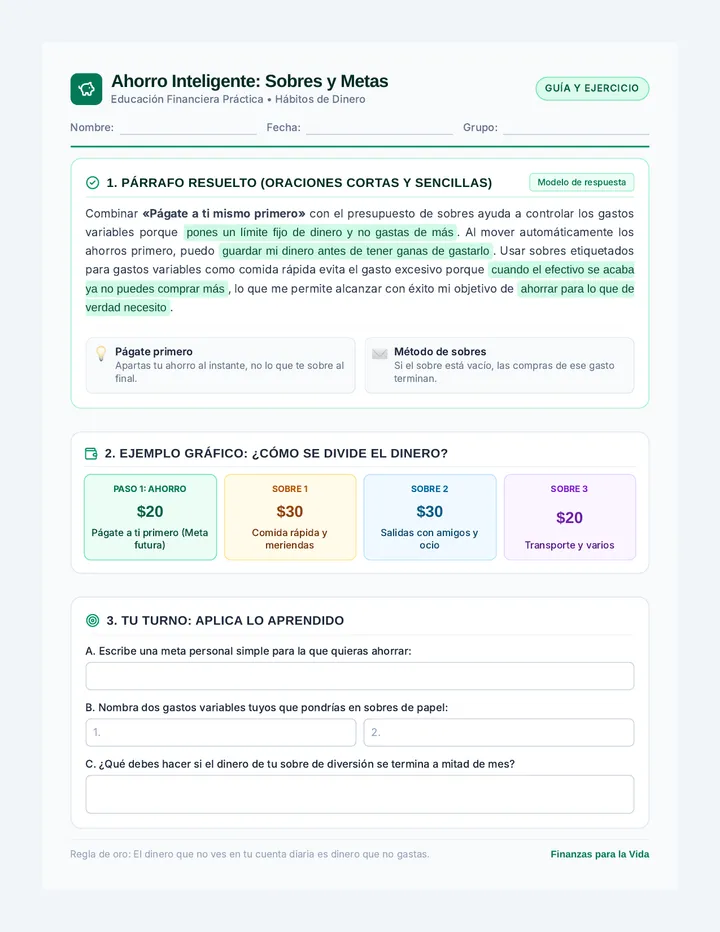
Combining "Pay Yourself First" with Envelope Budgeting helps control variable spending because
By automatically moving savings first, I can
Using labeled envelopes for variable expenses like fast food prevents overspending because
which allows me to successfully reach my goal of
Cash Control Answer Key
Teacher Guide & Evaluation Rubric
Cash Control Answer Key
Exemplary Solutions Grades 9–12 • Personal Finance
Master solutions, behavioral economic rationales, and grading criteria for the Cash Control synthesis prompts.
1-2
Core Concept & Budget Verification
PYF Calculation Check
$200 / $1,200 = 16.7% savings rate. Moves automatically to a separate savings account on direct deposit day.
Fixed Overhead Check
$550 / $1,200 = 45.8% of net pay. Automated recurring payments for mandatory non-discretionary costs.
Cash Envelopes Check
$450 / $1,200 = 37.5% total variable cap ($140 Food + $160 Social + $150 Personal).
3
Tactical Analysis: Model Student Responses
A. Preventing "Available Balance" Urges:
Model Response: Automating transfers removes reliance on willpower. When money never sits in the checking account, the brain cannot perceive it as "available to spend" (defeats Parkinson's Law of Money).
B. Cash Friction vs. Card Tapping:
Model Response: Physically handing over bills activates the psychological "pain of paying" and makes dwindling funds visible, whereas cards numb spending awareness and delay emotional feedback.
4
Completed Synthesis Statement (Exemplary Key)
Master Model
Combining "Pay Yourself First" with Envelope Budgeting helps control variable spending because it locks in savings automatically upfront before any money can be wasted, while envelopes impose concrete physical limits on daily discretionary categories.
By automatically moving savings first, I can treat my long-term goals like non-negotiable bills, bypass the trap of impulse spending, and budget only with funds that are genuinely available.
Using labeled envelopes for variable expenses like fast food prevents overspending because tangible cash creates psychological friction, shows exactly how much is left, and forces purchasing to stop as soon as the envelope runs empty.
which allows me to successfully reach my goal of accumulating a $1,000 emergency fund (and saving for post-secondary education or a car) without accumulating debt.
Versión en Español (Referencia Docente):
"Combinar 'Págate a ti primero' con el presupuesto en sobres ayuda a controlar el gasto variable porque asegura el ahorro de forma automática antes de gastar. Al mover el ahorro primero, puedo tratar mis metas como pagos obligatorios. Usar sobres con nombre evita gastar de más porque el dinero en efectivo impone un límite tangible que frena las compras al agotarse, lo que me permite alcanzar mi meta de construir un fondo de emergencia de $1,000."
Criterios de Evaluación (Rúbrica Rápida):
- Automatización: Identifica que el ahorro previo elimina la dependencia en la fuerza de voluntad.
- Límite Físico: Menciona que el dinero en sobre frena el gasto en cuanto se vacía.
- Meta Clara: Nombra una meta cuantificable (ej. fondo de emergencia, vehículo, estudios).